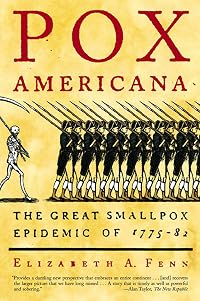
Pox Americana: The Great Smallpox Epidemic of 1775-82
by Elizabeth A. Fenn
On This Page
Description
Publisher description: A horrifying epidemic of smallpox was sweeping across the Americas when the War of Independence began, and yet we know almost nothing about it. Elizabeth A. Fenn reveals how deeply variola affected the outcome of the war in every colony and the lives of everyone in North America. By 1776, when military action and political ferment increased the movement of people and microbes, the epidemic worsened. Fenn's research shows us how smallpox devastated the American troops show more at Quebec and kept them at bay during the British occupation of Boston. Soon the disease affected the war in Virginia, where it ravaged slaves who had escaped to join the British forces. During the terrible winter at Valley Forge, General Washington had to decide if and when to attempt the risky inoculation of his troops. In 1779, while Creeks and Cherokees were dying in Georgia, smallpox broke out in Mexico City, whence it followed travelers going north, striking Santa Fe and outlying pueblos in January 1781. Simultaneously it moved up the Pacific coast and east across the plains as far as Hudson's Bay. The destructive, desolating power of smallpox made for a cascade of public-health crises and heartbreaking human drama. Fenn's work shows how this tragedy was met and what its consequences were for America. show lessTags
Recommendations





















Member Recommendations
Member Reviews
Holy moly there is so much packed into this little book that I can see why it was recommended to me.
Zabdiel Boylston is only a passing mention when compared to larger picture of smallpox ravaging the Revolutionary Army and devastating Native Americans, First Nation Peoples and the Indigenous of the Spanish Empire. That's right "Americana" in the title means ALL of North America. Why did the smallpox hit especially hard during the war? One theory is : "People were traveling about as never before...After long stressful marches, soldiers...were weak and lived close in unsanitary conditions..." And that's just ONE way the disease spreads. She gives the play by play right up to the surrender at Yorktown. We really could've lost due to show more smallpox! But the American Revolution was happening only on the east coast. At the same time, smallpox engulfed most of central Mexico. The Catholic missions relied on Spanish supply ships and as centers of commerce and communication, they spread smallpox to any and all, especially homogenic enslaved natives (You do get to learn about the strength of the Hopi which is great.) The final third of the book covers the Hudson Bay Company, the beaver trade and the York Factory in Canada. Famine in the area increased the mortality from smallpox. "Documentary evidence indicates that an equivalent calamity struck animal populations." Smallpox spread via the siege of Quebec and through trade. Trade and the ongoing war led to fighting amongst natives, fighting with Spaniards, fighting with French, all of it spreading smallpox.
I really enjoyed this book! I only couldn't give it 5 stars because it didn't really cover the Caribbean and the section on the Spanish New World Empire was noticeably smaller than the other two. show less
Zabdiel Boylston is only a passing mention when compared to larger picture of smallpox ravaging the Revolutionary Army and devastating Native Americans, First Nation Peoples and the Indigenous of the Spanish Empire. That's right "Americana" in the title means ALL of North America. Why did the smallpox hit especially hard during the war? One theory is : "People were traveling about as never before...After long stressful marches, soldiers...were weak and lived close in unsanitary conditions..." And that's just ONE way the disease spreads. She gives the play by play right up to the surrender at Yorktown. We really could've lost due to show more smallpox! But the American Revolution was happening only on the east coast. At the same time, smallpox engulfed most of central Mexico. The Catholic missions relied on Spanish supply ships and as centers of commerce and communication, they spread smallpox to any and all, especially homogenic enslaved natives (You do get to learn about the strength of the Hopi which is great.) The final third of the book covers the Hudson Bay Company, the beaver trade and the York Factory in Canada. Famine in the area increased the mortality from smallpox. "Documentary evidence indicates that an equivalent calamity struck animal populations." Smallpox spread via the siege of Quebec and through trade. Trade and the ongoing war led to fighting amongst natives, fighting with Spaniards, fighting with French, all of it spreading smallpox.
I really enjoyed this book! I only couldn't give it 5 stars because it didn't really cover the Caribbean and the section on the Spanish New World Empire was noticeably smaller than the other two. show less
Review of: Pox Americana: The Great Smallpox Epidemic of 1775-82, by Elizabeth A. Fenn
by Stan Prager (7-9-20)
Imagine there’s a virus sweeping across the land claiming untold victims, the agent of the disease poorly understood, the population in terror of an unseen enemy that rages mercilessly through entire communities, leaving in its wake an exponential toll of victims. As this review goes to press amid an alarming spike in new Coronavirus cases, Americans don’t need to stretch their collective imagination very far to envisage that at all. But now look back nearly two and a half centuries and consider an even worse case scenario: a war is on for the existential survival of our fledgling nation, a struggle compromised by mass show more attrition in the Continental Army due to another kind of virus, and the epidemic it spawns is characterized by symptoms and outcomes that are nothing less than nightmarish by any standard, then or now. For the culprit then was smallpox, one of the most dread diseases in human history.
This nearly forgotten chapter in America’s past left a deep impact on the course of the Revolution that has been long overshadowed by outsize events in the War of Independence and the birth of the Republic. This neglect has been masterfully redressed by Pox Americana: The Great Smallpox Epidemic of 1775-82, a brilliantly conceived and extremely well-written account by Pulitzer Prize-winning historian Elizabeth A. Fenn. One of the advantages of having a fine personal library in your home is the delight of going to a random shelf and plucking off an edition that almost perfectly suits your current interests, a volume that has been sitting there unread for years or even decades, just waiting for your fingertips to locate it. Such was the case with my signed first edition of Pox Americana, a used bookstore find that turned out to be a serendipitous companion to my self-quarantine for Coronavirus, the great pandemic of our times.
As horrific as COVID-19 has been for us—as of this morning we are up to one hundred thirty four thousand deaths and three million cases in the United States, a significant portion of the more than half million dead and nearly twelve million cases worldwide—smallpox, known as “Variola,” was far, far worse. In fact, almost unimaginably worse. Not only was it more than three times more contagious than Coronavirus, but rather than a mortality rate that ranges in the low single digits with COVID (the verdict’s not yet in), variola on average claimed an astonishing thirty percent of its victims, who often suffered horribly in the course of the illness and into their death throes, while survivors were frequently left disfigured by extensive scarring, and many were left blind. Smallpox has a long history that dates back to at least the third century BCE, as evidenced in Egyptian mummies. There were reportedly still fifteen million cases a year as late as 1967. In between it claimed untold hundreds of millions of lives over the years—some three hundred million in the twentieth century alone—until its ultimate eradication in 1980. There is perhaps some tragic irony that we are beset by Coronavirus on the fortieth anniversary of that milestone …
I typically eschew long excerpts for reviews, but Variola was so horrifying and Fenn writes so well that I believe it would be a disservice to do other than let her describe it here:
Headache, backache, fever, vomiting, and general malaise all are among the initial signs of infection. The headache can be splitting; the backache, excruciating … The fever usually abates after the first day or two … But … relief is fleeting. By the fourth day … the fever creeps upward again, and the first smallpox sores appear in the mouth, throat, and nasal passages …The rash now moves quickly. Over a twenty-four-hour period, it extends itself from the mucous membranes to the surface of the skin. On some, it turns inward, hemorrhaging subcutaneously. These victims die early, bleeding from the gums, eyes, nose, and other orifices. In most cases, however, the rash turns outward, covering the victim in raised pustules that concentrate in precisely the places where they will cause the most physical pain and psychological anguish: The soles of the feet, the palms of the hands, the face, forearms, neck, and back are focal points of the eruption … If the pustules remain discrete—if they do not run together— the prognosis is good. But if they converge upon one another in a single oozing mass, it is not. This is called confluent smallpox … For some, as the rash progresses in the mouth and throat, drinking becomes difficult, and dehydration follows. Often, an odor peculiar to smallpox develops… Patients at this stage of the disease can be hard to recognize. If damage to the eyes occurs, it begins now … Scabs start to form after two weeks of suffering … In confluent or semiconfluent cases of the disease, scabbing can encrust most of the body, making any movement excruciating … [One observation of such afflicted Native Americans noted that] “They lye on their hard matts, the poxe breaking and mattering, and runing one into another, their skin cleaving … to the matts they lye on; when they turne them, a whole side will flea of[f] at once.” … Death, when it occurs, usually comes after ten to sixteen days of suffering. Thereafter, the risk drops significantly … and unsightly scars replace scabs and pustules … the usual course of the disease—from initial infection to the loss of all scabs—runs a little over a month. Patients remain contagious until the last scab falls off … Most survivors bear … numerous scars, and some are blinded. But despite the consequences, those who live through the illness can count themselves fortunate. Immune for life, they need never fear smallpox again. [p16-20]
Smallpox was an unfortunate component of the siege of Boston by the British in 1775, but—as Fenn explains—it was far worse for Bostonians than the Redcoats besieging them. This was because smallpox was a fact of life in eighteenth century Europe—a series of outbreaks left about four hundred thousand people dead every year, and about a third of the survivors were blinded. As awful as that may seem, it meant that the vast majority of British soldiers had been exposed to the virus and were thus immune. Not so for the colonists, who not only had experienced less outbreaks but frequently lived in more rural settings at a greater distance from one another, which slowed exposure, leaving a far smaller quantity of those who could count on immunity to spare them. Nothing fuels the spread of a pestilence better than a crowded bottlenecked urban environment—such as Boston in 1775—except perhaps great encampments of susceptible men from disparate geographies suddenly crammed together, as was characteristic of the nascent Continental Army. To make matters worse, there was some credible evidence that the Brits at times engaged in a kind of embryonic biological warfare by deliberately sending known infected individuals back to the Colonial lines. All of this conspired to form a perfect storm for disaster.
Our late eighteenth-century forebears had a couple of things going for them that we lack today. First of all, while it was true that like COVID there was no cure for smallpox, there were ways to mitigate the spread and the severity that were far more effective than our masks and social distancing—or misguided calls to ingest hydroxychloroquine, for that matter. Instead, their otherwise primitive medical toolkit did contain inoculation, an ancient technique that had only become known to the west in relatively recent times. Now, it is important to emphasize that inoculation—also known as “variolation”—is not comparable to vaccination, which did not come along until closer to the end of the century. Not for the squeamish, variolation instead involved deliberately inserting the live smallpox virus from scabs or pustules into superficial incisions in a healthy subject’s arm. The result was an actual case of smallpox, but generally a much milder one than if contracted from another infected person. Recovered, the survivor would walk away with permanent immunity. The downside was that some did not survive, and all remained contagious for the full course of the disease. This meant that the inoculated also had to be quarantined, no easy task in an army camp, for example.
The other thing they had going for them back then was a competent leader who took epidemics and how to contain them quite seriously—none other than George Washington himself. Washington was not president at the time, of course, but he was the commander of the Continental Army, and perhaps the most prominent man in the rebellious colonies. Like many of history’s notable figures, Washington was not only gifted with qualities such as courage, intelligence, and good sense, but also luck. In this case, Washington’s good fortune was to contract—and survive—smallpox as a young man, granting him immunity. But it was likewise the good fortune of the emerging new nation to have Washington in command. Initially reluctant to advance inoculation—not because he doubted the science but rather because he feared it might accelerate the spread of smallpox—he soon concluded that only a systematic program of variolation could save the army, and the Revolution! Washington’s other gifts—for organization and discipline—set in motion mass inoculations and enforced isolation of those affected. Absent this effort, it is likely that the War of Independence—ever a long shot—may not have succeeded.
Fenn argues convincingly that the course of the war was significantly affected by Variola in several arenas, most prominently in its savaging of Continental forces during the disastrous invasion of Quebec, which culminated in Benedict Arnold’s battered forces being driven back to Fort Ticonderoga. And in the southern theater, enslaved blacks flocked to British lines, drawn by enticements to freedom, only to fall victim en masse to smallpox, and then tragically find themselves largely abandoned to suffering and death as the Brits retreated. There is a good deal more of this stuff, and many students of the American Revolution will find themselves wondering—as I did—why this fascinating perspective is so conspicuously absent in most treatments of this era?
Remarkably, despite the bounty of material, emphasis on the Revolution only occupies the first third of the book, leaving far more to explore as the virus travels to the west and southwest, and then on to Mexico, as well as to the Pacific northwest. As Fenn reminds us again and again, smallpox comes from where smallpox has been, and she painstakingly tracks hypothetical routes of the epidemic. Tragic bystanders in its path were frequently Native Americans, who typically manifested more severe symptoms and experienced greater rates of mortality. It has been estimated that perhaps ninety percent of pre-contact indigenous inhabitants of the Americas were exterminated by exposure to European diseases for which they had no immunity, and smallpox was one of the great vehicles of that annihilation. Variola proved to be especially lethal as a “virgin soil” epidemic, and Native Americans not unexpectedly suffered far greater casualties than other populations, resulting in death on such a wide scale that entire tribes simply disappeared to history.
No review can properly capture all the ground that Fenn covers in this outstanding book, nor praise her achievement adequately. It is especially rare when a historian combines a highly original thesis with exhaustive research, keen analysis, and exceptional talent with a pen to deliver a magnificent work such as Pox Americana. And perhaps never has there been a moment when this book could find a greater relevance to readers than to Americans in 2020.
Review of: Pox Americana: The Great Smallpox Epidemic of 1775-82, by Elizabeth A. Fenn https://regarp.com/2020/07/09/review-of-pox-americana-the-great-smallpox-epidemi...
This review is also available as a Podcast on Apple Podcasts, Google Play, Spotify & Podbean here: https://www.podbean.com/media/share/pb-nwmjq-e2a51a ... I encourage you to download and share it in your network. Many more reviews on an eclectic array of fiction and nonfiction books are available at www.regarp.com and www.regarpbookblogpod.com Have a great day! show less
by Stan Prager (7-9-20)
Imagine there’s a virus sweeping across the land claiming untold victims, the agent of the disease poorly understood, the population in terror of an unseen enemy that rages mercilessly through entire communities, leaving in its wake an exponential toll of victims. As this review goes to press amid an alarming spike in new Coronavirus cases, Americans don’t need to stretch their collective imagination very far to envisage that at all. But now look back nearly two and a half centuries and consider an even worse case scenario: a war is on for the existential survival of our fledgling nation, a struggle compromised by mass show more attrition in the Continental Army due to another kind of virus, and the epidemic it spawns is characterized by symptoms and outcomes that are nothing less than nightmarish by any standard, then or now. For the culprit then was smallpox, one of the most dread diseases in human history.
This nearly forgotten chapter in America’s past left a deep impact on the course of the Revolution that has been long overshadowed by outsize events in the War of Independence and the birth of the Republic. This neglect has been masterfully redressed by Pox Americana: The Great Smallpox Epidemic of 1775-82, a brilliantly conceived and extremely well-written account by Pulitzer Prize-winning historian Elizabeth A. Fenn. One of the advantages of having a fine personal library in your home is the delight of going to a random shelf and plucking off an edition that almost perfectly suits your current interests, a volume that has been sitting there unread for years or even decades, just waiting for your fingertips to locate it. Such was the case with my signed first edition of Pox Americana, a used bookstore find that turned out to be a serendipitous companion to my self-quarantine for Coronavirus, the great pandemic of our times.
As horrific as COVID-19 has been for us—as of this morning we are up to one hundred thirty four thousand deaths and three million cases in the United States, a significant portion of the more than half million dead and nearly twelve million cases worldwide—smallpox, known as “Variola,” was far, far worse. In fact, almost unimaginably worse. Not only was it more than three times more contagious than Coronavirus, but rather than a mortality rate that ranges in the low single digits with COVID (the verdict’s not yet in), variola on average claimed an astonishing thirty percent of its victims, who often suffered horribly in the course of the illness and into their death throes, while survivors were frequently left disfigured by extensive scarring, and many were left blind. Smallpox has a long history that dates back to at least the third century BCE, as evidenced in Egyptian mummies. There were reportedly still fifteen million cases a year as late as 1967. In between it claimed untold hundreds of millions of lives over the years—some three hundred million in the twentieth century alone—until its ultimate eradication in 1980. There is perhaps some tragic irony that we are beset by Coronavirus on the fortieth anniversary of that milestone …
I typically eschew long excerpts for reviews, but Variola was so horrifying and Fenn writes so well that I believe it would be a disservice to do other than let her describe it here:
Headache, backache, fever, vomiting, and general malaise all are among the initial signs of infection. The headache can be splitting; the backache, excruciating … The fever usually abates after the first day or two … But … relief is fleeting. By the fourth day … the fever creeps upward again, and the first smallpox sores appear in the mouth, throat, and nasal passages …The rash now moves quickly. Over a twenty-four-hour period, it extends itself from the mucous membranes to the surface of the skin. On some, it turns inward, hemorrhaging subcutaneously. These victims die early, bleeding from the gums, eyes, nose, and other orifices. In most cases, however, the rash turns outward, covering the victim in raised pustules that concentrate in precisely the places where they will cause the most physical pain and psychological anguish: The soles of the feet, the palms of the hands, the face, forearms, neck, and back are focal points of the eruption … If the pustules remain discrete—if they do not run together— the prognosis is good. But if they converge upon one another in a single oozing mass, it is not. This is called confluent smallpox … For some, as the rash progresses in the mouth and throat, drinking becomes difficult, and dehydration follows. Often, an odor peculiar to smallpox develops… Patients at this stage of the disease can be hard to recognize. If damage to the eyes occurs, it begins now … Scabs start to form after two weeks of suffering … In confluent or semiconfluent cases of the disease, scabbing can encrust most of the body, making any movement excruciating … [One observation of such afflicted Native Americans noted that] “They lye on their hard matts, the poxe breaking and mattering, and runing one into another, their skin cleaving … to the matts they lye on; when they turne them, a whole side will flea of[f] at once.” … Death, when it occurs, usually comes after ten to sixteen days of suffering. Thereafter, the risk drops significantly … and unsightly scars replace scabs and pustules … the usual course of the disease—from initial infection to the loss of all scabs—runs a little over a month. Patients remain contagious until the last scab falls off … Most survivors bear … numerous scars, and some are blinded. But despite the consequences, those who live through the illness can count themselves fortunate. Immune for life, they need never fear smallpox again. [p16-20]
Smallpox was an unfortunate component of the siege of Boston by the British in 1775, but—as Fenn explains—it was far worse for Bostonians than the Redcoats besieging them. This was because smallpox was a fact of life in eighteenth century Europe—a series of outbreaks left about four hundred thousand people dead every year, and about a third of the survivors were blinded. As awful as that may seem, it meant that the vast majority of British soldiers had been exposed to the virus and were thus immune. Not so for the colonists, who not only had experienced less outbreaks but frequently lived in more rural settings at a greater distance from one another, which slowed exposure, leaving a far smaller quantity of those who could count on immunity to spare them. Nothing fuels the spread of a pestilence better than a crowded bottlenecked urban environment—such as Boston in 1775—except perhaps great encampments of susceptible men from disparate geographies suddenly crammed together, as was characteristic of the nascent Continental Army. To make matters worse, there was some credible evidence that the Brits at times engaged in a kind of embryonic biological warfare by deliberately sending known infected individuals back to the Colonial lines. All of this conspired to form a perfect storm for disaster.
Our late eighteenth-century forebears had a couple of things going for them that we lack today. First of all, while it was true that like COVID there was no cure for smallpox, there were ways to mitigate the spread and the severity that were far more effective than our masks and social distancing—or misguided calls to ingest hydroxychloroquine, for that matter. Instead, their otherwise primitive medical toolkit did contain inoculation, an ancient technique that had only become known to the west in relatively recent times. Now, it is important to emphasize that inoculation—also known as “variolation”—is not comparable to vaccination, which did not come along until closer to the end of the century. Not for the squeamish, variolation instead involved deliberately inserting the live smallpox virus from scabs or pustules into superficial incisions in a healthy subject’s arm. The result was an actual case of smallpox, but generally a much milder one than if contracted from another infected person. Recovered, the survivor would walk away with permanent immunity. The downside was that some did not survive, and all remained contagious for the full course of the disease. This meant that the inoculated also had to be quarantined, no easy task in an army camp, for example.
The other thing they had going for them back then was a competent leader who took epidemics and how to contain them quite seriously—none other than George Washington himself. Washington was not president at the time, of course, but he was the commander of the Continental Army, and perhaps the most prominent man in the rebellious colonies. Like many of history’s notable figures, Washington was not only gifted with qualities such as courage, intelligence, and good sense, but also luck. In this case, Washington’s good fortune was to contract—and survive—smallpox as a young man, granting him immunity. But it was likewise the good fortune of the emerging new nation to have Washington in command. Initially reluctant to advance inoculation—not because he doubted the science but rather because he feared it might accelerate the spread of smallpox—he soon concluded that only a systematic program of variolation could save the army, and the Revolution! Washington’s other gifts—for organization and discipline—set in motion mass inoculations and enforced isolation of those affected. Absent this effort, it is likely that the War of Independence—ever a long shot—may not have succeeded.
Fenn argues convincingly that the course of the war was significantly affected by Variola in several arenas, most prominently in its savaging of Continental forces during the disastrous invasion of Quebec, which culminated in Benedict Arnold’s battered forces being driven back to Fort Ticonderoga. And in the southern theater, enslaved blacks flocked to British lines, drawn by enticements to freedom, only to fall victim en masse to smallpox, and then tragically find themselves largely abandoned to suffering and death as the Brits retreated. There is a good deal more of this stuff, and many students of the American Revolution will find themselves wondering—as I did—why this fascinating perspective is so conspicuously absent in most treatments of this era?
Remarkably, despite the bounty of material, emphasis on the Revolution only occupies the first third of the book, leaving far more to explore as the virus travels to the west and southwest, and then on to Mexico, as well as to the Pacific northwest. As Fenn reminds us again and again, smallpox comes from where smallpox has been, and she painstakingly tracks hypothetical routes of the epidemic. Tragic bystanders in its path were frequently Native Americans, who typically manifested more severe symptoms and experienced greater rates of mortality. It has been estimated that perhaps ninety percent of pre-contact indigenous inhabitants of the Americas were exterminated by exposure to European diseases for which they had no immunity, and smallpox was one of the great vehicles of that annihilation. Variola proved to be especially lethal as a “virgin soil” epidemic, and Native Americans not unexpectedly suffered far greater casualties than other populations, resulting in death on such a wide scale that entire tribes simply disappeared to history.
No review can properly capture all the ground that Fenn covers in this outstanding book, nor praise her achievement adequately. It is especially rare when a historian combines a highly original thesis with exhaustive research, keen analysis, and exceptional talent with a pen to deliver a magnificent work such as Pox Americana. And perhaps never has there been a moment when this book could find a greater relevance to readers than to Americans in 2020.
Review of: Pox Americana: The Great Smallpox Epidemic of 1775-82, by Elizabeth A. Fenn https://regarp.com/2020/07/09/review-of-pox-americana-the-great-smallpox-epidemi...
This review is also available as a Podcast on Apple Podcasts, Google Play, Spotify & Podbean here: https://www.podbean.com/media/share/pb-nwmjq-e2a51a ... I encourage you to download and share it in your network. Many more reviews on an eclectic array of fiction and nonfiction books are available at www.regarp.com and www.regarpbookblogpod.com Have a great day! show less
The problem with the history they teach you in school is that it’s really just a highlights reel. For instance, there’s how early American history is usually taught: Pilgrims landed at Jamestown --> more people came and settled New England --> King George III demanded taxes --> American Revolution. By shifting the focus from geopolitical issues to social/health issues – specifically the Great Smallpox Epidemic of 1775-1782 - Fenn gives us an “all the other stuff that was going on” account of North America during this pivotal time in history, give or take a few decades either way - and what an interesting, heretofore largely neglected, tale it is!
Given the number of diseases that plagued North America’s earliest European show more settlements – to include measles, influenza, mumps, typhus, cholera, plague, malaria, yellow fever, scarlet fever, whooping cough, and diphtheria – why does Fenn choose to focus on smallpox, aka Variola? For one thing, the disease is transmitted only through human contact, thus ensuring that tales of spreading infection are also, de facto, tales of human migration and communication. Also, Variola’s insidiously long incubation period (as long as 14 days might pass between initial infection and the first symptoms) immeasurably increased the odds that it would spread without detection.
Yes, the American Revolution still features large in Fenn’s account. In fact, the author offers a fairly convincing argument that smallpox played a heretofore entirely unappreciated role in determining the fate of many of the war’s most crucial battles. I admit these chapters left me somewhat unnerved, because before reading them I thought I was pretty familiar with the major events of the American Revolution. Not so much now! I gasped at the spectacle of Lord Dunmore’s 1000-strong “Ethiopian Regiment” marching to war in shirts boldly emblazoned “Liberty for Slaves!” only to perish in anguished heaps upon the shore of Gwynn Island; thrilled at the doomed attempt by valiant Daniel Morgan and his Virginia Riflemen to scale the walls of Quebec while there were still enough American troops alive to attempt the feat; and was shocked to learn that John Adams attributed his Congressional appointment to the fact that he was one of the few candidates willing to travel to smallpox-infested Boston to attend the meetings of the Continental Congress. Truly, I never imagined the extent of the devastation that Variola wrought within American cities and encampments during the war years, and I’m inclined to agree with Fenn’s conclusion that had George Washington not had the foresight to require all the men in his army to be innoculated against the disease, the outcome of the war might have been quite different.
But it was the chapters of the tale not specifically related to the American Revolution that I found most fascinating. Fenn chooses to relate the tale not so much chronologically as histiologically, tracking each smallpox outbreak from its probable origin and then tracing – via Native American oral traditions and settler diaries and church death records - the paths it travelled as it spread across the American continent, sometimes via the Canadian trappers and Native American middle-men who travelled to the Hudson Bay Company’s trading posts annually, only to carry back with them the fatal infection; sometimes via Franciscan monks who carried the infection with them into the Indian villages they attempted to convert; up and down the bustling trade road joining Mexico City to European settlements along the along the Rio Grande; in the saddlebags of Indian Raiding parties whose plunder included blankets and clothing teeming with disease; in the company Russian adventurers demanding “fur tributes” from the Inuit and other native tribes unlucky enough to inhabit the northeastern coasts, 10,000 of which were killed by smallpox in a single year. In the end, though, all these paths converge upon one truth: that one European-borne pestilence was probably, in and of itself, responsible for reducing the population of North American by 20-50% during the years of its terrifying reign.
One can quibble with Fenn’s conclusions – that smallpox very nearly altered the outcome of the American Revolution; that smallpox permanently shifted the balance of power among Native American tribes by selectively devastating traditionally peaceful agricultural tribes (such as the Shoshone) while sparing their more nomadic rivals (such as the Sioux); that Variola triggered the decline of Native American civilization by devastating whole tribes and undermining their confidence in traditional gods and healing rituals; that had it not been for Variola, African Americans might have gained their freedom 100 years earlier. But, as Fenn’s meticulously footnoted narrative makes clear, it’s hard to overstate the role that smallpox played in shaping the destiny of North America and the young republic that emerged from the chaos that Variola left in its wake. show less
Given the number of diseases that plagued North America’s earliest European show more settlements – to include measles, influenza, mumps, typhus, cholera, plague, malaria, yellow fever, scarlet fever, whooping cough, and diphtheria – why does Fenn choose to focus on smallpox, aka Variola? For one thing, the disease is transmitted only through human contact, thus ensuring that tales of spreading infection are also, de facto, tales of human migration and communication. Also, Variola’s insidiously long incubation period (as long as 14 days might pass between initial infection and the first symptoms) immeasurably increased the odds that it would spread without detection.
Yes, the American Revolution still features large in Fenn’s account. In fact, the author offers a fairly convincing argument that smallpox played a heretofore entirely unappreciated role in determining the fate of many of the war’s most crucial battles. I admit these chapters left me somewhat unnerved, because before reading them I thought I was pretty familiar with the major events of the American Revolution. Not so much now! I gasped at the spectacle of Lord Dunmore’s 1000-strong “Ethiopian Regiment” marching to war in shirts boldly emblazoned “Liberty for Slaves!” only to perish in anguished heaps upon the shore of Gwynn Island; thrilled at the doomed attempt by valiant Daniel Morgan and his Virginia Riflemen to scale the walls of Quebec while there were still enough American troops alive to attempt the feat; and was shocked to learn that John Adams attributed his Congressional appointment to the fact that he was one of the few candidates willing to travel to smallpox-infested Boston to attend the meetings of the Continental Congress. Truly, I never imagined the extent of the devastation that Variola wrought within American cities and encampments during the war years, and I’m inclined to agree with Fenn’s conclusion that had George Washington not had the foresight to require all the men in his army to be innoculated against the disease, the outcome of the war might have been quite different.
But it was the chapters of the tale not specifically related to the American Revolution that I found most fascinating. Fenn chooses to relate the tale not so much chronologically as histiologically, tracking each smallpox outbreak from its probable origin and then tracing – via Native American oral traditions and settler diaries and church death records - the paths it travelled as it spread across the American continent, sometimes via the Canadian trappers and Native American middle-men who travelled to the Hudson Bay Company’s trading posts annually, only to carry back with them the fatal infection; sometimes via Franciscan monks who carried the infection with them into the Indian villages they attempted to convert; up and down the bustling trade road joining Mexico City to European settlements along the along the Rio Grande; in the saddlebags of Indian Raiding parties whose plunder included blankets and clothing teeming with disease; in the company Russian adventurers demanding “fur tributes” from the Inuit and other native tribes unlucky enough to inhabit the northeastern coasts, 10,000 of which were killed by smallpox in a single year. In the end, though, all these paths converge upon one truth: that one European-borne pestilence was probably, in and of itself, responsible for reducing the population of North American by 20-50% during the years of its terrifying reign.
One can quibble with Fenn’s conclusions – that smallpox very nearly altered the outcome of the American Revolution; that smallpox permanently shifted the balance of power among Native American tribes by selectively devastating traditionally peaceful agricultural tribes (such as the Shoshone) while sparing their more nomadic rivals (such as the Sioux); that Variola triggered the decline of Native American civilization by devastating whole tribes and undermining their confidence in traditional gods and healing rituals; that had it not been for Variola, African Americans might have gained their freedom 100 years earlier. But, as Fenn’s meticulously footnoted narrative makes clear, it’s hard to overstate the role that smallpox played in shaping the destiny of North America and the young republic that emerged from the chaos that Variola left in its wake. show less
After reading Elizabeth Fenn's "Pox Americana: The great smallpox epidemic of 1775-82", I am inclined to think that General Washington's best decision during the Revolutionary War was to, in current political terminology, flip-flop, on the question of inoculating the Continental Army. When I first heard of this book I fell into the trap of judging it by its cover, I expected to learn how an outbreak of small pox had affected the participants of the Revolutionary War. While the author does that she goes much deeper into the epidemic. She follows the small pox outbreak from 1777 Boston up and down the eastern coast, to the Britain's indigenous allies, across Mexico, up to Canada and nearly into Alaska. Because the documentary evidence in show more the northwest is fragmentary at best she also looks into a Russian outbreak that reached western Alaska at approximately the same time to determine if it could be responsible for the bones and empty villages that greeted British explorers Vancouver and Puget in 1792.
If Fenn had simply concentrated on the interaction between the Revolution and small pox this would be an important book on an under-examined topic. By following the epidemic across North America she managed to create a fascinating book on a topic, to the best of my knowledge, that had been completely unexamined.
The breadth of the research necessary to uncover the epidemic's footsteps seems overwhelming. She looked at Russian, Spanish, British, French, and US records as well as church, business and personal diaries. Fenn managed to find enough passing references to small pox in this wide variety of sources that her argument tracing the epidemic from European outposts across the vast expanse of the continent still controlled by indigenous Americans, while her evidence does not reach the level of certainty, she managed marshal enough evidence to achieve probability. Considering that there are no direct documentary sources this is an impressive accomplishment.
I confess to being predisposed to like this book after learning in the introduction that the author spent years working as an auto mechanic. It is an experience we share that allowed me to appreciate her ability to take a small clue, a tick on a vacuum gauge, a hissing noise, or a passing reference in a text, and see them as road signs pointing to the solution of a puzzle. I have to recommend "Pox Americana" to anyone interested in the Revolutionary War or in reading a concise account of the interaction of the First Nations with each other and with European colonizers. I found the differences in how Spanish missions and British fur traders dealt with the sick and dying Native Americans surprising.
Fenn's writing is very readable, she uses plain English and generally eschews the obfuscation caused by some academics’ enamourment with polysyllabic verbiage. I found this book included in the syllabi of several medical history classes*; I am not the only one impressed by Fenn's intriguing topic, clear writing and quality scholarship.
* National Library of Medicine; History of Medicine: Online Syllabus Archive show less
If Fenn had simply concentrated on the interaction between the Revolution and small pox this would be an important book on an under-examined topic. By following the epidemic across North America she managed to create a fascinating book on a topic, to the best of my knowledge, that had been completely unexamined.
The breadth of the research necessary to uncover the epidemic's footsteps seems overwhelming. She looked at Russian, Spanish, British, French, and US records as well as church, business and personal diaries. Fenn managed to find enough passing references to small pox in this wide variety of sources that her argument tracing the epidemic from European outposts across the vast expanse of the continent still controlled by indigenous Americans, while her evidence does not reach the level of certainty, she managed marshal enough evidence to achieve probability. Considering that there are no direct documentary sources this is an impressive accomplishment.
I confess to being predisposed to like this book after learning in the introduction that the author spent years working as an auto mechanic. It is an experience we share that allowed me to appreciate her ability to take a small clue, a tick on a vacuum gauge, a hissing noise, or a passing reference in a text, and see them as road signs pointing to the solution of a puzzle. I have to recommend "Pox Americana" to anyone interested in the Revolutionary War or in reading a concise account of the interaction of the First Nations with each other and with European colonizers. I found the differences in how Spanish missions and British fur traders dealt with the sick and dying Native Americans surprising.
Fenn's writing is very readable, she uses plain English and generally eschews the obfuscation caused by some academics’ enamourment with polysyllabic verbiage. I found this book included in the syllabi of several medical history classes*; I am not the only one impressed by Fenn's intriguing topic, clear writing and quality scholarship.
* National Library of Medicine; History of Medicine: Online Syllabus Archive show less
I'm American. That can mean a lot of things. That I'm a fat, overindulgent, lazy or stupid? No! What it means is that I've had America's brief history hammered into my brain repeatedly in my 12 years of schooling. We covered the Revolutionary War numerous times, and I like to think I know just a little bit about it. However, I can say definitively that no one ever told me there was a third combatant in the war for my country's freedom. One whose soldiers were countless, who killed indifferently, indiscriminately, and without bias, and claimed more lives than the Continental and British armies combined. The third side, of which I was never taught about, was smallpox.
Smallpox played a subtly important role in the war. Between the fear of show more attacking a quarantined town and the risk of capturing and imprisoning infected soldiers, there was a lot more caution involved in the war than I ever knew about. Obviously disease has always been a factor in almost every war, but I'm amazed in my many years of American history courses no one ever covered the role of smallpox in a war as important as this one, and that there is so little information about it.
In this regard, Pox Americana is wonderfully enlightening. Elizabeth Fenn has apparently done some heavy research on this relatively neglected topic, and I'm definitely glad she did it. However, I did have a few minor issues with the book. Some of the information just wasn't recorded, mostly things like how the disease effected native Americans, so the author had to play fill-in-the-blank. I've never liked speculations, theories, assumptions, etc in my nonfiction, even if the topic is as interesting as this one. I also felt it was a little dry and I was rather bored throughout the latter half of the book, as it seemed to drag on a bit more than needed, but this is probably just because I'm not a big nonfiction history reader, and tend to get a little bored with the subject.
Regardless, my complaints are small and have more to do with my own reading preferences than how the book was actually written. If you think the topic sounds interesting, I can say Pox Americana is definitely a worthwhile read, especially for fans of American history. Go read it. show less
Smallpox played a subtly important role in the war. Between the fear of show more attacking a quarantined town and the risk of capturing and imprisoning infected soldiers, there was a lot more caution involved in the war than I ever knew about. Obviously disease has always been a factor in almost every war, but I'm amazed in my many years of American history courses no one ever covered the role of smallpox in a war as important as this one, and that there is so little information about it.
In this regard, Pox Americana is wonderfully enlightening. Elizabeth Fenn has apparently done some heavy research on this relatively neglected topic, and I'm definitely glad she did it. However, I did have a few minor issues with the book. Some of the information just wasn't recorded, mostly things like how the disease effected native Americans, so the author had to play fill-in-the-blank. I've never liked speculations, theories, assumptions, etc in my nonfiction, even if the topic is as interesting as this one. I also felt it was a little dry and I was rather bored throughout the latter half of the book, as it seemed to drag on a bit more than needed, but this is probably just because I'm not a big nonfiction history reader, and tend to get a little bored with the subject.
Regardless, my complaints are small and have more to do with my own reading preferences than how the book was actually written. If you think the topic sounds interesting, I can say Pox Americana is definitely a worthwhile read, especially for fans of American history. Go read it. show less
Reviewed Oct. 2006
Amazing info - some pictures and maps - large index. Apparently my professor attended her lecture when she was a PhD candidate and found her research to be very helpful in teaching American Revolution. I sure learned more about smallpox than I would ever need to know. We discussed this book quite a lot in class and essays. The professor asked...”if you were given 5 minutes to tell someone about the A.R. would you mention smallpox?” We all said “yes,” when asked if we would have before reading this book, we all answered “no.” Our professor feels that Fenn’s argument is that smallpox unified America, not the revolution, smallpox became the common evil. I that that Fenn got carried away with her research show more topic, she should have stuck with the East coast, and not include the second part dealing with the Native American and the trading routes. Maybe two different books would have been better. Fenn says she included Mexico, West Coast and Native Americans because they are often ignored. But when compared to what was happening on the East Coast I would think that they were right to be ignored. This book really reminded me of the flu book I read a few years ago. Written for popular audience with enough to please historians as well.
24-2006 show less
Amazing info - some pictures and maps - large index. Apparently my professor attended her lecture when she was a PhD candidate and found her research to be very helpful in teaching American Revolution. I sure learned more about smallpox than I would ever need to know. We discussed this book quite a lot in class and essays. The professor asked...”if you were given 5 minutes to tell someone about the A.R. would you mention smallpox?” We all said “yes,” when asked if we would have before reading this book, we all answered “no.” Our professor feels that Fenn’s argument is that smallpox unified America, not the revolution, smallpox became the common evil. I that that Fenn got carried away with her research show more topic, she should have stuck with the East coast, and not include the second part dealing with the Native American and the trading routes. Maybe two different books would have been better. Fenn says she included Mexico, West Coast and Native Americans because they are often ignored. But when compared to what was happening on the East Coast I would think that they were right to be ignored. This book really reminded me of the flu book I read a few years ago. Written for popular audience with enough to please historians as well.
24-2006 show less
Exhaustively researched.learned not just about smallpox but also about native Americans and the fur trade. There were occasionally quotes from diaries which were particularly interesting.
Members
- Recently Added By
Lists

Best History Books about Epidemics
27 works; 24 members

Best Books About Plagues and Epidemics
99 works; 17 members
Author Information

5 Works 1,036 Members
Elizabeth Fenn is the winner of the 2015 Pulitzer Prize for History with her title Encounters of the Heart of te World: A History of the Mandan People. (Bowker Author Biography)
Awards and Honors
Common Knowledge
- Canonical title
- Pox Americana: The Great Smallpox Epidemic of 1775-82
- Original publication date
- 2001 (1st edition ∙ New York ∙ Hill and Wang) (1st edition ∙ New York ∙ Hill and Wang)
- People/Characters
- George Washington; Edward Jenner; James Phipps; Robert Sutton; Dr. Shippen; Dr. William Rickman (show all 13); David George; Henry Clinton; Boston King; Andrew Jackson; Dr. Esteban Morel; Jean-Francois de Galoup; William Tomison
- Important places
- Quebec, Canada; Mexico City, Mexico; Kershaw County, South Carolina, United States; Charleston, South Carolina, USA
- Important events
- North American Smallpox Epidemic (1775 | 1782); American Revolution (1775 | 1783); Seige of Charleston (1780 | 03 | 29-1780 | 05 | 12)
- Dedication
- For Peter
- First words
- Time has left the early pages of his diary so damaged that the exact date remains uncertain.
- Last words
- (Click to show. Warning: May contain spoilers.)"This was the small pox," wrote Alexander Mackenzie, "which spread its destructive and desolating power, as the fire consumes the dry grass of the field."
- Blurbers
- Taylor, Alan; Kennedy, Michael; Franke-Ruta, Garance; Herter, Philip
- Disambiguation notice
- Full title (2001): Pox Americana : the great smallpox epidemic of 1775-82 / Elizabeth A. Fenn
Classifications
- Genres
- History, Nonfiction, General Nonfiction, Science & Nature
- DDC/MDS
- 614.521097309033 — Applied science & technology Medicine & health Epidemics, Poisons, Alternative Medicine Incidence of and public measures to prevent specific diseases and kinds of diseases Exanthemata Smallpox
- LCC
- RC183.49 .F46 — Medicine Internal medicine Internal medicine Infectious and parasitic diseases
- BISAC
Statistics
- Members
- 672
- Popularity
- 42,577
- Reviews
- 11
- Rating
- (3.66)
- Languages
- English
- Media
- Paper, Ebook
- ISBNs
- 6
- ASINs
- 4