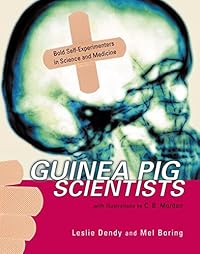
Guinea Pig Scientists: Bold Self-Experimenters in Science and Medicine (Outstanding Science Trade Books for Students K-12)
by Leslie Dendy
On This Page
Description
Stories of ten men and women, from the 1770s to the present, who devoted their lives, and sometimes risked them, to answer some of the big questions in science and medicine.Tags
Recommendations




























Member Recommendations
Member Reviews
A good book that shows the kids how science has evolved and the things people used to do before our modern safety protocols. It has pictures to keep the kids engaged and tells of different notable scientists who had to experiment on themselves. This is good to show how the importance of advancement of the human race was to people, and the peoples different experiments could be referenced during lessons about what they where experimenting on.
"Guinea Pig Scientists," features notable physicians, scientists, and citizens who bravely experimented on themselves or put themselves in grave danger in the name of science. For example, one of the stories feature Marie and Pierre Curie and their famous work with radioactivity. The stories are well supported by extensive appendices of bibliographical and quotation resources, and each author has the appropriate background to contribute to the work - Dr. Dendy teaches biology and chemistry in University of New Mexico, Los Alamos, and Mr. Boring has taught in the K-12 setting, editor of a children's website, and author of several nonfiction picture books. The content provides rich, vivid details about the risks and rewards the show more self-experimenters experienced, yet there were several technical details that could have benefitted from demonstrative or explanatory visuals such as how the human body regulates temperature and how George Fordyce and Charles Blagden experimented the response of their own bodies to temperatures up to 260 degrees in dry air. The facts offered are quite interesting to someone with previous knowledge of physics and chemistry, but the style can be found too wordy especially for elementary school readers. The authentic old photos of the Curies were useful in demonstrating the deleterious effects of working with radioactive material, yet the illustrations were more decorative rather than explanatory. This book is recommended for students as early as 10 years old, but would seem to be more appropriate for 11-12 years old. show less
Ratings
Members
- Recently Added By
Author Information
Leslie Dendy's book Tracks, Scats, and Signs (1995) is a guide for young naturalists who want to learn more about wild animals by understanding the signs they leave behind. It includes information on 17 different species in several habitats, with instructions on the plaster casting of animal tracks and "Scrapbook" pages to record information on show more animal signs and droppings. Dendy teaches biology at the Los Alamos campus of the University of New Mexico. (Bowker Author Biography) show less
All Editions
Some Editions
Awards and Honors
Awards
Distinctions
Common Knowledge
- Original publication date
- 2005
- People/Characters
- George Fordyce; Lazzaro Spallanzani; William T. G. Morton; Horace Wells; Daniel Carrion; Jesse Lazear (show all 13); Marie Curie; Pierre Curie; John Scott Haldane; J. B. S. Haldane; Werner Forssman; John Paul Stapp; Stefania Follini
- Epigraph
- guinea pig \ 'gi-nē'pig n [prob. so called from the fact that Guinea represented the name of a distant country (1664)]
1. One of eight species of small mammals, also known as cavies.... (show all) They live in South America, where they have been raised for meat for hundred of years. One domesticated species of guinea pigs has been shipped all over the world to be used in medical research experiments. Cavies are also kept as pets.
2. A person who is experimented on in a scientific study. - Dedication
- To Joe, Miranda, and Julian
with love, for a decade
of patience and encouragement
--Leslie Dendy
To my son Josh,
with the courage of the test pilot he is,
for giving me courage in my writing
--Mel Boring - First words
- You are flying an Air Force fighter jet at five hundred miles an hour, far above the clouds, when you're hit by enemy gunfire. (Introduction)
- Quotations
- The Curies were well aware of the way radium had burned their hands as they worked with it through the years, and how the skin, though scarred, always grew back. Now they asked: If you burned diseased tissue, such as a tumor,... (show all) with radium radiation, would it destroy the disease?
- Last words
- (Click to show. Warning: May contain spoilers.)There are still many questions left to answer and many stories yet to be written.
Classifications
Statistics
- Members
- 133
- Popularity
- 244,537
- Reviews
- 2
- Rating
- (3.77)
- Languages
- English
- Media
- Paper, Audiobook
- ISBNs
- 6
- ASINs
- 1