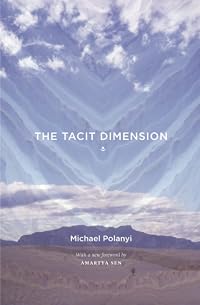
The Tacit Dimension
by Michael Polanyi
On This Page
Description
"I shall reconsider human knowledge by starting from the fact that we can know more than we can tell," writes Michael Polanyi, whose work paved the way for the likes of Thomas Kuhn and Karl Popper. The Tacit Dimension argues that tacit knowledge--tradition, inherited practices, implied values, and prejudgments--is a crucial part of scientific knowledge. Back in print for a new generation of students and scholars, this volume challenges the assumption that skepticism, rather than established show more belief, lies at the heart of scientific discovery. "Polanyi's work deserves serious attention. . . . [This is a] compact presentation of some of the essentials of his thought."--Review of Metaphysics "Polanyi's work is still relevant today and a closer examination of this theory that all knowledge has personal and tacit elements . . . can be used to support and refute a variety of widely held approaches to knowledge management."--Electronic Journal of Knowledge "The reissuing of this remarkable book give us a new opportunity to see how far-reaching--and foundational--Michael Polanyi's ideas are, on some of the age-old questions in philosophy."--Amartya Sen, from the new Foreword show lessTags
Recommendations














Member Reviews
Polanyi offers an insightful examination of tacit knowledge, that which we "know but cannot say." He sets the study in the context of science and its pursuit of objective knowledge of the world through skepticism and methodological purification, but the arguments apply more broadly to other knowledge pursuits.
Through three lectures, Polanyi argues that the tacit dimension is a realm of knowing that we comprehend (or maybe intuit) but do not articulate. Nevertheless, what we comprehend tacitly guides our explicit, concrete practices of knowledge creation. It guides our selection of problems to attend to, our choice of techniques, and our moment-by-moment assessment of whether something is right or wrong. The more skilled we become in show more any kind of practice (whether riding a bicycle, driving, singing, or doing an experiment) the more likely we are to look through the particulars of our actions to the more distant intent that is guiding those actions. In doing so, we are looking into the realm of comprehension and knowing that encompasses and mediates the more particular areas of knowledge. Areas of knowledge creation that focus outward (e.g., psychology, sociology, literature, art) afford us some glimpse of what might motivate the particulars of our actions. This tacit realm is then the seat of knowledge production: it provides the exigence, the selection of problems, and the hunches and intuitions that drive the development of more specific questions or concrete attempts at forming knowledge that are the particulars of knowledge creation. We bring our specific knowledge practices into coordination with what we understand tacitly. Although (and this is me speaking) surely there must be times when our tacit understanding of a situation is just play wrong because we cannot form an accurate tacit comprehension of something. I am not sure how concrete knowledge practices that conflict with tacit comprehension work backwards to change our tacit sensibilities. Maybe that, too, is a function of art and literature.
For such a slender book, it puts up a fight. As clearly as Polanyi is able to describe something as ineffable as tacit knowledge, readers will need to give it a measure and half of attention. show less
Through three lectures, Polanyi argues that the tacit dimension is a realm of knowing that we comprehend (or maybe intuit) but do not articulate. Nevertheless, what we comprehend tacitly guides our explicit, concrete practices of knowledge creation. It guides our selection of problems to attend to, our choice of techniques, and our moment-by-moment assessment of whether something is right or wrong. The more skilled we become in show more any kind of practice (whether riding a bicycle, driving, singing, or doing an experiment) the more likely we are to look through the particulars of our actions to the more distant intent that is guiding those actions. In doing so, we are looking into the realm of comprehension and knowing that encompasses and mediates the more particular areas of knowledge. Areas of knowledge creation that focus outward (e.g., psychology, sociology, literature, art) afford us some glimpse of what might motivate the particulars of our actions. This tacit realm is then the seat of knowledge production: it provides the exigence, the selection of problems, and the hunches and intuitions that drive the development of more specific questions or concrete attempts at forming knowledge that are the particulars of knowledge creation. We bring our specific knowledge practices into coordination with what we understand tacitly. Although (and this is me speaking) surely there must be times when our tacit understanding of a situation is just play wrong because we cannot form an accurate tacit comprehension of something. I am not sure how concrete knowledge practices that conflict with tacit comprehension work backwards to change our tacit sensibilities. Maybe that, too, is a function of art and literature.
For such a slender book, it puts up a fight. As clearly as Polanyi is able to describe something as ineffable as tacit knowledge, readers will need to give it a measure and half of attention. show less
This book contains, or at least it's based on, a series of lectures given by Polanyi in the 1960's. It's quite short and only gives a basic introduction to Polanyi's philosophy of science, so philosophers may just as well skip directly to his longer work Personal Knowledge which deals with the same questions in much more detail. Polanyi has a distinct writing style which seems to move in and out of focus. One point is brilliantly insightful, the next one might not seem to make any sense at all. But I still liked this short book and I recommend it as an introduction to his unique perspective on science.
Denne boken er et resultat av over 20 års arbeid fra en vitenskapsmann innen naturvitenskap, vitenskapsteori og filosofi.
Tacit Dimension by Michael Polanyi (1983)
Ratings
Members
- Recently Added By
Author Information

27+ Works 2,184 Members
Series
Belongs to Publisher Series
Terry Lectures (1962-1963)
Common Knowledge
- Original title
- The Tacit Dimension
- Original publication date
- 1966
- Important events
- Terry Lectures (1962)
- First words
- Some of you may know that I turned to philosophy as an afterthought to my career as a scientist.
Classifications
- Genres
- Philosophy, Nonfiction, Science & Nature, General Nonfiction
- DDC/MDS
- 121 — Philosophy & psychology Epistemology (how do you know what you know?) Epistemology (Theory of knowledge)
- LCC
- BD161 .P724 — Philosophy, Psychology and Religion Speculative philosophy Speculative philosophy Epistemology. Theory of knowledge
- BISAC
Statistics
- Members
- 437
- Popularity
- 70,479
- Reviews
- 4
- Rating
- (3.66)
- Languages
- 5 — Danish, English, German, Norwegian (Bokmål), Swedish
- Media
- Paper, Ebook
- ISBNs
- 10
- ASINs
- 5