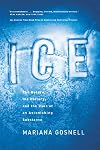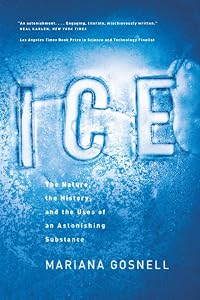
Ice: The Nature, the History, and the Uses of an Astonishing Substance
by Mariana Gosnell
On This Page
Description
More brittle than glass, at times stronger than steel, at other times flowing like molasses, ice covers 10 percent of the earth's land and 7 percent of its oceans. Its ebbs and flows over time have helped form the world we live in. Gosnell examines ice in plants, icebergs, icicles, and hail; sea ice and permafrost; ice on Mars and in the rings of Saturn; and several new forms of ice developed in labs. She discusses the work of scientists who extract cylinders of Greenland ice to study the show more history of the earth's climate and try to predict its future, and writes of the many uses humans make of ice, including ice-skating, ice fishing, iceboating, and ice climbing; building ice roads and seeding clouds; making ice castles, ice cubes, and iced desserts.--From publisher description. show lessTags
Recommendations




Member Reviews
This is one of those single-item books that were in vogue before Malcolm Gladwell-esque One True Ideas took over, like Cod and Salt and Mauve and the like, except that this one is twice the length, clocking in at just over 500 pages. It’s not particularly well organized, with chapters like “Ground Ice I” and “Ground Ice II”—why not one long chapter on ground ice? It’s a mystery, like ice itself, which turns out to be a deeply weird and changeable substance, though not weird enough to sustain this book; for many of the weird behaviors she describes we just know they exist and not really why, and I didn’t need quite so many descriptions of the different shapes ice can take.
The most difficult part of writing this review is avoiding the deluge of ice puns that could result. So instead of saying that Ice is a cool book, we could say that Ice by Mariana Gosnell covers an interesting subject. Since I live in Milwaukee, Wisconsin, I am somewhat familiar with the phenomenon known as ice. Going into this work, I knew that ice floats since it is less dense than water, I knew that this was a very good thing, and I knew that ice was refreshing in beverages. While I am not exactly stupid, I do admit that ice is something that I never really gave much thought to. I even knew that ice could be dangerous; practically everyone has heard of the Titanic disaster and how an iceberg sheared a hole through steel show more plates.
Gosnell delves deep into the science of ice by providing information gleaned from a wide swath of disciplines. So she talks about the actual structure of ice, the method and conditions of how it forms, the little names that people have for different forms of ice, and little tidbits of how ice is useful or terrifying. Take this, for example, I never thought about rivers freezing over, but it happens. I guess I thought that the flow of water would impede it or something, but that doesn’t stop the freezing process. In fact, it goes on to carry the ice downstream, sometimes creating massive floods if the ice blocks a pipe.
This book leaves no stone unturned in talking about ice in all of its glory. From frozen lakes and rivers to massive glaciers and mountains, ice can be found in many places. It can even be useful in finding out about atmospheric changes. If you take a coring of ice and analyze it, it is possible to find out many things about the period when that ice froze. Alongside all of this information are little asides from poems, plays, and novels on the beauty and power of ice. That is my one problem with this book though. It seems like the little creative pieces on ice would work to separate paragraphs or ideas, but that doesn’t exactly happen. The book finishes a paragraph, moves on to a quote by Shakespeare that pertains to ice, and moves on to the same chain of thought with a new paragraph. A lot of works have dealt with ice, which isn’t really surprising.
So in the sense of being informative, the book is great. It is quite exhaustive and the stories it tells are interesting in their own right. Some of the stories are pretty sad, but that is what you get for underestimating Mother Nature. I recall that short story by Jack London, To Build a Fire. In the face of incredible cold and the danger of the Alaskan wilderness, the man is referred to as a nameless agent. He is unimportant in the grand scheme of things, and when he tries to overdo it he dies nameless and faceless. All in all, I would rate this book pretty highly. show less
Gosnell delves deep into the science of ice by providing information gleaned from a wide swath of disciplines. So she talks about the actual structure of ice, the method and conditions of how it forms, the little names that people have for different forms of ice, and little tidbits of how ice is useful or terrifying. Take this, for example, I never thought about rivers freezing over, but it happens. I guess I thought that the flow of water would impede it or something, but that doesn’t stop the freezing process. In fact, it goes on to carry the ice downstream, sometimes creating massive floods if the ice blocks a pipe.
This book leaves no stone unturned in talking about ice in all of its glory. From frozen lakes and rivers to massive glaciers and mountains, ice can be found in many places. It can even be useful in finding out about atmospheric changes. If you take a coring of ice and analyze it, it is possible to find out many things about the period when that ice froze. Alongside all of this information are little asides from poems, plays, and novels on the beauty and power of ice. That is my one problem with this book though. It seems like the little creative pieces on ice would work to separate paragraphs or ideas, but that doesn’t exactly happen. The book finishes a paragraph, moves on to a quote by Shakespeare that pertains to ice, and moves on to the same chain of thought with a new paragraph. A lot of works have dealt with ice, which isn’t really surprising.
So in the sense of being informative, the book is great. It is quite exhaustive and the stories it tells are interesting in their own right. Some of the stories are pretty sad, but that is what you get for underestimating Mother Nature. I recall that short story by Jack London, To Build a Fire. In the face of incredible cold and the danger of the Alaskan wilderness, the man is referred to as a nameless agent. He is unimportant in the grand scheme of things, and when he tries to overdo it he dies nameless and faceless. All in all, I would rate this book pretty highly. show less
Great book but absolutely full of more information than you ever wanted to know about ice. I never had any idea it was such a complex subject.
Ratings
Members
- Recently Added By
Author Information

2 Works 186 Members
Mariana Gosnell is a former Newsweek reporter. She lives in New York City.
Awards and Honors
Awards
Classifications
Statistics
- Members
- 113
- Popularity
- 286,939
- Reviews
- 3
- Rating
- (3.88)
- Languages
- English
- Media
- Paper, Ebook
- ISBNs
- 3
- ASINs
- 1