
Jeffery Rothfeder
Author of McIlhenny's Gold: How a Louisiana Family Built the Tabasco Empire
About the Author
Works by Jeffery Rothfeder
Tagged
Common Knowledge
- Canonical name
- Rothfeder, Jeffery
- Gender
- male
Members
Reviews
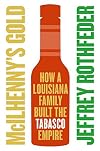
Never again will I be able to pick up that little bottle of Tabasco sauce and sprinkle a few drops on whatever I am eating, something I have done several times a week for a few decades now , without thinking of the amazing set of circumstances that came together to put that distinctive little bottle on my table. Sometimes the little diamond-shaped label on the front of the bottle, the one that still mentions Avery Island as being its home, would catch my eye and make me wonder how such a show more unique product could have been born in such an isolated place and how it managed to survive long enough to become a product recognized around the world. Jeffrey Rothfeder’s new book, McIlhenny’s Gold, provides the answers to all of my questions.
Rothfeder tells the story of a remarkable family, one that literally rose from the ashes of the Civil War to create a hugely successful business based on the sale of a single food product, a business that is still well known some 140 years later. In his research of the McIlhenny family, Rothfeder found that much of what has come to be accepted about the family’s history and the origin of Tabasco sauce is simply untrue. So many myths surround the family and its product, in fact, that even family members have found it difficult to separate fact from fiction.
When Edmund McIlhenny, fifty years old at the end of the Civil War, and prior to the war a successful New Orleans banker, returned to Louisiana in 1865 he found that the Avery family he had married into was largely destitute. The family’s rich sugar cane plantation was no more and the only thing of value still in family hands was Petit Anse, the little island that was later to be renamed Avery Island.
Edmund McIlhenny was a businessman, not a farmer. As a pre-war banker, he learned to market himself personally to such a degree that he became the best known and most sought after financial man in New Orleans. His marketing skills, and his willingness to bend the truth when it made for a better story, have made it difficult to determine exactly when he became aware of the chili pepper from Mexico’s Tabasco region and how he decided to make hot sauce the new family business. What is clear, however, is that he made the right decision and that he created a business that has served his family well for four generations.
The McIlhenny product has been a high quality one from the beginning. The three-year chili paste aging process and the inability to use mechanized pickers to gather the delicate chili peppers requires that manufacturing costs, especially labor costs, be controlled as tightly as possible. That concern led to the near recreation of the plantation system on Avery Island, a company town so complete with free shelter, medical care, schools and churches that white employees had little reason to ever leave little Avery Island. McIlhenny Co. workers, almost guaranteed a job for life, became extremely loyal to the company that provided them with everything they needed. This system lasted until a few years ago and was key to the company’s success.
McIlhenny Co., still based on the sale of a single product, has become a $250 million per year business but it is facing difficult times because one of its previous strengths has turned into its greatest weakness. The company has always been run by a member of the McIlhenny family and for three generations the family was blessed to have a family member ready to take on the job and to do it adequately, if not always completely well. But, as almost always happens in a closely held family business, future generations do not always see things through the eyes of its founder. McIlhenny Co. is at a historical crossroads and its future will be determined by a generation of McIlhennys who may decide that it is time finally to sell the company to the highest bidder rather than make the effort to keep it the tightly controlled family business that it has been for more than 140 years.
Jeffrey Rothfeder has written a well-researched history, complete with interviews of many McIlhenny family members and key employees, a history that tells the story of a fascinating family and business. McIlhenny Co. may not serve as a blueprint for future businesses, but it is hard to argue with what the company has achieved across parts of three centuries.
Rated at: 4.0 show less
Rothfeder tells the story of a remarkable family, one that literally rose from the ashes of the Civil War to create a hugely successful business based on the sale of a single food product, a business that is still well known some 140 years later. In his research of the McIlhenny family, Rothfeder found that much of what has come to be accepted about the family’s history and the origin of Tabasco sauce is simply untrue. So many myths surround the family and its product, in fact, that even family members have found it difficult to separate fact from fiction.
When Edmund McIlhenny, fifty years old at the end of the Civil War, and prior to the war a successful New Orleans banker, returned to Louisiana in 1865 he found that the Avery family he had married into was largely destitute. The family’s rich sugar cane plantation was no more and the only thing of value still in family hands was Petit Anse, the little island that was later to be renamed Avery Island.
Edmund McIlhenny was a businessman, not a farmer. As a pre-war banker, he learned to market himself personally to such a degree that he became the best known and most sought after financial man in New Orleans. His marketing skills, and his willingness to bend the truth when it made for a better story, have made it difficult to determine exactly when he became aware of the chili pepper from Mexico’s Tabasco region and how he decided to make hot sauce the new family business. What is clear, however, is that he made the right decision and that he created a business that has served his family well for four generations.
The McIlhenny product has been a high quality one from the beginning. The three-year chili paste aging process and the inability to use mechanized pickers to gather the delicate chili peppers requires that manufacturing costs, especially labor costs, be controlled as tightly as possible. That concern led to the near recreation of the plantation system on Avery Island, a company town so complete with free shelter, medical care, schools and churches that white employees had little reason to ever leave little Avery Island. McIlhenny Co. workers, almost guaranteed a job for life, became extremely loyal to the company that provided them with everything they needed. This system lasted until a few years ago and was key to the company’s success.
McIlhenny Co., still based on the sale of a single product, has become a $250 million per year business but it is facing difficult times because one of its previous strengths has turned into its greatest weakness. The company has always been run by a member of the McIlhenny family and for three generations the family was blessed to have a family member ready to take on the job and to do it adequately, if not always completely well. But, as almost always happens in a closely held family business, future generations do not always see things through the eyes of its founder. McIlhenny Co. is at a historical crossroads and its future will be determined by a generation of McIlhennys who may decide that it is time finally to sell the company to the highest bidder rather than make the effort to keep it the tightly controlled family business that it has been for more than 140 years.
Jeffrey Rothfeder has written a well-researched history, complete with interviews of many McIlhenny family members and key employees, a history that tells the story of a fascinating family and business. McIlhenny Co. may not serve as a blueprint for future businesses, but it is hard to argue with what the company has achieved across parts of three centuries.
Rated at: 4.0 show less

Every Drop for Sale is a short book, only 191 pages, that tackles the long-ignored problem of water rights and access through the world. From the Hoover Dam to projects in Egypt, Bolivia, and Malaysia, author Rothfeder takes the reader on a journey through numerous water-centric anecdotes to support his thesis that water rights and access are a vital challenge for our world right now and must be a central concern for year to come. He touches on privatization and globalization of water, and show more offers a balanced view of the role each has (and may) play in the struggle for clean, available water. Each instance is light reading and doesn't involve much in the way of the science behind the water cycle, instead remaining at a social, political, and logistical discussion.
For what this book attemps, namely to educate he reader on the wide variety of water-related troubles facing locales around the world, this book is excellent and easily digested. However, I offer two main reasons for giving this book a 3/5. First, it is very light on personal advice. This is by design, no doubt, but a bit of encouragement on how the reader might get involved and make a difference seems like a natural extention of the book's theme and is an opportunity missed by the author. Second, the book was written in 2001 and the stories the author relates are now greatly out of date. The points of emphasis at each story locale still stand, but many of the discussions of specific locales involve now-dated material. This is no fault of the author and happens with any current events book. A reader picking up this book for current info should be aware of this second point, however, and read the book for its thesis and not for its details. Well worth a quick read and is both eye-opening and enjoyable, even if a bit light on in-depth coverage of the issues. Three stars. show less
For what this book attemps, namely to educate he reader on the wide variety of water-related troubles facing locales around the world, this book is excellent and easily digested. However, I offer two main reasons for giving this book a 3/5. First, it is very light on personal advice. This is by design, no doubt, but a bit of encouragement on how the reader might get involved and make a difference seems like a natural extention of the book's theme and is an opportunity missed by the author. Second, the book was written in 2001 and the stories the author relates are now greatly out of date. The points of emphasis at each story locale still stand, but many of the discussions of specific locales involve now-dated material. This is no fault of the author and happens with any current events book. A reader picking up this book for current info should be aware of this second point, however, and read the book for its thesis and not for its details. Well worth a quick read and is both eye-opening and enjoyable, even if a bit light on in-depth coverage of the issues. Three stars. show less
The author does a good job of detailing the battles over water rights, describing the difficulties that arise when a human need as crucial as water is treated like a commodity.
My review of this book can be found on my Youtube Vlog at:
https://www.youtube.com/watch?v=9pG4vfom_Ik
Enjoy!
https://www.youtube.com/watch?v=9pG4vfom_Ik
Enjoy!
You May Also Like


Associated Authors
Statistics
- Works
- 9
- Members
- 248
- Popularity
- #92,013
- Rating
- 3.6
- Reviews
- 6
- ISBNs
- 30