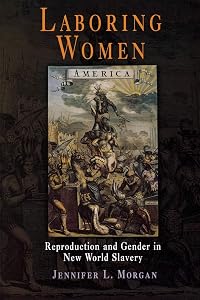
Laboring Women: Reproduction and Gender in New World Slavery
by Jennifer L. Morgan
Early American Studies (2004)
On This Page
Description
When black women were brought from Africa to the New World as slave laborers, their value was determined by their ability to work as well as their potential to bear children, who by law would become the enslaved property of the mother's master. In Laboring Women: Reproduction and Gender in New World Slavery, Jennifer L. Morgan examines for the first time how African women's labor in both senses became intertwined in the English colonies. Beginning with the ideological foundations of racial show more slavery in early modern Europe, Laboring Women traverses the Atlantic, exploring the social and cultural lives of women in West Africa, slaveowners' expectations for reproductive labor, and women's lives as workers and mothers under colonial slavery. Challenging conventional wisdom, Morgan reveals how expectations regarding gender and reproduction were central to racial ideologies, the organization of slave labor, and the nature of slave community and resistance. Taking into consideration the heritage of Africans prior to enslavement and the cultural logic of values and practices recreated under the duress of slavery, she examines how women's gender identity was defined by their shared experiences as agricultural laborers and mothers, and shows how, given these distinctions, their situation differed considerably from that of enslaved men. Telling her story through the arc of African women's actual lives-from West Africa, to the experience of the Middle Passage, to life on the plantations-she offers a thoughtful look at the ways women's reproductive experience shaped their roles in communities and helped them resist some of the more egregious effects of slave life. Presenting a highly original, theoretically grounded view of reproduction and labor as the twin pillars of female exploitation in slavery, Laboring Women is a distinctive contribution to the literature of slavery and the history of women. show lessTags
Recommendations
















Member Reviews
In Laboring Women: Reproduction and Gender in New World Slavery, Jennifer L. Morgan “argues that as slaveowners contemplated women’s reproductive potential with greed and opportunism, they utilized both outrageous images and callously indifferent strategies to ultimately inscribe enslaved women as racially and culturally different while creating an economic and moral environment in which the appropriation of a woman’s children as well as her childbearing potential became rational and, indeed, natural” (pg. 7). In this way, Morgan explores “the ways in which slavery changes the meaning of reproduction for the enslaved and the ways in which reproduction changes the experience of enslavement” (pg. 10). Further, “The show more expectations and experience of reproduction significantly influenced both the violence done to enslaved African women in the Americas and their ability to survive it” (pg. 11). Finally, Morgan argues, “The entire framework of slavery as an institution rested upon these contradictory assumptions and that centering the lives of enslaved women in the colonial period is not simply an exercise of inclusion but is rather a foundational methodology in writing the history of early America” (pg. 11).
Morgan writes, “Gender does not operate as a more profound category of difference than race; instead racialist discourse was deeply imbued with ideas about gender and sexual difference that, indeed, became manifest only in contact with each other” (pg. 15). She continues, “Those who would capture African women to exploit their labors in the Americas would have to grapple with, and harness, those women’s dual identity as workers and parents; once having done so they would inaugurate a language of race and racial hierarchy in which that dualism was reduced to denigration and mobilized as evidence of European distinction” (pg. 25). Further, “African women’s Africanness became contingent on the linkages between sexuality and a savagery that fitted them for both productive and reproductive labor” (pg. 36). Morgan writes, “African women most emphatically embodied the ideological definitions of what racial slavery ultimately meant. The inheritability of slavery depended upon the biological capacity of African mothers and fathers to pass their social identity as enslaveable – marked as it was on their skin – onto the bodies of their children. Racial slavery, then, functioned euphemistically as a social condition forged in African women’s wombs” (pg. 56).
According to Morgan, “Slaveowners ‘coupled’ men and women, named them husband and wife, and foresaw their own future in the bellies of enslaved workers. Childbirth, then, needs to stand alongside the more ubiquitously evoked scene of violence and brutality at the end of a slaveowner’s lash or branding iron” (pg. 105). Morgan writes, “The process through which slaveowners arrived at their understandings about the reach of their power were deeply implicated by their assumptions about women’s bodies and women’s work” (pg. 107). Turning to the Caribbean, Morgan writes, “If women enslaved in Barbados who survived a Middle Passage that sapped them of strength, hope, and the tangibility of their future, looked toward childbirth with the notion of reclaiming at least one familiar cultural process, they must have been shaken by the new terms and consequences of reproduction” (pg. 121). She continues, “Those women who could and did keep their children close were involved in a series of negotiated relationships with slaveowers” (pg. 132).
Morgan writes, “Slaveowners came to understand racial slavery as well as plantation management through a series of images, calculations, and experiences in which the notions of sex and race were fully intertwined. Enslaved women, and men too, from the moment they set foot aboard slave ships or were born in American colonies, came to understand their identity under slavery as marked by sex and race” (pg. 144). Further, “In the vacuum of perpetual resistance, there is no pain, no suffering, no wounds. Perhaps no better evidence of this conflict in interpretive frames exists than childbirth in a system that both relied upon and devalued it. It is to that end that centering or isolating enslaved women’s acts of political and economic autonomy is appropriate in a study that has explored the multiplicities of enslaved women’s reproductive lives” (pg. 167). Morgan writes, “Enslaved women threw their weight against the confines of their enslavement in many different ways. The tactics with which enslaved women expressed their anger, grief, and desperation about enslavement were obviously not strictly embodied – in other words, it was not just about regulating their fertility or raising children” (pg. 176). Morgan concludes, “On the most reductive level, this study has illustrated simply that African women were there” (pg. 197). In this, “Gender them – the range of interpretive possibilities around which socially inscribed identities are formed – is crucial to the work of early African-American history” (pg. 200). show less
Morgan writes, “Gender does not operate as a more profound category of difference than race; instead racialist discourse was deeply imbued with ideas about gender and sexual difference that, indeed, became manifest only in contact with each other” (pg. 15). She continues, “Those who would capture African women to exploit their labors in the Americas would have to grapple with, and harness, those women’s dual identity as workers and parents; once having done so they would inaugurate a language of race and racial hierarchy in which that dualism was reduced to denigration and mobilized as evidence of European distinction” (pg. 25). Further, “African women’s Africanness became contingent on the linkages between sexuality and a savagery that fitted them for both productive and reproductive labor” (pg. 36). Morgan writes, “African women most emphatically embodied the ideological definitions of what racial slavery ultimately meant. The inheritability of slavery depended upon the biological capacity of African mothers and fathers to pass their social identity as enslaveable – marked as it was on their skin – onto the bodies of their children. Racial slavery, then, functioned euphemistically as a social condition forged in African women’s wombs” (pg. 56).
According to Morgan, “Slaveowners ‘coupled’ men and women, named them husband and wife, and foresaw their own future in the bellies of enslaved workers. Childbirth, then, needs to stand alongside the more ubiquitously evoked scene of violence and brutality at the end of a slaveowner’s lash or branding iron” (pg. 105). Morgan writes, “The process through which slaveowners arrived at their understandings about the reach of their power were deeply implicated by their assumptions about women’s bodies and women’s work” (pg. 107). Turning to the Caribbean, Morgan writes, “If women enslaved in Barbados who survived a Middle Passage that sapped them of strength, hope, and the tangibility of their future, looked toward childbirth with the notion of reclaiming at least one familiar cultural process, they must have been shaken by the new terms and consequences of reproduction” (pg. 121). She continues, “Those women who could and did keep their children close were involved in a series of negotiated relationships with slaveowers” (pg. 132).
Morgan writes, “Slaveowners came to understand racial slavery as well as plantation management through a series of images, calculations, and experiences in which the notions of sex and race were fully intertwined. Enslaved women, and men too, from the moment they set foot aboard slave ships or were born in American colonies, came to understand their identity under slavery as marked by sex and race” (pg. 144). Further, “In the vacuum of perpetual resistance, there is no pain, no suffering, no wounds. Perhaps no better evidence of this conflict in interpretive frames exists than childbirth in a system that both relied upon and devalued it. It is to that end that centering or isolating enslaved women’s acts of political and economic autonomy is appropriate in a study that has explored the multiplicities of enslaved women’s reproductive lives” (pg. 167). Morgan writes, “Enslaved women threw their weight against the confines of their enslavement in many different ways. The tactics with which enslaved women expressed their anger, grief, and desperation about enslavement were obviously not strictly embodied – in other words, it was not just about regulating their fertility or raising children” (pg. 176). Morgan concludes, “On the most reductive level, this study has illustrated simply that African women were there” (pg. 197). In this, “Gender them – the range of interpretive possibilities around which socially inscribed identities are formed – is crucial to the work of early African-American history” (pg. 200). show less
Ratings
Members
- Recently Added By
Lists

Charleston Syllabus (waitingtoderail)
143 works; 2 members

Books in the Bibliography of Contested Continent by Peter Mancall
495 works; 1 member
Author Information

2+ Works 211 Members
Series

Common Knowledge
- Canonical title
- Laboring Women: Reproduction and Gender in New World Slavery
Classifications
- Genres
- Nonfiction, History, Sexuality and Gender Studies, General Nonfiction
- DDC/MDS
- 306.3 — Society, government, & culture Social sciences, sociology & anthropology Social Behavior - Dating, Marriage, Divorce Economic institutions
- LCC
- HT1048 .M67 — Social sciences Communities. Classes. Races Communities. Classes. Races Classes Slavery
- BISAC
Statistics
- Members
- 145
- Popularity
- 226,341
- Reviews
- 1
- Rating
- (2.94)
- Languages
- English
- Media
- Paper, Ebook
- ISBNs
- 4
- ASINs
- 1