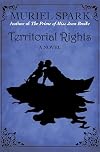
Territorial Rights
by Muriel Spark
On This Page
Description
A witty, romantic farce from the author of The Prime of Miss Jean Brodie: "Beautifully put together and effortlessly entertaining" (The New York Times). Robert wants nothing more than to become a serious art historian. But his hopes for a staid academic life are put on hold when he's driven from London to Venice to escape one lover and seek out another: the enigmatic Bulgarian refugee Lina Pancev. In Venice, Robert encounters a grand carnival of lust, lies, blackmail, cocktail parties, show more and regicide. As he chases Lina, his heart's desire, the city itself provides a priceless education in love, art, and beauty. Witty yet elegant, Territorial Rights is a celebration of human imperfection and complexity, with as many shifting identities, wardrobe changes, and sumptuous settings as a comic opera. This ebook features an illustrated biography of Muriel Spark including rare photos and never-before-seen documents from the author's archive at the National Library of Scotland. show lessTags
Recommendations
























Member Reviews
During the six and a half months that Edinburgh's public libraries were closed, one of many things I missed about them was ready access to Muriel Spark fiction. Every library in the city has all 22 of her novels and for once I have the urge to be completionist. I don't much care what precisely she writes about, as her wit, characterisation, and use of language are invariably enjoyable. 'Territorial Rights' concerns a web of intrigue among tourists and expats in Venice. There isn't one single discernable protagonist, although the narrative begins with Robert Leaver. He remains something of an enigma and most certainly not a nice boy according to his parents, girlfriend, sugar daddy, and various others. Compared to the youths, however, show more the older generation have much more significant misdeeds to their name. Sundry characters would prefer to keep their activities during the Second World War under wraps.
Although there are plenty of oblique references to violence, the tone is largely one of social farce. There are some very funny scenes, generally involving Grace and Lina. These two are ostensibly the most naive characters with the least knowledge of what is happening, yet they also appear the most sensible. I do love Spark's pragmatic women, always taking the initiative and stridently explaining their side of things. The brief extracts from the awful realist novel that Anthea is reading were likewise very amusing. I also enjoyed the succinct yet atmospheric descriptions of Venice, notably Lina's garrett in a condemned building. There are some very macabre scenes, as Spark's humour can certainly be bleak, and little in the way of narrative catharsis.
While I enjoyed 'Territorial Rights', it isn't among my favourite novels by Spark. I prefer it when she focuses on a single protagonist (e.g. [b:Loitering with Intent|58677|Loitering with Intent|Muriel Spark|https://i.gr-assets.com/images/S/compressed.photo.goodreads.com/books/1430344701l/58677._SY75_.jpg|1725461]) or very limited time period (e.g. [b:Not to Disturb|514627|Not to Disturb|Muriel Spark|https://i.gr-assets.com/images/S/compressed.photo.goodreads.com/books/1175444468l/514627._SY75_.jpg|502591]). Yet her writing is always a pleasure to read, even when the characters and plot aren't especially memorable. The elegant Polygon edition that I read has an interesting introduction as well, speculating on possible inspirations for various plot elements. show less
Although there are plenty of oblique references to violence, the tone is largely one of social farce. There are some very funny scenes, generally involving Grace and Lina. These two are ostensibly the most naive characters with the least knowledge of what is happening, yet they also appear the most sensible. I do love Spark's pragmatic women, always taking the initiative and stridently explaining their side of things. The brief extracts from the awful realist novel that Anthea is reading were likewise very amusing. I also enjoyed the succinct yet atmospheric descriptions of Venice, notably Lina's garrett in a condemned building. There are some very macabre scenes, as Spark's humour can certainly be bleak, and little in the way of narrative catharsis.
While I enjoyed 'Territorial Rights', it isn't among my favourite novels by Spark. I prefer it when she focuses on a single protagonist (e.g. [b:Loitering with Intent|58677|Loitering with Intent|Muriel Spark|https://i.gr-assets.com/images/S/compressed.photo.goodreads.com/books/1430344701l/58677._SY75_.jpg|1725461]) or very limited time period (e.g. [b:Not to Disturb|514627|Not to Disturb|Muriel Spark|https://i.gr-assets.com/images/S/compressed.photo.goodreads.com/books/1175444468l/514627._SY75_.jpg|502591]). Yet her writing is always a pleasure to read, even when the characters and plot aren't especially memorable. The elegant Polygon edition that I read has an interesting introduction as well, speculating on possible inspirations for various plot elements. show less
Perhaps because of the Venetian setting, this glorious romp of a crime novel that refuses to take itself seriously sometimes feels as though Spark is sending up Patricia Highsmith. There is a beautiful, over-inquisitive boy (escaped from The Comforters via Death in Venice), a Ripleyesque, amoral American millionaire, and a set of supremely prosaic English adulterers (a retired headmaster and his former Domestic Science teacher), all mixed up with a ludicrous Bulgarian spy plot, Italian gangsters and a dodgy detective agency that specialises in blackmailing its clients. And the headmaster's offstage wife who is forever nodding off to sleep over viciously-parodied excerpts from a sixties kitchen-sink novel. Far too much going on, not much show more chance of identifying any deeper meaning, but great fun. show less
This is a funny story written by Muriel Spark, a very bright intelligent woman who was a champion with the delivery of withering wit. Always attuned to the remarkable lengths people will extend themselves to further ambition, she lays bare hypocrasies, lies and deceit using singeing repartee and pointed sarcasm.
Reading this is a lot of fun; there's lots of seedy characters, Venice as a magical setting and Spark - someone who knows her history and how people behave.
Reading this is a lot of fun; there's lots of seedy characters, Venice as a magical setting and Spark - someone who knows her history and how people behave.
Another witty tangle of characters and events from Muriel Spark. Everyone in the novel is hiding something, often a secret identity or mysterious past. Robert, a young art student (or is he a male prostitute?), has just arrived in Venice, supposedly to complete his studies, having just broken off a complicated but unexplained relationship with Curran, a wealthy American art dealer. He no sooner arrives at the Pensione Sofia than he runs into his father--and a female companion. Back in England, Robert's mother, suspecting that her husband's travel companion is more than a colleague, contacts a private investigator--but her friend Grace decides to do her own detective work, arriving in Venice with Leo, a much younger man, in tow. show more Meanwhile, Robert's Bohemian artist girlfriend Lena Pancek, a Bulgarian defector, is trying to find out where the body of her father, a revolutionary, is buried; rumor has it he was killed in Vanice. Even the elderly sisters who run the Pensione Sofia seem to have something to hide. The fun is in the many crossed paths, unexpected twists, and slow unravelling. show less
Set at the time of publication (late 1970s), Territorial Rights was written during the period that Spark lived in Italy. The novel contains all the classic Muriel Spark elements: strange characters, murder, blackmail, and a slightly bizarre, highly-charged atmosphere. It’s a novel about the complications that can occur with deception—because everyone in this book has something to hide. But the characters are almost archetypes, serving as vehicles for the larger story. It’s just as comical as some of her other books, and I’m really enjoying this novel. In this case, there’s a possible kidnapping and a 30-year-old mystery dating back to WWII.
Robert comes to the Pensione Sofia in order to escape a disastrous relationship he left show more back in England—but almost as soon as he arrives, he runs into his father, a retired headmaster who’s on vacation with another woman. Back in England, Robert’s mother hires the services of a detective agency whose acronym is GESS (guess get it?). Also present is Robert’s art-collector friend Curran and Robert’s girlfriend Lina, a Bulgarian refugee with an untenable grasp on the English language (“I don’t have no spare cash”). All of these characters link back to a mystery that happened thirty years ago at the Pension Sofia.
As I’ve said, the characters are kind of archetypes: the Bulgarian refugee (although she is charming), the (supposedly) cheating husband, the (supposedly) betrayed wife, the mysterious Mr. B at GESS, etc. The characters seem to have a very loose link to each other, and the end of the story didn’t tie together very well—in fact, it all pretty much unravels as everyone leaves Italy, thereby returning to the “territorial rights” of home. That said, though I did enjoy this book; I liked how the mysteries of both past and present intertwined with one another. A Muriel Spark novel wouldn’t be complete wouldn’t be complete without a hint of the bizarre; in this case it’s not only the multiple mysteries but also the city of Venice, an enigma unto itself. Probably one of my favorite Muriel Spark novels, but my all-time favorite is still The Girls of Slender Means. show less
Robert comes to the Pensione Sofia in order to escape a disastrous relationship he left show more back in England—but almost as soon as he arrives, he runs into his father, a retired headmaster who’s on vacation with another woman. Back in England, Robert’s mother hires the services of a detective agency whose acronym is GESS (guess get it?). Also present is Robert’s art-collector friend Curran and Robert’s girlfriend Lina, a Bulgarian refugee with an untenable grasp on the English language (“I don’t have no spare cash”). All of these characters link back to a mystery that happened thirty years ago at the Pension Sofia.
As I’ve said, the characters are kind of archetypes: the Bulgarian refugee (although she is charming), the (supposedly) cheating husband, the (supposedly) betrayed wife, the mysterious Mr. B at GESS, etc. The characters seem to have a very loose link to each other, and the end of the story didn’t tie together very well—in fact, it all pretty much unravels as everyone leaves Italy, thereby returning to the “territorial rights” of home. That said, though I did enjoy this book; I liked how the mysteries of both past and present intertwined with one another. A Muriel Spark novel wouldn’t be complete wouldn’t be complete without a hint of the bizarre; in this case it’s not only the multiple mysteries but also the city of Venice, an enigma unto itself. Probably one of my favorite Muriel Spark novels, but my all-time favorite is still The Girls of Slender Means. show less
Never disliked a Muriel Spark book before, i was surprised to not get on with this.
There was one interesting scene (of a son embarrassing his father, no surprise I enjoyed that) and lots of crap I couldn't be bothered reading in the first few chapters. I've given up on bothering to finish it, seemed a bit of an odd mash which didn't really know what it was doing.
There was one interesting scene (of a son embarrassing his father, no surprise I enjoyed that) and lots of crap I couldn't be bothered reading in the first few chapters. I've given up on bothering to finish it, seemed a bit of an odd mash which didn't really know what it was doing.
Een Engelse student raakt in Venetië betrokken bij een groep criminelen en wordt geconfronteerd met afpersing en een bijna vergeten schandaal van vlak na de Tweede Wereldoorlog.
Members
- Recently Added By
Author Information

101+ Works 22,685 Members
Muriel Spark has been called "our most chillingly comic writer since Evelyn Waugh" by the London Spectator, and the New Yorker praised her novel Memento Mori ri (1959) as "flawless." Her fiction is marked by its remarkable diversity, wit, and craftsmanship. "She happens to be, by some rare concatenation of grace and talent, an artist, a show more serious---and most accomplished---writer, a moralist engaged with the human predicament, wildly entertaining, and a joy to read" (SRSR). She became widely known in the United States when the New Yorker devoted almost an entire issue to The Prime of Miss Jean Brodie (1961). Set in Edinburgh in the 1930s, this is the story of a schoolteacher, her unorthodox approach to life, and its effect on her select group of adolescent girls. Though their idol turns out to have feet of clay, she leaves an indelible mark on their lives. The Girls of Slender Means (1963), also warmly praised, is a sardonic look at the vivacity of youth and the anxieties of young womanhood. Reviewing The Mandelbaum Gate (1965) for the New Republic, Honor Tracy wrote: "There is an abundance here of invention, humor, poetry, wit, perception, that all but takes the breath away. . . . The story, in fact, is pure adventure, with the suspense as artfully maintained as anywhere by Graham Greene, but this is only one ingredient. There are memorable descriptions of the Holy Land, fascinating insights into the jumble of intrigue and piety surrounding the Holy Places, and penetrating studies of Arabs. . . . In each of [Spark's] novels heretofore one of her qualities has tended to predominate over the others. Here for the first time they are all impressively marshaled side by side, resulting in her best work so far." The daughter of an Englishwoman and a Scottish-Jewish father, Spark was born and educated in Edinburgh. After her marriage in 1938, she lived for some years in Central Africa, a period rarely reflected in her work. During World War II, she returned to Britain, where she worked in the Political Intelligence Department of the Foreign Office after the breakup of her marriage. She has been a magazine editor and written poetry and literary criticism. Spark has lived in London's Camberwell section, the setting of The Ballad of Peckham Rye (1960), but now makes her home in New York. Her novels reflect her conversion to Roman Catholicism. (Bowker Author Biography) Writer Muriel Spark was born in Edinburgh on February 1, 1918. In 1934-1935 she took a course in commercial correspondence and précis writing at Heriot-Watt College. After her marriage in 1937, she lived for some years in Central Africa. During World War II, she returned to Britain, where she worked in the Political Intelligence Department of the Foreign Office after the breakup of her marriage. After the war, she began her literary career. She became General Secretary of the Poetry Society, worked as an editor and wrote studies of Mary Shelley, John Masefield and the Brontë sisters. Her first book of poetry, The Fanfarlo and Other Verse, was published in 1952 and her first novel, The Comforters, was published in 1957. She wrote over twenty books including The Prime of Miss Jean Brodie and The Finishing School. She won numerous awards and honors including the 1965 James Tait Black Memorial Prize for The Mandelbaum Gate, the 1992 U. S. Ingersoll Foundation T. S. Eliot Award, the 1997 David Cohen British Literature Prize for Lifetime Achievement, and in 1993 she became Dame Commander of the Order of the British Empire in recognition of her services to literature. The Scottish Arts Council created the Muriel Spark International Fellowship in 2004. She died on April 13, 2006. (Bowker Author Biography) show less
Some Editions
Series
Belongs to Publisher Series
Work Relationships
Is contained in
Common Knowledge
- Original publication date
- 1979
- Important places
- Venice, Veneto, Italy
- First words
- The bureau clerk was telephoning to the Pensione Sofia while Robert Leaver watched the water-traffic at the ferry and the off-season visitors arriving in Venice.
- Last words
- (Click to show. Warning: May contain spoilers.)Katerina and Eufemia were always busy in the Pensione Sofia, whether attending to their guests at all seasons of the year or cultivating their roses in the garden, beyond which the canals lapped on the sides of the banks, the palaces of Venice rode in great state and the mosaics stood with the same patience that had gone into their formation, piece by small piece.
Classifications
Statistics
- Members
- 300
- Popularity
- 106,516
- Reviews
- 7
- Rating
- (3.36)
- Languages
- Dutch, English, German, Swedish
- Media
- Paper, Ebook
- ISBNs
- 16
- ASINs
- 2