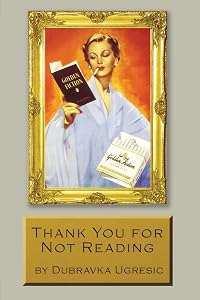
Thank You for Not Reading: Essays on Literary Trivia
by Dubravka Ugrešić
On This Page
Description
"Thank You for Not Reading is a biting critique of book publishing: agents, subagents, and scouts, supermarket-like bookstores, Joan Collins, book fairs that have little to do with books, authors promoted because of sex appeal instead of merit, and editors trying to look like writers by having their photograph taken against a background of bookshelves. Nowadays, the best strategy for young authors wanting to publish is to become famous in some other capacity first - as a sports star, an show more actress, or an Ivana Trump. One of the most interesting and paradoxical comparisons out of Urgesic's dissection of book culture is the similiarity between the art of socialist realism (as prescribed by the Soviets) and the nature of the contemporary marketplace to produce and promote art that appeals to everyone. Thanks to cultural forces like listicles and celebrity book clubs, the publishing machine neglects literature in favor of accesible, entertaining books for the masses."--page 4 of cover. show lessTags
Recommendations














Member Recommendations


gust Waar hij het over ballingschap heeft.
Member Reviews
Ugresic' comments on the publishing industry, both as an outsider-foreigner and as an intellectual make for painful reading. If this was the industry 20 years ago, what is it like now? Well, we know, full of sporting memoirs, tragedy porn, how to downsize, how to make money, the lives of celebrities, and endless pointless fiction boasting literariness, but about as compelling a read as the blurb. I felt I was in a dystopia reading it, only to find myself in a dystopia when I stopped.
Confirmation bias? Of course. But who else thinks they are better off reading great works from the past than wading through the treacle of modern prose? Sad, because how do we define the age we are in without those works that struggle with ideas and show more language, the individual vs society.
There are good books today, I'm carrying on. But the dross. Aaagggh! show less
Confirmation bias? Of course. But who else thinks they are better off reading great works from the past than wading through the treacle of modern prose? Sad, because how do we define the age we are in without those works that struggle with ideas and show more language, the individual vs society.
There are good books today, I'm carrying on. But the dross. Aaagggh! show less
These essays are light, funny and entertaining but also insightful and serious. Ugresic writes about the current publishing industry and the experience of being an exile. It would seem that these two issues aren’t related but Ugresic draws a number of comparisons between her experience with a repressive Communism system and the fickle book market. Each piece is pretty short but it the whole book covers a wide range and touches on topics from philosophy (she clearly describes the interpretations of Jean Baudrillard) to pop culture (Joan Collins, Ivana Trump, reality TV shows). If anything, her thoughts on publishing, globalization and exiles are even more relevant today.
The first section looks at the odd publishing industry, the show more changeable tastes of the public and writers who are snobbish and entitled or sad and neglected. Ugresic has a bemused attitude towards celebrity authors, ineffectual agents and an industry which is more concerned with how an author can market their works. I had some contradictory thoughts on this section though it was always fun to read. The publishing industry certainly releases its share of crap but I do think it is in response to the public reading trends and I don’t think everything large commercial publishers promote is bad (sometimes see people who seem to think the choice is between commercial pap and creative independent works, but there’s everything in between). I also think another way to go is the way Ugresic has chosen – I’ve read three books by her now and they were published by three different small or university presses. Ugresic has an interesting comparison between socialist realism literature and the American market though the requirement for happy endings and uplift reminded me more of mainstream movies. She describes all the perplexities of being a Croatian/Eastern European etc author in the West – they’re all grouped together when they’re not being ignored, sold as something exotic or not currently trendy. However, American universities can preserve and study some authors or works which have been neglected in their country of origin. Writers come out for criticism as well – self-aggrandizing or self-pitying behavior, male writers who don’t respect their female colleagues but almost always have women to negotiate their daily lives for them.
The second half of the book looks at Ugresic’s experiences as a child living in Yugoslavia and later in the West. Again, there are funny anecdotes and odd comparisons – the relentlessly positive socialist realist messages and emphasis on reading of her childhood lead to a parallel with Oprah. She also criticizes globalization though her analysis is sprinkled with humor and never goes for a straight America=bad, smaller countries=good. An overall decline in intelligent discourse and reading is mentioned as worrisome but again related with a wry smile. I didn’t always agree with everything she said but her essays certainly made me think and they were very enjoyable to read. show less
The first section looks at the odd publishing industry, the show more changeable tastes of the public and writers who are snobbish and entitled or sad and neglected. Ugresic has a bemused attitude towards celebrity authors, ineffectual agents and an industry which is more concerned with how an author can market their works. I had some contradictory thoughts on this section though it was always fun to read. The publishing industry certainly releases its share of crap but I do think it is in response to the public reading trends and I don’t think everything large commercial publishers promote is bad (sometimes see people who seem to think the choice is between commercial pap and creative independent works, but there’s everything in between). I also think another way to go is the way Ugresic has chosen – I’ve read three books by her now and they were published by three different small or university presses. Ugresic has an interesting comparison between socialist realism literature and the American market though the requirement for happy endings and uplift reminded me more of mainstream movies. She describes all the perplexities of being a Croatian/Eastern European etc author in the West – they’re all grouped together when they’re not being ignored, sold as something exotic or not currently trendy. However, American universities can preserve and study some authors or works which have been neglected in their country of origin. Writers come out for criticism as well – self-aggrandizing or self-pitying behavior, male writers who don’t respect their female colleagues but almost always have women to negotiate their daily lives for them.
The second half of the book looks at Ugresic’s experiences as a child living in Yugoslavia and later in the West. Again, there are funny anecdotes and odd comparisons – the relentlessly positive socialist realist messages and emphasis on reading of her childhood lead to a parallel with Oprah. She also criticizes globalization though her analysis is sprinkled with humor and never goes for a straight America=bad, smaller countries=good. An overall decline in intelligent discourse and reading is mentioned as worrisome but again related with a wry smile. I didn’t always agree with everything she said but her essays certainly made me think and they were very enjoyable to read. show less
My two-word review for this book would likely be, 'Oh, snap!' because Ugresic pretty much rips on everyone in the literary/publishing world: readers, writers, publishers, agents, advertisers -- everyone but book sellers (sort of, more on that later).
Ugrešić's writing style is wonderful: poetic, biting, passionate, and fiery, and there's nothing in the publishing world she won't attack. From grocery stores selling books to the passion for Umberto Eco among vacationers in Greece, Ugrešić critiques, muses, and skewers the publicity machine that commodifies books and reading. She also looks at the identity of the ex-pat writer, especially Eastern European writers following the fall of the Soviet Union and dissolution of Yugoslavia. show more
While of the essays feel dated -- they range from the late '90s through 2000 -- they're a lovely insider's/outsider's view of the publishing world and literary machine. Reading Ugrešić, I wondered what she'd think now, a decade later, so I'm wicked impatient to get my hands on her new collection of essays, Karaoke Culture. show less
Ugrešić's writing style is wonderful: poetic, biting, passionate, and fiery, and there's nothing in the publishing world she won't attack. From grocery stores selling books to the passion for Umberto Eco among vacationers in Greece, Ugrešić critiques, muses, and skewers the publicity machine that commodifies books and reading. She also looks at the identity of the ex-pat writer, especially Eastern European writers following the fall of the Soviet Union and dissolution of Yugoslavia. show more
While of the essays feel dated -- they range from the late '90s through 2000 -- they're a lovely insider's/outsider's view of the publishing world and literary machine. Reading Ugrešić, I wondered what she'd think now, a decade later, so I'm wicked impatient to get my hands on her new collection of essays, Karaoke Culture. show less
A unique blend of essays and short fictions, with neither fiction nor nonfiction marked. The author makes interesting insights into the effects of market forces on literature and the aftereffects of communism and its fall in Eastern Europe.
"The Book Proposal" and "Eco among the Nudists" are among my favorites, but "Long Live Socialist Realism" - which compares the Oprah bestseller phenomenon to the Socialist realism movement of Yugoslavia's communist past - is the hook I'm using to get friends reading.
"The Book Proposal" and "Eco among the Nudists" are among my favorites, but "Long Live Socialist Realism" - which compares the Oprah bestseller phenomenon to the Socialist realism movement of Yugoslavia's communist past - is the hook I'm using to get friends reading.
I finished the book and wanted to like it more than I did. I found it annoying in a way.
The author, an "exile" from the former Yugoslavia had much to criticize about the West. The essays in the book were primarily about writers and writing. I found the author's writing strongly negative and wondered what she found good about the West (both Western Europe and the United States). Some themes she covered were commercialism, the cheapening of respect for highly intelligent, literary writers, and the feelings of being an exile. I guess I disliked her expression of literary snobbery.
What I did like, though, was the opportunity to read a book by a Croatian author. The author was from a part of the former Yugoslavia in which my mother grew up. show more I guess I was looking for more writing about her native country.
After reading the essays, I found it hard to remember what she expressed even though I copied down some quotes. Nothing really stood out for me except the author's amazement that in the West anyone can be a writer. show less
The author, an "exile" from the former Yugoslavia had much to criticize about the West. The essays in the book were primarily about writers and writing. I found the author's writing strongly negative and wondered what she found good about the West (both Western Europe and the United States). Some themes she covered were commercialism, the cheapening of respect for highly intelligent, literary writers, and the feelings of being an exile. I guess I disliked her expression of literary snobbery.
What I did like, though, was the opportunity to read a book by a Croatian author. The author was from a part of the former Yugoslavia in which my mother grew up. show more I guess I was looking for more writing about her native country.
After reading the essays, I found it hard to remember what she expressed even though I copied down some quotes. Nothing really stood out for me except the author's amazement that in the West anyone can be a writer. show less
Ratings
Members
- Recently Added By
Lists

Top Five Books of 2022
736 works; 272 members
Author Information

30+ Works 2,602 Members
Dubravka Ugresic was born and raised in what used to be Yugoslavia. In 1993, she left Croatia for political reasons. She has taught in several American and European universities and been awarded many international prizes for her writing
Some Editions
Awards and Honors
Series
Belongs to Publisher Series
Common Knowledge
- Canonical title*
- Читать не надо!
- First words
- Anyone who has been through the experience known as completely renovating one's apartment knows that everything is in the hands of the workmen.
*Some information comes from Common Knowledge in other languages. Click "Edit" for more information.
Classifications
- Genres
- Nonfiction, Literature Studies and Criticism, General Nonfiction
- DDC/MDS
- 070.5 — Computer science, information & general works News media, journalism & publishing Documentary media, educational media, news media; journalism; publishing Publishing
- LCC
- Z278 .U3613 — Bibliography, Library Science and Information Resources Book industries and trade Bookselling and publishing
- BISAC
Statistics
- Members
- 271
- Popularity
- 119,733
- Reviews
- 6
- Rating
- (3.94)
- Languages
- 10 — Dutch, English, French, German, Polish, Russian, Serbian, Croatian, Spanish, Turkish
- Media
- Paper, Ebook
- ISBNs
- 11
- ASINs
- 2