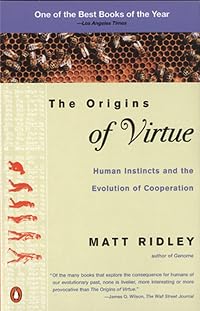
The Origins of Virtue: Human Instincts and the Evolution of Cooperation
by Matt Ridley
On This Page
Description
"If evolution by natural selection relentlessly favors self-interest, why do human beings live in complex societies and show so much cooperative spirit? In The Origins of Virtue, Matt Ridley, a zoologist and former American editor of the Economist, shows that recent research in a number of fields has suggested a resolution of the apparent contradiction between self-interest and mutual aid. Brilliantly orchestrating the new findings of geneticists, psychologists, and anthropologists, The show more Origins of Virtue re-examines the everyday assumptions upon which we base our actions towards others, whether we are nurturing parents, siblings, or trade partners." "The Origins of Virtue searches for the roots of that capacity for trust, contrasts it with the social instincts of ants, baboons, and naked mole rats, and draws provocative conclusions for our understanding of politics. Ridley not only traces the evolution of society but shows us how breakthroughs in computer programming, microbiology, and economics have all played their role in providing us with a unique perspective on how and why we relate to each other."--BOOK JACKET. show lessTags
Recommendations





Member Reviews
This book is like being run over by a steam-roller. It's a very polite steam-roller that goes forward; then backs off a bit and says sorry before trundling forward further than it went last time. And its roller is covered in cashmere, so the steel of the meaning feels softer because of the gentleness of the language.
At the end, of course, you have been considerably transformed in your outlook (that reminds me, I must read 'Flatland' sometime), but it's hard to pin down exactly what it was that you were like before, but aren't now. I think the proof will come when I hear someone blathering on about how human nature is purely formed by society, and I spot it for the utter bollocks that it is.
Suffice to say that I delighted in this book.
At the end, of course, you have been considerably transformed in your outlook (that reminds me, I must read 'Flatland' sometime), but it's hard to pin down exactly what it was that you were like before, but aren't now. I think the proof will come when I hear someone blathering on about how human nature is purely formed by society, and I spot it for the utter bollocks that it is.
Suffice to say that I delighted in this book.
The author, a popular science write, relies on game theory to explain the evolutionary origins of cooperation and altruism. There are many good reviews on Amazon, but I would like to add one detail:
The modern intelligentsia and media have portrayed Native Americans and other Aboriginal peoples as conservationists and environmentalists who were stewards of the earth's resources and were 'at one with nature'. If this is true, then it largely refutes Ridley's whole argument. Ridley devotes a whole chapter to this ( Chapter 11 - Ecology as Religion ) and shows that it is a complete myth. Some of the facts he adduces: Shortly after 'Native Americans' arrived in North America, 73% of the large mammals were exterminated and became extinct. show more Shortly after man arrived in South America, 80% of the large mammals were exterminated and became extinct. As the Polynesians colonized the Pacific, they extinguished 20% of all the bird species on earth. At Olsen-Chubbock, the site of ancient bison massacres in Colorado, where people regularly stampeded herds over a cliff, the animals lay in such heaps after a successful stampede that only the ones on the top were butchered, and only the best joints were taken from them. If you are incredulous - read the book, all the sources are there. Ridley's final conclusion is that the limitations of technology or demand, rather than a culture of self-restraint or religious respect, is what kept tribal people from over exploiting their environment. One nice touch is Ridley's quote of Chief Seattle's speech which Al Gore includes in his book 'Earth in the Balance'.
"How can you buy or sell the sky? The Land?...Every part of this earth is sacred to my people..."
This quote would seem to establish Native Americans as the original environmentalists. Unfortunately, the speech was never given. It was written by Ted Perry, in 1971, for an ABC television drama. Who says TV doesn't shape our perception of reality. show less
The modern intelligentsia and media have portrayed Native Americans and other Aboriginal peoples as conservationists and environmentalists who were stewards of the earth's resources and were 'at one with nature'. If this is true, then it largely refutes Ridley's whole argument. Ridley devotes a whole chapter to this ( Chapter 11 - Ecology as Religion ) and shows that it is a complete myth. Some of the facts he adduces: Shortly after 'Native Americans' arrived in North America, 73% of the large mammals were exterminated and became extinct. show more Shortly after man arrived in South America, 80% of the large mammals were exterminated and became extinct. As the Polynesians colonized the Pacific, they extinguished 20% of all the bird species on earth. At Olsen-Chubbock, the site of ancient bison massacres in Colorado, where people regularly stampeded herds over a cliff, the animals lay in such heaps after a successful stampede that only the ones on the top were butchered, and only the best joints were taken from them. If you are incredulous - read the book, all the sources are there. Ridley's final conclusion is that the limitations of technology or demand, rather than a culture of self-restraint or religious respect, is what kept tribal people from over exploiting their environment. One nice touch is Ridley's quote of Chief Seattle's speech which Al Gore includes in his book 'Earth in the Balance'.
"How can you buy or sell the sky? The Land?...Every part of this earth is sacred to my people..."
This quote would seem to establish Native Americans as the original environmentalists. Unfortunately, the speech was never given. It was written by Ted Perry, in 1971, for an ABC television drama. Who says TV doesn't shape our perception of reality. show less
Matt Ridley's style of writing makes reading about science easy and enjoyable. I particularly enjoyed what he had to say about game theory, and how humans don't act in the way that you'd logically anticipate them to behave in the areas of cooperation and reciprocity.
The chapter on trade and arbitrage was fascinating, as was his explanation of how societies through history have protected fauna that didn't move far, partly due to property rights. Anything that travelled further, like large roaming mammals, couldn't be owned and therefore weren't protected - people believed that they may as well hunt those animals, even where their populations ran low, because if they didn't then someone else would anyway, so many species were hunted to show more extinction.
All in all, this was a very satisfactory and convincing account of how virtue in people has evolved. show less
The chapter on trade and arbitrage was fascinating, as was his explanation of how societies through history have protected fauna that didn't move far, partly due to property rights. Anything that travelled further, like large roaming mammals, couldn't be owned and therefore weren't protected - people believed that they may as well hunt those animals, even where their populations ran low, because if they didn't then someone else would anyway, so many species were hunted to show more extinction.
All in all, this was a very satisfactory and convincing account of how virtue in people has evolved. show less
I really enjoyed this book. Ridley's aim is to answer an old question - "how is society possible?" - largely from the context of evolutionary biology.
For much of the book, his quest is to explain altruism - if our instincts have evolved to maximise the chances of our genes reproducing, then why should we care about strangers?
He starts with the genes themselves - each genome a cooperative society of individual genes, each individually 'selfish' but equally reliant on their neighbours for their survival. This introduces a theme that runs throughout the book - the division of labour - and gives some idea of why the book spends as much time discussing economics as biology.
There's plenty here on game theory and its use to derive theories of show more altruism (reciprocity and others). I was surprised at how far beyond biology Ridley treads, with chapters on tribalism, war, trade and property, for example.
The book begins by looking at Kropotkin's (flawed) theory of Mutual Aid, which sought to use animal behaviour to demonstrate that we are naturally altruistic, attempting to employ science to make a political point. By the end, this theory has been long dismissed, but Ridley bravely returns to similar territory. Having shown (and speculated) how biology and evolution can in fact lead to altruistic (or at least cooperative) behaviour, he draws the lessons for real-world politics.
I found this a great way to end - in an era where politicians seem as keen as ever to meddle in science, it's good to see that science can hold lessons for politics too, and good to see a science journalist unafraid to draw those lessons. show less
For much of the book, his quest is to explain altruism - if our instincts have evolved to maximise the chances of our genes reproducing, then why should we care about strangers?
He starts with the genes themselves - each genome a cooperative society of individual genes, each individually 'selfish' but equally reliant on their neighbours for their survival. This introduces a theme that runs throughout the book - the division of labour - and gives some idea of why the book spends as much time discussing economics as biology.
There's plenty here on game theory and its use to derive theories of show more altruism (reciprocity and others). I was surprised at how far beyond biology Ridley treads, with chapters on tribalism, war, trade and property, for example.
The book begins by looking at Kropotkin's (flawed) theory of Mutual Aid, which sought to use animal behaviour to demonstrate that we are naturally altruistic, attempting to employ science to make a political point. By the end, this theory has been long dismissed, but Ridley bravely returns to similar territory. Having shown (and speculated) how biology and evolution can in fact lead to altruistic (or at least cooperative) behaviour, he draws the lessons for real-world politics.
I found this a great way to end - in an era where politicians seem as keen as ever to meddle in science, it's good to see that science can hold lessons for politics too, and good to see a science journalist unafraid to draw those lessons. show less
Şayet Bencil Gen başlıklı kitabımın insanlara ayrılmış ikinci bir cildi olsaydı, sanırım aşağı yukarı Erdemin Kökenlerine benzer bir eser ortaya çıkardı. Richard Dawkins. İnsanlar neden topluluklar halinde yaşar? Toplumlar nasıl ortaya çıkmıştır? Peki, insanlar arasındaki işbirliğinin kökeninde ne vardır? Yoksa bizi özveri ve işbirliğine yönelten şey aklımız ya da vicdanımız değil de aslında milyonlarca yıllık genetik programımız mı aslında? Her yıl aynı göç yolunu izleyen kırlangıçlardan bir farkımız yok mu bu açıdan? Matt Ridley bu soruları, antropoloji ve zoolojiden ekonomi ve oyun kuramına kadar uzanan çok geniş bir yelpazede, evrimsel biyolojinin bulgularına show more dayanarak ele alıyor ve tartışma yaratacak, kışkırtıcı yanıtlara ulaşıyor. show less
I enjoyed the book but disagree with the author on the conclusions since unlike the author I'm not a anarcho-socialist. It's extremely biased but what is presented is mostly fact and history, even if examples are cherry-picked, but that's what happens when you start of with a clear agenda and don't let mere facts interfere with your plan.
This was my first introduction to the author, and it set a pattern that hasn't been relieved by further encounters. The author lacks integrity, willing to indulge in quote-mining to pretend that those who are on the other side of a question actually support his point of view, and he never misses an opportunity to make unsupported, unpleasant sexist comments. He plainly believes the evidence indicates irrefutably that women are inferior and should stay home and work as breeding machines. It is only somewhat indicated here, but even with the marginality of the topic to sexism, he manages to make his point very clear.
Members
- Recently Added By
Lists

Best Science Books for Non-Scientists
113 works; 57 members

Atheism, humanism, freethought, &c. — Best nonfiction books in favour of
167 works; 14 members

culture
320 works; 1 member

Foundations of Morality
10 works; 1 member

Ryan Holiday's Books To Base Your Life On
97 works; 2 members
Author Information

37+ Works 11,598 Members
Matt Ridley is the author of several award-winning books, including Genome, The Agile Gene, and The Red Queen, which have sold more than 800,000 copies in twenty-seven languages worldwide. He lives in England.
Some Editions
Awards and Honors
Awards
Distinctions
Notable Lists
Series
Belongs to Publisher Series
Common Knowledge
- Original publication date
- 1996
- People/Characters
- Robert Frank; Kristen Hawkes; Thomas Hobbes; Hillard Kaplan; Peter Kropotkin; Jean-Jacques Rousseau (show all 8); Adam Smith; Robert Trivers
- First words
- Prologue
In which a Russian anarchist
escapes from prison
The prisoner was in a dilemma. As he paced slowly along his accustomed path, he suddenly heard a violin, in the open window of a house overlooking the ... (show all)prison yard. - Last words
- (Click to show. Warning: May contain spoilers.)We must encourage social and material exchange between equals for that is the raw material of trust, and trust is the foundation of virtue.
- Blurbers
- Dawkins, Richard; Cornwell, John; Waal, F. B. M. de
Classifications
- Genres
- Science & Nature, Nonfiction, Anthropology, General Nonfiction, Philosophy, Economics
- DDC/MDS
- 302.14 — Society, government, & culture Social sciences, sociology & anthropology Mass Communication & Media General topics of social interaction Social participation
- LCC
- QH366.2 .R527 — Science Natural history – Biology Biology (General) Evolution
- BISAC
Statistics
- Members
- 1,170
- Popularity
- 21,408
- Reviews
- 14
- Rating
- (3.93)
- Languages
- 12 — Chinese, Czech, Dutch, English, Estonian, Finnish, German, Hungarian, Italian, Norwegian (Bokmål), Portuguese, Turkish
- Media
- Paper, Audiobook, Ebook
- ISBNs
- 19
- ASINs
- 11