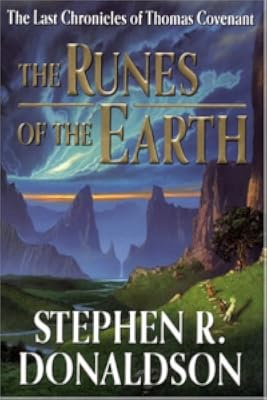
The Runes of the Earth
by Stephen R. Donaldson
The Last Chronicles of Thomas Covenant (1), The Complete Chronicles of Thomas Covenant (7)
On This Page
Description
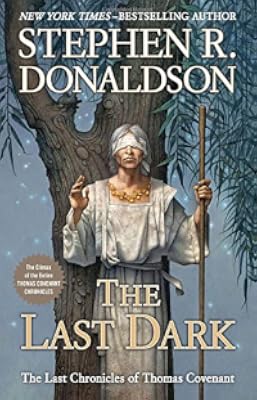
New York Times bestselling author Stephen R. Donaldson presents the first novel of the four-volume finale to the series that’s become a modern fantasy classic: The Chronicles of Thomas Covenant.Thomas Covenant lost everything. Abandoned by his wife and child, sick and alone, he was transported while unconscious to a magical, dreamlike world called the Land. Convinced it was all a delusion, Covenant was christened The Unbeliever by the Land’s inhabitants—but gave his life to save show more this new-found world he came to regard as precious.
Ten years after Covenant’s death, Linden Avery still mourns for her beloved companion. But a violent confrontation with Covenant’s son, who is doing the evil Lord Foul’s bidding, forces her into the Land, where a dark malevolence is about to unmake the laws of nature—and of life and death itself. It is here that she comes upon Esmer, son of the Dancers of the Sea, a creature of strange powers who draws Linden backwards through time to witness Thomas Covenant’s return to life, and to reinvent the mysterious, dangerous, and violent history of the Land. show less
Tags
Recommendations






Member Reviews
To abuse an overused cliche, when Donaldson burst onto the scene on 1977 with Thomas Covenant, this teen who had only Tolkien and the plagiarist Brooks, and the Chronicles turned the world on its ear. (Okay, many many years later, having read a part of an interview, I realize that Terry Brooks had no one but Tolkien as inspiration so it was natural that he emulate him) Those Chronicles were so different. And, then the Second Chronicles...then the Last. I’d read this when it came out in 2004, but remembered only a few things (the beginning and the ending.) I’d also read the next (and remember even less ...just the ending), but never got past 47 words into the third. I intend to fix that in 2019 and finish the series, but I needed a show more refresher, so ...
Fast forward ten years and 3,500 years from where he left off in White Gold Wielder, the evil that wants the destruction of the Land and everything is risen again in a new but familiar form, and it still has a foothold in the original world of Covenant. When the first of the Second Chronicles came out around the same time as Herbert’s God Emperor of Dune, they both imagined 4,000 years into a future from the familiar. Now, I was a huge Dune fan, but Donaldson did it far better. And he did it again with the Last Chronicles. This is a long set up. Really long. 500+ pages long. And that which was set up to be revealed at the end was a cliffhanger of epical aggravation. Good thing this time around the remaining novels have already been written and I don’t have to wait!
Donaldson has a skill rarely rivaled in using semi-obscure and sometimes really obscure technically correct but not archaic words. And he writes tomes! Sure Jordan and Eddings (and others) did as well, but they were definitely more somniferous and I couldn’t get into them. Donaldson makes it difficult not for the now and then thesaurus confirmation check but for a maddening central character. The inaction, whether from the unbelief of Covenant or the disbelief and later paralytic belief with Linden Avery, this reader for sure found himself more than once when young thinking, “Oh my god, what is wrong with you?!!” As an adult with 40 years maturity wadded on, thoughts tend more toward a sanitized "Just do it, damn it!"
These are not enjoyable reads. But that is not the same as enjoying reading them. They challenge the imagination. They challenge paradigms. There might be other writers who do this in the context of fantasy fiction, but Donaldson’s books are the ones I’ve chosen to read. They are dark and heavy, annoying and disconcerting, frustrating and yet satisfying, not enjoyable as I said but I enjoy reading them. show less
Fast forward ten years and 3,500 years from where he left off in White Gold Wielder, the evil that wants the destruction of the Land and everything is risen again in a new but familiar form, and it still has a foothold in the original world of Covenant. When the first of the Second Chronicles came out around the same time as Herbert’s God Emperor of Dune, they both imagined 4,000 years into a future from the familiar. Now, I was a huge Dune fan, but Donaldson did it far better. And he did it again with the Last Chronicles. This is a long set up. Really long. 500+ pages long. And that which was set up to be revealed at the end was a cliffhanger of epical aggravation. Good thing this time around the remaining novels have already been written and I don’t have to wait!
Donaldson has a skill rarely rivaled in using semi-obscure and sometimes really obscure technically correct but not archaic words. And he writes tomes! Sure Jordan and Eddings (and others) did as well, but they were definitely more somniferous and I couldn’t get into them. Donaldson makes it difficult not for the now and then thesaurus confirmation check but for a maddening central character. The inaction, whether from the unbelief of Covenant or the disbelief and later paralytic belief with Linden Avery, this reader for sure found himself more than once when young thinking, “Oh my god, what is wrong with you?!!” As an adult with 40 years maturity wadded on, thoughts tend more toward a sanitized "Just do it, damn it!"
These are not enjoyable reads. But that is not the same as enjoying reading them. They challenge the imagination. They challenge paradigms. There might be other writers who do this in the context of fantasy fiction, but Donaldson’s books are the ones I’ve chosen to read. They are dark and heavy, annoying and disconcerting, frustrating and yet satisfying, not enjoyable as I said but I enjoy reading them. show less
This is the first volume of the third (and final) trilogy. The first trilogy was published 1977, the second 1980 - 1983, and now this after a more than twenty year gap.
Time hasn't improved the product.
Unconventionally in the new novel, it centres round its eponymous hero – who died more than twenty years ago at the end of volume 6. This is an unusual challenge for a novelist, which Mr Donaldson doesn't succeed in resolving. The new novel is filled with the sound of pot-boiling and the disagreeable texture of padding. For half of its six hundred pages nothing of real interest happens. The author prolongs yet again his attention to existential problems – Come back, Camus and Sartre ! – with a prose which is thick, opaque and show more indigestible. His description of the indescribable – e.g. an experiential description of passing through a “time vortex” – is brave but unconvincing. He retains syntax patterns but juxtaposes words in a basically incoherent way. He relies on an expanded vocabulary (“cymar”, “phosphene”; “formication” was very strong in the chapter I just finished).
I'm having to force myself to conclude this long (thick, heavy) book; only acquired self-discipline prevents me from jettisoning it. So I don't imagine that I will feel any compulsion to read the further, future volumes.
Donaldson emerged on the fantasy scene in 1977 with a fresh, vigorous imaginative product – and he's never since recaptured that vibrant, involving style. show less
Time hasn't improved the product.
Unconventionally in the new novel, it centres round its eponymous hero – who died more than twenty years ago at the end of volume 6. This is an unusual challenge for a novelist, which Mr Donaldson doesn't succeed in resolving. The new novel is filled with the sound of pot-boiling and the disagreeable texture of padding. For half of its six hundred pages nothing of real interest happens. The author prolongs yet again his attention to existential problems – Come back, Camus and Sartre ! – with a prose which is thick, opaque and show more indigestible. His description of the indescribable – e.g. an experiential description of passing through a “time vortex” – is brave but unconvincing. He retains syntax patterns but juxtaposes words in a basically incoherent way. He relies on an expanded vocabulary (“cymar”, “phosphene”; “formication” was very strong in the chapter I just finished).
I'm having to force myself to conclude this long (thick, heavy) book; only acquired self-discipline prevents me from jettisoning it. So I don't imagine that I will feel any compulsion to read the further, future volumes.
Donaldson emerged on the fantasy scene in 1977 with a fresh, vigorous imaginative product – and he's never since recaptured that vibrant, involving style. show less
I really enjoyed this book - so much revelation of details that were in the previous books (so it was a nostalgic trip for me, as I enjoyed the previous six books). Linden becomes more fleshed out as a character. New characters that are discovered I find interesting and complex. New trials to overcome and layers of meaning are described throughout the chapters that bring a similar but new flavor from the previous series.
This paragraph from the book expresses much of what I enjoy about this book and the series as a whole:
"There is no dishonor in service. The Mahdoubt labors here, assuredly, and her tasks are weary. Yet by her efforts she is fed and clad and warmed. At night she sleeps beyond harm in a kindly bed, with no rough words"
One show more theme that is discussed in this book is the sacrifice of the many versus the needs of the one, or vice versa. Another theme is good cannot be done by evil means. Both of these themes are complex and varied throughout the story and drive the motivations of many of the characters.
Understanding that the humans are fragile and have inherent weakness is another theme that over arches the book and series.
With all of this said, I can understand many of the arguments that the characters are difficult to identify with or care about, that the language of the book is high and thick, and that the plot can seem plodding. In my estimation, these things are actually strengths of the book, but clearly no book is for everyone, and it is a rare book that is broad enough to satisfy many. show less
This paragraph from the book expresses much of what I enjoy about this book and the series as a whole:
"There is no dishonor in service. The Mahdoubt labors here, assuredly, and her tasks are weary. Yet by her efforts she is fed and clad and warmed. At night she sleeps beyond harm in a kindly bed, with no rough words"
One show more theme that is discussed in this book is the sacrifice of the many versus the needs of the one, or vice versa. Another theme is good cannot be done by evil means. Both of these themes are complex and varied throughout the story and drive the motivations of many of the characters.
Understanding that the humans are fragile and have inherent weakness is another theme that over arches the book and series.
With all of this said, I can understand many of the arguments that the characters are difficult to identify with or care about, that the language of the book is high and thick, and that the plot can seem plodding. In my estimation, these things are actually strengths of the book, but clearly no book is for everyone, and it is a rare book that is broad enough to satisfy many. show less
The first six Covenant books were favourites of mine in high school when I lacked critical thinking, a function I've since acquired and lost the shut-off switch for. My experience has been that it's a poor idea for any author to revisit a series that has become decades old. Even through a rose-coloured haze I could remember this series is weighty with psychological turmoil and relatively slow-paced. These downsides are more prominent to me now, and together with some other (new?) issues it made a lot of this novel problematic to enjoy.
An introduction before the narrative provides a brilliant summary of the first six novels, although the first trilogy published in 1977 should be the litmus test. Thomas Covenant is a dark anti-hero and I show more find him intriguing. His companion Linden Avery is less so in both respects and features here, but she's not to blame for the far too many pages spent on addressing hunger, thirst and weariness, or discussions that seem tangential at best. I especially tired of Linden interrogating Anele: akin to a detective with a murder witness sidekick whom she keeps trying to get another clue out of. Good developments do occur, mysteries sustained my interest, and the last four chapters almost make up for the journey to get there. I'm hopeful what follows will be better now that I'm through the introduction. show less
An introduction before the narrative provides a brilliant summary of the first six novels, although the first trilogy published in 1977 should be the litmus test. Thomas Covenant is a dark anti-hero and I show more find him intriguing. His companion Linden Avery is less so in both respects and features here, but she's not to blame for the far too many pages spent on addressing hunger, thirst and weariness, or discussions that seem tangential at best. I especially tired of Linden interrogating Anele: akin to a detective with a murder witness sidekick whom she keeps trying to get another clue out of. Good developments do occur, mysteries sustained my interest, and the last four chapters almost make up for the journey to get there. I'm hopeful what follows will be better now that I'm through the introduction. show less
This one should be subtitled Arrogance because almost every major character shows it at some point.
As a starting point for the four-book Last Chronicles of Thomas Covenant, it does its job adequately. We're shown the main characters and taken back to the Land. However, once there, very little happens, and Linden Avery, on at least two or three occasions, reminds us that this big, sprawling book takes place over a few days. Now that most of the characters are met (though I suspect we still need to get a giant or two into the mix), the story will actually pick up pace, because most of what happens in this one is hand-wringing and waiting.
Having said all this, I do remind myself that I have to give Donaldson time. When I first picked up show more the paperback of Lord Foul's Bane way back in 1978, it took me three tries to get past page 70. Once I did, I fell in love with this series.
I expect to do so again. show less
As a starting point for the four-book Last Chronicles of Thomas Covenant, it does its job adequately. We're shown the main characters and taken back to the Land. However, once there, very little happens, and Linden Avery, on at least two or three occasions, reminds us that this big, sprawling book takes place over a few days. Now that most of the characters are met (though I suspect we still need to get a giant or two into the mix), the story will actually pick up pace, because most of what happens in this one is hand-wringing and waiting.
Having said all this, I do remind myself that I have to give Donaldson time. When I first picked up show more the paperback of Lord Foul's Bane way back in 1978, it took me three tries to get past page 70. Once I did, I fell in love with this series.
I expect to do so again. show less
The Runes of the Earth begins the third and last chronicles of Thomas Covenant by Stephen Donaldson. My passion for reading was forged as a teenager with fantasy books by the likes of Lewis, Tolkien and Donaldson. When my eyes first fell upon Lord Foul’s Bane, the first book of the first chronicles published in 1977, I saw that it was another story about a ring of power craved by an evil lord, and thought that it must be another Lord of the Rings knockoff. Wow, was I wrong. Donaldson is a master of psychological adventure, taking readers deep into the interior of complex characters such as the anti-hero, Thomas Covenant, who disbelieves in the Land to preserve his health and sanity in our world. The fantasy genre uses symbols show more literally, and often crudely. Symbols are the language of the unconscious, and only a few like Donaldson can use them effectively.
Lord Foul is back after being twice defeated in his attempts to use Covenant’s white gold ring to destroy the Arch of Time. Covenant was slain at the end of the second chronicles, but the manner of his death promises a return in some form. Linden Avery reappears from the second chronicles as a worthy protagonist, equally tortured in her circumstances and decisions. Her son, Jeremiah, has been taken by Foul to manipulate her use of Covenant’s ring: “Tell her that I have her son.” Covenant’s family has been twisted into the service of Foul. The Staff of Law was lost a generation after Linden’s last victory over Foul, permitting new evils, including a smog called Kevin’s Dirt, and distortions of time called Falls or caesures. In the absence of any other leadership, the Haruchai have turned from servants of the Land to Masters, forbidding the use of Earthpower (health incarnate) to fight Foul. Linden’s only friends seem to be mad old Anele, who clings to her for protection, and young Liand, an untried Stonedowner.
Like any psychological journey, the action is more internal than external. The reader is treated to pages of deliberation, garnered in unfettered use of uncommon English (words like thetic and threnody), and dialog stretching over paragraphs at a time. Metaphysical questions are pondered deeply: can good come of evil? Readers travel leagues with Linden with only skirmishes for action. But when the moments of truth arrive, Donaldson delivers with fireworks. I recall that the conclusion to the second chronicles had me uttering aloud, “Oh my God!” These books are Old Testament fire and brimstone.
Thirty years after the first work was published, I wondered again if anything original could happen here. How many times can Foul return? I was not disappointed. This story had to be told. Consider that the villain has many names — Lord Foul, the Despiser, Despair. Despair is by nature a persistent foe. Donaldson is psychological novelist. Perhaps despair seldom wins, but can any of us truly vanquish despair for good? A major theme is this book is that of reckonings. When Stave the Haruchai is persuaded to assist Linden, he promises there will be a reckoning. What reckoning will be required to finally settle things with Foul? My hope is that by the end of this last chronicle, Donaldson will resolve the cycle in a new way, finding some kind of balance or synthesis in the Land between hope and despair.
http://johnmiedema.ca/2008/01/12/despair-is-a-persistent-foe-book-review/ show less
Lord Foul is back after being twice defeated in his attempts to use Covenant’s white gold ring to destroy the Arch of Time. Covenant was slain at the end of the second chronicles, but the manner of his death promises a return in some form. Linden Avery reappears from the second chronicles as a worthy protagonist, equally tortured in her circumstances and decisions. Her son, Jeremiah, has been taken by Foul to manipulate her use of Covenant’s ring: “Tell her that I have her son.” Covenant’s family has been twisted into the service of Foul. The Staff of Law was lost a generation after Linden’s last victory over Foul, permitting new evils, including a smog called Kevin’s Dirt, and distortions of time called Falls or caesures. In the absence of any other leadership, the Haruchai have turned from servants of the Land to Masters, forbidding the use of Earthpower (health incarnate) to fight Foul. Linden’s only friends seem to be mad old Anele, who clings to her for protection, and young Liand, an untried Stonedowner.
Like any psychological journey, the action is more internal than external. The reader is treated to pages of deliberation, garnered in unfettered use of uncommon English (words like thetic and threnody), and dialog stretching over paragraphs at a time. Metaphysical questions are pondered deeply: can good come of evil? Readers travel leagues with Linden with only skirmishes for action. But when the moments of truth arrive, Donaldson delivers with fireworks. I recall that the conclusion to the second chronicles had me uttering aloud, “Oh my God!” These books are Old Testament fire and brimstone.
Thirty years after the first work was published, I wondered again if anything original could happen here. How many times can Foul return? I was not disappointed. This story had to be told. Consider that the villain has many names — Lord Foul, the Despiser, Despair. Despair is by nature a persistent foe. Donaldson is psychological novelist. Perhaps despair seldom wins, but can any of us truly vanquish despair for good? A major theme is this book is that of reckonings. When Stave the Haruchai is persuaded to assist Linden, he promises there will be a reckoning. What reckoning will be required to finally settle things with Foul? My hope is that by the end of this last chronicle, Donaldson will resolve the cycle in a new way, finding some kind of balance or synthesis in the Land between hope and despair.
http://johnmiedema.ca/2008/01/12/despair-is-a-persistent-foe-book-review/ show less
The first two trilogies were okay--great imagination, but too much reliance on archaic words and long paragraphs of description. This one moved faster, with shorter paragraphs, but for some reason now Donaldson feels he has to include more hardcore swear-words, which, to me, detracts from the fantasy world of the Land he has created.
Members
- Recently Added By
Lists

NPRs your picks: top 100 Sci-Fi/Fantasy books
297 works; 80 members

Blue Pyramid 1,276 Best Books of All Time
1,248 works; 32 members

Books Read in 2006
424 works; 8 members

Missing Books
46 works; 1 member

Read in 2006
140 works; 1 member
Author Information

93+ Works 55,001 Members
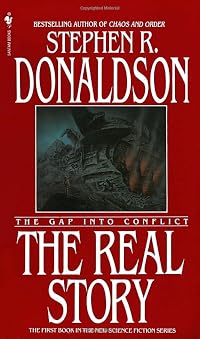
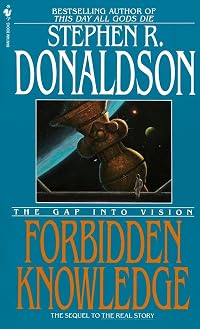
Stephen Donaldson, 1947 - Novelist Stephen Donaldson was born on May 13, 1947 in Cleveland, Ohio to James R. Donaldson, a medical missionary, and Mary Ruth Reeder, a prosthetist. His father was an orthopedic surgeon that worked with lepers in India. He lived in India between the ages of three to sixteen and while listening to one of his father's show more lectures on leprosy, he conceived the legendary Thomas Covenant. Donaldson attended the College of Wooster, Ohio and graduated in 1968. Afterwards, he spent two years being a conscientious objector doing hospital work in Akron and then attended Kent University where he received an M.A. in English. Donaldson's publishing debut was with "Lord Foul's Bane" (1977), which was the first book in the fantasy trilogy entitled The Chronicles of Thomas Covenant, the Unbeliever. It was named best novel of the year by the British Fantasy Society and received the John W. Campbell Award for Best New Writer, in 1979. He followed with the sequel series The Second Chronicles of Thomas Covenant, also set in The Land, starting with "Daughter of Regals," and then the Mordant's Need series with "The Mirror of Her Dreams" and "A Man Rides Through." Donaldson is also the author of the Gap Into series of science fiction adventure that began with "The Real Story" and followed with "Forbidden Knowledge," "A Dark and Hungry God Arises," and "Chaos and Order." In addition to the awards he received for his first novel/series, Donaldson has also received the Balrog Fantasy Award for Best Novel for "The Wounded Land" in 1981 and for "The One Tree" in 1983, the Saturn Award for Best Fantasy Novel for "The One Tree" in 1983, the Balrog Fantasy Award for Best Collection for "Daughter of Regals and Other Tales" in 1985, and the Science Fiction Book Club Award for Best Book of the Year for "The Mirror of Her Dreams" in 1988 and "A Man Rides Through" in 1989. He also received The College of Wooster Distinguished Alumni Award in 1989, the WIN/WIN Popular Fiction Readers Choice Award for Favorite Fantasy Author in 1991, the Atlanta Fantasy Fair Award for Outstanding Achievement in 1992 and the President's Award, The International Association for the Fantastic in the Arts in 1997. (Bowker Author Biography) show less
Some Editions
Awards and Honors
Awards
Notable Lists
Series


Work Relationships
Common Knowledge
- Canonical title
- The Runes of the Earth
- Original title
- The Runes of the Earth
- Original publication date
- 2004-10-14
- People/Characters
- Linden Avery; Roger Covenant; Stave; Anele
- Important places
- The Land
- Dedication
- to Jennifer Dunstan - the princess of my heart.
- First words
- "No, Mr. Covenant," she repeated for the third time.
- Last words
- (Click to show. Warning: May contain spoilers.)The other stranger was unmistakably Thomas Covenant.
- Original language
- English
- Canonical DDC/MDS
- 813.087661
Classifications
- Genres
- Fantasy, Fiction and Literature
- DDC/MDS
- 813.087661 — Literature & rhetoric American literature in English American fiction in English By type Genre fiction Adventure fiction Speculative fiction Fantasy High fantasy
- LCC
- PS3554 .O469 .R84 — Language and Literature American literature American literature Individual authors 1961-
- BISAC
Statistics
- Members
- 2,390
- Popularity
- 8,238
- Reviews
- 28
- Rating
- (3.62)
- Languages
- Dutch, English, German
- Media
- Paper, Audiobook, Ebook
- ISBNs
- 20
- UPCs
- 2
- ASINs
- 17