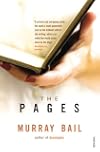
The Pages
by Murray Bail
On This Page
Description
"Erica Hazelhurst, a philosopher from Sydney, has been given a project by her university to work on the papers of the late Wesley Antill (The Pages). She travels across the Blue Mountains to his country property with her psychologist friend Sophie. They stay with Wesley's sister and brother and learn of Wesley's life as he travelled in Europe looking for philosophical insight. It looks at the relationship between ideas and experience, philosophy and psychology, and city and country show more life."--Provided by publisher. show lessTags
Recommendations




















Member Reviews
On a family sheep station in western New South Wales, a brother and sister work the property while their reclusive brother, Wesley Antill, spends years toiling away in one of the sheds, writing his philosophy.
Now he has died and Erica, a philosopher, is sent from Sydney to evaluate his life's work. Accompanying her is Sophie, a psychoanalyst who needs distracting from a string of failed relationships.
The pages Wesley wrote lie untouched in the shed, just as he left them. What they reveal is only one aspect of the lives sketched here with Bail's delicate touch.
Eesentially, this is a story of opposing journeys: Wesley's withdrawal into an increasingly dense torrent of words; and Erica's escape from the predictabilty of academia to the show more world of nature, albeit a sparse and barren nature. This book is as hard and sparse as that landscape, and as harshly beautiful as only the Australian bush can be. show less
Now he has died and Erica, a philosopher, is sent from Sydney to evaluate his life's work. Accompanying her is Sophie, a psychoanalyst who needs distracting from a string of failed relationships.
The pages Wesley wrote lie untouched in the shed, just as he left them. What they reveal is only one aspect of the lives sketched here with Bail's delicate touch.
Eesentially, this is a story of opposing journeys: Wesley's withdrawal into an increasingly dense torrent of words; and Erica's escape from the predictabilty of academia to the show more world of nature, albeit a sparse and barren nature. This book is as hard and sparse as that landscape, and as harshly beautiful as only the Australian bush can be. show less
Another goodreads review complains that this book isn't ambitious enough, despite being about the entire history of Western philosophy. That is a gross misreading: the book is about the very important differences between the third person perspective, here understood as essentially philosophical and analytical, and the first person perspective, assumed to be revealed by psychoanalysis.
Other goodreads reviews complaint that the book isn't like Eucalyptus, which just makes me not want to read Eucalyptus, because it makes Eucalyptus sound like an unbelievably dull paeon to the landscape and the Great Australian Soul and so on.
More positively: two women, one a professional philosopher, the other a psychoanalyst, go to a farm to work out if show more a squatter's amateur philosophical work is worth publishing or not. Then we get the history of the philosopher who, of course, goes to Europe and comes back a changed man. But there's a problem trying to devote yourself to the life of the mind when you're a farmer, and even more so when you're Australian: Bail's version of Henry James' American-in-or-and-Europe business, which he really does very well.
So, is (this) philosophy worth publishing? The reader gets to decide, thanks to a few pages of aphorisms at the end. They're of variable quality, and presumably have their origins in Bail's 'Notebooks.' I did like 'The disturbance of mind is the mind.'
And who understands (this) man better, the philosopher or the analyst? I can't help feeling that we're meant to see the importance of both perspectives--the third-person and the first--but the philosopher, quite rightly, is more convincing.
Downsides: I'm pretty sure this is not an accurate depiction of heterosexual women's feelings about relationships and men, and the romance sub-plots are much less interesting than the philosophical reflections on emotions. show less
Other goodreads reviews complaint that the book isn't like Eucalyptus, which just makes me not want to read Eucalyptus, because it makes Eucalyptus sound like an unbelievably dull paeon to the landscape and the Great Australian Soul and so on.
More positively: two women, one a professional philosopher, the other a psychoanalyst, go to a farm to work out if show more a squatter's amateur philosophical work is worth publishing or not. Then we get the history of the philosopher who, of course, goes to Europe and comes back a changed man. But there's a problem trying to devote yourself to the life of the mind when you're a farmer, and even more so when you're Australian: Bail's version of Henry James' American-in-or-and-Europe business, which he really does very well.
So, is (this) philosophy worth publishing? The reader gets to decide, thanks to a few pages of aphorisms at the end. They're of variable quality, and presumably have their origins in Bail's 'Notebooks.' I did like 'The disturbance of mind is the mind.'
And who understands (this) man better, the philosopher or the analyst? I can't help feeling that we're meant to see the importance of both perspectives--the third-person and the first--but the philosopher, quite rightly, is more convincing.
Downsides: I'm pretty sure this is not an accurate depiction of heterosexual women's feelings about relationships and men, and the romance sub-plots are much less interesting than the philosophical reflections on emotions. show less
An increasingly prominent Australian writer. The problem with this book is a problem it shares with many others: it just isn't ambitious enough. It's about a psychoanalyst and a philosopher, both women, who go into the Centre to look at the papers of a self-styled philosopher who had lived on a sheep ranch. The theme has potential as a dialogue among women friends (this is the best-developed part), as a meditation on nation and landscape, as a philosophic contrast between psychoanalysis and literature, and as a novel of letters. It just doesn't do very much with any of those themes. When the dead philosopher's papers are finally sampled at the end of the book, they reveal Bail's idea of philosophy -- at least in this instance -- as a show more mixture of Wittgenstein, popular psychobiography, and undigested Nietzsche. I wouldn't trust Bail to write about philosophy, or the idea of philosophy, and I have no evidence he knows anything about psychotherapy. The book is strong when it's about imagining the inner lives of the two women, but there is no much more that could have been done here. The moral, for me, is this: if you're going to write a novel of ideas, put in the ideas. If the novel has big ideas in it -- here, the entire history of Western philosophy -- then the prose should work to include those ideas in their full difficulty. The aspiring philosopher in the novel who has died has left sheets of aphorisms hanging on a clothesline. What if those had been real aphorisms? What if they had been Ludwig Hohl's sheets? Elias Canetti's? Wittgenstein's? show less
I plucked this book almost at random from the library shelves after finding the book I was seeking to be unavailable, and not wanting to go away empty handed. It turned out to be excellent reading. Quite different to most books I read, but not too modern! (Well, the author is quite old now.) I found the characters and their relationships interesting, and I think Bail makes some worthwhile comments on the nature of people and societies. I only know Australians, but it seems to me that the author is a rather astute observer of Australian character, and has given me some fresh insights into myself and my own behaviour - if not the people I relate to.
Like Ball's last book, Eucalyptus, The Pages is rather an ephemeral read. Nothing much seems to happen on the surface - but if you concentrate on the passing landscape and what is not said as opposed to what is, you start to get a feel for this novel. I usually avoid this type of novel, writing them off as too much hard work, but in the hands of Bail it is worth the effort. He has the ability to conjure an image that will stop you in your tracks and stay with you for some time (just wait for the analogy between an old lady's neck and the roots of a Moreton Bay Fig tree!). My biggest crticism of this novel is that I found some of the dialogue unbelievable, promting me to ask myself "... would someone really say that in that situation?" show more Maybe they would - but I was not completely convinced all the time. Also, it is a beautifully made book - definitely one to buy in hardback. show less
Wesley Antill was a philosopher. He lived with his brother and sister on a sheep farm in Australia and produced pages upon pages of thoughts. But when he died, his brother and sister asked Erica Hazlehurst to assess his work. She brings her friend Sophie (a psychologist) with her for the trip from Sydney. Together, they get to know Wesley's brother and sister as Erica attempt to understand Wesley through his writings.
Bail weaves together numerous threads in this book - Wesley's life before he returned to the farm to write, Erica's uncovering of Wesley's thoughts, the contradictions of philosophy and psychology. Bail's style is spare. Especially when telling Wesley's story, his writing, like Wesley himself, is a bit obscure and hard to show more follow. I had a bit of trouble getting into the story and identifying with some of the characters, but in places, Bail's writing conveys the nature of the characters beautifully. show less
Bail weaves together numerous threads in this book - Wesley's life before he returned to the farm to write, Erica's uncovering of Wesley's thoughts, the contradictions of philosophy and psychology. Bail's style is spare. Especially when telling Wesley's story, his writing, like Wesley himself, is a bit obscure and hard to show more follow. I had a bit of trouble getting into the story and identifying with some of the characters, but in places, Bail's writing conveys the nature of the characters beautifully. show less
A University professor is sent to a remote sheep ranch to examine the papers left by a now deceased man to see if they can be published. Erica takes her friend Sophie along for the trip and they meet the brother and sister of Wesley Antill, a philosopher. The narrative is sparse and pits the emotions against reason, almost like a "Sense and Sensibility. " One of those books that grows on you after reading.
Members
- Recently Added By
Author Information

16+ Works 2,008 Members
Murray Bail has won numerous prizes for his novels -- Eucalyptus, Homesickness, and Holden's Performance -- including the Commonwealth Writers Prize for Eucalyptus. He lives in Sydney
Awards and Honors
Common Knowledge
- People/Characters
- Wesley Antill; Erica Hazelhurst; Sophie; Lindsey Antill; Roger Antill
- Important places
- Australia; Country, Australia; New South Wales, Australia; Sydney, New South Wales, Australia
- First words
- At dawn - what a word: the beginning of the world all over again - the two women set out from Sydney in a small car, as other people were slowly going about their tasks, or at least beginning to stir, producing a series of ov... (show all)erlapping movements and stoppages, awakenings and false dawns, framed by the glass of the car.
- Quotations
- ‘In broad daylight at any given moment there was always somewhere a head-on collision taking place, especially on the road to Cooma. There were too many solid trees in Australia. Far better to lean forward, which she did,... (show all) allowing him to glimpse the softness of her neglected breasts’ (p49)
- Last words
- (Click to show. Warning: May contain spoilers.)We are philososphers; we cannot help being.
- Blurbers
- Miller, Alex; Lee, Hermione
Classifications
Statistics
- Members
- 173
- Popularity
- 188,677
- Reviews
- 10
- Rating
- (3.18)
- Languages
- Dutch, English, French
- Media
- Paper, Ebook
- ISBNs
- 13
- ASINs
- 3