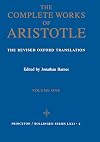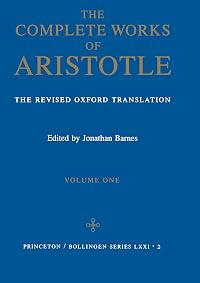
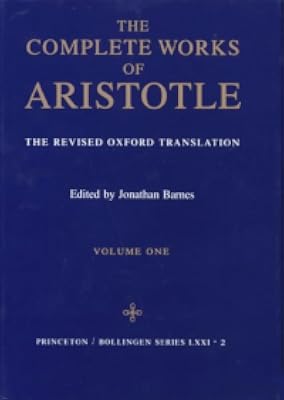
Complete Works of Aristotle, Volume One (Bollingen)
by Aristotle
On This Page
Description
The Oxford Translation of Aristotle was originally published in 12 volumes between 1912 and 1954. It is universally recognized as the standard English version of Aristotle. This revised edition contains the substance of the original Translation, slightly emended in light of recent scholarship; three of the original versions have been replaced by new translations; and a new and enlarged selection of Fragments has been added. The aim of the translation remains the same: to make the surviving show more works of Aristotle readily accessible to English speaking readers. show lessTags
Recommendations
















Member Recommendations
mcaution Surpassing Aristotle, Rand provides the solution to the problem of universals as well as laying the foundation for the proper methods of validating all other knowledge.
02
Voracious_Reader Good companion piece to Aristotle's original works. Love Adler's mind (and Aristotle's).
Member Reviews
Although the treatises on Sleep intrigued me prior to reading this, I really read this collection more for the sake of thoroughness than anything else. I have to say that it is probably the least interesting of the Aristotelian collections--and given Aristotle's pedantic tendencies, that's really saying something. I skipped the treatise on Memory and Reminiscence here because I had already read it previously in a book coupled with his De Anima.
I am not going to grade the book on it's obsolete knowledge; that would be anachronistically unfair; given the march of 2300 years, one has to accept that science (then called natural or physical philosophy) was in it's infancy at that time. It is interesting though that some of the philosophers show more that Aristotle maligns were actually closer to the truth than he was. It does indicate that someone's logic can seem totally valid and still be totally wrong.
If one keeps in mind Aristotle's general approach to nature and philosophical physics, one can anticipate most of the basic arguments of this book without reading it. The four elements (i.e. earth, water, air, fire) and how they influence environment and bodies (e.g. in moistness/dryness and heat/cold) figure into most of Aristotle's positions. Temperature seems to be the main deciding factor for life according to Aristotle. If an animal is too hot it dies from exhaustion, if too cold, from depletion.
I was disappointed with the treatises on Sleep. I thought at least the one on Divination In Dreams would be somewhat novel and metaphysical, but it wasn't. I shouldn't have been surprised given Aristotle's very mundane explanations for all phenomena.
I give this book probably about two-and-a-half to three stars. Honestly, one can easily skip this collection if one wants to concentrate on Aristotle's essential philosophy. There's not much here that isn't discussed in other works--and probably in more interesting ways in those. The treatise On Memory and Reminiscence is probably the best of what is here and that can be obtained in a book coupled with his De Anima and that is the one I would recommend rather than this. show less
I am not going to grade the book on it's obsolete knowledge; that would be anachronistically unfair; given the march of 2300 years, one has to accept that science (then called natural or physical philosophy) was in it's infancy at that time. It is interesting though that some of the philosophers show more that Aristotle maligns were actually closer to the truth than he was. It does indicate that someone's logic can seem totally valid and still be totally wrong.
If one keeps in mind Aristotle's general approach to nature and philosophical physics, one can anticipate most of the basic arguments of this book without reading it. The four elements (i.e. earth, water, air, fire) and how they influence environment and bodies (e.g. in moistness/dryness and heat/cold) figure into most of Aristotle's positions. Temperature seems to be the main deciding factor for life according to Aristotle. If an animal is too hot it dies from exhaustion, if too cold, from depletion.
I was disappointed with the treatises on Sleep. I thought at least the one on Divination In Dreams would be somewhat novel and metaphysical, but it wasn't. I shouldn't have been surprised given Aristotle's very mundane explanations for all phenomena.
I give this book probably about two-and-a-half to three stars. Honestly, one can easily skip this collection if one wants to concentrate on Aristotle's essential philosophy. There's not much here that isn't discussed in other works--and probably in more interesting ways in those. The treatise On Memory and Reminiscence is probably the best of what is here and that can be obtained in a book coupled with his De Anima and that is the one I would recommend rather than this. show less
Prior analytics was the worse thing I ever read. On the other hand for a guy so smart he sure got a lot of stuff wrong but this reading has helped me understand the basis for things. Hoping volume two is a bit more relevant and intriguing.
Ratings
Members
- Recently Added By
Lists

Shaykh Hamza's Book Recommendations
439 works; 3 members

The ESOTERICA Library by Dr. Justin Sledge (Classical Philosophy)
4 works; 1 member
Author Information

2,089+ Works 57,374 Members
All Editions
Series
Belongs to Publisher Series
Bollingen Series (71.02.1)
Work Relationships
Contains
Common Knowledge
- Canonical title
- Complete Works of Aristotle, Volume One (Bollingen) (Bollingen)
- Original publication date
- 1984
Classifications
Statistics
- Members
- 773
- Popularity
- 36,164
- Reviews
- 3
- Rating
- (4.34)
- Languages
- English
- Media
- Paper, Ebook
- ISBNs
- 9
- ASINs
- 5