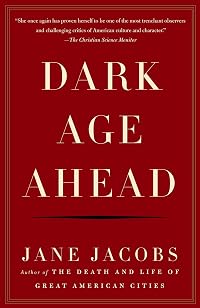
Dark Age Ahead
by Jane Jacobs
On This Page
Description
Publisher's description: Visionary thinker Jane Jacobs uses her authoritative work on urban life and economies to show us how we can protect and strengthen our culture and communities. In Dark Age Ahead, Jane Jacobs identifies five pillars of our culture that we depend on but which are in serious decline: community and family; higher education; the effective practice of science; taxation and government; and self-policing by learned professions. The decay of these pillars, Jacobs contends, is show more behind such ills as environmental crisis, racism and the growing gulf between rich and poor; their continued degradation could lead us into a new Dark Age, a period of cultural collapse in which all that keeps a society alive and vibrant is forgotten. But this is a hopeful book as well as a warning. Jacobs draws on her vast frame of reference -- from fifteenth-century Chinese shipbuilding to zoning regulations in Brampton, Ontario -- and in highly readable, invigorating prose offers proposals that could arrest the cycles of decay and turn them into beneficent ones. Wise, worldly, full of real-life examples and accessible concepts, this book is an essential read for perilous times. show lessTags
Recommendations









Member Recommendations
Member Reviews
The great Jane Jacobs' last book, Dark Age Ahead, will be familiar territory to her many devoted fans. Jacobs ruminates on the potential for it all winding down and falling apart in the West . This downer of a thesis may seem like an inevitable topic for someone in her late 80s, when Jacobs wrote this -- but her pessimism is not without merit and foundation. She identifies a series of structural problems in western societies that are eroding the foundations of our culture: pressure on families/communities; credentialism overwhelming higher education; the slackening pursuit of real science; the unwise levying and use of taxation; and the lack of policing in the professions.
Jacobs' thoughts often wander back to her familiar passions -- show more at times it seems as if proper levels of urban density and some nice clean electric streetcars would solve just about any crisis -- but there's plenty here that's cogent and provocative as well.
The weakness of the book is her reliance on trendy but not very trustworthy popular 'scholars' such as Jared Diamond and Karen Armstrong for much of her background on what makes societies come apart. I'd rather have heard more of Jacobs' own ideas.
These quibbles aside, Dark Age Ahead is not a bad place to start if you want to get into Jacobs' work. Her blunt, inimitable style is on display; her maddeningly unplaceable political stance is maintained; and at under 200 pages (if you skip the discursive endnotes, which you most certainly can) it's a brief and accessible work, much more so than her bombshell signature book, The Death and Life of American Cities. show less
Jacobs' thoughts often wander back to her familiar passions -- show more at times it seems as if proper levels of urban density and some nice clean electric streetcars would solve just about any crisis -- but there's plenty here that's cogent and provocative as well.
The weakness of the book is her reliance on trendy but not very trustworthy popular 'scholars' such as Jared Diamond and Karen Armstrong for much of her background on what makes societies come apart. I'd rather have heard more of Jacobs' own ideas.
These quibbles aside, Dark Age Ahead is not a bad place to start if you want to get into Jacobs' work. Her blunt, inimitable style is on display; her maddeningly unplaceable political stance is maintained; and at under 200 pages (if you skip the discursive endnotes, which you most certainly can) it's a brief and accessible work, much more so than her bombshell signature book, The Death and Life of American Cities. show less
Due to my current borderline obsession with social collapse, I was intrigued when I saw this recommended on the Multnomah County Library's website. So I placed a hold and received a copy not long after and got to reading.
I liked it. Hence the three stars. I didn't quite love it. Not because of any lack of good information and ideas or a lack of quality writing, but more because I wanted it to be a little more riled up. A bit more emotional. It was very straightforward and even, which is perfectly commendable but doesn't get my blood flowing.
Jacobs basically claims that North America (the U.S. and Canada, that is) is teetering dangerously close on the brink of sliding into a Dark Age. She cites five major reasons why: the continuing show more degradation of community and family, our higher education system, misuse of science and technology, governmental representation that has become disconnected from local needs, and the failure of self-regulation of the learned professions.
I found all the points really intriguing, with quite a number of viewpoints offered that I hadn't before heard or considered. Her talk of the degradation of community and family was a great section, not focusing on ranting moralistic concerns so much as on the ever-worsening economic brutalities that households face while trying to support themselves, as well as the destruction of community (in its most holistic sense) brought about by those economic hardships as well as poor planning practices. For instance, she takes suburban design to task. Again, this is not in some kind of moralistic view in which she proclaims suburbs evil, but rather she simply points out the ways in which thought-processes behind their planning have been terribly misguided and destructive, often leading to neighborhoods that lack any real sense of community.
Her taking to task of most of the universities in North America was also quite compelling. It comes across as a somewhat more dispassionate version of [a:Wendell Berry|8567|Wendell Berry|http://photo.goodreads.com/authors/1209652700p2/8567.jpg]'s arguments in [b:Life Is a Miracle: An Essay Against Modern Superstition|76732|Life Is a Miracle An Essay Against Modern Superstition|Wendell Berry|http://photo.goodreads.com/books/1236228896s/76732.jpg|74220], although the substance of the arguments do have their differences, as well. Still, she quite convincingly argues that universities have become little more than credentialing agencies, rather than institutions that work to create fully formed human beings via comprehensive education (that fosters and creates the ability of critical and independent thought) and mentoring.
Those are just a few of the intriguing arguments Jacobs makes in the book, and if they sound interesting, I certainly would recommend reading it. I perhaps prefer this sort of information to come to me via a more agitated voice--someone railing, though ideally not to the degree of incoherence. That Dark Age Ahead doesn't come in that exact voice is no condemnation of it as a fine bit of writing. Hell, for some, it's probably a much more palatable approach to a topic that can easily become very emotionally charged. For me, I would have preferred a bit more Berry-type anger.
But then, I have Berry for that. Jacobs fulfills her own niche quite nicely. show less
I liked it. Hence the three stars. I didn't quite love it. Not because of any lack of good information and ideas or a lack of quality writing, but more because I wanted it to be a little more riled up. A bit more emotional. It was very straightforward and even, which is perfectly commendable but doesn't get my blood flowing.
Jacobs basically claims that North America (the U.S. and Canada, that is) is teetering dangerously close on the brink of sliding into a Dark Age. She cites five major reasons why: the continuing show more degradation of community and family, our higher education system, misuse of science and technology, governmental representation that has become disconnected from local needs, and the failure of self-regulation of the learned professions.
I found all the points really intriguing, with quite a number of viewpoints offered that I hadn't before heard or considered. Her talk of the degradation of community and family was a great section, not focusing on ranting moralistic concerns so much as on the ever-worsening economic brutalities that households face while trying to support themselves, as well as the destruction of community (in its most holistic sense) brought about by those economic hardships as well as poor planning practices. For instance, she takes suburban design to task. Again, this is not in some kind of moralistic view in which she proclaims suburbs evil, but rather she simply points out the ways in which thought-processes behind their planning have been terribly misguided and destructive, often leading to neighborhoods that lack any real sense of community.
Her taking to task of most of the universities in North America was also quite compelling. It comes across as a somewhat more dispassionate version of [a:Wendell Berry|8567|Wendell Berry|http://photo.goodreads.com/authors/1209652700p2/8567.jpg]'s arguments in [b:Life Is a Miracle: An Essay Against Modern Superstition|76732|Life Is a Miracle An Essay Against Modern Superstition|Wendell Berry|http://photo.goodreads.com/books/1236228896s/76732.jpg|74220], although the substance of the arguments do have their differences, as well. Still, she quite convincingly argues that universities have become little more than credentialing agencies, rather than institutions that work to create fully formed human beings via comprehensive education (that fosters and creates the ability of critical and independent thought) and mentoring.
Those are just a few of the intriguing arguments Jacobs makes in the book, and if they sound interesting, I certainly would recommend reading it. I perhaps prefer this sort of information to come to me via a more agitated voice--someone railing, though ideally not to the degree of incoherence. That Dark Age Ahead doesn't come in that exact voice is no condemnation of it as a fine bit of writing. Hell, for some, it's probably a much more palatable approach to a topic that can easily become very emotionally charged. For me, I would have preferred a bit more Berry-type anger.
But then, I have Berry for that. Jacobs fulfills her own niche quite nicely. show less
This is the last book Jane Jacobs wrote. It was written in 2003 and she was born in 1916 so she was 87 at the time. How wonderful to have the mental acuity and wide-ranging curiosity at that age to bring together such divergent fields as city planning, economics, history, politics and education.
Jacobs takes us through a discussion of various Dark Ages and how they resulted in a cultural amnesia into a dissection of five pillars that show signs of a coming Dark Age and finally into a prescription for forestalling this. The five pillars are:
1. Community and family
2. Higher education
3. Science and technology
4. Governmental representation
5. Self-governing professions
Although I can’t speak authoritatively about any of these pillars I do show more know a little bit more about science and technology than the others. Jacobs describes the way the scientific process works better than anyone else I have ever read. At page 69 she says “In sum, the scientific state of mind works along two slightly different avenues, one abstract, the other feeling its way more concretely and pragmatically. Both approaches demand integrity, awareness of evidence and respect for it, and attention to new questions that arise as immediate practical problems to be grappled with, or else as more abstract and postponable. Both avenues are valid and effective. They work together so well that they frequently shift back and forth in the course of an investigation or they overlap.” She then goes on to say “If a body of enquiry becomes disconnected from the scientific state of mind, that unfortunate segment of knowledge is no longer scientific.” She cites three examples of supposed scientific thinking that became disconnected from the scientific state of mind. The fact that she saw this as an issue in 2003, long before the Harper Government started to wage its war on science strikes me as remarkably prescient. The federal government has muzzled its own scientists and attacked non-governmental science groups with everything from audits to lies.
If Jacobs was as correct about her other arguments as she was about science and technology then we are probably further down the road to a Dark Age than we were a decade ago. Let us hope we are not too late to unwind the vicious spiral (the title of Chapter Seven). show less
Jacobs takes us through a discussion of various Dark Ages and how they resulted in a cultural amnesia into a dissection of five pillars that show signs of a coming Dark Age and finally into a prescription for forestalling this. The five pillars are:
1. Community and family
2. Higher education
3. Science and technology
4. Governmental representation
5. Self-governing professions
Although I can’t speak authoritatively about any of these pillars I do show more know a little bit more about science and technology than the others. Jacobs describes the way the scientific process works better than anyone else I have ever read. At page 69 she says “In sum, the scientific state of mind works along two slightly different avenues, one abstract, the other feeling its way more concretely and pragmatically. Both approaches demand integrity, awareness of evidence and respect for it, and attention to new questions that arise as immediate practical problems to be grappled with, or else as more abstract and postponable. Both avenues are valid and effective. They work together so well that they frequently shift back and forth in the course of an investigation or they overlap.” She then goes on to say “If a body of enquiry becomes disconnected from the scientific state of mind, that unfortunate segment of knowledge is no longer scientific.” She cites three examples of supposed scientific thinking that became disconnected from the scientific state of mind. The fact that she saw this as an issue in 2003, long before the Harper Government started to wage its war on science strikes me as remarkably prescient. The federal government has muzzled its own scientists and attacked non-governmental science groups with everything from audits to lies.
If Jacobs was as correct about her other arguments as she was about science and technology then we are probably further down the road to a Dark Age than we were a decade ago. Let us hope we are not too late to unwind the vicious spiral (the title of Chapter Seven). show less
Dark Age Ahead is not an impressive performance. Alice Sparbert Alexiou noted that Jacobs's last two books "received mixed reviews" and "do not in any way measure up to her great urban trilogy" (Jane Jacobs: Urban Visionary [Rutgers UP, 2006], 198). Dark Age Ahead is little more than a jeremiad filtering her longtime preoccupations through a sort of world history lite. The author, 87 at the time of publication, relied on popular works, articles from the press, observations, experiences, memories, and her own imagination—but not research. Her insights are shallow ("Life is full of surprises" [25]; "survivors [of a heat wave] differed [from those who died] in having successfully kept cool" [82]; "The enemy of truth is untruth" [70]). show more Chapters are rambling. The text reads like table talk. The author oversimplifies. Her terms of analysis do not bear close inspection. She calls a community "a complex organism" (34), but this is a logical fallacy known as organicism. She personifies societies ("a society must be self-aware" [176]), and implies that a culture's progress can be rated or measured ("culture's trajectory pivoted upward" [102]). Jacobs is eager to pronounce cultures "winners" or "losers," as though history is some kind of Olympics. She overgeneralizes (the "purpose of life" [55-58]; the "scientific state of mind" [66-68]). She insists on representing abstractions spatially ("Interlocked problems, intractably spiraling downward and joining with other problems into amalgamated declines" [139]; "watch the vicious spirals go into action!" [160]). This book is a sad end to a distinguished oeuvre. show less
Due to my current borderline obsession with social collapse, I was intrigued when I saw this recommended on the Multnomah County Library's website. So I placed a hold and received a copy not long after and got to reading.I liked it. Hence the three stars. I didn't quite love it. Not because of any lack of good information and ideas or a lack of quality writing, but more because I wanted it to be a little more riled up. A bit more emotional. It was very straightforward and even, which is perfectly commendable but doesn't get my blood flowing.Jacobs basically claims that North America (the U.S. and Canada, that is) is teetering dangerously close on the brink of sliding into a Dark Age. She cites five major reasons why: the continuing show more degradation of community and family, our higher education system, misuse of science and technology, governmental representation that has become disconnected from local needs, and the failure of self-regulation of the learned professions.I found all the points really intriguing, with quite a number of viewpoints offered that I hadn't before heard or considered. Her talk of the degradation of community and family was a great section, not focusing on ranting moralistic concerns so much as on the ever-worsening economic brutalities that households face while trying to support themselves, as well as the destruction of community (in its most holistic sense) brought about by those economic hardships as well as poor planning practices. For instance, she takes suburban design to task. Again, this is not in some kind of moralistic view in which she proclaims suburbs evil, but rather she simply points out the ways in which thought-processes behind their planning have been terribly misguided and destructive, often leading to neighborhoods that lack any real sense of community.Her taking to task of most of the universities in North America was also quite compelling. It comes across as a somewhat more dispassionate version of [a:Wendell Berry|8567|Wendell Berry|http://photo.goodreads.com/authors/1209652700p2/8567.jpg]'s arguments in [b:Life Is a Miracle: An Essay Against Modern Superstition|76732|Life Is a Miracle An Essay Against Modern Superstition|Wendell Berry|http://photo.goodreads.com/books/1236228896s/76732.jpg|74220], although the substance of the arguments do have their differences, as well. Still, she quite convincingly argues that universities have become little more than credentialing agencies, rather than institutions that work to create fully formed human beings via comprehensive education (that fosters and creates the ability of critical and independent thought) and mentoring.Those are just a few of the intriguing arguments Jacobs makes in the book, and if they sound interesting, I certainly would recommend reading it. I perhaps prefer this sort of information to come to me via a more agitated voice--someone railing, though ideally not to the degree of incoherence. That Dark Age Ahead doesn't come in that exact voice is no condemnation of it as a fine bit of writing. Hell, for some, it's probably a much more palatable approach to a topic that can easily become very emotionally charged. For me, I would have preferred a bit more Berry-type anger.But then, I have Berry for that. Jacobs fulfills her own niche quite nicely. show less
Does Jane Jacobs really think that we are facing a breakdown in society like unto that described in her first chapter? People starving on the highways, a breakdown in social cohesion, dogs and cats living together, mass hysteria? It is hard to tell from the rest of her book. Ultimately, it seems the coming "dark age" described by Jacobs is in reality more of a "period of rolling blackouts."
She identifies five "pillars of society" that she sees as showing signs of cultural decay, but fails to adequately explain why the failure of those five pillars leads to the Dark Ages, or define those five clearly, or present more than anecdotal support for her views of their decay. If she truly sees a breakdown in society profound enough to be called show more a "Dark Age," she fails to explain the nature of the threat with any clarity (unless poor traffic management is the hitherto unknown Fifth Horseman of the Apocalypse). Jacobs further fails, except in very limited fashion, to even address contrary views of society's progression.
Ultimately, this is a longish essay masquerading as a profound book, a tract instead of a treatise. It is sloppily organized, poorly expounded, and the supporting notes are underwhelming. Yet I would not have picked up this book if I were not concerned that there is a chance we are on the brink of a collapse, or at least a great change in Western Civilization. If my own fears are any indicator, there is a serious study to be made of the decay of our society, and the potential dangers we face. If this book was supposed to be taken as a serious review of this possibility, it should have been better devised and its arguments better supported. As it is, I am oddly comforted by this book's failure to convince me. show less
She identifies five "pillars of society" that she sees as showing signs of cultural decay, but fails to adequately explain why the failure of those five pillars leads to the Dark Ages, or define those five clearly, or present more than anecdotal support for her views of their decay. If she truly sees a breakdown in society profound enough to be called show more a "Dark Age," she fails to explain the nature of the threat with any clarity (unless poor traffic management is the hitherto unknown Fifth Horseman of the Apocalypse). Jacobs further fails, except in very limited fashion, to even address contrary views of society's progression.
Ultimately, this is a longish essay masquerading as a profound book, a tract instead of a treatise. It is sloppily organized, poorly expounded, and the supporting notes are underwhelming. Yet I would not have picked up this book if I were not concerned that there is a chance we are on the brink of a collapse, or at least a great change in Western Civilization. If my own fears are any indicator, there is a serious study to be made of the decay of our society, and the potential dangers we face. If this book was supposed to be taken as a serious review of this possibility, it should have been better devised and its arguments better supported. As it is, I am oddly comforted by this book's failure to convince me. show less
I have only two things to add to the other reviews, in which most of what is written I agree with.
First, is that this work seemed horribly out of focus. Some of the anecdotes were quite good, but the failure to create any sort of coherent theme to the work rendered the entire book a sloppy mish-mash. As in, her discussion of the history of traffic engineering was quite interesting, yet she fails to tie what amounts to the actions of a priesthood into her larger thesis.
Second, she seems unwilling or unable to come to terms with the fact that the USA and Canada, as democracies, mean that the government at some level or other is going to reflect majority opinion. The chapter on taxes being one in particular where she goes through the show more oddest contortions to avoid discussing this. Not sure what that is all about. show less
First, is that this work seemed horribly out of focus. Some of the anecdotes were quite good, but the failure to create any sort of coherent theme to the work rendered the entire book a sloppy mish-mash. As in, her discussion of the history of traffic engineering was quite interesting, yet she fails to tie what amounts to the actions of a priesthood into her larger thesis.
Second, she seems unwilling or unable to come to terms with the fact that the USA and Canada, as democracies, mean that the government at some level or other is going to reflect majority opinion. The chapter on taxes being one in particular where she goes through the show more oddest contortions to avoid discussing this. Not sure what that is all about. show less
Members
- Recently Added By
Published Reviews
Released in 2004 when she was 88 years old, Dark Age Ahead is hardly talked about among urbanists and fans of Jacobs’ earlier works. In fact, it was widely panned as the work of an aging crank whose best days and smartest commentary were behind her.
Back in 2004, before the economic crisis, urbanists were celebrating the resurgence of the city. We didn’t think much about the rise of show more conservative populists like Trump or the late Rob Ford. But there was Jane Jacobs, arguing “caution” against a new dark age lurking right around the corner.
In Dark Age, Jacobs focused on the erosion of the key pillars of stable, democratic societies—the decline of the family, the rise of consumerism and hyper-materialism, the transformation of education into credentialism, the undermining of scientific norms, and the take-over of politics by powerful special interest groups, among others. Persistent racism, worsening crime and violence, the growing gap between the rich and poor, and increasing divides between the winners and losers of globalization provided growing evidence of the decay of society, she argued.
At the very center of Jacobs’ work, I have come to believe, lies a great concern over the darker, more pessimistic forces of standardization, top-down planning, bureaucracy, and globalization that have acted against diversity and human progress. This was the same kind of concern evident in the work of great thinkers such as Karl Marx, Max Weber, and Joseph Schumpeter, who saw capitalism, bureaucracy, and large corporations as draining the humanity out of modern society.
She went on to worry about the eventual decline of the United States, noting that “the collapse will come about as a banal thing.” One can only imagine how unsurprised Jacobs would be by the evolution of America’s economy and society in the decade since her death—particularly the hyper-gentrification of great cities, the growing social and economic divides, the continuing erosion of scientific norms, burgeoning celebrity culture, and, most recently, the rise of Donald Trump—in many ways the symbol of it all. show less
Back in 2004, before the economic crisis, urbanists were celebrating the resurgence of the city. We didn’t think much about the rise of show more conservative populists like Trump or the late Rob Ford. But there was Jane Jacobs, arguing “caution” against a new dark age lurking right around the corner.
In Dark Age, Jacobs focused on the erosion of the key pillars of stable, democratic societies—the decline of the family, the rise of consumerism and hyper-materialism, the transformation of education into credentialism, the undermining of scientific norms, and the take-over of politics by powerful special interest groups, among others. Persistent racism, worsening crime and violence, the growing gap between the rich and poor, and increasing divides between the winners and losers of globalization provided growing evidence of the decay of society, she argued.
At the very center of Jacobs’ work, I have come to believe, lies a great concern over the darker, more pessimistic forces of standardization, top-down planning, bureaucracy, and globalization that have acted against diversity and human progress. This was the same kind of concern evident in the work of great thinkers such as Karl Marx, Max Weber, and Joseph Schumpeter, who saw capitalism, bureaucracy, and large corporations as draining the humanity out of modern society.
She went on to worry about the eventual decline of the United States, noting that “the collapse will come about as a banal thing.” One can only imagine how unsurprised Jacobs would be by the evolution of America’s economy and society in the decade since her death—particularly the hyper-gentrification of great cities, the growing social and economic divides, the continuing erosion of scientific norms, burgeoning celebrity culture, and, most recently, the rise of Donald Trump—in many ways the symbol of it all. show less
added by Lemeritus
In the course of ''Dark Age'' Ms. Jacobs raises a lot of interesting questions about the nature of dark ages: why certain cultures fall prey to assaults from outside or to rot from within; how a fortress mentality can lead to isolation and technological retreat; how memories of traditions, values and language can fade. She also discusses a lot of troubling recent developments, including show more corporate corruption, weakening academic standards, the prevalence of imagemaking and spin in politics and business, and the lack of affordable housing in cities like New York. But these discussions are cursory in the extreme, and they are never connected to one another, much less to some larger theory about a coming Dark Age. show less
added by Lemeritus
A lifetime of unwasted experience in a number of fields has gone into this short but pungent book, and to ignore its sober warnings would be foolish indeed.
added by Lemeritus
Lists

Recommend the 20 best books you've read in the last five years
2,168 works; 608 members

Non-Fiction Worth Reading
1,025 works; 264 members

Club Read's Recommended Nonfiction Written by Women
618 works; 30 members
Books That Changed Our Perspective
423 works; 168 members
Author Information

16+ Works 7,953 Members
Jane Jacobs lives in Toronto. (Publisher Provided) Author and community activist Jane Jacobs was born in Scranton, Pennsylvania on May 4, 1916. She spent two years at Columbia University in the School of General Studies. She was interrogated by the U.S. government over her loyality to the country on March 25, 1952 and was arrested during a show more demonstration against the Vietnam War on April 10, 1968. She also helped defeat a plan, proposed by the New York City park commissioner Robert Moses, to build an expressway through Washington Square in the early 1960s. She moved to Toronto in 1969 partially because of her objection to the Vietnam War. She became a Canadian citizen in 1974. Her most influential book, The Death and Life of Great American Cities, is a critique of 1950's urban renewal policies which, according to her, destroyed communities and created isolated, unnatural urban spaces. She received numerous honors including a lifetime achievement award from the National Building Foundation in 2000 and was appointed to the Order of Canada in 1996. In 1997, the Jane Jacobs prize was created by the City of Toronto at the Jane Jacobs: Ideas That Matter conference. She died on April 25, 2006 at the age of 89. (Bowker Author Biography) show less
Awards and Honors
Awards
Distinctions
Notable Lists
Common Knowledge
- Original publication date
- 2004-05-04
- People/Characters
- Karen Armstrong; Jared Diamond; Robert Moses
- Important places
- New York, New York, USA; Toronto, Ontario, Canada
- Dedication
- To
Sid Adilman and
Martha Shuttleworth,
Merry Leading-Edge Explorers - First words
- This is both a gloomy and a hopeful book.
- Quotations
- . . . the death or the stagnated moribundity of formerly unassailable and vigorous cultures is caused not by assault from outside but by assault from within, that is, by internal rot in the form of fatal cultural turnings, no... (show all)t recognized as wrong turnings while they occur or soon enough afterward to be correctable.
In the early fifteenth century, a political power struggle was waged between two factions of the Chinese imperial bureaucracy. The losing faction had championed treasure fleets and taken an interest in their leadership and w... (show all)ell-being. The winning faction asserted its success by abruptly calling a halt to voyages, forbidding further ocean voyaging, and dismantling shipyards.
. . . the vicious spiral of interlocked housing shortages for the poor, loss of inclusive communities, and excessive car dependency [in the contemporary USA] had its origins in fifteen years of depression and war.
All three assumptions [undesirablility of high population and building densities, and of mingled workplace and residential environments] are rejections of cities and city life, devised by utopians and reformers who tried to o... (show all)vercome public health problems and "disorder" with these abstract, dysfunctional solutions.
[forced artifical contrivances] probably wouldn't work any better than the policies of rent control, redlining, and [slum] clearances, the contrived social engineering that yielded homelessness and helped erase communities.
A paradigm tends to be so greatly cherished that, as new knowledge or evidence turns up that contradicts it or calls it into question, the paradigm is embroidered with qualifications and exceptions, along with labored pseudo-... (show all)explanations - anything, no matter how intellectually disreputable or craven, to avoid losing the paradigm.
. . . the crashing of the Berlin Wall finally was required as an exclamation point, after unheeded evidence of many decades reported that Marxism was untruthful as an economic theory.
. . . the severity of the Japanese bubble's collapse was probably owing to Japanese banks' protracted indulgence of bad business debts based on inflated speculative assets that had lost value.
Since [a share of income-tax yields] would go to municipalities as of right, without strings, the so-called senior governments could cease trying to micromanage and to standardize municipal policies and governance. Standardi... (show all)zation is the parent of stagnation.
Legions of hired liars labor to disconnect reality from all manner of images - images of personalities, of legislation, of corporations, of places, and of activities.
Just to keep itself going, life makes demands on energy, supplied from inside and outside a living being, that are voracious compared with the undemanding thriftiness of death and decay.
Beneficent spirals, operating by benign feedback, mean that everything needful is not required at once: each individual improvement is beneficial for the whole.
Most of the essayists value agrarianism as a religion, with religious values, and denigrate industrialization as godless, without values. - Last words
- (Click to show. Warning: May contain spoilers.)The many indispensable minutiae for expressing and safeguarding that core were added into the culture over centuries; as long as they are not lost to practice and memory, the possibility remains that they can be augmented for centuries to come.
- Publisher's editor
- Ebershoff, David; Collins, Anne
- Canonical DDC/MDS
- 901
- Canonical LCC
- CB19.J33
Classifications
Statistics
- Members
- 872
- Popularity
- 31,308
- Reviews
- 17
- Rating
- (3.40)
- Languages
- English, French
- Media
- Paper, Audiobook, Ebook
- ISBNs
- 10
- ASINs
- 3