On This Page
Description
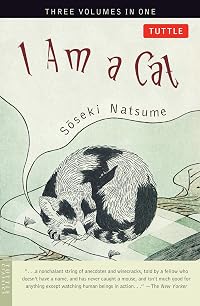
Written over the course of 1904-1906, Soseki Natsume's comic masterpiece, I Am a Cat, satirizes the foolishness of upper-middle-class Japanese society during the Meiji era. With acerbic wit and sardonic perspective, it follows the whimsical adventures of a world-weary stray kitten who comments on the follies and foibles of the people around him. A classic of Japanese literature, I Am a Cat is one of Soseki's best-known novels. Considered by many as the greatest writer in modern Japanese show more history, Soseki's I Am a Cat is a classic novel sure to be enjoyed for years to come. show lessTags
Recommendations

Member Recommendations
Member Reviews
Mr Sneaze, a schoolteacher, and his regular companions, Waverhouse, a bon vivant, Coldmoon, a graduate student, and Singleman, a Zen monk, along with others tease each other and gripe about their condition whilst making seemingly profound statements. Thank heavens that an unnamed cat sits silently (though not unjudgementally) observing, periodically sharing its thoughts with us on the utter inanity of humans, not excepting its master the irascible Mr Sneaze. Humour abounds.
This classic of early 20th century Japanese literature is both highly modern and steeped in tradition. It will perhaps prompt the reader to think of near-contemporary stylists such as Jerome K. Jerome or Oscar Wilde. But I think its sensibility is its own. And show more certainly a delight.
Recommended. show less
This classic of early 20th century Japanese literature is both highly modern and steeped in tradition. It will perhaps prompt the reader to think of near-contemporary stylists such as Jerome K. Jerome or Oscar Wilde. But I think its sensibility is its own. And show more certainly a delight.
Recommended. show less
«Soy un gato, aunque todavía no tengo nombre.» Así comienza la primera y más hilarante novela de Natsume Sōseki, una auténtica obra maestra de la literatura japonesa, que narra las aventuras de un desdeñoso felino que cohabita, de modo accidental, con un grupo de grotescos personajes, miembros todos ellos de la bienpensante clase media tokiota: el dispéptico profesor Kushami y su familia, teóricos dueños de la casa donde vive el gato; el mejor amigo del profesor, el charlatán e irritante Meitei; o el joven estudioso Kangetsu, que día sí, día no, intenta arreglárselas para conquistar a la hija de los vecinos. Escrita justo antes de su aclamada novela Botchan, Soy un gato es una sátira descarnada de la burguesía Meiji. show more Dotada de un ingenio a prueba de bombas y de un humor sardónico, recorre las peripecias de un voluble filósofo gatuno que no se cansa de hacer los comentarios más incisivos sobre la disparatada tropa de seres humanos con la que le ha tocado convivir. show less
Solo un gatto può essere così curioso, scanzonato, acuto e imprevedibile nello scandagliare e descrivere l'incoerenza, la boria e la saccenza umane.
Siamo nel giappone moderno, e il gatto si destreggia tra un padrone dispeptico e nevrotico, la sua famiglia scalcinata e gli amici, ciascuno dei quali rappresenta una variante della stessa perfetta balordaggine.
Ma alla fine il gatto è un gatto, e, come spesso succede ai gatti, sarà la stua stessa curiosità a perderlo, eppure, come il Budda, troverà l'illuminazione.
Siamo nel giappone moderno, e il gatto si destreggia tra un padrone dispeptico e nevrotico, la sua famiglia scalcinata e gli amici, ciascuno dei quali rappresenta una variante della stessa perfetta balordaggine.
Ma alla fine il gatto è un gatto, e, come spesso succede ai gatti, sarà la stua stessa curiosità a perderlo, eppure, come il Budda, troverà l'illuminazione.
Apparently this is a classic of Japanese fiction. It dates from the period following the collapse of feudalism and opening up to outside influence, with consequent social upheaval. Soseki pokes gentle fun at the culture he finds himself in and gets away with it, mainly through the twin devices of making the observations those of a nameless kitten and making himself the chief butt of the jokes - though people from many walks of life and social stations are examined in order to fully capture life in Japan at the time.
Whilst there are some through-line "plot threads" e.g. the impending wedding of one character, this isn't really a novel, regardless of what the cover blurb would have you believe and I wouldn't recommend treating it as such: show more I found that too much at once became a bit of a grind and treating each "chapter" as a separate story, with big breaks between each, worked better. Taken that way, this was a lot of fun and an insight into a time and culture I knew little of. show less
Whilst there are some through-line "plot threads" e.g. the impending wedding of one character, this isn't really a novel, regardless of what the cover blurb would have you believe and I wouldn't recommend treating it as such: show more I found that too much at once became a bit of a grind and treating each "chapter" as a separate story, with big breaks between each, worked better. Taken that way, this was a lot of fun and an insight into a time and culture I knew little of. show less
All praise to translator Nick Bradley for tackling both the Japanese and early twentieth century setting, and his introduction is very informative, but there was just far too much obnoxious academic male 'banter' ('These creatures called humans, purely in order to kill time, waste it by flapping their jaws - laughing at things that aren't funny, finding interest in things that aren't interesting') and not enough cats! And when the nameless cat does get centre stage, there is usually cruelty involved. I was going to try the more traditional volume as well, but won't bother now ('if you're here for the cats, volume one is where you'll find them').
This is such a fun early 20th century classic—with perhaps the worst ending. It does get a bit long, and progressively less funny with each installment, but it always held my interest and made me smile (again, except for the end! What WAS that?).
Content warnings:
- Roma slur
- ableist r slur
- pretty bad ableism in general, to be honest
- colorism
- casual racism against the indigenous peoples of Taiwan
- fatphobia
- suicide
- sexism & misogyny
- regarding the ending, the cat dies
Representation:
- I'm pretty sure that all of the characters are Japanese, although that took me a while to understand, given the translation
- I'm headcanoning Coldmoon as autistic; there's no way that he's not
NOTE: If you have this edition, the one with three show more volumes published together, do NOT read the introduction until you've finished the entire thing! There is a huge spoiler that puts a damper on things.
Natsume Sōseki is one of the most highly regarded Japanese writers of all time, and his book, I Am a Cat has had a huge cultural impact, commonly being assigned to schoolchildren today. The book, originally published in ten serialized installments in a literary journal, is narrated by the somewhat arrogant and pompous house cat of a teacher. This cat follows around and remarks upon the foolishness of the people in the neighborhood: the book is a satire of upper-class society during the Meiji period and its mixing of Western and Japanese culture.
This book is best read with breaks in between each chapter/installment (which is how it was meant to be read, anyway). Otherwise, it can feel a bit sluggish, and the funny situations a little annoying. But this was just my experience with it. Taking breaks makes the narration seem fresh again.
I LOVE this unnamed cat! This lordly stray who pokes fun at his master (and company) when he gets taken in and who, over the course of these three volumes, eventually finds himself becoming much more human-like and less catlike. Some of the situations these characters find themselves in would make hilarious one-act plays today (please…) or are the sort of thing you could find on current situational comedies—just with slightly older language. The observations and criticisms the author makes are funny and astute.
(This chapter, chapter two of the second volume, was definitely the funniest and most enjoyable!)
Toward the middle, things become a little rough when the author takes stabs at disabled kids, and then writes in racism and ableism everywhere. I don't know if it had something to do with what was going on in the world at the time, but the last chapter of the second volume was the worst; different groups of people was crapped on by the narrator (and the author?), and I was never quite sure if this was part of the satire or not. But one thing's for sure: from the beginning of the last chapter of the second volume, the vile ableism—both physical and mental, but especially mental—is enduring. It almost seems like something inspired by the eugenics movement from around World War II.
Things pick back up for the last story, only to be dashed by that ending! But overall, incredibly entertaining, funny, and thought-provoking. The characters are so finely created and consistent. I ADORE Coldmoon, who is an autistic man if I've ever read one. Despite the issues I have with these stories (or my failure to understand the satire; in which case, PLEASE let me know in the comments, because I'd love to learn), I really admire this author and will probably add the rest of his books to my to-read list. show less
Content warnings:
- Roma slur
- ableist r slur
- pretty bad ableism in general, to be honest
- colorism
- casual racism against the indigenous peoples of Taiwan
- fatphobia
- suicide
- sexism & misogyny
- regarding the ending,
Representation:
- I'm pretty sure that all of the characters are Japanese, although that took me a while to understand, given the translation
- I'm headcanoning Coldmoon as autistic; there's no way that he's not
NOTE: If you have this edition, the one with three show more volumes published together, do NOT read the introduction until you've finished the entire thing! There is a huge spoiler that puts a damper on things.
Natsume Sōseki is one of the most highly regarded Japanese writers of all time, and his book, I Am a Cat has had a huge cultural impact, commonly being assigned to schoolchildren today. The book, originally published in ten serialized installments in a literary journal, is narrated by the somewhat arrogant and pompous house cat of a teacher. This cat follows around and remarks upon the foolishness of the people in the neighborhood: the book is a satire of upper-class society during the Meiji period and its mixing of Western and Japanese culture.
This book is best read with breaks in between each chapter/installment (which is how it was meant to be read, anyway). Otherwise, it can feel a bit sluggish, and the funny situations a little annoying. But this was just my experience with it. Taking breaks makes the narration seem fresh again.
I LOVE this unnamed cat! This lordly stray who pokes fun at his master (and company) when he gets taken in and who, over the course of these three volumes, eventually finds himself becoming much more human-like and less catlike. Some of the situations these characters find themselves in would make hilarious one-act plays today (please…) or are the sort of thing you could find on current situational comedies—just with slightly older language. The observations and criticisms the author makes are funny and astute.
"'Admiral Tōgō has the Japanese Spirit,
so has the man in the street:
fish shop managers, swindlers, murderers,
none would be complete,
none would be the men they are,
none would be a man
if he wasn't wrapped up like a tuppenny cup
in the Spirit of Japan'
'Please,' breathes Coldmoon, 'please do mention that Coldmoon has it too.'"
(This chapter, chapter two of the second volume, was definitely the funniest and most enjoyable!)
"Next we may ask to what extent did human effort contribute to the creation of heaven and earth, and the answer is that it contributed nothing. What right, then, do human beings hold to decide that things not of their own creation nevertheless belong to them? Of course the absence of right need not prevent such creatures from making that decision, but surely there can be no possible justification for them prohibiting others from innocent passage in and out of so-called human property. If it can be accepted that Mr. So-and-so may set up stakes, fence off rations of this boundless earth, and register the area as his own, what is to prevent such persons from roping off blue sky, from staking claim to heaven, an enclosure of the air?"
Toward the middle, things become a little rough when the author takes stabs at disabled kids, and then writes in racism and ableism everywhere. I don't know if it had something to do with what was going on in the world at the time, but the last chapter of the second volume was the worst; different groups of people was crapped on by the narrator (and the author?), and I was never quite sure if this was part of the satire or not. But one thing's for sure: from the beginning of the last chapter of the second volume, the vile ableism—both physical and mental, but especially mental—is enduring. It almost seems like something inspired by the eugenics movement from around World War II.
Things pick back up for the last story, only to be dashed by that ending! But overall, incredibly entertaining, funny, and thought-provoking. The characters are so finely created and consistent. I ADORE Coldmoon, who is an autistic man if I've ever read one. Despite the issues I have with these stories (or my failure to understand the satire; in which case, PLEASE let me know in the comments, because I'd love to learn), I really admire this author and will probably add the rest of his books to my to-read list. show less
Reviewing this book is complicated for me because I had a fairly wide variety of reactions to it. First of all, I can best describe it as a Japanese version of "Waiting For Godot" although the play is fairly brief and this is a 470 page novel. It also is reminiscent of "La Nausee" by Albert Camus. It is a narration of the absolute absurdity of human beings, as perceived by the narrator, who is a cat without a name. It is filled with Dickensian characters such as Beauchamp Blowlamp, the Goldfields (wealthy snobs), and Mr. Sneaze (a self-absorbed hypochondriac and owner of the unnamed cat), just to name a few. I laughed out loud more times than I can count and sent a list of favorite quotes about cats to my feline loving brother. Witty, show more existential, uncomfortable, confusing, and profound. Originally published in installments, I can see how the length was irrelevant at the time of the original publication. And frankly, I cannot say what I would cut!! I thought about giving it four stars because it dragged at times, but I ended up giving it five stars because it is unique, because it is thought-provoking around the meaning of existence, because of the marvelous characters and lastly, because I do not often laugh out loud when reading, but the humor in this novel is marvelous and drew me through the slower parts quickly in anticipation of whatever would come next. Tough ending, but it worked. show less
Members
- Recently Added By
Lists

Japanese Literature
230 works; 40 members

1900s (Decade, not century)
73 works; 17 members

Nonhuman Protagonists
245 works; 35 members
Favorite Animal Fiction
359 works; 156 members

Animals in the Title
498 works; 11 members

the dog was the hero
31 works; 5 members

Books Read in 2016
4,666 works; 197 members

BingoDOG - Animals in Adult Fiction
78 works; 20 members
Read These Too
458 works; 9 members

Books about Animals
86 works; 4 members

Best Books About Animals
143 works; 48 members

Cats in Fiction
209 works; 9 members

Children's Picture Books
188 works; 1 member

Top Five Books of 2025
954 works; 303 members

Global Reads: Books Set in East Asia
139 works; 12 members

03
9 works; 1 member
Author Information

249+ Works 11,657 Members
Natsume Soseki's early education included the study of Chinese classics and architecture, but as an English literature major he found his life's work, as well as the friendship of haiku poet Masaoka Shiki, an important personal and literary influence. Soseki's prose, for example, is often interspersed with his own haiku. In 1900 the Japanese show more government sent Soseki, who was a professor of English literature, to London, but, poorly funded and isolated, he found his years abroad painful and began to exhibit neurotic behavior. On his return, he shocked society by giving up his teaching position at Tokyo University to write fiction for the Asahi newspaper, a profession associated with the world of "entertainers." Despite poor health in the last years of his life, Soseki continued to write an average of one novel a year. (Bowker Author Biography) show less
Some Editions
Awards and Honors
Series

Belongs to Publisher Series
Work Relationships
Contains
Has the adaptation
Common Knowledge
- Canonical title
- I Am a Cat
- Original title
- 吾輩は猫である (Wagahai wa neko de aru) (Wagahai wa neko de aru); Wagahai wa neko de aru; 吾輩は猫である (Wagahai wa Neko de aru) (Wagahai wa Neko de aru); 坑夫
- Alternate titles*
- I Am a Cat
- Original publication date
- 1905 (original Japanese) (original Japanese); 1905; 1908; 1906 (English) (English)
- People/Characters
- Kushami; Meitei; Mizushima Kangetsu
- Important places
- Japan
- Related movies
- Wagahai wa neko de aru (1936 | IMDb); Wagahai wa neko de aru (1975 | IMDb); Wagahai wa neko de aru (1982 | IMDb)
- First words
- I am a cat.
- Last words
- (Click to show. Warning: May contain spoilers.)I cannot help but feel that he's been made to make a ninny of himself.
- Original language
- Japanese
*Some information comes from Common Knowledge in other languages. Click "Edit" for more information.
Classifications
- Genres
- General Fiction, Fiction and Literature
- DDC/MDS
- 895 — Literature & rhetoric Literatures of other languages Literatures of East and Southeast Asia
- LCC
- PL812 .A8 .W313 — Language and Literature Languages and literatures of Eastern Asia, Africa, Oceania Languages of Eastern Asia, Africa, Oceania Japanese language and literature Japanese literature Individual authors and works
- BISAC
Statistics
- Members
- 2,825
- Popularity
- 6,463
- Reviews
- 50
- Rating
- (3.50)
- Languages
- 15 — Chinese, Dutch, English, French, German, Hungarian, Italian, Japanese, Polish, Portuguese, Romanian, Russian, Spanish, Swedish, Turkish
- Media
- Paper, Audiobook, Ebook
- ISBNs
- 82
- UPCs
- 1
- ASINs
- 23