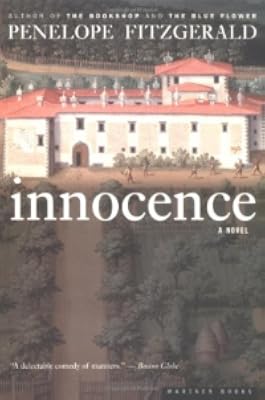
Innocence
by Penelope Fitzgerald
On This Page
Description
"A delectable comedy of manners" set in 1950s Florence, by the Man Booker Prize-winning author of The Bookshop (The Boston Globe). It's 1955, and Italy is still struggling a decade after the end of World War II. So are the Ridolfis, a Florentine family of long and fading noble lineage. Like their decrepit villa, they've seen better days. Only eighteen-year-old Chiara shows anything like vitality--however impulsive and perilously naïve. Chiara has set her heart and her future on Salvatore show more Rossi, a brilliant, penniless young doctor and bull-headed son of a Communist, who has erased both politics and romance from his list of priorities. With her plans stymied, Chiara calls on her resourceful and meddlesome British girlfriend, Barney, to help make an impossible match. Now, out of good intentions and the most innocent of instincts, two guileless friends are going to make a series of astonishingly wrong moves in the name of love. From a winner of multiple major literary awards who was called "the best English novelist of her time" by Julian Barnes, Innocence is a novel "not just about Italians in love but of living and loving for all humans" (The Times). "As intoxicating as a shot of aged brandy." --The Washington Post show lessTags
Recommendations


















Member Reviews
As usual, Fitzgerald has an unexpected, oblique approach here: not only is this an English novel set in Florence in which all the main characters are Italian, thus making gentle fun of the great Henry James/E.M. Forster tradition, but it's also a book in which she redefines "innocence" to refer to a whole class of well-intentioned acts performed by naive people with uniformly disastrous consequences.
The story is set in Florence in 1955, with Italy still in the transition period between Bicycle thieves and Dolce vita, although we get strong hints (never followed up) that the unidentified narrator is looking at events from thirty years later. At its centre is the marriage of Chiara, daughter of the aristocratic but slightly down-at-heel show more Ridolfi family, who still own a farm and a renaissance villa as well as their Florence town house, with Salvatore Rossi, a young doctor with his roots in the working-class, communist South — he had a momentous childhood meeting with the dying Gramsci, which he has been trying to live down ever since. The momentum of the story comes from the way the cultivated, conservative, and slightly mad Ridolfi clan and the sensitive, prickly, scientific Rossi fail to understand each other, with various wildcards like the Monsignore and Chiara's English schoolfriend "Barney" (née Lavinia) thrown in to create extra chaos.
Lovely writing, with Fitzgerald's characteristic gentle wit and pared-down prose, and equally characteristic insistence on leaving us in doubt as to whether or not certain things really happened. show less
The story is set in Florence in 1955, with Italy still in the transition period between Bicycle thieves and Dolce vita, although we get strong hints (never followed up) that the unidentified narrator is looking at events from thirty years later. At its centre is the marriage of Chiara, daughter of the aristocratic but slightly down-at-heel show more Ridolfi family, who still own a farm and a renaissance villa as well as their Florence town house, with Salvatore Rossi, a young doctor with his roots in the working-class, communist South — he had a momentous childhood meeting with the dying Gramsci, which he has been trying to live down ever since. The momentum of the story comes from the way the cultivated, conservative, and slightly mad Ridolfi clan and the sensitive, prickly, scientific Rossi fail to understand each other, with various wildcards like the Monsignore and Chiara's English schoolfriend "Barney" (née Lavinia) thrown in to create extra chaos.
Lovely writing, with Fitzgerald's characteristic gentle wit and pared-down prose, and equally characteristic insistence on leaving us in doubt as to whether or not certain things really happened. show less
80. Innocence by Penelope Fitzgerald
preface : Hermione Lee (2013), introduction : Julian Barnes (2013),
OPD: 1986
format: 350-page paperback
acquired: August read: Nov18-25 time reading: 11:01, 1.9 mpp
rating: 4½
genre/style: Not quite contemporary fiction theme: random
about the author: 1916 –2000: A Booker Prize-winning novelist, poet, essayist and biographer from Lincoln, England. She was the daughter of Edmund Knox, later an editor of Punch, and Christina, née Hicks, daughter of Edward Hicks, Bishop of Lincoln, and one of the first women students at Oxford. She was a niece of the theologian and crime writer Ronald Knox, the cryptographer Dillwyn Knox, the Bible scholar Wilfred Knox, and the novelist and biographer Winifred show more Peck.
-----
I'm new to Penelope Fitzgerald. I didn't know she was a genius author, or how she hid away until she became a widow. I didn't know how distinct and clever and funny she is, how she lies along that line of absurd for her own purposes. Much like American writers in the 1980's pulled from the Beat generation to be ridiculous and fun, she pulls from her own sense of the absurd - but for pointed affect. It works. The whole book turns on some her lines. I'm reading, trying to understand why I like this, how does it work? And, she gently notes about our groom that, "As a favorite son, he had been obliged to receive a quite unjust amount of his mother's traditional wisdom"
Salvatore is a most inauspicious potential husband. He's thirty, whereas our innocent Chiara, his fiancé, is merely 17! He's a cold useless doctor of neuralgia. Careful, he's not a neurologist. He denies all emotions. We are, I should note, in Florence in the 1950's. Chiara's dad is a count with an ancient Florentine lineage and little money, and little ability to make money. His brother, Cesare, so short spoken no one knows what he thinks, runs the family winery that happens to lay outside the Chianti designation, severely cheapening the value of his product. They need money. A rich doctor would nice. Salvatore is economically self-sufficient, but not much else.
So, when Salvatore courts, he thinks like this:
Chiara is smitten. She has her doubts, and brings her frank English school friend to evaluate him, this friend tells her he's crazy. Alas, Chiara carries on.
What possessed Fitzgerald write this novel? What possessed her to spend time in this somewhat faded 1950's Florence with this terrible marriage coming? And why does it work? Why do I care? Why is Salvatore, so full of repressed strong emotions and yet so cold in his speech, so entertaining? I would ask Cesare, as he seems to know everything, but he doesn't speak. Instead, he specifically allows this novel to gather its greatest tension.
This is my second novel by Fitzgerald this year. She does brilliant stuff, and it's all so hidden. As a reader, I have no idea how it works. She's writes humbly, at a distance, softly, and it comes across in flashes of striking lines that first make you smile. Her characters are flawed and lovable, almost always. They're ridiculous extremes, and we want to embrace them all, or I do. If, when we read, we are looking for inspiration to read more fiction, this book does that. It bewilders and inspires.
2024
https://www.librarything.com/topic/365030#8696905 show less
preface : Hermione Lee (2013), introduction : Julian Barnes (2013),
OPD: 1986
format: 350-page paperback
acquired: August read: Nov18-25 time reading: 11:01, 1.9 mpp
rating: 4½
genre/style: Not quite contemporary fiction theme: random
about the author: 1916 –2000: A Booker Prize-winning novelist, poet, essayist and biographer from Lincoln, England. She was the daughter of Edmund Knox, later an editor of Punch, and Christina, née Hicks, daughter of Edward Hicks, Bishop of Lincoln, and one of the first women students at Oxford. She was a niece of the theologian and crime writer Ronald Knox, the cryptographer Dillwyn Knox, the Bible scholar Wilfred Knox, and the novelist and biographer Winifred show more Peck.
-----
I'm new to Penelope Fitzgerald. I didn't know she was a genius author, or how she hid away until she became a widow. I didn't know how distinct and clever and funny she is, how she lies along that line of absurd for her own purposes. Much like American writers in the 1980's pulled from the Beat generation to be ridiculous and fun, she pulls from her own sense of the absurd - but for pointed affect. It works. The whole book turns on some her lines. I'm reading, trying to understand why I like this, how does it work? And, she gently notes about our groom that, "As a favorite son, he had been obliged to receive a quite unjust amount of his mother's traditional wisdom"
Salvatore is a most inauspicious potential husband. He's thirty, whereas our innocent Chiara, his fiancé, is merely 17! He's a cold useless doctor of neuralgia. Careful, he's not a neurologist. He denies all emotions. We are, I should note, in Florence in the 1950's. Chiara's dad is a count with an ancient Florentine lineage and little money, and little ability to make money. His brother, Cesare, so short spoken no one knows what he thinks, runs the family winery that happens to lay outside the Chianti designation, severely cheapening the value of his product. They need money. A rich doctor would nice. Salvatore is economically self-sufficient, but not much else.
So, when Salvatore courts, he thinks like this:
"It was his rule to never waste time. He believed, indeed, that as a rational man, he had trained himself to a point where it was impossible to waste any. The amount of time, therefore, that he spent thinking about Chiari Ridolfi since his his visit to the Teatro della Pergola in the spring of 1955 must, he thought, be in some way biologically useful."
Chiara is smitten. She has her doubts, and brings her frank English school friend to evaluate him, this friend tells her he's crazy. Alas, Chiara carries on.
What possessed Fitzgerald write this novel? What possessed her to spend time in this somewhat faded 1950's Florence with this terrible marriage coming? And why does it work? Why do I care? Why is Salvatore, so full of repressed strong emotions and yet so cold in his speech, so entertaining? I would ask Cesare, as he seems to know everything, but he doesn't speak. Instead, he specifically allows this novel to gather its greatest tension.
This is my second novel by Fitzgerald this year. She does brilliant stuff, and it's all so hidden. As a reader, I have no idea how it works. She's writes humbly, at a distance, softly, and it comes across in flashes of striking lines that first make you smile. Her characters are flawed and lovable, almost always. They're ridiculous extremes, and we want to embrace them all, or I do. If, when we read, we are looking for inspiration to read more fiction, this book does that. It bewilders and inspires.
2024
https://www.librarything.com/topic/365030#8696905 show less
"Innocence" is, more or less, the story of a marriage between a southern Italian neurologist and a young, beautiful, and, yes, innocent, half-Scottish Italian countess. It resembles a lot of nineteenth-century British novels in that it's a novel about both love and property: Chiara's family has at least three impressive living spaces, and the characters constantly ping-pong between all three. Her family's financial condition is discussed at length and in detail. The complex social machinations of Salvatore's perpetually impoverished southern Italian hometown are also examined at length. "Innocence" is also, in a sense, an expatriate novel, but Fitzgerald seems to know the territory so well that it doesn't really seem like it. It show more doesn't, like "A Room with a View," start out in a boarding house run by a Cockney landlady. There are a few trips made to England, and an old boarding school friend plays a role, but Italy and her Italian characters always seem to take center stage here. A family of expatriate Brits appear, but they're mostly to be gently mocked. Baggy in its plotting and leisurely in its pacing, "Innocence" might be said to be mostly about what it might have been like to live in Florence in the mid-twentieth century.
And I guess the book is about innocence, too, of all kinds: personal, romantic, political, and also the kinds that arise from wealth, or from inexperience, or from unearned self-assurance. Fitzgerald makes it clear from a doubtful but enchanting historical anecdote attached to the family's grandest house that innocence can certainly lead to barbarity, but, considering how insightful Fitzgerald can be about the general indifference and loneliness of human life, she treats most of this novel's characters remarkably gently. This might, perhaps, be a comment on their social or economic status: the rich can afford to be slightly eccentric and pleasant but ineffectual, after all. But I also think that the author might have been genuinely fond of the characters she created here and chose to treat them with a lenient hand. And I was genuinely surprised at how much I came to like them, too, even those personages that Fitzgerald drew with just a few strokes seem remarkably vivid and human. But maybe the old adage that God loves fools, drunks, and innocents holds true here, too. I get the distinct impression that the author just wanted to see these lucky people tumble gracefully and awkwardly through life. Recommended. I'm wondering why I waited so long to read Penelope Fitzgerald. show less
And I guess the book is about innocence, too, of all kinds: personal, romantic, political, and also the kinds that arise from wealth, or from inexperience, or from unearned self-assurance. Fitzgerald makes it clear from a doubtful but enchanting historical anecdote attached to the family's grandest house that innocence can certainly lead to barbarity, but, considering how insightful Fitzgerald can be about the general indifference and loneliness of human life, she treats most of this novel's characters remarkably gently. This might, perhaps, be a comment on their social or economic status: the rich can afford to be slightly eccentric and pleasant but ineffectual, after all. But I also think that the author might have been genuinely fond of the characters she created here and chose to treat them with a lenient hand. And I was genuinely surprised at how much I came to like them, too, even those personages that Fitzgerald drew with just a few strokes seem remarkably vivid and human. But maybe the old adage that God loves fools, drunks, and innocents holds true here, too. I get the distinct impression that the author just wanted to see these lucky people tumble gracefully and awkwardly through life. Recommended. I'm wondering why I waited so long to read Penelope Fitzgerald. show less
In mid-50s Florence, the Ridolfi family is both an historical sport of nature and precious stock that needs grafting to the deep roots of political consciousness that will herald the future. The count and his daughter are both of the world but also strangely absent. However, when the teenage Chiara falls head over heels for Dr Salvatore Rossi while standing in the rain during the intermission at a concert, she sets in train a sequence of events that will eventuate in romantic bliss or disaster. Meanwhile, Salvatore, who as a child met the dying marxist Antonio Gramsci, is as perplexed as he is smitten by both Chiara and her famous family. He is driven to distraction, which is not a comfortable state for a psychiatrist. How can he go on? show more How can he not? It is, as ever, the unanswerable question.
Fitzgerald’s prose here is both delicate, almost fastidious, and gaudy. The humour, when it arrives (and it comes often and in droves) is beyond farcical. Yet there is such a sweetness about Chiara, the disturbed Salvatore, and Chiara’s blundering English friend, Barney, that you can’t help falling in love with all of them. The fact that the novel doesn’t really go anywhere makes it hardly any different than life itself. And Fitzgerald clearly sees both the muddle and the majesty of life.
The wandering style and the Italian families might be confusing at first, but this is a novel with as much evidence of Penelope Fitzgerald’s mastery as any in her oeuvre. Recommended, as ever. show less
Fitzgerald’s prose here is both delicate, almost fastidious, and gaudy. The humour, when it arrives (and it comes often and in droves) is beyond farcical. Yet there is such a sweetness about Chiara, the disturbed Salvatore, and Chiara’s blundering English friend, Barney, that you can’t help falling in love with all of them. The fact that the novel doesn’t really go anywhere makes it hardly any different than life itself. And Fitzgerald clearly sees both the muddle and the majesty of life.
The wandering style and the Italian families might be confusing at first, but this is a novel with as much evidence of Penelope Fitzgerald’s mastery as any in her oeuvre. Recommended, as ever. show less
A neurologist, son of a peasant-stock communist, falls in love with the daughter of an old Italian family: the money is long gone but not the more aristocratic view of the world, circa 1950s post-war Italy. Most characters share one defining trait — a steadfast belief in their own perceptions and a strong desire to inflict their good intentions on each other.
Character driven more than plot, but even the characters do not have the usual arcs and though amusing to read, I didn’t find the characters particularly “real” with the odd exception of Caesare: with very few lines and scenes I think he stole the story. It’s similar to “Offshore” (earlier novel by Fitzgerald) as it is more of a mood piece and a commentary on human show more foibles. It’s a gentle, wandering story that allows the reader to fill in the blanks and consider a possible continuation for themselves. A typical Fitzgerald vignette style. show less
Character driven more than plot, but even the characters do not have the usual arcs and though amusing to read, I didn’t find the characters particularly “real” with the odd exception of Caesare: with very few lines and scenes I think he stole the story. It’s similar to “Offshore” (earlier novel by Fitzgerald) as it is more of a mood piece and a commentary on human show more foibles. It’s a gentle, wandering story that allows the reader to fill in the blanks and consider a possible continuation for themselves. A typical Fitzgerald vignette style. show less
A stormy love affair starts between a twenty-nine year old doctor, Salvatore Rossi, and Chiara Ridolfi, just out of school and nineteen. He comes from a poor rural family in the south and his father worshipped Antonio Gramsci, whom Salvatore saw dying when the boy was ten. Chiara comes from an old aristocratic family of decaying fortunes; they have a villa, the Ricordanza, a farm at Valsassina which now produces a little wine for sale, and a palazzo in Florence. The Ricordanza is named after the verse in Dante where Francesca asks whether memory in her situation is the worst misery in hell or a small consolation.
Chiara’s school friend, the formidable Barney (Lavinia Barnes) comes to help. Complicating rather than helping are show more Chiara’s gentle, retiring father, Count Giancarlo Ridolfi, his sister Maddalena, and his nephew Cesare, who runs the farm. Chiara and Salvatore marry, but his bristliness and Chiara’s direct, unswerving honesty make for continued friction, which becomes public in a funny scene at a villa party given by a family friend, Professor Pulci. One of Fitzgerald’s themes is the irrational manner in which those who love each other can get into and sustain arguments. Another is the notion of children recognizing that in a particular situation they are older than their parents. Something she repeats here is the way deception becomes easier with practice. And as always, we wonder how she knows so much about Italian farming, Gramsci, and various other arcane matters. show less
Chiara’s school friend, the formidable Barney (Lavinia Barnes) comes to help. Complicating rather than helping are show more Chiara’s gentle, retiring father, Count Giancarlo Ridolfi, his sister Maddalena, and his nephew Cesare, who runs the farm. Chiara and Salvatore marry, but his bristliness and Chiara’s direct, unswerving honesty make for continued friction, which becomes public in a funny scene at a villa party given by a family friend, Professor Pulci. One of Fitzgerald’s themes is the irrational manner in which those who love each other can get into and sustain arguments. Another is the notion of children recognizing that in a particular situation they are older than their parents. Something she repeats here is the way deception becomes easier with practice. And as always, we wonder how she knows so much about Italian farming, Gramsci, and various other arcane matters. show less
My first introduction to Penelope Fitzgerald's work had come with 'The Bookshop', and with this second helping I feel like I'm on the road to becoming a big fan. Her writing never calls attention to herself, and yet it is some of the most penetrative, striking prose I've ever seen. In 'Innocence' this characteristic voice carries the reader through what is not the most incredible plot to have ever graced literature, and yet you don't mind the otherwise pedestrian story simply thanks to the joy of reading each sumptuous paragraph. I've got more Fitzgeralds on my bookshelf, and I'm eager to move on to the next.
Members
- Recently Added By
Lists

Books set in Firenze (Florence, Italy)
35 works; 1 member
Author Information

24+ Works 12,100 Members
In 1997 Penelope Fitzgerald's novel The Blue Flower was named one of the New York Times Book Review's eleven Best Books of the Year. Winner of the 1979 Booker Prize for Offshore, Fitzgerald was also short-listed for the Booker for The Bookshop. The Beginning of Spring, and The Gate of Angels. Penelope Fitzgerald lives in England. (Bowker Author show more Biography) Penelope Fitzgerald, one of England's most-celebrated contemporary writers, is the author of "The Blue Flower," which won the National Book Critics Circle Award. Winner of the 1979 Booker Prize for "Offshore," she was also shortlisted for the Booker for "The Bookshop," "The Beginning of Spring," & "The Gate of Angels." She lives in London. (Bowker Author Biography) Admired by many as one of the leading English novelists of her day, Penelope Fitzgerald (1916-2000) wrote some twelve books of fiction and nonfiction over the course of her writing career; which began at the age of sixty. She won the National Book Critics Circle Award for "The Blue Flower" and the Booker Prize for "Offshore". She died on April 28, 2000, at the age of eighty-three. (Bowker Author Biography) show less
Some Editions
Common Knowledge
- Original publication date
- 1986
- People/Characters
- Chiara Ridolfi; Salvatore Rossi; Giancarlo Ridolfi; Maddalena; Cesare Ridolfi; Lavinia Barnes
- Important places
- Florence, Italy
- First words
- Anyone can tell when they are passing the Ridolfi villa, the Ricordanza, because of the stone statues of what are known as "the Dwarfs" on the highest part of the surrounding walls.
- Last words
- (Click to show. Warning: May contain spoilers.)He called out that he was going back to Florence and would be starting first thing in the morning for Riomaggiore.
Classifications
Statistics
- Members
- 480
- Popularity
- 63,308
- Reviews
- 11
- Rating
- (3.63)
- Languages
- English, Italian, Spanish
- Media
- Paper, Ebook
- ISBNs
- 11
- UPCs
- 1
- ASINs
- 9