
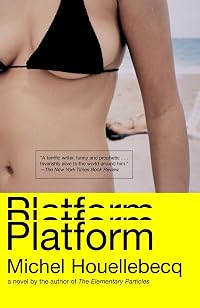
Platform
by Michel Houellebecq
On This Page
Description
Michel is a civil-servant at the Ministry of Culture. When his father is murdered and he comes into some money, Michel takes leave of absence to go on a package tour to Thailand. Infuriated by the shallow hypocrisy and mediocrity of his fellow travellers, only the awkward Valerie attracts his attention. Too bashful to pursue her, Michel prefers the uncomplicated pleasures of Thai massage parlours and sex with local women. But, back in Paris, he calls Valerie and they plunge into a passionate show more affair which strays far beyond the bounds of his previous 'vanilla' existence, into S&M, partner-swapping and sex in public. Michel quits his job, and tries to help Valerie and her boss, Jean-Yves, in their ailing travel business, by offering travel packages based on sex tourism in the third world. When their project comes to fruition and the three return to Thailand, Michel discovers that sex is neither the most consuming nor the most dangerous of human passions... show lessTags
Recommendations
































Member Recommendations

Member Reviews
'Platform' (2001) was Houllebecq's fourth novel. It may be more famous for a rather ridiculous scandal about his alleged (almost certainly actual) Islamophobia in an era of terrorism than its content but its content is worth considering.
This is the writer just coming into his forties with three novels under his belt. The maturation shows but, in maturing and producing a classically structured novel, he also, it must be admitted, has lost some of his pungent verve. It is a bitter-sweet book rather than an existentially desperate one.
This is still the Houllebecq of the 1990s, detached, reminiscent of Camus' Meursault, fascinated by sexual expression and hanging on to a cultural traditionalism that is both highly political and which has show more abandoned conventional liberal democratic politics.
It is perhaps one of the few novels from the literary class that treats capitalism and entrepreneurialism not only without condemnation but with a certain distant approval. He seems only to regret that 'culture' (society) gets in the way of it granting our true desires.
The story centres on three individuals. The bitter sweetness comes from the fact that the protagonist, a time-serving civil servant in the Ministry of Culture, actually finds true emotional and sexual happiness with a woman who acts as business aide to the third.
Houllebecque thankfully avoids any temptation to create some hackneyed menage a trois and has the three of them simply engage in a shared project with a shared vision and shared respect - an attempt to create a viable sex tourism business within the mainstream tourist industry.
As we would expect, Houllebecq writes well and gives us a strong sense of what it is like to go on a package holiday, to Thailand or to Cuba but also what it is like to be detached from your father or slowly and inevitably detaching from an unsuitable wife.
His ability to say the unsayable is undiminished not only with the sex scenes and cultural sterotyping but even with the third character's desperate short sexual laison with an under-age girl. The story is one of male desperation, the girl is willing and the issue is the law and not morality.
A variant of this desperation is the meaning one of the dying victims of the atrocity, a working class guy, got from the happiness of his time with a Thai prostitute as if even his death was worth the brief moment of time when he was happy.
The fact that the Thai prostitute is not invested in him at all and perhaps that one day such happiness may come from a well-formed robot is not the point. He is not an intellectual. He felt as if he was loved and experienced something in himself greater than being a cog in a wheel.
The sex will not surprise those who know Houllebecq. It is graphic and fairly frequent, presented without all the moral or romantic gilding we have come to expect in literature, and yet the sex is not without love or respect even when it is purchased.
What is framed in our world today as exploitation is interpreted differently here as a trade between people who are agents on their own account according to their desires, needs and situation. No wonder the book was loathed as much as admired by the 'bien-pensants'.
It is a different conservative-libertarian way of looking at the world. It was unfashionable when the book was published and, now, nearly a quarter of a century on, it is tantamount to being forbidden. The fashionable philosophers are determined on not merely denying the self but controlling it.
Houllebecq's vision of sex is thus totally counter-cultural, especially in this age of political correctness and wokery. He dismisses narratives of exploitation. The world is as it is, what looks like exploitation to the protagonist looks like fair trade under the circumstances. He may be right.
What will surprise the Houllebecquians is how much not only sex but love based on sex, an unconditional and powerful love, is presented not as a trade but as a glorious thing in itself. It ends not because of decay but because of the violence of Islamic terrorism.
Our protagonist, Michel, finds perfect happiness with Valerie but his world collapses him into becoming the Houellebecq hero we know from the past on the chance shot of a sex negative religious maniac and the subsequent posturing of Western, in this case French, society.
The subsequent scandal was not so much about the book as about statements made by Houllebecq outside the text that then got read back into the text. Fortunately, French judges asserted the right of a man to criticise religion against the spurious claims of the human rights industry.
The cultural attacks on Houllebecq are simply the defensive posturing of a lesser minds terrified of his exposure of the hollow at the centre of their lives, of the value of raw sex and its role in finding love and his brutal truths about the world that feeds them
The ruthlessness of capitalism is a sub-text of the book but even this is not treated with the usual moral affectation of the literary set. When everything crumbles and Jean-Yves' high-flying career takes a dive there is no anger, just sorrow at the way of the world, the human condition.
Houllebecq writes sympathetically of all his characters. There are no villains other than faceless maniacs. There is certainly no racism. His Arabs are treated as persons as much as Africans, Germans and Thais. Maybe a slight disdain for the Anglo-Saxon can be detected but he is French after all.
The structure of the book is also interesting. The sexually graphic scenes appear at almost rhythmic intervals but what I was most struck by was his slight parodying of the airport thriller (he critiques three best selling authors in short didactic segments).
The story is set in the world of global tourism which represents brief moments of exoticism for people living fairly meaningless lives of drudgery in roles imposed on them by chance and necessity. Thrillers are brief moments of dreamed excitement in those same lives.
Houllebecq tells his story straight and chronologically without tiresome post-modern trickery but periodically inserts factual accounts of, say, management techniques in the tourism industry or some other bit of 'education' in the way that thriller writers explain the intricacies of weaponry.
What struck this reader was that Houellebecq's honesty about the world and our position in it is not feigned or calculated for effect but rather structured with great art to provoke us into recognition. If we do not recognise what is being claimed or said, this will be down to our personality.
He never preaches even about those things he clearly does not like - sex-negativity, intrusion into private life and choices, denial of pleasures, moral affectation. He presents us with an alternative way of seeing our situation, then gets sad that our situation is just how it is and probably always will be. show less
This is the writer just coming into his forties with three novels under his belt. The maturation shows but, in maturing and producing a classically structured novel, he also, it must be admitted, has lost some of his pungent verve. It is a bitter-sweet book rather than an existentially desperate one.
This is still the Houllebecq of the 1990s, detached, reminiscent of Camus' Meursault, fascinated by sexual expression and hanging on to a cultural traditionalism that is both highly political and which has show more abandoned conventional liberal democratic politics.
It is perhaps one of the few novels from the literary class that treats capitalism and entrepreneurialism not only without condemnation but with a certain distant approval. He seems only to regret that 'culture' (society) gets in the way of it granting our true desires.
The story centres on three individuals. The bitter sweetness comes from the fact that the protagonist, a time-serving civil servant in the Ministry of Culture, actually finds true emotional and sexual happiness with a woman who acts as business aide to the third.
Houllebecque thankfully avoids any temptation to create some hackneyed menage a trois and has the three of them simply engage in a shared project with a shared vision and shared respect - an attempt to create a viable sex tourism business within the mainstream tourist industry.
As we would expect, Houllebecq writes well and gives us a strong sense of what it is like to go on a package holiday, to Thailand or to Cuba but also what it is like to be detached from your father or slowly and inevitably detaching from an unsuitable wife.
His ability to say the unsayable is undiminished not only with the sex scenes and cultural sterotyping but even with the third character's desperate short sexual laison with an under-age girl. The story is one of male desperation, the girl is willing and the issue is the law and not morality.
A variant of this desperation is the meaning one of the dying victims of the atrocity, a working class guy, got from the happiness of his time with a Thai prostitute as if even his death was worth the brief moment of time when he was happy.
The fact that the Thai prostitute is not invested in him at all and perhaps that one day such happiness may come from a well-formed robot is not the point. He is not an intellectual. He felt as if he was loved and experienced something in himself greater than being a cog in a wheel.
The sex will not surprise those who know Houllebecq. It is graphic and fairly frequent, presented without all the moral or romantic gilding we have come to expect in literature, and yet the sex is not without love or respect even when it is purchased.
What is framed in our world today as exploitation is interpreted differently here as a trade between people who are agents on their own account according to their desires, needs and situation. No wonder the book was loathed as much as admired by the 'bien-pensants'.
It is a different conservative-libertarian way of looking at the world. It was unfashionable when the book was published and, now, nearly a quarter of a century on, it is tantamount to being forbidden. The fashionable philosophers are determined on not merely denying the self but controlling it.
Houllebecq's vision of sex is thus totally counter-cultural, especially in this age of political correctness and wokery. He dismisses narratives of exploitation. The world is as it is, what looks like exploitation to the protagonist looks like fair trade under the circumstances. He may be right.
What will surprise the Houllebecquians is how much not only sex but love based on sex, an unconditional and powerful love, is presented not as a trade but as a glorious thing in itself. It ends not because of decay but because of the violence of Islamic terrorism.
Our protagonist, Michel, finds perfect happiness with Valerie but his world collapses him into becoming the Houellebecq hero we know from the past on the chance shot of a sex negative religious maniac and the subsequent posturing of Western, in this case French, society.
The subsequent scandal was not so much about the book as about statements made by Houllebecq outside the text that then got read back into the text. Fortunately, French judges asserted the right of a man to criticise religion against the spurious claims of the human rights industry.
The cultural attacks on Houllebecq are simply the defensive posturing of a lesser minds terrified of his exposure of the hollow at the centre of their lives, of the value of raw sex and its role in finding love and his brutal truths about the world that feeds them
The ruthlessness of capitalism is a sub-text of the book but even this is not treated with the usual moral affectation of the literary set. When everything crumbles and Jean-Yves' high-flying career takes a dive there is no anger, just sorrow at the way of the world, the human condition.
Houllebecq writes sympathetically of all his characters. There are no villains other than faceless maniacs. There is certainly no racism. His Arabs are treated as persons as much as Africans, Germans and Thais. Maybe a slight disdain for the Anglo-Saxon can be detected but he is French after all.
The structure of the book is also interesting. The sexually graphic scenes appear at almost rhythmic intervals but what I was most struck by was his slight parodying of the airport thriller (he critiques three best selling authors in short didactic segments).
The story is set in the world of global tourism which represents brief moments of exoticism for people living fairly meaningless lives of drudgery in roles imposed on them by chance and necessity. Thrillers are brief moments of dreamed excitement in those same lives.
Houllebecq tells his story straight and chronologically without tiresome post-modern trickery but periodically inserts factual accounts of, say, management techniques in the tourism industry or some other bit of 'education' in the way that thriller writers explain the intricacies of weaponry.
What struck this reader was that Houellebecq's honesty about the world and our position in it is not feigned or calculated for effect but rather structured with great art to provoke us into recognition. If we do not recognise what is being claimed or said, this will be down to our personality.
He never preaches even about those things he clearly does not like - sex-negativity, intrusion into private life and choices, denial of pleasures, moral affectation. He presents us with an alternative way of seeing our situation, then gets sad that our situation is just how it is and probably always will be. show less
Platform is a great example of Houellebecq as a deeply moral writer. That might sound like an odd description for someone who writes such lovingly detailed scenes of group sex, but it's true - amid his signature brand of overwhelming cynicism for the modern world, Platform contains some of his most moving passages on the search for happiness and fulfillment. If you read Houellebecq's novels out of order, like me, then it's striking how consistent yet unrepetititive he is. In each novel he has the same preoccupations, the same characters, and the same writing style, and though you would think that only a very few hands could be drawn from such a small deck, the strength of those themes, his ability to place his essentially identical show more author-surrogates in fresh situations, and his great sense of irony and black comedy make his books worth shuffling through. The sex doesn't hurt, either.
Platform ticks off the whole list of Houellechecqs:
- the emotionally deadened yet materially comfortable protagonist with terrible family relations is here named Michel
- the stunning and sexually adventurous babe who for no real reason falls in love with the protagonist is named Valérie
- the hollowness of contemporary artistic pursuits is explored via the modern art scene
- the remunerative yet trivial occupation of the protagonist is government coordinator for art events
- the protagonist's family is either absent or quickly killed off, here on the first page
- the spiritual poverty of the West's affluence is explored via the tourism industry
- the continual allure of religion despite its self-evident absurdity focuses here on Islam
- the salubrious effects of large quantities of graphic sex is praised, here via... large quantities of graphic sex
Excellent. Moral lessons are much more pleasant when accompanied by the good stuff, and I personally would much rather read musings on the true nature of life when they're wrapped in smut. For example, is it possible to be truly happy? Michel has some thoughts:
"Later, thinking about this happy time with Valérie, a time of which, paradoxically, I have so few memories, I would say that man is clearly not intended to be happy. To truly arrive at the practical possibility of happiness, man would have to transform himself - transform himself physically. What does God compare to? In the first place, obviously, a woman's pussy; but also perhaps the vapors of a Turkish bath. Something, at any rate, in which spiritual bliss becomes possible, because the body is sated with contentment, with pleasure, and all anxiety is abolished. I now know for certain that the spirit is not born, that it needs to be brought forth, and that this birth is difficult, something of which we now have only a dangerously vague idea. When I brought Valérie to orgasm, when I felt her body quiver under mine, I sometimes had the impression - fleeting but irresistible - of attaining a new level of consciousness, where every evil had been abolished. In those moments of suspension, almost of motionlessness, when the pleasure in her body mounted, I felt like a god on whom depended tranquility and storms. It was the first, most perfect, most indisputable sort of joy."
Well there you have it, the mystery of happiness has been solved! If only all joy was so easy to attain. That cheerful mix of philosophy and erotomania leads Michel down some interesting roads over the course of the book. Platform is essentially the anti-Nymphomaniac, in that Houellebecq seems to really believe in love as a redemptive force, and while sex for him does not necessarily bear any relationship to anything other than getting off, I was somewhat surprised to see passages on how much more honorable and moral prostitution is than BDSM, as I didn't imagine Houellebecq would have any issues with it: "There's the sexuality of those who love each other, and the sexuality of those who don't love each other. When there's no longer any possibility of identifying with the other, the only thing left is suffering - and cruelty." The relationship Michel has with Valérie, the deepest of his life, is seen as something he didn't truly earn, which I think is how most people feel about a truly great relationship.
I always appreciate his takes on the morality of sexuality, particularly commodification. After all, what exactly is so wrong about that? If economic logic should be applied to every sphere of life, then is there some sort of moral line to be drawn around paid dating sites, strip clubs, prostitution, sex tourism, and so forth, and exactly where should it be? Houellebecq has a great disdain for the effects of Anglo-Saxon culture on France, but he recognizes that France seems not have produced a superior model. The tourism industry is the example here, an expression of global capitalism that seems to mostly cater to desperate Europeans who find their own culture intolerable. While plenty of sex is available at home, a similar amount of love, or at least of satisfying relationships, is not, as the relentless workings of the sexual marketplace transforms seduction from a means to an end into an end in itself. If you can't beat them, why not join them? Michel discusses with Valérie whether women will take to sex tourism with the same gusto as men:
"What will probably happen is that women will become much more like men. For the moment, they're still very hung up on romance; whereas at heart, men don't give a shit about romance, they just want to fuck. Seduction only appeals to a few guys who haven't got particularly exciting jobs and nothing else of interest in their lives. As women attach more importance to their professional lives and personal projects, they'll find it easier to pay for sex too; and they'll turn to sex tourism. It's possible for women to adapt to male values; they sometimes find it difficult, but they can do it; history has proved it."
There's obviously a lot of gender stereotyping in there, but I think that and his dig at pickup artists obscure his broader point about how people respond to the instability of modern life. After all, sex tourism was how Michel and Valérie met in the first place - it took traveling to a foreign country to connect with each other. Why not provide a platform (if you will) for people to escape each other and the unpleasurable world they've created in search of their own paths to joy? There's no single point at which the search for love changes all at once; instead it's step by step, until eventually life looks unrecognizable. This being a Houellebecq novel, it's not like he could give his protagonist a happy ending, and so the scene in which he loses Valérie, right after they've seemingly figured everything out, functions as a sort of structural joke, showing that in the end all of the theorizing in the world about love, sex, happiness, and life can be meaningless in the face of real events. Not exactly uplifting, but hey - the kind of happy endings Houellebecq likes are not the literary kind.
I wouldn't declare that this is his finest work - The Map and The Territory has probably my favorite plot, and I think the criticism of Islam that got him in so much trouble here was done better in Submission - but again, it's remarkable how consistently entertaining and thoughtful his trademark gloom can be. The scene where Michel, in desperate need of something to read and with only airport best-sellers available, points out how masturbatory John Grisham's prose style is by literally masturbating onto a copy of The Firm is literary criticism at its most genius. show less
Platform ticks off the whole list of Houellechecqs:
- the emotionally deadened yet materially comfortable protagonist with terrible family relations is here named Michel
- the stunning and sexually adventurous babe who for no real reason falls in love with the protagonist is named Valérie
- the hollowness of contemporary artistic pursuits is explored via the modern art scene
- the remunerative yet trivial occupation of the protagonist is government coordinator for art events
- the protagonist's family is either absent or quickly killed off, here on the first page
- the spiritual poverty of the West's affluence is explored via the tourism industry
- the continual allure of religion despite its self-evident absurdity focuses here on Islam
- the salubrious effects of large quantities of graphic sex is praised, here via... large quantities of graphic sex
Excellent. Moral lessons are much more pleasant when accompanied by the good stuff, and I personally would much rather read musings on the true nature of life when they're wrapped in smut. For example, is it possible to be truly happy? Michel has some thoughts:
"Later, thinking about this happy time with Valérie, a time of which, paradoxically, I have so few memories, I would say that man is clearly not intended to be happy. To truly arrive at the practical possibility of happiness, man would have to transform himself - transform himself physically. What does God compare to? In the first place, obviously, a woman's pussy; but also perhaps the vapors of a Turkish bath. Something, at any rate, in which spiritual bliss becomes possible, because the body is sated with contentment, with pleasure, and all anxiety is abolished. I now know for certain that the spirit is not born, that it needs to be brought forth, and that this birth is difficult, something of which we now have only a dangerously vague idea. When I brought Valérie to orgasm, when I felt her body quiver under mine, I sometimes had the impression - fleeting but irresistible - of attaining a new level of consciousness, where every evil had been abolished. In those moments of suspension, almost of motionlessness, when the pleasure in her body mounted, I felt like a god on whom depended tranquility and storms. It was the first, most perfect, most indisputable sort of joy."
Well there you have it, the mystery of happiness has been solved! If only all joy was so easy to attain. That cheerful mix of philosophy and erotomania leads Michel down some interesting roads over the course of the book. Platform is essentially the anti-Nymphomaniac, in that Houellebecq seems to really believe in love as a redemptive force, and while sex for him does not necessarily bear any relationship to anything other than getting off, I was somewhat surprised to see passages on how much more honorable and moral prostitution is than BDSM, as I didn't imagine Houellebecq would have any issues with it: "There's the sexuality of those who love each other, and the sexuality of those who don't love each other. When there's no longer any possibility of identifying with the other, the only thing left is suffering - and cruelty." The relationship Michel has with Valérie, the deepest of his life, is seen as something he didn't truly earn, which I think is how most people feel about a truly great relationship.
I always appreciate his takes on the morality of sexuality, particularly commodification. After all, what exactly is so wrong about that? If economic logic should be applied to every sphere of life, then is there some sort of moral line to be drawn around paid dating sites, strip clubs, prostitution, sex tourism, and so forth, and exactly where should it be? Houellebecq has a great disdain for the effects of Anglo-Saxon culture on France, but he recognizes that France seems not have produced a superior model. The tourism industry is the example here, an expression of global capitalism that seems to mostly cater to desperate Europeans who find their own culture intolerable. While plenty of sex is available at home, a similar amount of love, or at least of satisfying relationships, is not, as the relentless workings of the sexual marketplace transforms seduction from a means to an end into an end in itself. If you can't beat them, why not join them? Michel discusses with Valérie whether women will take to sex tourism with the same gusto as men:
"What will probably happen is that women will become much more like men. For the moment, they're still very hung up on romance; whereas at heart, men don't give a shit about romance, they just want to fuck. Seduction only appeals to a few guys who haven't got particularly exciting jobs and nothing else of interest in their lives. As women attach more importance to their professional lives and personal projects, they'll find it easier to pay for sex too; and they'll turn to sex tourism. It's possible for women to adapt to male values; they sometimes find it difficult, but they can do it; history has proved it."
There's obviously a lot of gender stereotyping in there, but I think that and his dig at pickup artists obscure his broader point about how people respond to the instability of modern life. After all, sex tourism was how Michel and Valérie met in the first place - it took traveling to a foreign country to connect with each other. Why not provide a platform (if you will) for people to escape each other and the unpleasurable world they've created in search of their own paths to joy? There's no single point at which the search for love changes all at once; instead it's step by step, until eventually life looks unrecognizable. This being a Houellebecq novel, it's not like he could give his protagonist a happy ending, and so the scene in which he loses Valérie, right after they've seemingly figured everything out, functions as a sort of structural joke, showing that in the end all of the theorizing in the world about love, sex, happiness, and life can be meaningless in the face of real events. Not exactly uplifting, but hey - the kind of happy endings Houellebecq likes are not the literary kind.
I wouldn't declare that this is his finest work - The Map and The Territory has probably my favorite plot, and I think the criticism of Islam that got him in so much trouble here was done better in Submission - but again, it's remarkable how consistently entertaining and thoughtful his trademark gloom can be. The scene where Michel, in desperate need of something to read and with only airport best-sellers available, points out how masturbatory John Grisham's prose style is by literally masturbating onto a copy of The Firm is literary criticism at its most genius. show less
Very topical novel in the Trump era, concerning individual freedom versus public morality. The main thrust of the story is two men and a woman establishing a chain of resorts for sex tourism. But there is also a strong underlying philosophical theme of private freedoms versus public and religious morality. The author has no inhibitions in expressing his views through a main character. Nevertheless the story remains fascinating and holds the attention despite the provocative underlying political message.
De l'exotisme et du pittoresque, du sexe et du fanatisme, tels sont les ingrédients (torrides et subversifs) de "Plateforme", dernier roman de Michel Houellebecq, probablement l'écrivain le plus controversé aujourd'hui…
Michel est un employé du ministère de la Culture. Il vit simplement, au rythme des feuilletons et des jeux télé, des peep shows au sortir du boulot, des purées Mousseline dégluties machinalement…
A la mort de son père, "un vieux con", il se décide pour un séjour en Thaïlande, en "voyage organisé" sous la houlette de Nouvelles Frontières.
Accompagné par une galerie de "beaufs", armés du "Guide du routard", le narrateur visite les sites touristiques de Bangkok à Surat Thani, de Patong Beach à Koh Phi show more Phi, se livre au plaisir du body massage, quête les bars à putes, se lie avec Valérie. Ensemble, ils voyageront à Cuba, multipliant les expériences sexuelles, ici et là…
Cinglant et drôle, rarement avare d'outrances (sexuelles), observateur attentif, sarcastique même, l'écrivain ne rate rien de son époque.
Fable sur les voyages organisés, regard sur le tourisme sexuel et le "déploiement du monde", "Plateforme" aurait pu n'être qu'un exercice littéraire de dénonciation mise en scène par une sensibilité exacerbée.
Si le texte connaît des longueurs, c'est aussi le juste portrait d'une société moyenne, peuplée d'individus moyens, parfois médiocres, avec ses paradis et ses enfers. --Céline Darne show less
Michel est un employé du ministère de la Culture. Il vit simplement, au rythme des feuilletons et des jeux télé, des peep shows au sortir du boulot, des purées Mousseline dégluties machinalement…
A la mort de son père, "un vieux con", il se décide pour un séjour en Thaïlande, en "voyage organisé" sous la houlette de Nouvelles Frontières.
Accompagné par une galerie de "beaufs", armés du "Guide du routard", le narrateur visite les sites touristiques de Bangkok à Surat Thani, de Patong Beach à Koh Phi show more Phi, se livre au plaisir du body massage, quête les bars à putes, se lie avec Valérie. Ensemble, ils voyageront à Cuba, multipliant les expériences sexuelles, ici et là…
Cinglant et drôle, rarement avare d'outrances (sexuelles), observateur attentif, sarcastique même, l'écrivain ne rate rien de son époque.
Fable sur les voyages organisés, regard sur le tourisme sexuel et le "déploiement du monde", "Plateforme" aurait pu n'être qu'un exercice littéraire de dénonciation mise en scène par une sensibilité exacerbée.
Si le texte connaît des longueurs, c'est aussi le juste portrait d'une société moyenne, peuplée d'individus moyens, parfois médiocres, avec ses paradis et ses enfers. --Céline Darne show less
A very strange novel not least because it must be one of the only novels that takes place in the context of the tourism industry. However, lest that conjure up images of dad helping the kids build sandcastles while mum kicks back on the sunlounger with a pina colada, Houellebecq’s characters are passionate about sex tourism.
The self-absorbed Michel (how’d he come up with that name?) narrates his experiences of a relationship with a travel company executive he meets while servicing his needs at the expense of the women of Thailand. This relationship takes on two dimensions, the first of which is sex. The second, much less important dimension, is his role in providing ideas for her career move creating a series of resorts catering show more specifically to sex tourism.
Naturally, their growing sex empire draws the attention of those who are less tolerant of these things and the novel ends with an Islamic terrorist attack on a resort which kind of puts future punters off.
The novel was criticised for being critical of Islam, but critics were forced to admit that however distasteful the novel was, it was at least prescient; it was publised just weeks before 9/11 and a year before the Bali bombings which may well have been inspired by it.
However, if you’re not a fan of writers obsessed with sex, this isn’t for you. Houellebecq seems to get off on writing about it if not doing it. It’s amazing what inner insecurities are revealed by our obsessions. Reading up on his life on the web it was no surprise to discover that he felt his mother “lost interest in his existence.” The obsession with sex is typical of a man with a wound caused by lack of early connections to a female caregiver.
Sadly, writers like Houellebecq can’t seem to make any connections between the sex they create and the plots they are also constructing. Maybe that’s because the sex they’re actually having has no connection to the life they’re living. Everything is humdrum and then suddenly everyone’s clothes are off and the sex is the best anyone’s ever experienced since we were given legs to walk on. Yeah, right. My only hope is that Houellebecq is a satirist on par with Sterne or Swift.
I haven’t got the faintest idea what Houellebecq wanted the world to do with this novel. Maybe he just wanted to keep the legacy of J. G. Ballard alive. If so, lamentably, he succeeded to some degree. I’m supposed to also read his Elementary Particles off the 1001 books list. Not sure I’ll bother. show less
The self-absorbed Michel (how’d he come up with that name?) narrates his experiences of a relationship with a travel company executive he meets while servicing his needs at the expense of the women of Thailand. This relationship takes on two dimensions, the first of which is sex. The second, much less important dimension, is his role in providing ideas for her career move creating a series of resorts catering show more specifically to sex tourism.
Naturally, their growing sex empire draws the attention of those who are less tolerant of these things and the novel ends with an Islamic terrorist attack on a resort which kind of puts future punters off.
The novel was criticised for being critical of Islam, but critics were forced to admit that however distasteful the novel was, it was at least prescient; it was publised just weeks before 9/11 and a year before the Bali bombings which may well have been inspired by it.
However, if you’re not a fan of writers obsessed with sex, this isn’t for you. Houellebecq seems to get off on writing about it if not doing it. It’s amazing what inner insecurities are revealed by our obsessions. Reading up on his life on the web it was no surprise to discover that he felt his mother “lost interest in his existence.” The obsession with sex is typical of a man with a wound caused by lack of early connections to a female caregiver.
Sadly, writers like Houellebecq can’t seem to make any connections between the sex they create and the plots they are also constructing. Maybe that’s because the sex they’re actually having has no connection to the life they’re living. Everything is humdrum and then suddenly everyone’s clothes are off and the sex is the best anyone’s ever experienced since we were given legs to walk on. Yeah, right. My only hope is that Houellebecq is a satirist on par with Sterne or Swift.
I haven’t got the faintest idea what Houellebecq wanted the world to do with this novel. Maybe he just wanted to keep the legacy of J. G. Ballard alive. If so, lamentably, he succeeded to some degree. I’m supposed to also read his Elementary Particles off the 1001 books list. Not sure I’ll bother. show less
Gosh, there is so much to this book, including some really quite profound observations. There is also quite a bit of gratutious sex, as if Houllebecq kept getting horny by all his intensity and had to mix it up a bit. Fair enough. Unfortunately, a review on the back of my copy of the book had the ENDING REVEALED in it. Really very, very annoying, as the end is quite a turnaround from the rest of the book, though the clues are there. So what is this book about? Good question...the decline of the Western world and its values, the sex trade, inertia, traditional females roles (is that really what men want?), plus much more. Really got me thinking.
The problem with the French is...they talk a lot and have nothing to say. In Candide, Voltaire said ...’wherever you go in France, you will find that their three chief occupations are making love, backbiting, and talking nonsense’. Houellebecq's novel, for all its talk of death, sex, and consumerism, simply proves this point.
Much like a stereotypical French film, this novel brims to overflowing with much sex, symbolism, and suspense. Sadly, none are handled very well. The premise is that, in the end, life is an unbearable journey into suffering and vanity and that our only respite can be found in sexual ecstasy.
The narrator, Michel, is a disaffected racially-charged forty-year-old Frenchman with a penchant for sex and television show more quiz shows (in that order, albeit just barely). He provides plenty of grim atmosphere to go around. Michel feels nothing after his father's death and uses his inheritance to engage in sex tours throughout Thailand where he explores the depths of the salacious and skewers his traveling companions. His misanthropic quips were amusing for the first sixty pages or so but, as a 260-page novel, I found the book to be a bit flat. How many pages do you need to tell the world that life is a brutal bore punctuated with some sexual respite? How long can you listen to a boring self-opinionated slob talk about how alienated he is from his fellow humans, who come across as pretentious philistines, impostors, cliché-loving, soulless bureaucrats, and religious fanatics?
The important thing for the narrator (and I suspect the author) is the sex. If Michel isn't receiving some form of sexual pleasure at least every other page, then the rhythm of the story falls apart. Yet, it isn't a "Penthouse" variety of sex. The clinical terms come into play so frequently that I wondered whether I had picked up the latest version of a "How-to" manual: Pretentious Sex For Beginners. In between sexual liaisons, there are depressing diatribes on economic/socio-political theory, endless details of tour cruise finances, and stilted views on the most popular race of people to bed.
The rant should have been relegated to a novella, a taut hundred pages. I forced myself to read to the end, believing that there must be more because of all the reviewers who had raved over this. But, in the end, I just didn’t get it - so this book is perhaps best left to the fans of Houllebecq. show less
Much like a stereotypical French film, this novel brims to overflowing with much sex, symbolism, and suspense. Sadly, none are handled very well. The premise is that, in the end, life is an unbearable journey into suffering and vanity and that our only respite can be found in sexual ecstasy.
The narrator, Michel, is a disaffected racially-charged forty-year-old Frenchman with a penchant for sex and television show more quiz shows (in that order, albeit just barely). He provides plenty of grim atmosphere to go around. Michel feels nothing after his father's death and uses his inheritance to engage in sex tours throughout Thailand where he explores the depths of the salacious and skewers his traveling companions. His misanthropic quips were amusing for the first sixty pages or so but, as a 260-page novel, I found the book to be a bit flat. How many pages do you need to tell the world that life is a brutal bore punctuated with some sexual respite? How long can you listen to a boring self-opinionated slob talk about how alienated he is from his fellow humans, who come across as pretentious philistines, impostors, cliché-loving, soulless bureaucrats, and religious fanatics?
The important thing for the narrator (and I suspect the author) is the sex. If Michel isn't receiving some form of sexual pleasure at least every other page, then the rhythm of the story falls apart. Yet, it isn't a "Penthouse" variety of sex. The clinical terms come into play so frequently that I wondered whether I had picked up the latest version of a "How-to" manual: Pretentious Sex For Beginners. In between sexual liaisons, there are depressing diatribes on economic/socio-political theory, endless details of tour cruise finances, and stilted views on the most popular race of people to bed.
The rant should have been relegated to a novella, a taut hundred pages. I forced myself to read to the end, believing that there must be more because of all the reviewers who had raved over this. But, in the end, I just didn’t get it - so this book is perhaps best left to the fans of Houllebecq. show less
Members
- Recently Added By
Published Reviews
ThingScore 63
Lists

1001 Books You Must Read Before You Die
1,448 works; 1,133 members

Best 21st Century Books (So Far)
670 works; 86 members

Best of French Literature
138 works; 27 members

Vulture's 100 Best Books of the 21st Century (So Far)
98 works; 9 members

1,001 BYMRBYD Concensus
723 works; 27 members

Summer Books
82 works; 9 members

.
184 works; 1 member
Author Information

60+ Works 23,160 Members
Michel Houellebecq's first novel, Whatever, was followed by two collections of poetry and a book of essays. He lives in Dublin. (Bowker Author Biography)
Some Editions
Awards and Honors
Awards
Notable Lists
Series
Belongs to Publisher Series
Common Knowledge
- Canonical title
- Platform
- Original title
- Plateform : Au milieu du monde
- Alternate titles*
- Platform : midden in de wereld
- Original publication date
- 2001
- People/Characters
- Michel Renault; Valérie
- Important places
- Paris, France; Thailand; Cuba
- Epigraph
- Plus sa vie est infame, plus l'homme y tient; elle est alors une protestation, une vengeance de tous les instants. Honore de Balzac
(The more contemptible his life, the more a man clings to it; it thus becomes a pro... (show all)test, a retribution for every moment.) - First words
- Father died last year.
- Quotations
- In fact, nothing disturbs me.
Not having anything around to read is dangerous: you have to content yourself with life itself, and that can lead you to take risks. - Last words
- (Click to show. Warning: May contain spoilers.)I'll quickly be forgotten.
- Original language*
- Frans
*Some information comes from Common Knowledge in other languages. Click "Edit" for more information.
Classifications
Statistics
- Members
- 3,107
- Popularity
- 5,647
- Reviews
- 52
- Rating
- (3.67)
- Languages
- 26 — Bosnian, Catalan, Czech, Danish, Dutch, English, Estonian, Finnish, French, German, Greek, Hebrew, Hungarian, Icelandic, Italian, Japanese, Lithuanian, Norwegian (Bokmål), Norwegian, Polish, Portuguese, Romanian, Russian, Croatian, Spanish, Swedish
- Media
- Paper, Audiobook, Ebook
- ISBNs
- 83
- ASINs
- 15