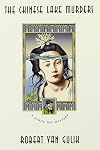
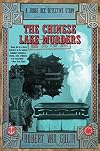
The Chinese Lake Murders
by Robert van Gulik
Judge Dee: Publication order (3), Judge Dee: Chronological order (3)
On This Page
Description
This is one of a series of five detective stories set in 7th century China when the judge was also the detective. Judge Dee has three murders to solve and there is an obvious suspect who everyone wants to put on trial, but Judge Dee is suspicious and manages to track down the real murderer.Tags
Recommendations















































Member Reviews
Robert van Gulik was a Dutch diplomat, linguist (he writes English like a native!), and an expert in China, both modern and ancient. Thank God he also decided to become an author!
The Chinese Lake Murders unfurls with three cases from when Judge Dee was a new magistrate in Han-yuang in A.D. 666. While being feted on a pleasure boat, Judge Dee discovers the body of a murdered courtesan, Almond Blossom. Just moments earlier, the girl had whispered to Judge Dee that a terrible conspiracy was afoot in Han-yuang, making the magistrate certain that she was killed to keep her from divulging her secret.
Traditionally, Chinese detective stories focus on three mysteries solved by a magistrate. However, in The Chinese Lake Murders, Judge Dee faces show more quite a few enigmas: The report of a bride who dies on her wedding night and is quickly laid into a coffin. When Judge Dee opens that coffin, the bride is gone, but the murdered corpse of a carpenter has taken its place! What happened to the bride? Who killed the carpenter? What happened to the bridegroom, who vanished on the same night? What is the dangerous conspiracy that Almond Blossom was murdered to conceal? And what about the strange actions of a 90-year-old retired Imperial Councilor? Those familiar with Judge Dee won't be surprised to find that these disparate threads become intertwined by the time of the novel's twist ending! That intertwined case becomes the most important case of Judge Dee's career -- and the centerpiece of an excellent novel.
Van Gulik first introduced Judge Dee to the West in Celebrated Cases of Judge Dee, first published in 1949 (although not translated into English until 1976). Using a real-life Chinese magistrate during the T'ang Dynasty named Ti Jen-chieh, van Gulik simplified the magistrate's name to Judge Dee Jen-djieh, and, in that first novel, he pretty much just used the cases from an 18th century Chinese detective novel, Dee Goong An. In his later novels, van Gulik, while influenced by cases from original ancient Chinese cases and 18th century Chinese detective stories, wrote the books from his own imagination. While some readers contend that the first book is van Gulik's best, I love The Lacquer Screen the best; that said, all of the Judge Dee novels I've read so far have been fantastic! I can't wait for the next one! show less
The Chinese Lake Murders unfurls with three cases from when Judge Dee was a new magistrate in Han-yuang in A.D. 666. While being feted on a pleasure boat, Judge Dee discovers the body of a murdered courtesan, Almond Blossom. Just moments earlier, the girl had whispered to Judge Dee that a terrible conspiracy was afoot in Han-yuang, making the magistrate certain that she was killed to keep her from divulging her secret.
Traditionally, Chinese detective stories focus on three mysteries solved by a magistrate. However, in The Chinese Lake Murders, Judge Dee faces show more quite a few enigmas: The report of a bride who dies on her wedding night and is quickly laid into a coffin. When Judge Dee opens that coffin, the bride is gone, but the murdered corpse of a carpenter has taken its place! What happened to the bride? Who killed the carpenter? What happened to the bridegroom, who vanished on the same night? What is the dangerous conspiracy that Almond Blossom was murdered to conceal? And what about the strange actions of a 90-year-old retired Imperial Councilor? Those familiar with Judge Dee won't be surprised to find that these disparate threads become intertwined by the time of the novel's twist ending! That intertwined case becomes the most important case of Judge Dee's career -- and the centerpiece of an excellent novel.
Van Gulik first introduced Judge Dee to the West in Celebrated Cases of Judge Dee, first published in 1949 (although not translated into English until 1976). Using a real-life Chinese magistrate during the T'ang Dynasty named Ti Jen-chieh, van Gulik simplified the magistrate's name to Judge Dee Jen-djieh, and, in that first novel, he pretty much just used the cases from an 18th century Chinese detective novel, Dee Goong An. In his later novels, van Gulik, while influenced by cases from original ancient Chinese cases and 18th century Chinese detective stories, wrote the books from his own imagination. While some readers contend that the first book is van Gulik's best, I love The Lacquer Screen the best; that said, all of the Judge Dee novels I've read so far have been fantastic! I can't wait for the next one! show less
One of the most effective of the Dee novels, for its political and sexual intrigue, though very grim
# 4 in the Judge Dee series.
Judge Dee travels throughout China to serve as magistrate. In this installment, he is in Han-yuan, where the case he is supposed to investigate involves embezzlement. However, as in all of these books, a number of different mysteries arise: the popular courtesan disappearance of the top courtesan Almond Blossom and the replacement of the body of a dead bride with a man who had most obviously been murdered. Add the White Lotus sect (a notoriously dangerous sect of rebels) and Judge Dee has a full plate here.
Recommended for people who enjoy books set in China, or who like historical mysteries.
Judge Dee travels throughout China to serve as magistrate. In this installment, he is in Han-yuan, where the case he is supposed to investigate involves embezzlement. However, as in all of these books, a number of different mysteries arise: the popular courtesan disappearance of the top courtesan Almond Blossom and the replacement of the body of a dead bride with a man who had most obviously been murdered. Add the White Lotus sect (a notoriously dangerous sect of rebels) and Judge Dee has a full plate here.
Recommended for people who enjoy books set in China, or who like historical mysteries.
Imperial China, T'ang dynasty, seventh century A.D - home of Judge Dee, imperial magistrate and detective. A near mythic figure in the pre-communist Chinese consciousness, Judge Dee distinguished himself as a tribunal magistrate, inquisitor, and public avenger. Long after his death, accounts of his exploits were celebrated in Chinese folklore.
See the Celebrated Cases of Judge Dee by Van Gulik
Cuarta entrega de la serie. La desaparición de una bella bailarina durante un viaje en barco en el lago de la pequeña ciudad de Huan-yan es el inicio de una sucesión de muertes misteriosas a las que el juez Di deberá encontrar explicación tan simple. No tarda en surgir una explicación popular a los casos: el lago está encantado y devora a quieres se apartan de las buenas costumbres. Di no está de acuerdo con la explicación y deberá trabajar con celeridad debido a la rapidez con la que se suceden las muertes. Como siempre, el autor consigue atraparnos en un ambiente cultural exótico, de aventuras y con un toque erótico, que nunca falta en las novelas de esta serie.
Nov 9, 2022Spanish
Kina, Han-yuan, år 666
Dommer Di er udnævnt til dommer i Han-yuan. Chiao Tai, Ma Jung og sergent Hung hjælper ham undervejs og Tao Gan støder til undervejs. Et mord foregår for næsen af dommeren, mens han er gæst på en blomsterbåd. Dommer Di forklæder sig som tigger, hvilket er en dårlig ide. Han tænker at læge eller sandsiger er en bedre forklædning. En gammel skakopgave finder sin løsning, men undervejs får dommeren i den grad sin sag for. En dommer forventes at vide, hvad der foregår i hans distrikt! Den kejserlige hemmelige efterretningstjeneste er også interesseret i hvad der foregår i distriktet, så der er storpolitik på spil.
En glimrende og meget læsværdig krimi, der foregår i det gamle Kina
Dommer Di er udnævnt til dommer i Han-yuan. Chiao Tai, Ma Jung og sergent Hung hjælper ham undervejs og Tao Gan støder til undervejs. Et mord foregår for næsen af dommeren, mens han er gæst på en blomsterbåd. Dommer Di forklæder sig som tigger, hvilket er en dårlig ide. Han tænker at læge eller sandsiger er en bedre forklædning. En gammel skakopgave finder sin løsning, men undervejs får dommeren i den grad sin sag for. En dommer forventes at vide, hvad der foregår i hans distrikt! Den kejserlige hemmelige efterretningstjeneste er også interesseret i hvad der foregår i distriktet, så der er storpolitik på spil.
En glimrende og meget læsværdig krimi, der foregår i det gamle Kina
Nov 15, 2008 (Edited)Danish
Members
- Recently Added By
Lists

Books Read in 2017
4,249 works; 130 members
Author Information

112+ Works 10,335 Members
Robert H. Van Gulik was born in the Netherlands on August 9, 1910. He joined the Dutch Foreign Service in 1935. From 1942-1945, he was secretary for the Dutch mission to Chiang Kai-shek's Nationalist government in Chongqing, China. During this time, he translated a number of Chinese texts including Celebrated Cases of Judge Dee (Dee Goong An). He show more proceeded to write sixteen of his own Judge Dee novels. His scholarly works included Siddham: An Essay on the History of Sanskrit Studies in China and Japan, Hayagriva: Horse Cult in Asia, and Sexual Life in Ancient China. He died on September 24, 1967. (Bowker Author Biography) show less
Some Editions
Series


Belongs to Publisher Series
SaPo (145)
Work Relationships
Common Knowledge
- Canonical title
- The Chinese Lake Murders
- Original title
- The Chinese Lake Murders
- Original publication date
- 1960
- People/Characters
- Judge Dee; Hoong Liang; Ma Joong; Chiao Tai; Tao Gan
- Important places
- China
- Important events
- Tang Dynasty (618 | 907)
- First words*
- Uskon ettei kukaan pidä huonona saavutuksena sitä että palvelee loistavaa Ming-keisariamme kaksikymmentä vuotta.
- Last words*
- (Click to show. Warning: May contain spoilers.)"Luulenpa ettei sielunsa pirulle myyneen miehen ole hyvä kuljeskella öisin yksin tämän järven rantamilla."
- Original language*
- Engels
*Some information comes from Common Knowledge in other languages. Click "Edit" for more information.
Classifications
Statistics
- Members
- 572
- Popularity
- 51,746
- Reviews
- 10
- Rating
- (4.06)
- Languages
- 13 — Czech, Danish, Dutch, English, Estonian, Finnish, French, German, Italian, Polish, Portuguese, Spanish, Turkish
- Media
- Paper, Ebook
- ISBNs
- 28
- ASINs
- 18