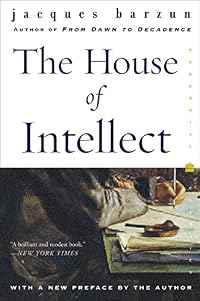
The house of intellect
by Jacques Barzun
On This Page
Description
The House of Intellect embraces: persons who consciously and methodically employ the mind, the forms and habits governing the activities in which the mind is so employed, and the conditions under which these people and activities exist.Tags
Recommendations


























Member Reviews
Summary: A discussion of the decline of the intellect and its causes.
It is fashionable in higher educational circles these days to decry the decline of intellectual life. Jacques Barzun, a patrician educator, professor of history and Dean at Columbia was doing that in 1959. What was striking to me was the continuity between what he wrote and our situation over sixty years later.
Barzun would define intellect as the basics of communication from the alphabet to the conventions of the clear articulation and argumentation of idea, disciplinary ideas and habits and more. He explains his idea of intellect as follows:
“That part of the world I call the House of the Intellect embraces at least three groups of subjects: the persons who show more consciously and methodically employ the mind; the forms and habits governing the activities in which the mind is so employed; and the conditions under which these people and activities exist. “
He goes on to explain the “house” metaphor:
“I would speak of the realm of the mind–limited and untamed–but I say the House of the Intellect, because it is an establishment, requiring appurtenances and prescribing conventions.”
He begins by contending that there are three enemies facing the intellect. When artistic sensibilities intrude into intellectual life, aesthetic sense obscures the discursive character of intellectual articulation. When the language of science intrudes, its precision and specificity intrudes into the unity of knowledge. Philanthropy as he uses it is opens education to a wide audience, regardless of fitness (which comes off as elitist, one of my problems with this part of his argument).
He describes the pseudo-intellectualism of public discourse and our polite, cultured conventions of conversation that prevent serious discussions of ideas (although some polite conventions and manners might be needed in our own day). He describes education as without instruction, observing the use of television for instruction (if only he knew) and instruction without authority. He is one of the earliest to recognize the conversion of education into business and college leadership into bureaucracies. And he points out how intellectual pedantry has influenced every discipline, and far beyond–even President Eisenhower declaims, “Marshal Zhukov and I operated together very closely” rather than saying “worked.”
Barzun makes an argument for power and pretension intruding into the work of the intellect. What is concerning is that he also sweeps up the broadening of American education into his critique. I was one of those who benefited by that “broadening,” or as he would call it, “philanthropy.” I would not naturally have enjoyed access to these opportunities, growing up in a lower middle, working class neighborhood. In another era, I might have been excluded from “the house of the Intellect.”
Nevertheless, Barzun poses some important questions. Today, it is the hegemony of STEM fields over those disciplines that classically taught clarity of thought and expression. He guts the jargon-laden discourse of many academic disciplines. He questions the academic fads that often substitute for the instruction that cultivates the intellect. He exposes the conventions of public and personal conversation that thwart intellectual life (I’d love to see what he would do with social media).
Barzun is an educator from another era, and while I cannot endorse some of his ideas, he also holds up a mirror to contemporary educational practice, asking, “why are we doing this?” He was a kind of educational prophet. If you can find a used copy of this online, and care about education, I think you will find this a thought-provoking read. show less
It is fashionable in higher educational circles these days to decry the decline of intellectual life. Jacques Barzun, a patrician educator, professor of history and Dean at Columbia was doing that in 1959. What was striking to me was the continuity between what he wrote and our situation over sixty years later.
Barzun would define intellect as the basics of communication from the alphabet to the conventions of the clear articulation and argumentation of idea, disciplinary ideas and habits and more. He explains his idea of intellect as follows:
“That part of the world I call the House of the Intellect embraces at least three groups of subjects: the persons who show more consciously and methodically employ the mind; the forms and habits governing the activities in which the mind is so employed; and the conditions under which these people and activities exist. “
He goes on to explain the “house” metaphor:
“I would speak of the realm of the mind–limited and untamed–but I say the House of the Intellect, because it is an establishment, requiring appurtenances and prescribing conventions.”
He begins by contending that there are three enemies facing the intellect. When artistic sensibilities intrude into intellectual life, aesthetic sense obscures the discursive character of intellectual articulation. When the language of science intrudes, its precision and specificity intrudes into the unity of knowledge. Philanthropy as he uses it is opens education to a wide audience, regardless of fitness (which comes off as elitist, one of my problems with this part of his argument).
He describes the pseudo-intellectualism of public discourse and our polite, cultured conventions of conversation that prevent serious discussions of ideas (although some polite conventions and manners might be needed in our own day). He describes education as without instruction, observing the use of television for instruction (if only he knew) and instruction without authority. He is one of the earliest to recognize the conversion of education into business and college leadership into bureaucracies. And he points out how intellectual pedantry has influenced every discipline, and far beyond–even President Eisenhower declaims, “Marshal Zhukov and I operated together very closely” rather than saying “worked.”
Barzun makes an argument for power and pretension intruding into the work of the intellect. What is concerning is that he also sweeps up the broadening of American education into his critique. I was one of those who benefited by that “broadening,” or as he would call it, “philanthropy.” I would not naturally have enjoyed access to these opportunities, growing up in a lower middle, working class neighborhood. In another era, I might have been excluded from “the house of the Intellect.”
Nevertheless, Barzun poses some important questions. Today, it is the hegemony of STEM fields over those disciplines that classically taught clarity of thought and expression. He guts the jargon-laden discourse of many academic disciplines. He questions the academic fads that often substitute for the instruction that cultivates the intellect. He exposes the conventions of public and personal conversation that thwart intellectual life (I’d love to see what he would do with social media).
Barzun is an educator from another era, and while I cannot endorse some of his ideas, he also holds up a mirror to contemporary educational practice, asking, “why are we doing this?” He was a kind of educational prophet. If you can find a used copy of this online, and care about education, I think you will find this a thought-provoking read. show less
1959, but not the same edition.
Ratings
Members
- Recently Added By
Lists

Books Read in 2021
5,361 works; 114 members
Author Information

74+ Works 9,614 Members
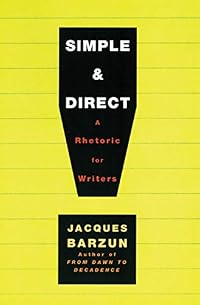
Jacques Barzun was born in Créteil, France on November 30, 1907. He came to the United States in 1920 and graduated magna cum laude from Columbia University in 1927. Following graduation, he joined Columbia's faculty as an instructor while continuing his studies in graduate school there, receiving a master's degree in 1928 and a doctorate in show more French history in 1932. He became a full professor in 1945, was dean of graduate faculties from 1955 to 1958, and dean of faculties from 1958 to 1967. He retired from Columbia University in 1975. He was a historian and cultural critic. The core of his work was the importance of studying history to understand the present and a fundamental respect for intellect. Although he wrote on subjects as diverse as detective fiction and baseball, he was especially known for his many books on music, nineteenth-century romanticism and education. His works include Darwin, Marx and Wagner: Critique of a Heritage; Romanticism and the Modern Ego; The House of Intellect; Race: A Study in Superstition; Simple and Direct: A Rhetoric for Writers; A Stroll with William James; The Culture We Deserve; and From Dawn to Decadence. He died on October 25, 2012 at the age of 104. (Bowker Author Biography) show less
Awards and Honors
Awards
Distinctions
Common Knowledge
- Original publication date
- 1959
Classifications
- Genres
- Nonfiction, Philosophy, General Nonfiction, History
- DDC/MDS
- 001.2 — Computer science, information & general works Computer science, knowledge & systems Knowledge and learning in general Scholars and learning: Intellectual activity directed toward increase of knowledge
- LCC
- AZ221 .B3 — General Works History of scholarship and learning. The humanities History of scholarship and learning. The humanities History
- BISAC
Statistics
- Members
- 500
- Popularity
- 59,865
- Reviews
- 2
- Rating
- (4.12)
- Languages
- English, Swedish
- Media
- Paper
- ISBNs
- 7
- ASINs
- 11