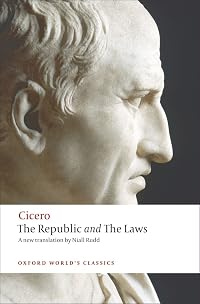
The Republic and The Laws
by Cicero
On This Page
Description
Cicero's On the Commonwealth and On the Laws were his first and most substantial attempt to adapt Greek theories of political life to the circumstances of the Roman Republic. They represent Cicero's vision of an ideal society, and remain his most important works of political philosophy. On the Commonwealth survives only in part, and On the Laws was never completed. The present volume offers a scholarly reconstruction of the fragments of On the Commonwealth and a masterly translation of both show more dialogues, prepared by James E. G. Zetzel, Professor of Classics at Columbia University. The texts are supported by a concise introduction, notes, synopsis, biographical notes and bibliography, all designed to assist students in politics, philosophy, ancient history, law and classics. show lessTags
Recommendations





Member Reviews
In these two dialogues, Cicero sets out to articulate an ideal but practically achievable form of government designed to protect natural law through the creation and enforcement of human-made law that ensures the happiness and protection of citizens, in so far as they remain duty-conscious members of and contributors to their communities. In this way, Cicero builds from the ideals of Plato’s concept of justice but with an Aristotelean emphasis on the practical wisdom needed to operationalize a form of mixed governance (i.e., sharing qualities of monarchy, aristocracy, and democracy) that is focused on preserving the common good — the reduction of worry and freedom from work (100).
There is a strong sense of duty that runs through show more Cicero’s account of the republic, which is an interesting and necessary change from some of the Greek models that Cicero references. The rights and protections that come to individuals are not owed to them as individuals but are instead granted to them as citizens, as contributors to the communities they belong to:
As Cicero sees it, our first responsibilities as citizens are to the commonwealth. To the common good we owe as much of our wealth, wisdom, energy, allegiance, and loyalty as is needed to ensure its operation. Whatever is left over is for our own needs, and presumably toward the potential, unequal betterment of individual positions. Like Aristotle, Cicero appears to advocate for a system of differential justice, where each receives a fair, if unequal, share of wealth, property, freedom. “A state by adjusting the proportions between the highest, lowest, and intermediate classes, as if they were musical notes, achieves harmony” (58).
This all sounds fine in principle but so much depends on a functioning governmental system that is oriented to the common good and not individual interest, where the laws are not bent to the good of individuals and the infrastructure of the republic is not weighted unfairly toward the benefit of the few. Achieving such harmony is the role of the statesman (83) whose function is to apply right reason to recognize where government and law is needed to manage and guide the day to day complexities of co-existence. As individuals it can be difficult for us to see what the common good is because we are so wrapped up in a consideration of our own interests. Our orientation toward natural law provides some inherent guidance about what is right and wrong, but not enough.
In The Laws, Cicero demonstrates practical wisdom — the ability recognize the ideal, tempered by the possible, and the ability to find a way to put value into practice, as imperfect as it might be. Cicero comes through, in The Laws, with an articulation of a governmental structure that reflects the mixed constitutional framework of The Republic but also introduces a set of offices with obligatory interactions that we would recognized today as a bureaucratic system of representative and appointed offices designed to operate within a system of checks and balances. There is also a recognition that some degree of flexibility is to be tolerated (e.g., around the acceptance of religious practices and laws) so long as individuals preserve the harmony of the larger community into which they have been (sometimes forcibly) assimilated. These seem like practical concessions of a governmental system with an eye toward empire, as opposed to the ruling of a 2,000 person city state.
Of the two dialogues, The Republic is a more fragmented than The Laws. As such there are significant jumps in the thread of the conversation (due to missing pages) that make the points a little hard to follow. The Laws is more intact. Nevertheless, the editors have pieced together what the missing dialogue might have covered based on references found in other sources. show less
There is a strong sense of duty that runs through show more Cicero’s account of the republic, which is an interesting and necessary change from some of the Greek models that Cicero references. The rights and protections that come to individuals are not owed to them as individuals but are instead granted to them as citizens, as contributors to the communities they belong to:
“our country did not give us life and nurture unconditionally, without expecting to receive in return, as it were, some maintenance from us; nor did it engage simply to serve our convenience, providing a safe haven for our leisure and a quiet place for our relaxation. No, it reserved the right to appropriate for its own purpose the largest and most numerous portions of our loyalty, ability, and sagacity, leaving to us for our private use only what might be surplus to its needs” (6)
As Cicero sees it, our first responsibilities as citizens are to the commonwealth. To the common good we owe as much of our wealth, wisdom, energy, allegiance, and loyalty as is needed to ensure its operation. Whatever is left over is for our own needs, and presumably toward the potential, unequal betterment of individual positions. Like Aristotle, Cicero appears to advocate for a system of differential justice, where each receives a fair, if unequal, share of wealth, property, freedom. “A state by adjusting the proportions between the highest, lowest, and intermediate classes, as if they were musical notes, achieves harmony” (58).
This all sounds fine in principle but so much depends on a functioning governmental system that is oriented to the common good and not individual interest, where the laws are not bent to the good of individuals and the infrastructure of the republic is not weighted unfairly toward the benefit of the few. Achieving such harmony is the role of the statesman (83) whose function is to apply right reason to recognize where government and law is needed to manage and guide the day to day complexities of co-existence. As individuals it can be difficult for us to see what the common good is because we are so wrapped up in a consideration of our own interests. Our orientation toward natural law provides some inherent guidance about what is right and wrong, but not enough.
In The Laws, Cicero demonstrates practical wisdom — the ability recognize the ideal, tempered by the possible, and the ability to find a way to put value into practice, as imperfect as it might be. Cicero comes through, in The Laws, with an articulation of a governmental structure that reflects the mixed constitutional framework of The Republic but also introduces a set of offices with obligatory interactions that we would recognized today as a bureaucratic system of representative and appointed offices designed to operate within a system of checks and balances. There is also a recognition that some degree of flexibility is to be tolerated (e.g., around the acceptance of religious practices and laws) so long as individuals preserve the harmony of the larger community into which they have been (sometimes forcibly) assimilated. These seem like practical concessions of a governmental system with an eye toward empire, as opposed to the ruling of a 2,000 person city state.
Of the two dialogues, The Republic is a more fragmented than The Laws. As such there are significant jumps in the thread of the conversation (due to missing pages) that make the points a little hard to follow. The Laws is more intact. Nevertheless, the editors have pieced together what the missing dialogue might have covered based on references found in other sources. show less
The works included here are rather fragmentary -especially The Republic, so it's hard to give the works a fair appraisal. That being said, I did gain some insight into ancient Roman politics. I also think some of the ideas in here speak to us all these centuries later. There is one quote that had to do with the anarchic tendency of democracy that particularly caught my attention:
"In a state of that kind total freedom must prevail. Every private household is devoid of authority…Father fears son, son ignores father, respect is completely absent. In the interests of universal freedom there is no distinction between citizen and foreigner… Youngsters assume the authority of older men… As this unlimited license comes to a head… show more citizens become so tender and hypersensitive that at the slightest hint of authority they are enraged and cannot bear it. In consequence they begin to ignore laws too; and the final outcome is total anarchy."
The above struck me because of how relevant it is to our current state of democracy in this country, where a certain contingent of voters really see no difference between criminal illegal immigrants, extremist foreign dissidents and legal citizens. They insist on conflating all of the above to the point that they will cause riots if people vote against them and all the while they will insist that they are tolerant, peaceful, freedom-loving, egalitarians. This country embodies to a great extent that puerile and idiotic freedom that Cicero decried.
Like Plato, Cicero recognized the shifting tides of political systems. Absolute democracy becomes the rule of an ignorant mob, who lack the knowledge and wisdom to even govern themselves responsibly, let alone govern others. Left to it's own devices, absolute democracy degrades into chaos; a chaos where everything is a constant leveling to the lowest common denominator until there is no longer any respect for authority, nor law. When society degrades to this point, it opens the way to tyranny in order to put a stop to that increasing tide of societal chaos. And that tyranny will hold sway until, once again, some control is yet again given to the masses after some kind of revolution or government upheaval; and the cycle starts again.
As was in Plato's day and in Cicero's day, so in our day. There are still tyrants waiting to seize the reigns of power and there are still ignorant and unruly masses of people that will give them the impetus they need to seize control. An ever watchful vigilance must always be on guard against both extremes. Cicero seems to advocate a mixed system of government. That is what our founding fathers attempted to create here. Even in an optimal system of government that embodies the best aspects of a republic and a democracy, personal accountability and responsibility are needed to make it work. That's what was lacking in the past and that is still what is lacking today. show less
"In a state of that kind total freedom must prevail. Every private household is devoid of authority…Father fears son, son ignores father, respect is completely absent. In the interests of universal freedom there is no distinction between citizen and foreigner… Youngsters assume the authority of older men… As this unlimited license comes to a head… show more citizens become so tender and hypersensitive that at the slightest hint of authority they are enraged and cannot bear it. In consequence they begin to ignore laws too; and the final outcome is total anarchy."
The above struck me because of how relevant it is to our current state of democracy in this country, where a certain contingent of voters really see no difference between criminal illegal immigrants, extremist foreign dissidents and legal citizens. They insist on conflating all of the above to the point that they will cause riots if people vote against them and all the while they will insist that they are tolerant, peaceful, freedom-loving, egalitarians. This country embodies to a great extent that puerile and idiotic freedom that Cicero decried.
Like Plato, Cicero recognized the shifting tides of political systems. Absolute democracy becomes the rule of an ignorant mob, who lack the knowledge and wisdom to even govern themselves responsibly, let alone govern others. Left to it's own devices, absolute democracy degrades into chaos; a chaos where everything is a constant leveling to the lowest common denominator until there is no longer any respect for authority, nor law. When society degrades to this point, it opens the way to tyranny in order to put a stop to that increasing tide of societal chaos. And that tyranny will hold sway until, once again, some control is yet again given to the masses after some kind of revolution or government upheaval; and the cycle starts again.
As was in Plato's day and in Cicero's day, so in our day. There are still tyrants waiting to seize the reigns of power and there are still ignorant and unruly masses of people that will give them the impetus they need to seize control. An ever watchful vigilance must always be on guard against both extremes. Cicero seems to advocate a mixed system of government. That is what our founding fathers attempted to create here. Even in an optimal system of government that embodies the best aspects of a republic and a democracy, personal accountability and responsibility are needed to make it work. That's what was lacking in the past and that is still what is lacking today. show less
Cicero wrote his dialogue, The Republic, just before the civil war that ended the Roman Republic. In it he discusses the history of Rome and its constitution. The Republic of Cicero is in one sense modeled after Plato's Republic, but it is different as well. Cicero presents a more realistic view of the state based on the Roman Republic that was in its last stages during Cicero's lifetime. He assimilates the philosophy of Plato, but also Aristotle's Politics and others.
In it he discusses the nature of different political organizations including Monarchy, Aristocracy, and Democracy, among others. His discussion of the best states and his comparison of monarchy, aristocracy, and democracy is thoughtful --- highlighting the differences and show more weighing the advantages and disadvantages of each; he concludes that the best regime may be one that is a blend of all three.
In the sequel essay entitled The Laws he promulgates a doctrine of Natural Law, which he then applies to all mankind. His code of law is developed for a reformed Roman Republic that, unfortunately, he never lived to see -- and after his death was preempted by the imposition of the Empire under the leadership of Augustus Caesar.
The following remarks give some indication of the best of his thinking: "The aim of a ship's captain is a successful voyage; a doctor's, health; a general's, victory. So the aim of our ideal statesman is the citizen's happy life---that is, a life secure in wealth, rich in resources, abundant in renown, and honorable in its moral character. That is the task which I wish him to accomplish---the greatest and best that any man can have." show less
In it he discusses the nature of different political organizations including Monarchy, Aristocracy, and Democracy, among others. His discussion of the best states and his comparison of monarchy, aristocracy, and democracy is thoughtful --- highlighting the differences and show more weighing the advantages and disadvantages of each; he concludes that the best regime may be one that is a blend of all three.
In the sequel essay entitled The Laws he promulgates a doctrine of Natural Law, which he then applies to all mankind. His code of law is developed for a reformed Roman Republic that, unfortunately, he never lived to see -- and after his death was preempted by the imposition of the Empire under the leadership of Augustus Caesar.
The following remarks give some indication of the best of his thinking: "The aim of a ship's captain is a successful voyage; a doctor's, health; a general's, victory. So the aim of our ideal statesman is the citizen's happy life---that is, a life secure in wealth, rich in resources, abundant in renown, and honorable in its moral character. That is the task which I wish him to accomplish---the greatest and best that any man can have." show less
A lawyer by trade, statesman by calling and philosopher by hobby, Cicero was the ideal candidate to draw from the political philosophy of Plato and Aristotle, combine it with an examination of the constitution and civic laws of his own country Rome, the most powerful state of his time, and propose a political theory both philosophically grounded and legitimately sound.
Like the ancient Greek and Roman statues and architecture, only fragments of Cicero's two works (De Republica and De Legibus) have been preserved, and, as a result, this translation is incomplete and disjointed in many places. However, I discovered that even fragmented works of a great mind are worth more than complete volumes of mediocrity.
A Call to Public Service
Cicero show more is his eloquent, oratorical self when he delivers a passionate speech exhorting the virtues and advantages of the life and career of a statesman, who dedicates himself to public service, not for self-interest or personal gain, but for the just cause and demand of his country.
The Nature and Origin of the Law
As a foundation of his entire discourse, Cicero lays down a definition of the Law derived from his view of the universe, which is in accord with those of Plato and the Stoics, and argues that law and justice are inherent in nature, not drawn up by custom or convention.
The universe is governed by God, who has implanted the immortal soul in man from His own divine nature. The Mind of God (i.e., the highest reason and intelligence) is the unchanging and universal Law governing the whole universe, both the natural world and human society. "Law is the highest reason, inherent in nature, which enjoins what ought to be done and forbids the opposite. When that reason is fully formed and completed in the human mind, it too is law." Man comprehends the Law because he partakes of the faculty of reason and intelligence from God. The laws of human societies are based on their understanding of the universal Law, and may vary from people to people, depending on the integrity of their vision and their political acumen. Nevertheless, the essence of the Law is the same. "It received its Greek name from giving each his own. I think its Latin name comes from choosing. As they stress the element of fairness in law, and we stress that of choice; but in fact each of these is an essential property of law."
The Best Form of Government
Of the three forms of government, monarchy, aristocracy and democracy, Cicero, as Aristotle did in Politics, proposes a moderate mixture of the three as the best form of government, because the pure forms easily degenerate into their corrupted counterpart (i.e. monarchy into tyranny, aristocracy into oligarchy), although he agrees with Plato that monarchy in its uncorrupted form is the best government. show less
Like the ancient Greek and Roman statues and architecture, only fragments of Cicero's two works (De Republica and De Legibus) have been preserved, and, as a result, this translation is incomplete and disjointed in many places. However, I discovered that even fragmented works of a great mind are worth more than complete volumes of mediocrity.
A Call to Public Service
Cicero show more is his eloquent, oratorical self when he delivers a passionate speech exhorting the virtues and advantages of the life and career of a statesman, who dedicates himself to public service, not for self-interest or personal gain, but for the just cause and demand of his country.
The Nature and Origin of the Law
As a foundation of his entire discourse, Cicero lays down a definition of the Law derived from his view of the universe, which is in accord with those of Plato and the Stoics, and argues that law and justice are inherent in nature, not drawn up by custom or convention.
The universe is governed by God, who has implanted the immortal soul in man from His own divine nature. The Mind of God (i.e., the highest reason and intelligence) is the unchanging and universal Law governing the whole universe, both the natural world and human society. "Law is the highest reason, inherent in nature, which enjoins what ought to be done and forbids the opposite. When that reason is fully formed and completed in the human mind, it too is law." Man comprehends the Law because he partakes of the faculty of reason and intelligence from God. The laws of human societies are based on their understanding of the universal Law, and may vary from people to people, depending on the integrity of their vision and their political acumen. Nevertheless, the essence of the Law is the same. "It received its Greek name from giving each his own. I think its Latin name comes from choosing. As they stress the element of fairness in law, and we stress that of choice; but in fact each of these is an essential property of law."
The Best Form of Government
Of the three forms of government, monarchy, aristocracy and democracy, Cicero, as Aristotle did in Politics, proposes a moderate mixture of the three as the best form of government, because the pure forms easily degenerate into their corrupted counterpart (i.e. monarchy into tyranny, aristocracy into oligarchy), although he agrees with Plato that monarchy in its uncorrupted form is the best government. show less
I was surprised by how fragmentary the Republic is. You can hardly get through two or three pages before there's another break due to missing leaves. So it's hard to make much sense of what Cicero is trying to say in that work. The Laws, on the other hand, is much more readable and an influential classic in the history of legal theory.
Good book, The Republic is very fragmented and therefore a little bit hard to read. We have more of Laws but it, too, is missing a bit.
Cicero's application of Aristotelianism to the Roman context.
Members
- Recently Added By
Lists

Books and authors mentioned by Le Clézio in his Nobel Prize speech
87 works; 3 members

Book wishlist
78 works; 1 member

Philosophy, Politics, and Ethics from Oxford World Classics
11 works; 1 member
Author Information

2,152+ Works 26,803 Members
Born in Arpinum on January 3, 106 B.C., Marcus Tullius Cicero was a Roman orator, writer, and politician. In Rome, Cicero studied law, oratory, philosophy, and literature, before embarking on a political career. Banished from Rome in 59 B.C. for the execution of some members of the Catiline group, Cicero devoted himself to literature. Cicero was show more pardoned by Julius Caesar in 47 B.C., and returned to Rome to deliver his famous speeches, known as the "Philippics," urging the senate to declare war on Marc Antony. Cicero's chief works, written between 46 and 44 B.C., can be classified in the categories of philosophical works, letters, and speeches. The letters, edited by his secretary Tiro, showcase a unique writing style and charm. The most popular work of the period was De Officiis, a manual of ethics, in which Cicero espoused fundamental Christian values half a century before Christ. Cicero was murdered in Formiae, Italy, on December 4, 43 B.C., by Antony's soldiers after the triumvirate of Antony, Lepidus, and Octavius was formed. (Bowker Author Biography) show less
Some Editions
Awards and Honors
Notable Lists
Series
Belongs to Publisher Series
Common Knowledge
- Canonical title
- The Republic and The Laws
- Important places
- Rome, Roman Empire
Classifications
Statistics
- Members
- 1,021
- Popularity
- 25,589
- Reviews
- 8
- Rating
- (3.69)
- Languages
- 8 — Chinese, Danish, English, French, German, Latin, Polish, Spanish
- Media
- Paper, Ebook
- ISBNs
- 30
- ASINs
- 9