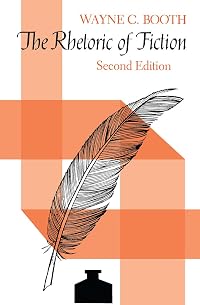
The Rhetoric of Fiction
by Wayne C. Booth
On This Page
Description
"Rhetoric is the author's term for the means by which the writer makes known his vision to the reader and persuades him of its validity; and he demonstrates convincingly that there is no essential difference between ostentatiously rhetorical novelists like Fielding and Dickens, and the admired masters of impersonality--Flaubert, James, Joyce ... this is a major critical work which should be required reading for everyone concerned in the academic study of prose fiction." [Modern Language Review].Tags
Recommendations






Member Reviews
I picked up and read "Rhetoric" from the perspective of an author-wannabe, so my copy is now scored with underlines and margin notes that will enable me to keep my interpretations and its key points straight when I browse through it later for reference. It goes beyond grammer/syntax advice, beyond plot/character/theme construction, to explore what actually makes a good novel a good novel. I'm not taking away any hard and fast lessons - Mr. Booth largely dispenses with the possibility of such things - but I have now been made witness to many enlightening examples. It makes me interested in pursuing works I previously had no desire to read (e.g. Tristram Shandy, Tom Jones, Madame Bovary, possibly Ulysses and the works of Henry James and show more Graham Greene, among a few others) because I'm better positioned to appreciate the telling of these tales, not just the tales themselves. I can see "Rhetoric" being a worthwhile read for anyone who would like to acquire a similar appreciation.
Someone wiser than me summarized this book's thesis as "all narrative is rhetoric". An author has tangible presence in his/her fiction novel, however well disguised or aloof he/she strives to be (and many have tried very hard, depending on changing trends in critcism of how obvious / how much obvious presence is judged acceptable). There is a second self thus produced by the author, here called the 'implied author', in the course of writing a fiction piece, that suggests a personality who is pulling the strings behind the scenes. This implied author is tantamount to being a character in the story, and should not be equated with the actual author. The actual author needs to be aware of this implied presence he/she is creating and its effect on how the reader perceives and reads the story. A good author, writing a good novel, will be aware of and use this presence to his/her advantage by being fully aware of what he/she is making a case for and employ good rhetoric accordingly.
I'm led to wonder, how much of what I would have called an author's style is more correctly attributed as characteristics of this "implied author" concept? I think my next step should be to find a book that takes what Mr. Booth produced here and explores that question. I'd like to obtain a firmer understanding of what is meant by "style" in the context of this book's thesis. show less
Someone wiser than me summarized this book's thesis as "all narrative is rhetoric". An author has tangible presence in his/her fiction novel, however well disguised or aloof he/she strives to be (and many have tried very hard, depending on changing trends in critcism of how obvious / how much obvious presence is judged acceptable). There is a second self thus produced by the author, here called the 'implied author', in the course of writing a fiction piece, that suggests a personality who is pulling the strings behind the scenes. This implied author is tantamount to being a character in the story, and should not be equated with the actual author. The actual author needs to be aware of this implied presence he/she is creating and its effect on how the reader perceives and reads the story. A good author, writing a good novel, will be aware of and use this presence to his/her advantage by being fully aware of what he/she is making a case for and employ good rhetoric accordingly.
I'm led to wonder, how much of what I would have called an author's style is more correctly attributed as characteristics of this "implied author" concept? I think my next step should be to find a book that takes what Mr. Booth produced here and explores that question. I'd like to obtain a firmer understanding of what is meant by "style" in the context of this book's thesis. show less
Great read! I learned a lot about why authors in the post-Flaubert/Henry James era of modern fiction became so obsessed with eliminating all traces of narratorial commentary from their novels (that is, why modern fiction sought to privilege "showing" over "telling"), and Booth does a great job of questioning what should certainly be seen as an ideological insistence on certain modes of storytelling that only rarely question their own premises. That is, if Henry James was really quite responsible and dedicated in his discussions of why the presentation of dramatic scenes where stories more or less tell themselves, he also seemed to understand that this was an ideal that no text achieves. As Booth demonstrates, you can disguise the show more "telling" of a story in a lot of different ways so that it looks like the narrator isn't intruding on the narrative and injecting his or her own subjective views on the matter at hand, but you can't completely avoid using strategies that show your hand as the story's creator in various subtle ways.
The Rhetoric of Fiction gives some great practical guidance for readers of novels. I feel like I'm much more attuned to some of the subtleties of novel writing than I was before. I don't necessarily agree with his overarching concern with rescuing a certain moral function for the novel (that is, as he himself admits in an afterword written 20 years after the book's original publication, he is rather overzealous in his condemnation of books like Céline's Voyage au bout de la nuit due to their immorality), but his own historically-situated conclusions don't take anything away from his analyses of modern fiction. And, in fact, they're challenging in that I don't want to agree with his insistence on the moral function of fiction, but I'm not sure I have good reasons for disagreeing.
It's always refreshing to read classics like this, and I'd definitely recommend it. The Rhetoric of Fiction helped me understand late-19th and early-20th century literature in ways I hadn't necessarily thought of before. show less
The Rhetoric of Fiction gives some great practical guidance for readers of novels. I feel like I'm much more attuned to some of the subtleties of novel writing than I was before. I don't necessarily agree with his overarching concern with rescuing a certain moral function for the novel (that is, as he himself admits in an afterword written 20 years after the book's original publication, he is rather overzealous in his condemnation of books like Céline's Voyage au bout de la nuit due to their immorality), but his own historically-situated conclusions don't take anything away from his analyses of modern fiction. And, in fact, they're challenging in that I don't want to agree with his insistence on the moral function of fiction, but I'm not sure I have good reasons for disagreeing.
It's always refreshing to read classics like this, and I'd definitely recommend it. The Rhetoric of Fiction helped me understand late-19th and early-20th century literature in ways I hadn't necessarily thought of before. show less
(Original Review, 1981-03-28)
When Booth came up with the idea of the "unreliable narrator," he wasn't speaking to writers; he was reminding critics and teachers and readers in general of something every decent writer of fiction has always known: that a narrator is a voice, and a voice is a character, and is still a character - a created fictional person - whether it has a name or is just an apparently omniscient intermediary. The idea that this particular character must for some reason be an honest (much less an accurate) portrait of the author himself is just silly, but it's a silliness that a great many critics once allowed themselves to fall into. If Hammett's voice in Falcon is anything, it's purposeful and controlled, and he had to show more have worked very hard on it. The idea that that voice must also be Hammett or Heinlein themselves... well, I don't think fatuous is too strong a word. We have had very little of that kind of fatuous talk around here (thank goodness), but at times we – me, as much as anyone – have gone off in the opposite direction and assumed that because we can find something in Falcon Hammett or in Strange Heinlein, must have meant for it to matter more than the story itself. In other words, I know there’s a line but I don’t know exactly where to draw it - and I suppose that all I want from you is a reassurance that you agree that that line is lurking somewhere quite close by.
This is one of the books that made me appreciate Robert A. Heinlein even more. [2018 EDIT: And K. J. Parker in this day and age; if you want to know what it means to write sucessful "unreliable narrators" look no further.]
(By the way, the idea that there are male equivalents to femmes fatales is strangely familiar to me...) show less
When Booth came up with the idea of the "unreliable narrator," he wasn't speaking to writers; he was reminding critics and teachers and readers in general of something every decent writer of fiction has always known: that a narrator is a voice, and a voice is a character, and is still a character - a created fictional person - whether it has a name or is just an apparently omniscient intermediary. The idea that this particular character must for some reason be an honest (much less an accurate) portrait of the author himself is just silly, but it's a silliness that a great many critics once allowed themselves to fall into. If Hammett's voice in Falcon is anything, it's purposeful and controlled, and he had to show more have worked very hard on it. The idea that that voice must also be Hammett or Heinlein themselves... well, I don't think fatuous is too strong a word. We have had very little of that kind of fatuous talk around here (thank goodness), but at times we – me, as much as anyone – have gone off in the opposite direction and assumed that because we can find something in Falcon Hammett or in Strange Heinlein, must have meant for it to matter more than the story itself. In other words, I know there’s a line but I don’t know exactly where to draw it - and I suppose that all I want from you is a reassurance that you agree that that line is lurking somewhere quite close by.
This is one of the books that made me appreciate Robert A. Heinlein even more. [2018 EDIT: And K. J. Parker in this day and age; if you want to know what it means to write sucessful "unreliable narrators" look no further.]
(By the way, the idea that there are male equivalents to femmes fatales is strangely familiar to me...) show less
It helps to have read Emma, Tristram Shandy, Samuel Beckett's Company, some Dafoe, some Swift, and whole lot of Henry James, to really piece this work together. Booth is primarily concerned with the relationship between the narrator, the implied author, and the reader. I think he is one of the first to use the term "unreliable narrator" to describe the critical distance required when reading a first person narrative.
I enjoyed his analysis of Austen's Emma the most, as I recently reread it and appreciated his commentary on Austen's use of narrative voice to gain the both the reader's sympathy and approbation for her heroine.
I enjoyed his analysis of Austen's Emma the most, as I recently reread it and appreciated his commentary on Austen's use of narrative voice to gain the both the reader's sympathy and approbation for her heroine.
Admittedly, I am only about 30 pages into the book, and I realize that the original edition was written in 1961, but I find myself balking at the notion of "the author's voice" (I guess I've read too much Barthes) and also at the preponderance of the male pronoun when it comes to discussing the author (too much feminist theory). But when I take all of my poststructuralist leanings away, I find that this book will be eventually very useful for teaching formal approaches to fiction, as its tone, structure, and analytical approach are clear and crisp, and not laden with the sometimes useless questioning and undermining of the text that sometimes complicates the usefulness of later literary theory. This appears to me so far to be the apex show more of "literary criticism" as opposed to theory, and as a closet structuralist, I am enjoying it so far. show less
Admittedly, I am only about 30 pages into the book, and I realize that the original edition was written in 1961, but I find myself balking at the notion of "the author's voice" (I guess I've read too much Barthes) and also at the preponderance of the male pronoun when it comes to discussing the author (too much feminist theory). But when I take all of my poststructuralist leanings away, I find that this book will be eventually very useful for teaching formal approaches to fiction, as its tone, structure, and analytical approach are clear and crisp, and not laden with the sometimes useless questioning and undermining of the text that sometimes complicates the usefulness of later literary theory. This appears to me so far to be the apex show more of "literary criticism" as opposed to theory, and as a closet structuralist, I am enjoying it so far. show less
Such a smart way of looking at novels. Useful both for students of literature and for writers.
Members
- Recently Added By
Lists

The One Book That Changed You
15 works; 16 members

Books That Changed Our Perspective
423 works; 168 members

Literature and Criticism
12 works; 1 member
Author Information

24+ Works 6,221 Members
A graduate student at the University of Chicago in the late 1940s, when the English Department was dominated by members of the Chicago School of criticism, Wayne Booth returned to his alma mater in the early 1960s and became an exponent of its critical methodology. The Chicago Critics were influenced by the formalistic, rhetorical analysis of the show more Poetics of Aristotle, which was concerned with the principles of literary construction and literary esthetics. Unlike the New Critics, who shared their interest in formalist analysis of texts, the Chicago Critics emphasized the importance of knowledge about the author and his or her historical context. They considered the New Criticism, which had developed at about the same time, too restrictive in its bracketing of that information as external to the text and therefore incidental to understanding and evaluating it. The first generation of Chicago School critics, who were Booth's teachers, did not have much impact beyond the university itself. Booth, however, continued to advocate pluralism. Critical Understanding: The Powers and Limits of Pluralism Critical Understanding: (1979) helped revitalize and popularize Chicago School principles. Booth is associated with two other movements in contemporary literary theory: reader-response criticism and narratology. The former includes a heterogeneous group of reader-oriented rather than text-oriented methodologies. The latter is usually seen as a type of structuralist or proto-structuralist literary study, since it focuses on the function and the grammar, or structure, of narrative. Linked with both is Booth's Rhetoric of Fiction (1962), which concentrates on the analysis of point of view and how writers manipulate it so that readers accept the values of the implied author of a text's narration. Booth's work has increasingly emphasized reading, ethics, and the rhetoric of persuasion-a concern already implicit in this early book. (Bowker Author Biography) show less
Awards and Honors
Awards
Work Relationships
Common Knowledge
- Canonical title
- The Rhetoric of Fiction
- Original publication date
- 1961
- Epigraph
- "It is the first necessity of the novelist's position that he make himself pleasant." --TROLLOPE
"My task...is to make you see." --CONRAD
"Until these things are judged and given each its appointed place in the ... (show all)whole scheme, they have no meaning in the world of art." --KATHERINE MANSFIELD, protesting the method of Dorothy Richardson
"The author makes his readers, just as he makes his characters." --HENRY JAMES
"I write; let the reader learn to read." --MARK HARRIS - Dedication
- To Ronald Crane
- First words
- One of the most obviously artificial devices of the storyteller is the trick of going beneath the surface of the action to obtain a reliable view of a character's mind and heart.
- Quotations
- My goal is not to set everyone straight about my favourite novelists but rather to free both readers and novelists from the constraints of abstract rules about what novelists must do, by reminding them in a systematic way abo... (show all)ut what novelists have in fact done.
- Last words
- (Click to show. Warning: May contain spoilers.)The author makes his readers. If he makes them badly--that is, if he simply waits, in all purity, for the occasional reader whose perceptions and norms happen to match his own, then his conception must be lofty indeed if we are to forgive him for his bad craftsmanship. But if he makes them well--that is, makes them see what they have never seen before, moves them into a new order of perception and experience altogether--he finds his reward in the peers he has created.
(Click to show. Warning: May contain spoilers.)2nd Ed: What we pursue here is nothing other than the best practice of all tellers and listeners, joined in the best talk we can manage about how we all do that. There is in fact no one who cannot, by applying thought to firsthand reading experience, help to tell it all better.
Classifications
- Genres
- Literature Studies and Criticism, Nonfiction
- DDC/MDS
- 808.3 — Literature & rhetoric Literature, rhetoric & criticism Rhetoric and collections of literary texts from more than two literatures Rhetoric of fiction
- LCC
- PN3355 .B597 — Language and Literature Literature (General) Literature (General) Prose. Prose fiction Technique. Authorship
- BISAC
Statistics
- Members
- 977
- Popularity
- 27,135
- Reviews
- 11
- Rating
- (4.13)
- Languages
- 6 — Chinese, English, Italian, Serbian, Spanish, Turkish
- Media
- Paper, Ebook
- ISBNs
- 12
- ASINs
- 4