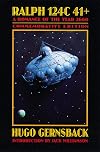
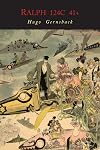
Ralph 124C 41+
by Hugo Gernsback
On This Page
Description
By the year 2660, science has transformed and conquered the world, rescuing humanity from itself. Spectacular inventions from the farthest reaches of space and deep beneath the earth are available to meet every need, providing antidotes to individual troubles and social ills. Inventors are highly prized and respected, and they are jealously protected and lavishly cared for by world governments. That support and acclaim, however--as the most brilliant of scientists, Ralph 124C 41+, show more discovers--is not without its price. This visionary novel of the twenty-seventh century was written by Hugo Gernsback (1887-1964), founder of the influential magazine Amazing Stories. Marvelously prophetic and creative, Ralph 124C 41+ celebrates technological advances and entrances readers with an exuberant, unforgettable vision of what our world might become. This commemorative edition makes this landmark tale widely available for the first time in decades and features the prized Frank R. Paul illustrations from the rare first edition, a list of inventions and technological devices, and Hugo Gernsback's prefaces to the first and second editions. show lessTags
Recommendations














Member Reviews
Arguably, Hugo Gernsback is more famous than he ought to be. Compared with some speculative fiction writers of the previous generation--such as Edward Bellamy, Samuel Butler, H. G. Wells, and Jules Verne--Gernsback is laughably amateurish. So, why do we enshrine his name in Awards and credit him with somehow starting science fiction as a genre? Rereading Ralph124C41+, I have decided it must be because no one else has his gushing, almost religious enthusiasm for technology with scientist-engineers as the new clergy. Consider this early description of Ralph: “His physical superiority, however, was nothing compared to his gigantic mind. He was Ralph 124C 41+, one of the greatest living scientists and one of the ten men on the whole show more planet earth permitted to use the Plus sign after his name.”
Clunky though his style may be, you can’t beat Gernsback for sheer fecundity. From color television to electric vehicles and beamed power, Ralph creates a new gadget to solve every problem. He is the prototype of what editor John Campbell would call the ideal of the “competent man,” one able to use a rational imagination to face whatever life throws his way. show less
Clunky though his style may be, you can’t beat Gernsback for sheer fecundity. From color television to electric vehicles and beamed power, Ralph creates a new gadget to solve every problem. He is the prototype of what editor John Campbell would call the ideal of the “competent man,” one able to use a rational imagination to face whatever life throws his way. show less
http://nhw.livejournal.com/852938.html
Brian Aldiss blames Gernsback for taking sf away from the literary tradition established by Mary Shelley, and reading this, the Luxembourg-born author's only well-known work of fiction, I can see why Aldiss accuses Gernsback of "a deadening literalism"; and yet I can also understand why the Worldcon hands out Hugos rather than Shelleys.
This fairly short novel was written in 1911, and concerns Ralph 124C 41+, the greatest inventor of his age, who one day meets the beautiful Alice as a result of a crossed videophone conversation, and saves her from an avalanche in distant Switzerland by remote control. He takes her on a tour of 27th century New York and rescues her from abduction and certain death in show more space at the hands of his rivals for her affections.
Of course the narrative (such as it is) is interrupted frequently by breathless descriptions of the technical advances of the year 2660. Some of these (e.g. radar and solar panels) are now familiar to us in 2007, while in some cases one wonders why he didn't take the idea a step further (you can watch live broadcasts from Europe, and phone calls use video as a matter of course, but no mention of video recording of any kind - and this was written several years after the dawn of cinema).
No robots (still nine years before Čapek invented them in R.U.R.), and perhaps more unexpectedly no rockets - space flight happens via antigravity. (Robert Goddard only began his rocket experiments that same year, 1911; Tsiolkovsky had been writing on the subject for decades, but I don't know how well know his work was in the English-speaking world.)
Yet Gernsback's most spectacular miss is in his failure to understand how technology would revolutionise society. Ralph's sleep is enlivened by a recording of Homer's Odyssey; his manservant puts it on for him. Ralph's dictation machine means that his secretary can devote her time to other things, not that he can dispense with her services. As noted above, we hear a lot about live entertainment, but not much about other forms of literature. The technicalities of how the newspaper of 2660 is produced and read are described in detail; its contents are not.
(And Gernsbach's asteroids have atmospheres.)
Still, I can find a lot more forgiveness for him than Brian Aldiss did: for me, Gernsbach's enthusiasm makes up for his desperately clunky prose. And I love the line, "Martians in New York were not sufficiently rare to excite any particular comment." show less
Brian Aldiss blames Gernsback for taking sf away from the literary tradition established by Mary Shelley, and reading this, the Luxembourg-born author's only well-known work of fiction, I can see why Aldiss accuses Gernsback of "a deadening literalism"; and yet I can also understand why the Worldcon hands out Hugos rather than Shelleys.
This fairly short novel was written in 1911, and concerns Ralph 124C 41+, the greatest inventor of his age, who one day meets the beautiful Alice as a result of a crossed videophone conversation, and saves her from an avalanche in distant Switzerland by remote control. He takes her on a tour of 27th century New York and rescues her from abduction and certain death in show more space at the hands of his rivals for her affections.
Of course the narrative (such as it is) is interrupted frequently by breathless descriptions of the technical advances of the year 2660. Some of these (e.g. radar and solar panels) are now familiar to us in 2007, while in some cases one wonders why he didn't take the idea a step further (you can watch live broadcasts from Europe, and phone calls use video as a matter of course, but no mention of video recording of any kind - and this was written several years after the dawn of cinema).
No robots (still nine years before Čapek invented them in R.U.R.), and perhaps more unexpectedly no rockets - space flight happens via antigravity. (Robert Goddard only began his rocket experiments that same year, 1911; Tsiolkovsky had been writing on the subject for decades, but I don't know how well know his work was in the English-speaking world.)
Yet Gernsback's most spectacular miss is in his failure to understand how technology would revolutionise society. Ralph's sleep is enlivened by a recording of Homer's Odyssey; his manservant puts it on for him. Ralph's dictation machine means that his secretary can devote her time to other things, not that he can dispense with her services. As noted above, we hear a lot about live entertainment, but not much about other forms of literature. The technicalities of how the newspaper of 2660 is produced and read are described in detail; its contents are not.
(And Gernsbach's asteroids have atmospheres.)
Still, I can find a lot more forgiveness for him than Brian Aldiss did: for me, Gernsbach's enthusiasm makes up for his desperately clunky prose. And I love the line, "Martians in New York were not sufficiently rare to excite any particular comment." show less
A pulpy sci-fi romance. The first half is really just a tour of New York circa 2660 and a chance to show off various sci-fi inventions. Its quite interesting if a little dry at times. The second-half is more devoted to the romance adventure, as Ralph has to deal with two rivals who are in love with his girlfriend. Its surprisingly gripping and with a real sense of danger.
The sci-fi stuff is mostly based on outmoded scientific principals but that didn't bother me. A small complaint, it would have been nice to have more info on the Martians. In addition the world doesn't seem to have advanced socially nearly as much as it has technologically. Overall though really good pulp.
The sci-fi stuff is mostly based on outmoded scientific principals but that didn't bother me. A small complaint, it would have been nice to have more info on the Martians. In addition the world doesn't seem to have advanced socially nearly as much as it has technologically. Overall though really good pulp.
My son loved this book, even though it was written nearly a hundred years ago and that shows in the style and vocabulary. Gernsback was totally caught up in the wonders of the year 2660 and that somehow connected. I have a soft spot for visions of the future written in the past, and this one is from 1911, so it is even more fun. It is mostly a travelogue of the future, but there is enough plot to keep it moving.
Be sure to get the edition from the Bison Books Frontiers of Imagination series because it has the cool illustrations. Sigh, that web site is a disaster, but the books are really nice. But if they could reissue the catalog of Sam Moskowitz’s Hyperion Press, I wouldn’t care if they wrote their whole site in PDF.
Be sure to get the edition from the Bison Books Frontiers of Imagination series because it has the cool illustrations. Sigh, that web site is a disaster, but the books are really nice. But if they could reissue the catalog of Sam Moskowitz’s Hyperion Press, I wouldn’t care if they wrote their whole site in PDF.
A somewhat unsatisfactory read at the present time given that this book was written in 1911. Nevertheless, it remains important for historical reasons. The Hugo Award in science fiction is named after the author of this book. The narrative is very basic and bare with hardly any nuance introduced in matters of psychological makeup of characters. Descriptions remain technical as matter-of-fact explanations of how devices, methods or procedures work or are used in what purports to be the world in the year 2660. Certainly, things have changed, yet politically the situation and outlook of international relations don't appear to have radically moved from well-established patterns of the past. Perhaps the most notable innovation is the way show more that space travel has developed, and galactic would be the adjective to use for world relations. Mars and Martians have become principal characters, the latter exhibiting very Earth-inhabitant features insofar emotions are concerned. In spite of all the technological advances achieved, the plot hinges on an error in communications. show less
It was worth reading this to get a sense of the origins of science fiction, but the story does not stand up well on its own merits. The story is very boring and fairly unimaginative when compared to other works of the day. Also, I assume that it was originally written in serial, as the story really doesn't have much flow to it, which is a negative when it is presented in book form.
Ratings
Members
- Recently Added By
Author Information

150+ Works 527 Members
Some Editions
Series
Belongs to Publisher Series
Common Knowledge
- Canonical title
- Ralph 124C 41+
- Original publication date
- 1911
- Blurbers
- De Forest, Lee
Classifications
Statistics
- Members
- 210
- Popularity
- 156,329
- Reviews
- 6
- Rating
- (3.16)
- Languages
- English, German
- Media
- Paper, Ebook
- ISBNs
- 12
- ASINs
- 18