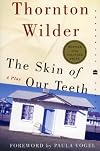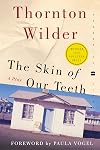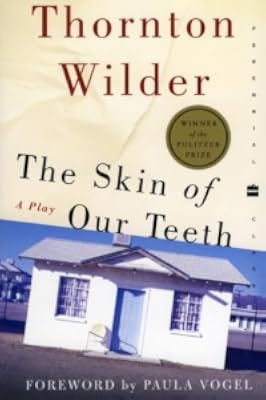
The Skin of Our Teeth
by Thornton Wilder
On This Page
Description
A timeless statement about human foibles... and human endurance, this beautiful new edition features Wilder's unpublished production notes, diary entries, and other illuminating documentary material, all of which is included in a new Afterword by Tappan Wilder. Time magazine called The Skin of Our Teeth "a sort of Hellzapoppin' with brains," as it broke from established theatrical conventions and walked off with the 1943 Pulitzer Prize for Best Drama. Combining farce, burlesque, and satire show more (among other styles), Thornton Wilder departs from his studied use of nostalgia and sentiment in Our Town to have an Eternal Family narrowly escape one disaster after another, from ancient times to the present. Meet George and Maggie Antrobus (married only 5, 000 years); their two children, Gladys and Henry (perfect in every way!); and their maid, Sabina (the ageless vamp) as they overcome ice, flood, and war -- by the skin of their teeth. show lessTags
Recommendations












Member Reviews
Of the works which won Wilder the Pulitzer Prize, this is the best of the three, which is really saying something. As always, he synthesizes philosophy, culture, and humor in remarkably compressed, intelligent writing, and in ‘The Skin of Our Teeth’ he was at the peak of his powers. The first couple of pages set the stage for apocalyptic absurdity, with ‘modern’ suburban man inventing the wheel and the alphabet while facing an ice age and living amid dinosaurs and mammoths. There are looming catastrophes in acts two and three as well, which sparks humanity’s age-old questions: Why live? Why hope? Is everything we’ve done, everything we’ve worked for, ultimately for nothing?
This play is a revolution, and it’s ironic that show more because of his language (and perhaps the over-exposure of ‘Our Town’ in high school drama classes), Wilder is considered ‘quaint’. Aside from the deep questions, there is a darkness here – rape, murder, violence, adultery, and suicide all surface over the course of the play. As in ‘Our Town’, Wilder zooms out and has characters not only directly addressing the audience, but talking about the content of the play, as well as having one character share her low opinion of it. In style and content this play would influence Beckett, Williams, Miller, and probably many others.
Written in 1942, it was perfect for the time, with one theme being how people dehumanize others - and yet it’s timeless. But who is evil here? As extinction looms, the ordinary suburban family thinks oh, if only all these people were out of our way, what a better world it would be, or oh, those others won’t feel pain and suffering as deeply as we would in their places, as they view them from positions of greater comfort. The insidiousness in humanity that leads to Hitler and Mussolini starts with these kinds of thoughts, and are probably within us all.
And yet we persevere. Our best hope? Act three shows it to be books, and learning, and those from our past who were most enlightened, and who reach out to us over time to impart wisdom, and to warn us of the mistakes their generation made. Are they successful in doing this? There are no easy answers here, and the play may be a litmus test. Many early viewers found it “defeatist” and left the theater before it was over, possibly having been also overwhelmed by the absurdity of it at a time when other performances were light comedies or musicals. The recurrence across the three acts may have you concluding the same thing. And yet Wilder himself was an optimist, and saw it as a message of hope. Personally, I think it says that we are our own enemy, and yet we must hope – and while this paradox is absurd, it’s the reality of our condition.
Easily 5 stars. Stunning and a must-read.
Quotes:
On fathers and daughters; this from the mother:
“Don’t you know your father thinks your perfect? Don’t you know he couldn’t live if he didn’t think you were perfect?”
On fortune telling:
Fortune Teller: “I tell the future. Keck. Nothing easier. Everybody’s future is in their face. Nothing easier.
But who can tell your past, eh? Nobody!
Your youth, - where did it go? It slipped away while you weren’t looking. While you were asleep. While you were drunk? Puh! You’re like our friends, Mr. and Mrs. Antrobus; you lie awake nights trying to know your past. What did it mean? What was it trying to say to you?”
On love:
Sabina: “There’s that old whine again. All you people think you’re not loved enough, nobody loves you. Well, you start being lovable and we’ll love you.”
On Man’s achievements in the face of possible annihilation; I loved these lines:
Telegraph Boy: ‘Then listen to this: ‘Ten tens make a hundred semi-colon consequences far-reaching.’
Mrs. Andrews: ‘The earth’s turning to ice, and all he can do is make up new numbers.’
Telegraph Boy: ‘Well, Mrs. Antrobus, like the head man at our office said: a few more discoveries like that and we’ll be worth freezing.’
On women; go Thornton:
Mrs. Antrobus:
“It’s a bottle. And in the bottle’s a letter. And in the letter is written all the things that a woman knows.
It’s never been told to any man and it’s never been told to any woman, and if it finds its destination, a new time will come. We’re not what books and plays say we are. We’re not what advertisements say we are. We’re not in the movies and we’re not on the radio.
We’re not what you’re all told and what you think we are:
We're ourselves. And if any man can find one of us he’ll learn why the whole universe was set in motion.” show less
This play is a revolution, and it’s ironic that show more because of his language (and perhaps the over-exposure of ‘Our Town’ in high school drama classes), Wilder is considered ‘quaint’. Aside from the deep questions, there is a darkness here – rape, murder, violence, adultery, and suicide all surface over the course of the play. As in ‘Our Town’, Wilder zooms out and has characters not only directly addressing the audience, but talking about the content of the play, as well as having one character share her low opinion of it. In style and content this play would influence Beckett, Williams, Miller, and probably many others.
Written in 1942, it was perfect for the time, with one theme being how people dehumanize others - and yet it’s timeless. But who is evil here? As extinction looms, the ordinary suburban family thinks oh, if only all these people were out of our way, what a better world it would be, or oh, those others won’t feel pain and suffering as deeply as we would in their places, as they view them from positions of greater comfort. The insidiousness in humanity that leads to Hitler and Mussolini starts with these kinds of thoughts, and are probably within us all.
And yet we persevere. Our best hope? Act three shows it to be books, and learning, and those from our past who were most enlightened, and who reach out to us over time to impart wisdom, and to warn us of the mistakes their generation made. Are they successful in doing this? There are no easy answers here, and the play may be a litmus test. Many early viewers found it “defeatist” and left the theater before it was over, possibly having been also overwhelmed by the absurdity of it at a time when other performances were light comedies or musicals. The recurrence across the three acts may have you concluding the same thing. And yet Wilder himself was an optimist, and saw it as a message of hope. Personally, I think it says that we are our own enemy, and yet we must hope – and while this paradox is absurd, it’s the reality of our condition.
Easily 5 stars. Stunning and a must-read.
Quotes:
On fathers and daughters; this from the mother:
“Don’t you know your father thinks your perfect? Don’t you know he couldn’t live if he didn’t think you were perfect?”
On fortune telling:
Fortune Teller: “I tell the future. Keck. Nothing easier. Everybody’s future is in their face. Nothing easier.
But who can tell your past, eh? Nobody!
Your youth, - where did it go? It slipped away while you weren’t looking. While you were asleep. While you were drunk? Puh! You’re like our friends, Mr. and Mrs. Antrobus; you lie awake nights trying to know your past. What did it mean? What was it trying to say to you?”
On love:
Sabina: “There’s that old whine again. All you people think you’re not loved enough, nobody loves you. Well, you start being lovable and we’ll love you.”
On Man’s achievements in the face of possible annihilation; I loved these lines:
Telegraph Boy: ‘Then listen to this: ‘Ten tens make a hundred semi-colon consequences far-reaching.’
Mrs. Andrews: ‘The earth’s turning to ice, and all he can do is make up new numbers.’
Telegraph Boy: ‘Well, Mrs. Antrobus, like the head man at our office said: a few more discoveries like that and we’ll be worth freezing.’
On women; go Thornton:
Mrs. Antrobus:
“It’s a bottle. And in the bottle’s a letter. And in the letter is written all the things that a woman knows.
It’s never been told to any man and it’s never been told to any woman, and if it finds its destination, a new time will come. We’re not what books and plays say we are. We’re not what advertisements say we are. We’re not in the movies and we’re not on the radio.
We’re not what you’re all told and what you think we are:
We're ourselves. And if any man can find one of us he’ll learn why the whole universe was set in motion.” show less
First, let’s just say this play is nuts… but in a clever, clever way, with preposterousness and humor. Written at a time when the world is increasingly at war (1941-1942), Wilder delivered a message of survival and self-betterment despite facing calamities, centuries after centuries, even if it’s barely by the skin of our teeth.
In Act I, the Antrobus family, George and Maggie with children Gladys and Henry, and their perpetual maid, Sabina confronts the great ice age. Valuing intellect with an eye towards the future, George invites in refugees of Homer, Moses, the Muses, and a doctor. To make room for the refugees, he takes out the family pets – a dinosaur and a mammoth. (Get it? Haha.) Meanwhile, he has invented the wheel, show more alphabet, and math. This was my favorite act.
In Act II, George has been elected the President of the Mammals party (vs. other species) and was partying at a convention where two of every species gathered. Naturally, the act ends with the great flood.
In Act III, they have just survived the war. Their son Henry was a general of the enemy side. The need to recover from war is physical (a nifty straightening out the house on stage) and mental (rebuilding of the family unit, despair). The source of comfort is books! I.e., knowledge. Everyone puts on the same outfit as the first act. The cycle continues – the resiliency of the human species.
Style wise, this play was revolutionary in its days employing audience engagement, having the actors playing the actor’s roles and themselves and even critiquing aspects of the play (most affecting in Act III), and the occasional stage manager participation. Its non-standard format resulted in audiences leaving the show early (confused?), so much so that the Playbill was updated with a leaflet to better explain the context of the play.
As I read the Afterword of Wilder’s hopes and the message he seeks to deliver, I thought of the present day – the threat of nuclear war, multiple major natural disasters throughout the world, and ethnic/racial/religious hatred towards each other. A side of me feel as though we just might be heading towards the end of an act with a dooming disaster in the horizon. But Wilder’s point is that we keep going, we persevere. We return to books for guidance. Amongst George’s closing statements: “…We’ve come a long ways. We’ve learned. We’re learning...” Seeing the world as it is now, that last bit is quite an understatement. There is a crap-ton to learn yet!
What a play. When I was done, I sat there holding the book thinking how thoroughly complete and perfect it is. I sure hope to see it performed someday.
Two quotes:
On inventions, this was so creative:
Telegraph Boy: ‘Then listen to this: ‘Ten tens make a hundred semi-colon consequences far-reaching.’
Mrs. Andrews: ‘The earth’s turning to ice, and all he can do is make up new numbers.’
Telegraph Boy: ‘Well, Mrs. Antrobus, like the head man at our office said: a few more discoveries like that and we’ll be worth freezing.’
On women, from Mrs. Antrobus:
“It’s a bottle. And in the bottle’s a letter. And in the letter is written all the things that a woman knows.
It’s never been told to any man and it’s never been told to any woman, and if it finds its destination, a new time will come. We’re not what books and plays say we are. We’re not what advertisements say we are. We’re not in the movies and we’re not on the radio.
We’re not what you’re all told and what you think we are:
We're ourselves. And if any man can find one of us he’ll learn why the whole universe was set in motion.” show less
In Act I, the Antrobus family, George and Maggie with children Gladys and Henry, and their perpetual maid, Sabina confronts the great ice age. Valuing intellect with an eye towards the future, George invites in refugees of Homer, Moses, the Muses, and a doctor. To make room for the refugees, he takes out the family pets – a dinosaur and a mammoth. (Get it? Haha.) Meanwhile, he has invented the wheel, show more alphabet, and math. This was my favorite act.
In Act II, George has been elected the President of the Mammals party (vs. other species) and was partying at a convention where two of every species gathered. Naturally, the act ends with the great flood.
In Act III, they have just survived the war. Their son Henry was a general of the enemy side. The need to recover from war is physical (a nifty straightening out the house on stage) and mental (rebuilding of the family unit, despair). The source of comfort is books! I.e., knowledge. Everyone puts on the same outfit as the first act. The cycle continues – the resiliency of the human species.
Style wise, this play was revolutionary in its days employing audience engagement, having the actors playing the actor’s roles and themselves and even critiquing aspects of the play (most affecting in Act III), and the occasional stage manager participation. Its non-standard format resulted in audiences leaving the show early (confused?), so much so that the Playbill was updated with a leaflet to better explain the context of the play.
As I read the Afterword of Wilder’s hopes and the message he seeks to deliver, I thought of the present day – the threat of nuclear war, multiple major natural disasters throughout the world, and ethnic/racial/religious hatred towards each other. A side of me feel as though we just might be heading towards the end of an act with a dooming disaster in the horizon. But Wilder’s point is that we keep going, we persevere. We return to books for guidance. Amongst George’s closing statements: “…We’ve come a long ways. We’ve learned. We’re learning...” Seeing the world as it is now, that last bit is quite an understatement. There is a crap-ton to learn yet!
What a play. When I was done, I sat there holding the book thinking how thoroughly complete and perfect it is. I sure hope to see it performed someday.
Two quotes:
On inventions, this was so creative:
Telegraph Boy: ‘Then listen to this: ‘Ten tens make a hundred semi-colon consequences far-reaching.’
Mrs. Andrews: ‘The earth’s turning to ice, and all he can do is make up new numbers.’
Telegraph Boy: ‘Well, Mrs. Antrobus, like the head man at our office said: a few more discoveries like that and we’ll be worth freezing.’
On women, from Mrs. Antrobus:
“It’s a bottle. And in the bottle’s a letter. And in the letter is written all the things that a woman knows.
It’s never been told to any man and it’s never been told to any woman, and if it finds its destination, a new time will come. We’re not what books and plays say we are. We’re not what advertisements say we are. We’re not in the movies and we’re not on the radio.
We’re not what you’re all told and what you think we are:
We're ourselves. And if any man can find one of us he’ll learn why the whole universe was set in motion.” show less
I’m not sure how much I liked The Skin of Our Teeth, Thornton Wilder’s second most well-known play..
I should stipulate, reading a play is a very different thing from seeing a play. I don't have much experience reading plays and mentally transmuting the written words and actions to that ancient medium, so take all I say here with a grain of salt. I'm sure the performances would outweigh my imagination.
The Skin of Our Teeth is metaphor many layers deep. The story, such as it is, has the Antrobus family facing three ideas of "the end of the world". First, the ice age, second, the Flood of Noah, and third, a war, reminiscent of WWII, which the play was written during. The metaphorical part here: the family lives in New Jersey. The show more family is both ancient man and the 20th-century nuclear family.
The fourth wall is broken time and time again. Wilder doesn’t let you forget you’re in a play. (More than anything, in these moments, I think Wilder is saying more about theater at the time than anything else.)
The outcome, the moral, the defining idea, is that humanity always recovers. But the other side of Thornton Wilder's coin is that humanity continues to make the same mistakes over and over again. A husband cheats, a boy murders, the rabble rouses, yet humanity continues. Men learn of true women (for that is the reason the universe was put in motion), children are born, grow, die, and the philosophers continue their march like hours on a clock.
It’s a fine philosophy of a play. Maybe go see it as one, rather than reading about it in a book. show less
I should stipulate, reading a play is a very different thing from seeing a play. I don't have much experience reading plays and mentally transmuting the written words and actions to that ancient medium, so take all I say here with a grain of salt. I'm sure the performances would outweigh my imagination.
The Skin of Our Teeth is metaphor many layers deep. The story, such as it is, has the Antrobus family facing three ideas of "the end of the world". First, the ice age, second, the Flood of Noah, and third, a war, reminiscent of WWII, which the play was written during. The metaphorical part here: the family lives in New Jersey. The show more family is both ancient man and the 20th-century nuclear family.
The fourth wall is broken time and time again. Wilder doesn’t let you forget you’re in a play. (More than anything, in these moments, I think Wilder is saying more about theater at the time than anything else.)
The outcome, the moral, the defining idea, is that humanity always recovers. But the other side of Thornton Wilder's coin is that humanity continues to make the same mistakes over and over again. A husband cheats, a boy murders, the rabble rouses, yet humanity continues. Men learn of true women (for that is the reason the universe was put in motion), children are born, grow, die, and the philosophers continue their march like hours on a clock.
It’s a fine philosophy of a play. Maybe go see it as one, rather than reading about it in a book. show less
Just a strange allegory of early Biblical history (Adam and Eve; Cain and Abel) that takes itself more seriously than merited.
The play obviously considers itself deep and profound. Laughing at the earnest tone is probably more entertaining than the play's vague attempts at humor, which pretty well fail for blending with the drama--which is frankly more interesting. My reading of Aristotle's poetics was nearly twenty years ago, but I remember he advised that drama plus comedy only produces bad drama or bad comedy.
What's the point of the allegory in The Skin of Our Teeth? Did it stimulate me to conclude something new? I cannot say it did. And were the characters interesting? No, not particularly. Especially the Antrobus parents. I found show more the play a disappointment and only an odd curiosity. I cannot recommend it. show less
The play obviously considers itself deep and profound. Laughing at the earnest tone is probably more entertaining than the play's vague attempts at humor, which pretty well fail for blending with the drama--which is frankly more interesting. My reading of Aristotle's poetics was nearly twenty years ago, but I remember he advised that drama plus comedy only produces bad drama or bad comedy.
What's the point of the allegory in The Skin of Our Teeth? Did it stimulate me to conclude something new? I cannot say it did. And were the characters interesting? No, not particularly. Especially the Antrobus parents. I found show more the play a disappointment and only an odd curiosity. I cannot recommend it. show less
we saw the Lincoln Center production of this a couple of weeks ago, and were surprised by the darkness of the last act. But it's right there in the script, allowing the director to emphasis or not emphasis it. The edition I read has a Forward by Paula Vogel, which emphasizes the way Wilder departs from the conventions of theater in his day, and how that freedom of form affected the writers after him. And there's an afterword by Tappan Wilder, nephew of the writer, outlining the process and difficulties encountered in the creation and staging of the play, along with some photographs from the production.
The Skin of Our Teeth is one of Thorton Wilder's plays. Although not as well known as Our Town, it certainly holds up its own.
Granted, poetry and plays are not my favourite forms of literature. It's not that I dislike them, it's just that I often lose my patience with them. I also find that there is a greater disparity between the best and worst of both poetry and plays. Rarely do you find something that's in the middle in terms of quality.
I have to admit that I preferred Our Town. Although the plot of this play was certainly interesting - it follows an unusual family that manages to live through all of the world's biggest events - I found it easier to relate to Our Town. The message was great - history repeating itself and whatnot - show more but it's still second on the list.
There was an amazing humour in these characters though. I loved how they would turn to the audience to issue the occasional sarcastic line. It was clear that this play didn't take itself too seriously, and it was really all the better for that! show less
Granted, poetry and plays are not my favourite forms of literature. It's not that I dislike them, it's just that I often lose my patience with them. I also find that there is a greater disparity between the best and worst of both poetry and plays. Rarely do you find something that's in the middle in terms of quality.
I have to admit that I preferred Our Town. Although the plot of this play was certainly interesting - it follows an unusual family that manages to live through all of the world's biggest events - I found it easier to relate to Our Town. The message was great - history repeating itself and whatnot - show more but it's still second on the list.
There was an amazing humour in these characters though. I loved how they would turn to the audience to issue the occasional sarcastic line. It was clear that this play didn't take itself too seriously, and it was really all the better for that! show less
When I first cracked open this script I was instantly confused. I bought it after hearing great things about it from my drama teacher, and I figured I would trust her oponion. Not only was I extremly confussed, it was absolutley HALARIOUS. The only problem is that the sets are constantly changing, so sets may be an issue. We were unable to do this show because of that. I enjoyed every minute of reading this, because I could simply never predict what would happen next.
Members
- Recently Added By
Lists

Plays I Like
230 works; 31 members

Five star books
1,767 works; 109 members

1940s
221 works; 25 members
r/acting on Reddit - Essential Plays
44 works; 2 members
My Play Collection
769 works; 3 members

The Complete Rory Gilmore Reading List
506 works; 5 members

Next Plays / 2025
352 works; 1 member

Writers In Public Domain 2026
90 works; 1 member
Author Information

112+ Works 18,626 Members
One of the most honored and versatile of modern writers, Thornton Wilder combined a career as a successful novelist with work for the theater that made him one of this century's outstanding dramatists. It was an early short novel, however, that first brought him fame. The Bridge of San Luis Rey (1927), a bestseller that won the Pulitzer Prize in show more 1927, is the story of a group of assorted people who happen to be on a bridge in Peru when it collapses. Ingeniously constructed and rich in its philosophical implications about fate and synchronicity, Wilder's book would seem to be the first well-known example of a formula that has become a cliche in popular literature. His attraction to classical themes is manifested in The Woman of Andros (1930), a tragedy about young love in pre-Christian Greece, and The Ides of March (1948), set in the time of Julius Caesar and told in letters and documents covering a long span of years. Heaven's My Destination (1934), is a seriocomic and picaresque story about a young book salesman traveling through the Midwest during the early years of the Great Depression.Theophilus North (1973), Wilder's last novel, disappointed many reviewers, but it provided its author with opportunities to offer some wry observations on the life of the idle rich in Newport during the summer of 1926 and to ponder in the story of his alter ego what might have happened if Wilder had stayed home, so to speak, instead of becoming Thornton Wilder. As a serious writer of fiction, Wilder's main claim rests on The Eighth Day (1967), an intellectual thriller, which the N.Y. Times called "the most substantial fiction of his career." It won the National Book Award for fiction in 1968. (Bowker Author Biography) show less
Awards and Honors
Awards
Work Relationships
Is contained in
Common Knowledge
- Canonical title
- The Skin of Our Teeth
- Original publication date
- 1942
- Related movies
- American Playhouse: The Skin of Our Teeth (1983 | IMDb)
- Original language
- English
Classifications
Statistics
- Members
- 476
- Popularity
- 64,185
- Reviews
- 10
- Rating
- (3.75)
- Languages
- Dutch, English, German
- Media
- Paper, Ebook
- ISBNs
- 7
- ASINs
- 19