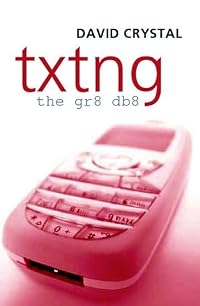
Txtng: The Gr8 Db8
by David Crystal
On This Page
Description
Does txtng spell the end of literacy? David Crystal looks at the evidence, investigating how txtng began, what it is, why it's used, and how it works. Txtng: The Gr8 Db8 is entertaining and instructive: reassuring for parents, illuminating for teenagers, fascinating for everyone. - ;This book takes a long hard look at the text-messaging phenomenon and its effects on literacy, language, and society. Young people who seem to spend much of their time texting sometimes appear unable or unwilling show more to write much else. Media outrage has ensued. "It is bleak, bald, sad shorthand," writes a co show lessTags
Recommendations














Member Reviews
In a digital age where no one seems to be able to live without a smart phone at hand, here's a relevant book addressing the passionate debate regarding how our languages' future might be (if at all) affected by texting.
The never ending complaint is well known: we give in to the need for speed, and so text each others messages those grammar is butchered, mercilessly massacred, throwing thus out of the window the rules and conventions that had been established over centuries. Is it just a matter of time before those rules are all but forgotten, and the future of English (or any other language, for that matter) about 2 die just lik dat 4ever cuz no1 can spel @ all? Lol & OMG! Youngsters especially are now accused, more and more, of being show more completely ignorant when it comes to spelling; the blame being put on, you guess it, their digital gadgets and electronic doolalis with which they not only get their thumbs overexcited, but, also, vandalise and ransack, text messages after text messages, their poor language! The never ending complaint is well known, and yet...
David Crystal, the famous linguist, tackles here the issue; debunking, not without some quirky smirks, a few myths going around. In fact, he tells what texting really implies in terms of linguistics; and that from pictograms, logograms, ellipsis, abbreviations, initialisms, and other contractions, there's no need to panic: here's nothing new under the sun. Technology is new, but all the language plays we are dealing with certainly aren't (a reason which, actually, explains their so rapid and popular appropriation and success…). As for the rampant illiteracy rate among our poor youth (mmh?) he affirms not only that such worries are also far from new, but, also, that texting, despite the dislike of some hysterical mass medias, are just a scapegoat - and a bad one at that!
Here's the surprise: quoting studies to support him, David Crystal demonstrates that text messages, with all their features and peculiarities differentiating them from other contexts (eg the writing of a school homework essay...) help the understanding that language is above all about different registers interacting with each other, making thus young people way more clued on in term of language use than their previous generations.
You get it: fascinating and easy to read, witty too, a few preconceived ideas are quite turned to shred. It's a quick read, but a gr8 db8 indeed! show less
The never ending complaint is well known: we give in to the need for speed, and so text each others messages those grammar is butchered, mercilessly massacred, throwing thus out of the window the rules and conventions that had been established over centuries. Is it just a matter of time before those rules are all but forgotten, and the future of English (or any other language, for that matter) about 2 die just lik dat 4ever cuz no1 can spel @ all? Lol & OMG! Youngsters especially are now accused, more and more, of being show more completely ignorant when it comes to spelling; the blame being put on, you guess it, their digital gadgets and electronic doolalis with which they not only get their thumbs overexcited, but, also, vandalise and ransack, text messages after text messages, their poor language! The never ending complaint is well known, and yet...
David Crystal, the famous linguist, tackles here the issue; debunking, not without some quirky smirks, a few myths going around. In fact, he tells what texting really implies in terms of linguistics; and that from pictograms, logograms, ellipsis, abbreviations, initialisms, and other contractions, there's no need to panic: here's nothing new under the sun. Technology is new, but all the language plays we are dealing with certainly aren't (a reason which, actually, explains their so rapid and popular appropriation and success…). As for the rampant illiteracy rate among our poor youth (mmh?) he affirms not only that such worries are also far from new, but, also, that texting, despite the dislike of some hysterical mass medias, are just a scapegoat - and a bad one at that!
Here's the surprise: quoting studies to support him, David Crystal demonstrates that text messages, with all their features and peculiarities differentiating them from other contexts (eg the writing of a school homework essay...) help the understanding that language is above all about different registers interacting with each other, making thus young people way more clued on in term of language use than their previous generations.
You get it: fascinating and easy to read, witty too, a few preconceived ideas are quite turned to shred. It's a quick read, but a gr8 db8 indeed! show less
Txtng thoughtfully examines the fear expressed by many people that text messaging is ruining the literacy skills of the young. While acknowledging the many frustrations of sending text via phone pads (for example, inadequate keyboards and limited available characters lead to abbreviating), the author points out the strengths too: the skill and verbal wit that is required to take part at all, the privacy and speed by which communication can take place, the relative cheapness and immediateness of the messages. Crystal gathers the academic work that has been done on this newest form of computer mediated communication to show that most of the negative effects discussed in society are brought about by hasty media coverage of unfounded show more opinion, rather than actual assessment of who texts, why, and in what manner. He compares the current moral panic over this technology to first responses to printing, telephones, computers, and the Web. In addition, the book lays out some good contrastive work in looking beyond just English or even Roman script-based languages to explore what features of texting are shared by the world’s languages, and which language differences affect the forms of texting. An articulate and amusing book. show less
From Library
I had fun cataloguing this (had to put a separate catalogue title entry reading "Texting: the great debate"*) and, of course, reading it. Crystal really is the master of the accessible linguistics book and this was no exception. His central premise is that there shouldn't be such a foaming at the gills about "text speak": a) the features included in it have been used for decades in acrostics and other word games, b) the amount of texting that is in "text speak" is actually a very small part of the whole, and c) it is fascinating to see language change as it happens. He looks at how we use language in texting, differences between ages and genders of texters, and there's a particularly interesting chapter on the use of text show more speak in languages other than English.
Great stuff!
* yes, cataloguers out there, I know I didn't need to do a 246 including the subtitle, but I checked, and I did. show less
I had fun cataloguing this (had to put a separate catalogue title entry reading "Texting: the great debate"*) and, of course, reading it. Crystal really is the master of the accessible linguistics book and this was no exception. His central premise is that there shouldn't be such a foaming at the gills about "text speak": a) the features included in it have been used for decades in acrostics and other word games, b) the amount of texting that is in "text speak" is actually a very small part of the whole, and c) it is fascinating to see language change as it happens. He looks at how we use language in texting, differences between ages and genders of texters, and there's a particularly interesting chapter on the use of text show more speak in languages other than English.
Great stuff!
* yes, cataloguers out there, I know I didn't need to do a 246 including the subtitle, but I checked, and I did. show less
How this for a bit of reflexivity: I'm composing the initial draft of this review on a mobile phone. Admittedly, a full qwerty keyboard-toting BlackBerry and not an old school mobile, so not with the numeric keypad limitations of the usual SMS utilising device but, still, typing-one thumbed while I cling on to a tube strap on an underground carriage with my other hand does put the debate into context.
This is an interesting enough, quick read, but it lets itself down in a couple of presentational respects and also in scope.
Firstly, the title and sale. Already on reviews on this site there is a debate between those who find the book a bit dry and dusty and those who point out it is written by a linguistics professor, so you shouldn't show more really expect anything else. I suppose composing its title in textspeak was an obvious (if somewhat unimaginative) marketing ploy, but the cheap laugh it gets trades badly against its implied presentation as a book of limited ambition and sophistication - one of those impulse buys at the counter that will wind up on the cistern in the loo, rather than a book you'd buy for its own sake.
As it happens, this is a thoughtful and insightful book written (for the layman - I didn't find it dry in the slightest) by an academic and published by Oxford University Press. But the way OUP has elected to market may cause it to fall betwixt cup and lip.
But - assuming we are meant to treat it as a substantive entry - that leads onto some substantive reservations.
Firstly, I'm not so sure what's so distinctly interesting or permanent about SMS texting over instant messaging, email, discussion forums, blogs, twitter and the manifest other forms of electronic communication that have emerged over the last twenty years that it deserves separate treatment.
To be sure, SMS text has produced some unique artefacts, but it has borrowed more ("LOL"s, preposition abbreviations and emoticons are more prevalent in IM and forum posting) and those few artefacts that are unique (as Crystal recounts) are a function of transient technological limitations inherent in the particular format which are likely to be superseded. As data entry technique and information technology evolve (and they already have: things like predictive text, qwerty keyboards on PDAs, and forthcoming inevitabilities like voice recognition) the SMS idiom will almost certainly wane. I suspect, like the facsimile, it is destined for a short but incandescent trajectory through the communicative cosmos.
Secondly, limiting himself as he does, David Crystal is obliged, in a short book, to look at relatively uninteresting aspects of a minor medium (like texting in a foreign language - it takes him a few pages to illustrate this works much like English does - which is no more than the slightest sober reflection would suggest) at the expense of bigger topics of far more interest and relevance to the whole medium of electronic communication. The linguistic implications of non-destructive abbreviation are significant - but again, more so in the world of general electronic communication (where Larry Lessig's book Code: Version 2.0 or Doug Hofstadter's I Am a Strange Loop are far more fascinating) and not SMS in particular. The fact that, almost overnight, we have converted our language by means of ASCII into a numerical code which can thus be manipulated, processed and treated is a revolutionary insight, but by limiting himself to texting where those implications amount to very little, Crystal can't really joint the debate.
Finally, Crystal's motive seems to have been to take wind out of the sails of the sorts of grumpy old men (Guardian op-ed columnists and commentators like John Humphrys) who claim (much as they and their kind have done about email, typewriters, television, immigrants, slang, hip hop, cockneys, and even the great vowel shift) that this new blight is destroying all that is precious our language. That's obviously horse-puckey: that it is evolution and not destruction isn't really news, and this isn't debate I'd bother engaging in even as a media commentator, let alone as an academic. No one takes these old curmudgeons seriously anyway.
There is enough in this book to make it worth reading through, but that won't take you long, and it probably would have been better pitched as a feature article in a Sunday paper. Where it could have taken on the Grumpies on their own turf.
Olly Buxton show less
This is an interesting enough, quick read, but it lets itself down in a couple of presentational respects and also in scope.
Firstly, the title and sale. Already on reviews on this site there is a debate between those who find the book a bit dry and dusty and those who point out it is written by a linguistics professor, so you shouldn't show more really expect anything else. I suppose composing its title in textspeak was an obvious (if somewhat unimaginative) marketing ploy, but the cheap laugh it gets trades badly against its implied presentation as a book of limited ambition and sophistication - one of those impulse buys at the counter that will wind up on the cistern in the loo, rather than a book you'd buy for its own sake.
As it happens, this is a thoughtful and insightful book written (for the layman - I didn't find it dry in the slightest) by an academic and published by Oxford University Press. But the way OUP has elected to market may cause it to fall betwixt cup and lip.
But - assuming we are meant to treat it as a substantive entry - that leads onto some substantive reservations.
Firstly, I'm not so sure what's so distinctly interesting or permanent about SMS texting over instant messaging, email, discussion forums, blogs, twitter and the manifest other forms of electronic communication that have emerged over the last twenty years that it deserves separate treatment.
To be sure, SMS text has produced some unique artefacts, but it has borrowed more ("LOL"s, preposition abbreviations and emoticons are more prevalent in IM and forum posting) and those few artefacts that are unique (as Crystal recounts) are a function of transient technological limitations inherent in the particular format which are likely to be superseded. As data entry technique and information technology evolve (and they already have: things like predictive text, qwerty keyboards on PDAs, and forthcoming inevitabilities like voice recognition) the SMS idiom will almost certainly wane. I suspect, like the facsimile, it is destined for a short but incandescent trajectory through the communicative cosmos.
Secondly, limiting himself as he does, David Crystal is obliged, in a short book, to look at relatively uninteresting aspects of a minor medium (like texting in a foreign language - it takes him a few pages to illustrate this works much like English does - which is no more than the slightest sober reflection would suggest) at the expense of bigger topics of far more interest and relevance to the whole medium of electronic communication. The linguistic implications of non-destructive abbreviation are significant - but again, more so in the world of general electronic communication (where Larry Lessig's book Code: Version 2.0 or Doug Hofstadter's I Am a Strange Loop are far more fascinating) and not SMS in particular. The fact that, almost overnight, we have converted our language by means of ASCII into a numerical code which can thus be manipulated, processed and treated is a revolutionary insight, but by limiting himself to texting where those implications amount to very little, Crystal can't really joint the debate.
Finally, Crystal's motive seems to have been to take wind out of the sails of the sorts of grumpy old men (Guardian op-ed columnists and commentators like John Humphrys) who claim (much as they and their kind have done about email, typewriters, television, immigrants, slang, hip hop, cockneys, and even the great vowel shift) that this new blight is destroying all that is precious our language. That's obviously horse-puckey: that it is evolution and not destruction isn't really news, and this isn't debate I'd bother engaging in even as a media commentator, let alone as an academic. No one takes these old curmudgeons seriously anyway.
There is enough in this book to make it worth reading through, but that won't take you long, and it probably would have been better pitched as a feature article in a Sunday paper. Where it could have taken on the Grumpies on their own turf.
Olly Buxton show less
I had a feeling that I would be a bit bored with this book as soon as I got a few chapters in. As it was published in 2009 it is surprising how much has changed when it comes to texting and phones themselves so points that were made then no longer have a purpose now. However, there was some lively conversation on how text speak has become a new popular way of communicating and a humorous outlook at the moral panics over texting and its 'disastrous' impact on education. I like the way that David writes but do think he could stop plugging his other books so much...
I had a feeling that I would be a bit bored with this book as soon as I got a few chapters in. As it was published in 2009 it is surprising how much has changed when it comes to texting and phones themselves so points that were made then no longer have a purpose now. However, there was some lively conversation on how text speak has become a new popular way of communicating and a humorous outlook at the moral panics over texting and its 'disastrous' impact on education. I like the way that David writes but do think he could stop plugging his other books so much...
Abrv msgs r nthng nu. txtng dsnt mk u stpd. u nEd a gd grsp of spch & lang 2 cmnc8 by txtng. Dr Krstl's bk is a gr8t rEd. Includes cartoons, glossaries of text abbreviations in English and 11 languages. Neat examples of text poetry..
Members
- Recently Added By
Published Reviews
ThingScore 75
Crystal sounds only a few mild notes of concern. He mentions, for example, a study that found that descriptions written by young people who text were shorter than those by their nontexting counterparts. But overall, he's pretty doubtful that the Internet has been around for long enough to corrode our language culture.
added by Shortride
Crystal is a professional linguist, and professional linguists, almost universally, do not believe that any naturally occurring changes in the language can be bad. So his conclusions are predictable: texting is not corrupting the language; people who send text messages that use emoticons, initialisms (“g2g,” “lol”), and other shorthands generally know how to spell perfectly well; and show more the history of language is filled with analogous examples of nonstandard usage. show less
added by Shortride
Author Information

103+ Works 14,169 Members
David Crystal is Honorary Professor of Linguistics at the University of Wales, Bangor.
Common Knowledge
- Canonical title
- Txtng: The Gr8 Db8
- Original publication date
- 2008
- First words
- Virtually every day I get an email or phone call - occasionally even a letter - from someone asking a linguistic question or wanting to share a linguistic observation.
- Quotations
- Texting is one of the most innovative linguistic phenomena of modern times, and perhaps that is why it has generated such strong emotion ... [y]et all the evidence suggests that belief in an impending linguistic disaster is a... (show all) consequence of a mythology created largely by the media.
Some people dislike texting. Some are bemused by it. Some love it. I am fascinated by it, for it is the latest manifestation of the human ability to be linguistically creative and adapt language to suit the demands of dive... (show all)rse settings. In texting we are seeing, in a small way, language in evolution. - Last words
- (Click to show. Warning: May contain spoilers.)In texting we are seeing, in a small way, language in evolution.
Classifications
- Genres
- Nonfiction, Technology
- DDC/MDS
- 004.692 — Computer science, information & general works Computer science, knowledge & systems Computer science Interfacing and communications (including networking) Other Specific Types of Computer Communications E-mail & Instant Messaging
- LCC
- TK5105.73 .C79 — Technology Electrical engineering. Electronics. Nuclear engineering Electrical engineering. Electronics. Nuclear Telecommunication
- BISAC
Statistics
- Members
- 165
- Popularity
- 197,798
- Reviews
- 9
- Rating
- (3.78)
- Languages
- English, French
- Media
- Paper, Ebook
- ISBNs
- 7
- ASINs
- 2