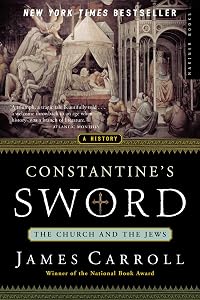
Constantine's Sword: The Church and the Jews -- A History
by James Carroll
On This Page
Description
In a bold and moving book that is sure to spark heated debate, the novelist and cultural critic James Carroll maps the profoundly troubling two-thousand-year course of the Church's battle against Judaism and faces the crisis of faith it has provoked in his own life as a Catholic. More than a chronicle of religion, this dark history is the central tragedy of Western civilization, its fault lines reaching deep into our culture. The Church's failure to protest the Holocaust - the infamous show more "silence" of Pius XII - is only part of the story: the death camps, Carroll shows, are the culmination of a long, entrenched tradition of anti-Judaism. From Gospel accounts of the death of Jesus on the cross, to Constantine's transformation of the cross into a sword, to the rise of blood libels, scapegoating, and modern anti-Semitism, Carroll reconstructs the dramatic story of the Church's conflict not only with Jews but with itself. Yet in tracing the arc of this narrative, he implicitly affirms that it did not necessarily have to be so. There were roads not taken, heroes forgotten; new roads can be taken yet. Demanding that the Church finally face this past in full, Carroll calls for a fundamental rethinking of the deepest questions of Christian faith. Only then can Christians, Jews, and all who carry the burden of this history begin to forge a new future. Drawing on his well-known talents as a storyteller and memoirist, and weaving historical research through an intensely personal examination of conscience, Carroll has created a work of singular power and urgency. CONSTANTINE'S SWORD is a brave and affecting reckoning with difficult truths that will touch every reader. show lessTags
Recommendations








Member Reviews
I don't read much non-fiction; after all, I read plenty of non-fiction at work. But this book was recommended to me following the release of Mel Gibson's The Passion of the Christ. James Carroll, a former Catholic priest became interested in the history of Catholic-Jewish relations following outcry by Jewish groups over the erection of crosses at Auschwitz. Carroll's interest evolved into Constantine's Sword, a book that traces both the aforementioned history as well as Carroll's own religious growth. The book is extremely detailed, superbly written, and clearly heartfelt. Much of the history was not new to me (as a Catholic theologian said at a forum to discuss Anti-Semitism in The Passion of the Christ, Jews and Catholics share 2,000 show more years of history; Jews know that history, but Catholics do not); however, the theological underpinnings from the Catholic perspective were entirely new. Many of the points that Carroll makes were the type that resonated profoundly. I only wish that every Christian who still harbors a degree of Anti-Semitism would read this book and think seriously about some of the theological issues that Carroll raises. Constantine's Sword was one of the most powerful books that I've ever read and I give it the highest recommendation. show less
Contantine the Great was the Roman emperor that embraced Christianity in the 4th century and gave this religion the necessary means to propagate itself throughout the Roman Empire and become, over time, the world's largest religion. The story goes, that on the eve of the crucial Milvian Bridge battle of Rome in 312, Constantine saw a vision of a cross in the night sky with the words In Hoc Signo Vinces ("with this sign you shall win") across it. He pledged that if he would be victorious, he would embrace Christianity. Thus, "Constantine's Sword" became a symbol of the power of the cross combined with the sword, the power of the Christian Church.
James Carroll used to be a Catholic priest, and nowadays he's a writer-historian with a show more mission in life: to reform the Catholic Church. For Carroll, the fundamental flaw and central issue in the church's thinking since its inception, the "defining sin" if you like, is the church's attitude towards Jews. In this book, Carroll describes almost 2,000 years of how the church thought, preached and acted towards Jews. It is an extended version of J'accuse, an indicting statement against the Catholic chruch through the ages. What Carroll tries to show is that an alternative path could have been chosen by the church's leaders at various points in this bloody and murderous journey, a path that would have defined the Christian-Jewish debate in completely different terms.
Carroll strips traditional Christian beliefs apart, showing how they were formed and why they are flawed. He does so by starting the obvious: Jesus lived and died as Jew, wanting to renew and reform his fellow Jews. It was only much later, within the context of the debate between his followers and the Jewish majority and in response to the persecution by the Roman emperors, that the concept of the "other" was formed and a line separating the two religions began to form. He does so also by unravelling the political and economic factors hiding behind the church's leaders' so-called theological decisions through the ages: from Constantine's "conversion of convenience", through the murder and explusion of Jews for "religious reasons", culminating the in unholy pact between Pope Pius XII and Hitler shortly after the latter came to power.
This book is, strictly speaking, not a history book. Many would undoubtedly argue, and with justice, that Carroll is not an historian and his use of secondary (and selective) sources to prove his point of view is not rigorously academic. But I don't think that was his intent. This is very much a personal story, of how Carroll fell in love with the Catholic Church, how he became a priest, why he decided to remove his habit, his journeys through Europe and his ideas about chruch reform. This combination of historical facts with a personal story is very powerful. Although it does become a little too personal for my likeing when he tells us about his erotic attraction to his pious mother, who took him to see the seamless robe of Jesus in Trier.
I read this book during and after a course I took about Jews and Christians in medieval times. It was a good companion to the course and helped me frame many historical events in their proper context. It is not an easy book to read (not least because of its length) but it's a must read for anyone wanting to understand the core values that drove, and to a certain extent are still driving, the attitude of the Catholic church towards Jews. show less
James Carroll used to be a Catholic priest, and nowadays he's a writer-historian with a show more mission in life: to reform the Catholic Church. For Carroll, the fundamental flaw and central issue in the church's thinking since its inception, the "defining sin" if you like, is the church's attitude towards Jews. In this book, Carroll describes almost 2,000 years of how the church thought, preached and acted towards Jews. It is an extended version of J'accuse, an indicting statement against the Catholic chruch through the ages. What Carroll tries to show is that an alternative path could have been chosen by the church's leaders at various points in this bloody and murderous journey, a path that would have defined the Christian-Jewish debate in completely different terms.
Carroll strips traditional Christian beliefs apart, showing how they were formed and why they are flawed. He does so by starting the obvious: Jesus lived and died as Jew, wanting to renew and reform his fellow Jews. It was only much later, within the context of the debate between his followers and the Jewish majority and in response to the persecution by the Roman emperors, that the concept of the "other" was formed and a line separating the two religions began to form. He does so also by unravelling the political and economic factors hiding behind the church's leaders' so-called theological decisions through the ages: from Constantine's "conversion of convenience", through the murder and explusion of Jews for "religious reasons", culminating the in unholy pact between Pope Pius XII and Hitler shortly after the latter came to power.
This book is, strictly speaking, not a history book. Many would undoubtedly argue, and with justice, that Carroll is not an historian and his use of secondary (and selective) sources to prove his point of view is not rigorously academic. But I don't think that was his intent. This is very much a personal story, of how Carroll fell in love with the Catholic Church, how he became a priest, why he decided to remove his habit, his journeys through Europe and his ideas about chruch reform. This combination of historical facts with a personal story is very powerful. Although it does become a little too personal for my likeing when he tells us about his erotic attraction to his pious mother, who took him to see the seamless robe of Jesus in Trier.
I read this book during and after a course I took about Jews and Christians in medieval times. It was a good companion to the course and helped me frame many historical events in their proper context. It is not an easy book to read (not least because of its length) but it's a must read for anyone wanting to understand the core values that drove, and to a certain extent are still driving, the attitude of the Catholic church towards Jews. show less
This excellent book directly confronts the question of religious justification for war. it asks where people got the idea that it is alright to kill in the name of a God. In the modern world God is no longer commanding his people to eradicate all men, women, children and living thing of the opposing peoples (with the convenient exception of female virgins Numbers 31:18). The monotheistic religions in particular rationalize their divine warmongering edicts in more abstract ways in today's world. The author is particularly sensitive to the plight of Jews, of whom Jesus was a purportedly peace-loving member who curiously confessed to bring not peace, but a sword Matthew 10:34.
An interesting observation made in the book is that the show more cross/sword was not a symbol used by the early Christians, and that its adoption has cast a sinister shadow over the true teachings of Jesus. show less
An interesting observation made in the book is that the show more cross/sword was not a symbol used by the early Christians, and that its adoption has cast a sinister shadow over the true teachings of Jesus. show less
A National Book Award deservedly went to this work by James Carroll. A former Roman Catholic priest, he deals at length and in depth with anti-Semitism in the European Catholic, and later Protestant, tradition. He is caught between the horror of centuries of horrific oppression of Jews in Europe and his love of his Church. The author's honesty is palpable on each page as he resolutely lays bare the depth and implications of anti-Semitism in the long history of the western Catholic church. It's a history that must be faced by all Christians, because significant Christian teachings have been and continue to be soaked with anti-Jewish attitudes. I( personally know that even in the most liberal towns in the US, there are Jews who fear to show more appear on the streets during Holy Week--the week preceding Easter Sunday.) The author also provides some useful insight into how this anti-Semitism could have arisen within Christian memory and tradition. show less
I just finished reading Constantine's Sword: The Church and the Jews, by James Carroll. Constantine was the Roman emperor who fused the Roman Empire with Christianity, forming what is now known as the Roman Catholic Church. James Carroll, the author, was a Catholic priest from the late 1960's through 1973, when he left the priesthood.
Constantine's Sword gets, from me, five stars. Constantine's Sword was incredibly moving. It highlights the fraught relationship between Christianity, focusing on the Catholic Church, and the Jewish religion from which it sprang. This book ultimately is a paean to the Jewish religion far more than to his own Catholic religion. My copy of this book is a sea of highlighting but here is a brief quote:
So while this is one of the most important books I have read, I have to provide criticisms, some quibbles and some substantive:
1) The writing structure was complex and I had to flip back through the pages often (quibble);
2) The book had an annoying number of run-on sentences(quibble);
3) The book was unnecessarily harsh to the Pope in office in 2001, when the book was published. 4) While the author heaps praise in Pope John (1959-63) he asserts that John Paul II hewed to previous doctrines of supersessionism (essentially an argument that Christians have replaced Jews as the people of G-d over the Jewish religion;
5) The author is unnecessarily critical of Nostra Aetate, which he feels did not go far enough in seeking rapprochement with the Jewish people and religion; and
6) The author proposes an unrealistic agenda for a Vatican III conference.
I am an avid reader of history and remember much of John Paul II's reign, and the Nostra Aetate era. The author provides no analysis of whether the Catholic parishioners would follow where James Carroll would have a Pope lead as far as abandoning the cross as a major religious symbol, and other major liturgical changes. I am Jewish and I have my doubts as to whether this book represents idealism more than possible reality.
As for James Carroll's severe criticism of John Paul II, I have cued up to read, as my next book, John Paul the Great: Remembering a Spiritual Father by Peggy Noonan. I feel that Karol Józef Wojtyła, the former name of John Paul II, had a crucial rule in demolishing the tragic tyranny of Communism. He actually did recognize the State of Israel, a major leap about which James Carroll is strangely silent. Choosing one's battles is important, and mounting a confrontational and divisive Vatican III would likely have been counterproductive, or so John Paul II may well have believed.
One of my friends, who recommended I read this book, suggested that it took much "courage" for a former priest to write it. I must partially depart from this view, however. s the beneficiary of education sufficient to admit him to the priesthood the author presumably had access to information not generally available. I thus to some extent question his loyalty.
In conclusion, it is impossible to agree with everything in as sweeping a tour de force as Constantine's Sword, and that is not necessary. I highly recommend this book.
Note: While I started reading this book almost two months ago, a few books on reserve at the library interceded. Four weeks should about do it, even if employed full-time, which I am show less
Constantine's Sword gets, from me, five stars. Constantine's Sword was incredibly moving. It highlights the fraught relationship between Christianity, focusing on the Catholic Church, and the Jewish religion from which it sprang. This book ultimately is a paean to the Jewish religion far more than to his own Catholic religion. My copy of this book is a sea of highlighting but here is a brief quote:
There isshow more
a special tragedy in the fact that, for contingent historical reasons; the Catholic Church set itself so ferociously against the coming of democracy -tragic because Christianity began its life as a small gathering of Jews who were devoted to conversation. This was, of course, characteristically Jewish, since Judaism was a religion of the Book. Indeed, that was what made Judaism unique. That the Book was at the center of this group's identity meant that the group was never more itself than when reading and responding to texts, and while the rabbinical schools may have presided over such a process, all Jews participated in it, especially after the liturgical cult of sacrifice was lost when the Temple was destroyed. Gatherings around the Book became everything. Conversation became everything.,
So while this is one of the most important books I have read, I have to provide criticisms, some quibbles and some substantive:
1) The writing structure was complex and I had to flip back through the pages often (quibble);
2) The book had an annoying number of run-on sentences(quibble);
3) The book was unnecessarily harsh to the Pope in office in 2001, when the book was published. 4) While the author heaps praise in Pope John (1959-63) he asserts that John Paul II hewed to previous doctrines of supersessionism (essentially an argument that Christians have replaced Jews as the people of G-d over the Jewish religion;
5) The author is unnecessarily critical of Nostra Aetate, which he feels did not go far enough in seeking rapprochement with the Jewish people and religion; and
6) The author proposes an unrealistic agenda for a Vatican III conference.
I am an avid reader of history and remember much of John Paul II's reign, and the Nostra Aetate era. The author provides no analysis of whether the Catholic parishioners would follow where James Carroll would have a Pope lead as far as abandoning the cross as a major religious symbol, and other major liturgical changes. I am Jewish and I have my doubts as to whether this book represents idealism more than possible reality.
As for James Carroll's severe criticism of John Paul II, I have cued up to read, as my next book, John Paul the Great: Remembering a Spiritual Father by Peggy Noonan. I feel that Karol Józef Wojtyła, the former name of John Paul II, had a crucial rule in demolishing the tragic tyranny of Communism. He actually did recognize the State of Israel, a major leap about which James Carroll is strangely silent. Choosing one's battles is important, and mounting a confrontational and divisive Vatican III would likely have been counterproductive, or so John Paul II may well have believed.
One of my friends, who recommended I read this book, suggested that it took much "courage" for a former priest to write it. I must partially depart from this view, however. s the beneficiary of education sufficient to admit him to the priesthood the author presumably had access to information not generally available. I thus to some extent question his loyalty.
In conclusion, it is impossible to agree with everything in as sweeping a tour de force as Constantine's Sword, and that is not necessary. I highly recommend this book.
Note: While I started reading this book almost two months ago, a few books on reserve at the library interceded. Four weeks should about do it, even if employed full-time, which I am show less
This is a grand, sweeping, dense, and above all, splendid book. Carroll has crafted something that’s a blend of history, memoir, theology, hopes and dreams. His writing is captivating throughout. This is one of the most engaging and unique history books I’ve ever read.
A straightforward recitation of the history and injustice of the church’s relationship with the Jews would have been sobering on its own. Perceptively, Carroll realizes that each of us cannot help but read this history through our own lens. He therefore exposes his own journey along with the narrative and shares in deeply heartfelt ways how the research has affected his own thoughts. This device is human and effective throughout.
At one point, he makes the comment show more that with any complicated case, one must step back, in order to “see the rope, not the threads”. Thus have my perceptions of isolated moments in history been knitted together by his efforts in this book.
His indictment of the church is devastating, but is created from a position of faith and love for the institution and what it can represent. He’s not out to “get” anyone, but certainly calls for brutal honesty that has been lacking for too long. It’s not a stretch to call for the institution to search its conscience in a similar fashion to his own journey.
In the main body, the book covers in sweeping and fluid fashion, the full 2000 year arc of the story, examining unforgettable characters and events along the way, connecting the threads from Christ’s crucifixion through the Holocaust, and to the papacy of John Paul II. You’ll meet Christian and Jewish philosophers, secular and sacred warriors, kings and peasants, and watch, slack-jawed, as devastating events inexorably unfold through Carroll’s resonant prose.
The final section of the book is the most beautifully written, and evocative. He makes an honest attempt at crafting a method by which the church, and we as individuals, can make a run at atonement, reconciliation, and re-imagining, of what Christian faith can be. I was swept up in his writing. The hitch here, is that his thinking is very liberal, and somewhat naïve with regards to what’s possible. I fear that Carroll’s continuing faith in the face of the unmitigated horror that he’s uncovered is alive only in the future fantasy of reconciliation that he’s beautifully concocted.
There is a haunting section where he imagines a silent ceremony, dismantling the cross at Auschwitz, that is as elegiac and moving as it is improbable and wistful. Ah, but that things were as he imagines they could be.
We all must find a way to make accommodation within ourselves for history, with its majesty and majestic warts, as we discover it. This book is a wonderful way to frame the unthinkable, the inconsiderable, but the undeniable story of Christianity and the “imagined other” as enemy of the faith.
Please read this book. show less
A straightforward recitation of the history and injustice of the church’s relationship with the Jews would have been sobering on its own. Perceptively, Carroll realizes that each of us cannot help but read this history through our own lens. He therefore exposes his own journey along with the narrative and shares in deeply heartfelt ways how the research has affected his own thoughts. This device is human and effective throughout.
At one point, he makes the comment show more that with any complicated case, one must step back, in order to “see the rope, not the threads”. Thus have my perceptions of isolated moments in history been knitted together by his efforts in this book.
His indictment of the church is devastating, but is created from a position of faith and love for the institution and what it can represent. He’s not out to “get” anyone, but certainly calls for brutal honesty that has been lacking for too long. It’s not a stretch to call for the institution to search its conscience in a similar fashion to his own journey.
In the main body, the book covers in sweeping and fluid fashion, the full 2000 year arc of the story, examining unforgettable characters and events along the way, connecting the threads from Christ’s crucifixion through the Holocaust, and to the papacy of John Paul II. You’ll meet Christian and Jewish philosophers, secular and sacred warriors, kings and peasants, and watch, slack-jawed, as devastating events inexorably unfold through Carroll’s resonant prose.
The final section of the book is the most beautifully written, and evocative. He makes an honest attempt at crafting a method by which the church, and we as individuals, can make a run at atonement, reconciliation, and re-imagining, of what Christian faith can be. I was swept up in his writing. The hitch here, is that his thinking is very liberal, and somewhat naïve with regards to what’s possible. I fear that Carroll’s continuing faith in the face of the unmitigated horror that he’s uncovered is alive only in the future fantasy of reconciliation that he’s beautifully concocted.
There is a haunting section where he imagines a silent ceremony, dismantling the cross at Auschwitz, that is as elegiac and moving as it is improbable and wistful. Ah, but that things were as he imagines they could be.
We all must find a way to make accommodation within ourselves for history, with its majesty and majestic warts, as we discover it. This book is a wonderful way to frame the unthinkable, the inconsiderable, but the undeniable story of Christianity and the “imagined other” as enemy of the faith.
Please read this book. show less
A great narrative of the history of the church (Catholic) and its relationship to the Jews. Carroll is a ex-priest and an excellent writer.
Members
- Recently Added By
Lists

Recommend the 20 best books you've read in the last five years
2,168 works; 603 members

Books in the Bibliography of Freethinkers by Susan Jacoby
155 works; 1 member
Author Information

40+ Works 4,330 Members
James Carroll is the author of nine novels & the memoir "An American Requiem," which won the National Book Award. His essays on culture & politics appear weekly in the "Boston Globe." He wrote "Constantine's Sword" while on fellowships at Harvard University. Before becoming a writer, Carroll was a Catholic priest. He lives in Boston, show more Massachusetts. (Bowker Author Biography) show less
Awards and Honors
Awards
Distinctions
Common Knowledge
- Original publication date
- 2001
- People/Characters
- Pope Pius XII; Pope John Paul II; Constantine the Great; Alfred Dreyfus; Pope John XXIII; Saint Paul (show all 10); Pius IX, Pope (Beatified, Giovanni Maria Mastai Ferretti, 1792–1878); Saint Anselm; Augustine of Hippo (Saint, 354-430); Jesus Christ
- Important places
- Roman Empire; France; Germany; Rome, Italy
- Important events
- World War II (1939 | 1945); Holocaust (1939 | 1945); Vatican Council II; Inquisition
- Epigraph
- For it is the bitter grief of theology and its blessed task, too,
always to have to seek (because it does not clearly have pres-
ent to it at the time) what in a true sense - in its historical
memory - it has always ... (show all)known . . . always providing that
one has the courage to ask questions, to be dissatisfied, to
think with the mind and heart one actually has, and not with
the mind and heart one is supposed to have.
-Karl Rahner, S.J. - Dedication
- For Bill and Margaret
and for Don - First words
- The cross is made of stout beams, an intersection of railroad ties.
- Quotations
- THIS STORY REACHES its climax in Germany, where, in the twentieth century, the last act of Europe’s hatred of Jews was played out. The Catholic Church is faulted for its silence in the face of the Final Solution, even for i... (show all)ts tacit sponsorship of the virulent Nazi antisemitism that drove the machinery of genocide. But our inquiry must go deeper, to ask how the Church’s choices led to consequences that put Jews as Jews at risk, and to what further Church choices did those consequences lead, and how did they affect the fate of. . . Jews as Jews?
Thinking of the care with which social scientists distinguish between “strong causality” and “weak causality,” with which philosophers distinguish between “necessary causes” and “sufficient causes,” I have assumed all along in this book that it would be simplistic to argue that Hitler was “caused” by Christianity. There was nothing deterministic in the coming of Nazism, as if it were the inevitable and preordained result of factors beginning with the deicide charge and proceeding through the Crusades, the Inquisition, and finally the intermingling of antimodernism and antisemitism. Without this strain in Europe’s past, Nazism, a fascist movement organized around Jew hatred, would not have occurred, of course, but history is not dominoes in a line, and we have seen repeatedly how this story could have gone another way.
The peculiar evil of Adolf Hitler was not predictable, nor was Christianity his only antecedent. He was as much a creature of the racist, secular, colonizing empire builders who preceded him on the world stage as he was of the religion into which he was born, and which he parodied. But in truth, the racist colonizers, before advancing behind the standards of nations and companies, had marched behind the cross.
When “the Church as such,” as opposed to its “sinful members,” is absolved of any guilt in relation to Nazism, and when what Christian failures there were are reduced to sins of omission, as if the only crime were silence, then the real meaning of this history is being deflected. However modern Nazism was, it planted its roots in the soil of age-old Church attitudes and a nearly unbroken chain of Church-sponsored acts of Jew hatred. However pagan Nazism was, it drew its sustenance from groundwater poisoned by the Church’s most solemnly held ideology – its theology.
In this narrative, we have watched as the ambivalence that followed Augustine was transformed into a murderous paranoia, a fear of Jewish blood invisibly corrupting a host society. That society’s attempt to purge itself of “foreign” but parasitic elements, as happened with the conversos, involves a different – and far more lethal – kind of hatred than hatred of the mere other, which is how Christian anti-Judaism is more often discussed. That this diabolical hatred of Jews ran mostly below the surface of “normal” hatred does not change the fact that it was essential to what Nazism inherited from the Church. That is why attempts to exonerate “the Church as such,” or even to reduce the Church's failure to what it did not do between 1933 and 1945, are so evasive and, finally, immoral.
To imagine that the Catholic Church was craven in the face of the challenge posed by Adolf Hitler, that it failed to oppose him out of cowardice, is to ignore, as we shall see, the brave history of Church resistance in the not too distant past – this Church was not cowardly. Nor does the Church’s anxiety about Bolshevism adequately account for its relatively more benign stance toward Nazism. Not even the other usual explanation, that the Church was too concerned with its own power and prerogatives to risk defending the Jews, is enough to account for what happened. No: Nazism, by tapping into a deep, ever-fresh reservoir of Christian hatred of Jews, was able to make an accomplice of the Catholic Church in history’s worst crime, even though, by then, it was the last thing the Church consciously wanted to be.
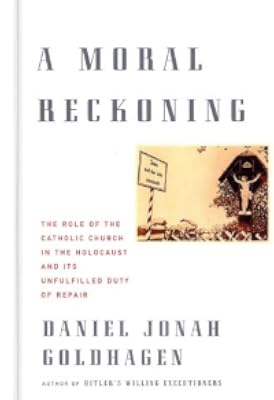
By focusing so much of the Jewish-Catholic dialogue on the question of Pius XII, the broader question of a massive Catholic failure is deflected. One example of this surfaces in the work of Daniel Jonah Goldhagen, whose book ... (show all)Hitler’s Willing Executioners caused such a sensation in 1996. He deals extensively with the failure of the Christian churches in Germany. Following the historian Guenter Lewy, he shifts the focus from what the churches did not do – the “silence” – toward their positive role in the Nazis’ genocidal project, that of supplier of crucial records. Goldhagen writes, “The foundational element of the Nuremberg Laws was the regime’s capacity to distinguish and demonstrate the extent of a person’s Jewish ancestry, to know who was a Jew. Enforcement therefore depended upon the use of the genealogical records in the possession of local churches.” Lewy quoted a priest who defined this identification activity as a “service to the people,” but that was in 1934. Once the function – and the result – of this role became clear, did the churches stop performing it? Lewy says no. “The very question of whether the Church should lend its help to the Nazi state in sorting out people of Jewish descent was never debated.” A few heroes among the clergy, including Angelo Roncalli, the future Pope John XXIII, exploited the Church’s function as a racial-certification agent to provide false identity documents to Jews, but the institutional Church never renounced this role. “The cooperation of the Church in this matter continued right through the war years,” Lewy writes, “when the price of being Jewish was no longer dismissal from a government job and loss of livelihood, but deportation and outright physical destruction.” This fact leads Goldhagen to include certain Church officials among the agents of destruction. “What defines a perpetrator?” he asks. “A perpetrator is anyone who knowingly contributed in some intimate way to the mass slaughter of Jews . . . Perpetrators include railroad engineers and administrators who knew that they were knew that their participation in the identification of Jews as non-Christians would lead to the deaths of the Jews.”
Pope Pius XII, without violating his tactic of diplomatic prudence, could have quietly instructed parish priests throughout Europe to destroy baptismal records once their diabolical function became clear. He never did.
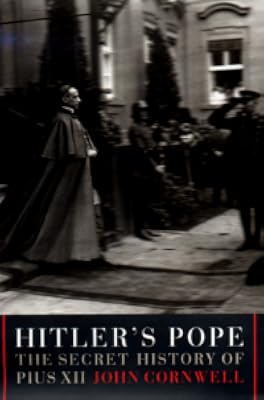
Critics of Pius XII, like Hochhuth, have accounted for his failure to challenge Hitler more directly by charging him with cowardice, or with Nazi sympathies, but his biographer John Cornwell shows that the former was never the case, and by the late 1930s neither was the latter. Pius XII’s courage and his contempt for Hitler were demonstrated by his active participation, early in his pontificate, in a plot to overthrow the German dictator. From late 1939 through March 1940, Pius XII served as a channel of communication between a group of anti-Hitler German army chiefs, led by General Ludwig Beck, and the British government, represented by Britain’s Vatican minister, Francis d’Arcy Osborne. The Germans indicated their readiness to stage a coup and end the war, but only with assurances from London that the Munich settlement would be honored. For whatever reason, the British failed to pick up on the initiative, but not before the plotters and the pope himself had acted in ways that Hitler, had he learned of them, would have savagely punished. This episode leads Cornwell to a firm conclusion about Pacelli [birth name of Pius XII]: “Pusillanimity and indecisiveness – shortcomings that would be cited to extenuate his subsequent silence and inaction in other matters – were hardly in his nature.”
So what accounts not only for the silence of Pius XII, but for Eugenio Pacelli’s complicity with Hitler in the early years? The early years offer the clue, for it was then that Pacelli’s determination to put the accumulation and defense of papal power above everything else showed itself for what it was. Above the fate of the Jews, certainly, but also above the fate of the Catholic Church elsewhere in Europe. “Was there something in the modern ideology of papal power,” Cornwell asks, “that encouraged the Holy See to acquiesce in the face of Hitler’s evil, rather than oppose it?” The answer to this awful question, it seems increasingly clear, is yes, which makes even more problematic, too, the Vatican’s current wish to make a saint of Pius IX, whose claim to infallibility and whose “Syllabus of Errors” made him the supreme modern ideologue of papal power. It almost goes without saying that Pacelli would have shared the broad antisemitism of his culture, the Christian contempt for Judaism that would not be repudiated until Vatican II. But the pursuit of papal power transporting Jews to their deaths. They include any Church officials who in the modern era had come at the expense of Jews, and that too is part of what led to Europe’s acquiescence before the Final Solution. We just recalled how this played out in the Roman ghetto, but it affected theology as well. When the “Syllabus of Errors” (1864) was defined by a leading Catholic journal as a set of detested “modern ideas . . . of Jewish when European liberal movements in politics and education were denounced as a demonic Jewish conspiracy; when Church organs led the way in branding Jews simultaneously as revolutionaries and financiers; and when all of this is centered in vengeful Catholic policies toward Jews in the Roman ghetto, under the pope’s windows, a far graver issue arises than the silence of one man. The question rather becomes, How did a succession of popes prepare the way for the “silence” of an entire civilization?
“The Pope’s silence,” Father Edward Flannery wrote, “is better seen as the apex of a triangle that rested on the much wider acquiescence of the German episcopacy, his most immediate ‘constituents,’ which, in turn, rested on the still wider apathy or collusion with Nazism of German Catholics – or Christians – themselves so ill prepared for any better response by accustomed antisemitic attitudes so often aided and abetted in the past by the churches themselves. The triangle continues to widen, as we include a Europe and a Western world, impregnated with an indifference, if not an antipathy, to Jews.”
If Pius XII had done what his critics, in hindsight, wish him to have done – excommunication of Hitler, revocation of the concordat, “a flaming protest against the massacre of the Jews,” in Lewy’s phrase – it would have been only a version of what Pius IX did in 1875 against Bismarck, and in 1871 against Garibaldi when he excommunicated all Italians who cooperated with the new Italian state, even if only by voting in its elections. As before, Catholics would have had to choose between a Church-hating government and the Church. But in the 1930s, there is reason to believe, vast numbers of Catholic Germans, and perhaps other Catholic Europeans as well – those who had celebrated the Reichskonkordat, and those who had baited the Dreyfusards – would have preferred Hitler to Pius XII. “Shall I bring them into conflicts of conscience?” Pius asked, referring to Catholic Germans, in explaining why he could not protest the extermination of Jews. Because of the “dark symbiosis” of ancient Christian Jew-hatred and modern racism, Hitler’s anti-Jewish program, even at its extreme, was simply not that offensive to the broad population of Catholics. As the scholar of antisemitism Léon Poliakov put it, “The Vatican’s silence only reflected the deep feeling of the Catholic masses of Europe.” And in fact, the Vatican’s preference for its own power, as it pursued its vision of an absolute papacy, was only a version of the choice countless Europeans made to pursue their own welfare without regard for those outside the circle of their concern – the Jews.
That choice had been nearly two thousand years in the making. It is the last consequence of the long story this book has told, from the Seamless Robe of Christ to the cross of Constantine to La Croix to Kreuz und Adler, to the cross at Auschwitz. This story is itself the source of the pope’s silence, and the meaning of it. This is the moral failure of Catholicism, and of the civilization of which it is so centrally a part. The pope’s silence is better seen, that is, not as the indictment but as the evidence. - Last words
- (Click to show. Warning: May contain spoilers.)I answer, this too with Simon Peter, "Lord, to whom shall I go?"
- Publisher's editor
- Darehshori, Nader; Cooper, Larry; Chinski, Eric
- Blurbers
- Morris, Charles R.; Skloot, Floyd; Van Biema, David; Sullivan, Andrew
- Disambiguation notice
- "Portions of this book appeared, in different form, in The New Yorker and The Atlantic Monthly. T.p. verso
Classifications
- Genres
- Religion & Spirituality, History, Nonfiction, General Nonfiction
- DDC/MDS
- 261.2609 — Religion Christian organization, social work & worship Social theology and interreligious relations and attitudes Christianity and other systems of (non-)belief Judaism
- LCC
- BM535 .C37 — Philosophy, Psychology and Religion Judaism Judaism Relation of Judaism to special subject fields Religions
- BISAC
Statistics
- Members
- 1,715
- Popularity
- 12,992
- Reviews
- 21
- Rating
- (4.08)
- Languages
- English, Portuguese
- Media
- Paper, Audiobook, Ebook
- ISBNs
- 9
- UPCs
- 2
- ASINs
- 9