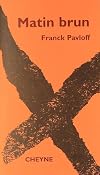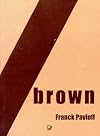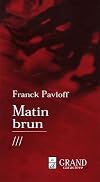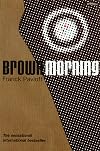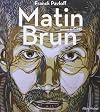
Brown
by Franck Pavloff
On This Page
Description
Charlie and his friend live in a time marked by the rise of an extreme totalitarian regime:the Brown State.Everyday life goes on more or less as normal: they read the newspapers over morning coffee; they watch football and play cards.So, to avoid trouble, they fall in with the small changes and seemingly insignificant edicts of the powers-that-be, turning a blind eye to what is really happening ... with disastrous consequences.Tags
Recommendations


























Member Reviews
A hard-hitting novella that delivers a powerful message without going overboard on the verbosity.
Written in the first person, the narrator begins in a conversational style, casually speaking of government dictates about the colour ‘brown’ and how easy it had been to adapt his lifestyle towards the new regulations. His friend Charlie, for instance, got rid of his black Labrador and the narrator himself, of his black and white cat. Easy changes after all. The modifications don’t stop here and the narrator’s world is slowly turned more “brown”, but he still isn’t much worried. The government is catching OTHERS, so “everything was ok”. As you can guess, the almost Orwellian rules don’t stay without impacting everyone, show more and by the time the narrator realises the magnitude of the changes, it is too late.
Originally written in French, this allegory against the fascist government was penned for a conference on fascism in 1998 when the Rhone-Alps region of France leaned to the politics of the extreme right. The story was published by a small independent publisher. Matin Brun (translating to “Brown Morning”) sold more than 20000 copies within three years, mainly through word of mouth publicity. After a radio broadcaster spoke about it in 2001, the book came back in the public eye and has gone on to sell more than 500000 copies in Europe and has been translated into several languages.
I had a slight sense of déjà vu while reading this little twelve-page novella. It reminded me of some short story I had read where an old couple has suffered losses through their dystopian rulers and knows that death is inevitable. (I wish I could remember which story this was and where I had read it. If I recollect it, I will update my review.) At the same time, it also has shades of the famous poem by Martin Niemöller. Titled ”First They Came”, it speaks of how the narrator stays silent when others are affected, until he realises that there is no left to speak for him. A common human tendency, right? “As long as it doesn’t affect me, I will not open my mouth” syndrome.
Within just a few pages, the book, with its simplistic prose and straightforward delivery, creates a strong impact, highlighting the importance of speaking up at the right time before it too late. After all, if common citizens stay silent allowing the injustice to be widespread, it can’t be reigned in until later, sometimes never.
If you are looking for a short yet meaningful read, do give this title a try.
4.25 stars.
I came across this title through the review of a Goodreads friend, Nika. Check out her brilliant review on this title. Thanks for the lovely recommendation, Nika. Would have missed out on this gem otherwise.
The book can be read online in both English and French through the below link:
https://issuu.com/obrienpress/docs/brownmorning_book
———————————————
Connect with me through:
My Blog | The StoryGraph | Facebook | Twitter show less
Written in the first person, the narrator begins in a conversational style, casually speaking of government dictates about the colour ‘brown’ and how easy it had been to adapt his lifestyle towards the new regulations. His friend Charlie, for instance, got rid of his black Labrador and the narrator himself, of his black and white cat. Easy changes after all. The modifications don’t stop here and the narrator’s world is slowly turned more “brown”, but he still isn’t much worried. The government is catching OTHERS, so “everything was ok”. As you can guess, the almost Orwellian rules don’t stay without impacting everyone, show more and by the time the narrator realises the magnitude of the changes, it is too late.
Originally written in French, this allegory against the fascist government was penned for a conference on fascism in 1998 when the Rhone-Alps region of France leaned to the politics of the extreme right. The story was published by a small independent publisher. Matin Brun (translating to “Brown Morning”) sold more than 20000 copies within three years, mainly through word of mouth publicity. After a radio broadcaster spoke about it in 2001, the book came back in the public eye and has gone on to sell more than 500000 copies in Europe and has been translated into several languages.
I had a slight sense of déjà vu while reading this little twelve-page novella. It reminded me of some short story I had read where an old couple has suffered losses through their dystopian rulers and knows that death is inevitable. (I wish I could remember which story this was and where I had read it. If I recollect it, I will update my review.) At the same time, it also has shades of the famous poem by Martin Niemöller. Titled ”First They Came”, it speaks of how the narrator stays silent when others are affected, until he realises that there is no left to speak for him. A common human tendency, right? “As long as it doesn’t affect me, I will not open my mouth” syndrome.
Within just a few pages, the book, with its simplistic prose and straightforward delivery, creates a strong impact, highlighting the importance of speaking up at the right time before it too late. After all, if common citizens stay silent allowing the injustice to be widespread, it can’t be reigned in until later, sometimes never.
If you are looking for a short yet meaningful read, do give this title a try.
4.25 stars.
I came across this title through the review of a Goodreads friend, Nika. Check out her brilliant review on this title. Thanks for the lovely recommendation, Nika. Would have missed out on this gem otherwise.
The book can be read online in both English and French through the below link:
https://issuu.com/obrienpress/docs/brownmorning_book
———————————————
Connect with me through:
My Blog | The StoryGraph | Facebook | Twitter show less
More of a pamplet than a book, I'm not even sure it is long enough to be considered a novella. It is a parable written in response to the growing support in France in the 1990s for extreme right-wing groups. In this fictional society, the Brown party rule and have introduced a law banning the ownership of cats who aren't brown. Then the law expands to include dogs that aren't brown. It is short and simple, but a very powerful tale. My edition had great graphics of brown cats and dogs and the original French text as well as the English version.
Je viens de relire cette courte nouvelle pour préparer un travail avec mes élèves. Je me souviens avoir été assez dubitative quand je l'avais lue, probablement en 2002, quand elle a été à la mode après le coup de tonnerre du 2nd tour de la présidentielle (mais la nouvelle a été initialement publiée en 1998). Mais je crois que j'en attendais trop à ce moment-là. C'est une nouvelle qui dit de façon limpide des choses complexes, en utilisant une allégorie, ou plus exactement c’est un apologue (un court récit narratif, didactique, démonstratif et fictif, à visée argumentative, dont se tire une vérité morale pratique, un enseignement pour le lecteur d'après la définition de Wikipédia), comme je l'ai découvert show more lors de mes rapides recherches.
Il ne faut donc pas en attendre une grande profondeur ou une grande complexité. Et il faut savoir replacer ce texte dans son contexte, celui d'un coup de gueule assumé de l'auteur effaré par les compromissions de la Droite avec le FN (je me demande, s'il était effaré en 1998, quel adjectif je pourrais utiliser pour ce qu'il doit être aujourd'hui…), et celui d'un texte qui, aujourd'hui, presque 25 ans plus tard, est je pense principalement à destination des jeunes.
L'ayant cette fois clairement lu dans cette optique, eh bien, je l'ai trouvé plutôt bien ficelé, et je crois que l'on va en faire une lecture intéressante cette semaine en classe…
Liens avec d’autres textes : Comme je lisais aussi ce week-end [Grand-peur et misère du IIIème Reich] de Brecht que j'ai pu aller voir au théâtre il y a peu, j'ai bien sûr vu des passerelles entre les deux, qui cherchent à décrire des réalités qui ont quelques similitudes, mais là on n'est plus sur le même lectorat et la même intention littéraire.
A retenir aussi, un parallèle (voire plus qu'un parallèle, Franck Pavloff a presque littéralement pris cette citation pour l'étendre au format d'une nouvelle) à faire avec la célèbre (mais mouvante) citation du pasteur Martin Niemöller, que je connaissais sans en connaître l'auteur :
« Quand ils sont venus chercher les ..., je n'ai rien dit, je n'étais pas ... . » On connaît la fin... show less
Il ne faut donc pas en attendre une grande profondeur ou une grande complexité. Et il faut savoir replacer ce texte dans son contexte, celui d'un coup de gueule assumé de l'auteur effaré par les compromissions de la Droite avec le FN (je me demande, s'il était effaré en 1998, quel adjectif je pourrais utiliser pour ce qu'il doit être aujourd'hui…), et celui d'un texte qui, aujourd'hui, presque 25 ans plus tard, est je pense principalement à destination des jeunes.
L'ayant cette fois clairement lu dans cette optique, eh bien, je l'ai trouvé plutôt bien ficelé, et je crois que l'on va en faire une lecture intéressante cette semaine en classe…
Liens avec d’autres textes : Comme je lisais aussi ce week-end [Grand-peur et misère du IIIème Reich] de Brecht que j'ai pu aller voir au théâtre il y a peu, j'ai bien sûr vu des passerelles entre les deux, qui cherchent à décrire des réalités qui ont quelques similitudes, mais là on n'est plus sur le même lectorat et la même intention littéraire.
A retenir aussi, un parallèle (voire plus qu'un parallèle, Franck Pavloff a presque littéralement pris cette citation pour l'étendre au format d'une nouvelle) à faire avec la célèbre (mais mouvante) citation du pasteur Martin Niemöller, que je connaissais sans en connaître l'auteur :
« Quand ils sont venus chercher les ..., je n'ai rien dit, je n'étais pas ... . » On connaît la fin... show less
Oct 8, 2024French
1
Et si, un matin, de nouvelles lois nous obligeaient à avoir un chat ou un chien uniformément brun ? Il faudrait nous débarrasser de nos chats et chiens s'ils sont d'une autre couleur. Après tout, ce ne sont que des animaux de compagnie. On serait triste un moment, mais on se consolerait avec le nouveau chat/chien. Oui mais et si ce même gouvernement nous imposait aussi de dire le mot "brun" à chaque fin de phrase ? Jusqu'où supporterions nous le ridicule, virant bientôt au dangereux ? Ce texte, très court, est percutant et révèle les lâchetés du quotidien, celles qui ont des conséquences fâcheuses...
Sep 18, 2012French
1
Das Buch erzählt eine einfache Parabel der Anpassung. Sie schließt eher ans dritte Reich an als an den momentanen Alltagsfaschismus. Ich fand sie sehr gut, aber im Augenblick nicht treffend genug.
Mar 2, 2017German
Un texte malheureusement toujours d'actualité qui nous rappelle que toute concession, aussi anodine soit-elle, peut amener à de graves dérives.
May 3, 2017French
Så jävla viktig och bra pamflett.
Dec 9, 2014Swedish
Members
- Recently Added By
Author Information

25+ Works 263 Members
Common Knowledge
- Canonical title
- Brown
- Original title
- Matin brun
- Alternate titles
- Brown Morning
- Original publication date
- 1998
- First words*
- Les jambes allongées au soleil, on ne parlait pas vraiment avec Charlie, on échangeait des pensées qui nous couraient dans la tête, sans bien faire attention à ce que l'autre racontait de son côté.
- Last words*
- (Click to show. Warning: May contain spoilers.)On frappe à la porte. Si tôt le matin, ça n'arrive jamais. J'ai peur. Le jour n'est pas levé, il fait encore brun dehors. Mais arrêtez de frapper si fort, j'arrive.
*Some information comes from Common Knowledge in other languages. Click "Edit" for more information.
Classifications
- Genres
- Fiction and Literature, General Fiction
- DDC/MDS
- 800 — Literature & rhetoric Literature, rhetoric & criticism Literature (Belles-lettres) and rhetoric
- LCC
- PQ2676 .A8826 .M3713 — Language and Literature French, Italian, Spanish and Portuguese literatures French literature Modern literature 1961-2000
- BISAC
Statistics
- Members
- 204
- Popularity
- 159,871
- Reviews
- 9
- Rating
- (3.97)
- Languages
- 11 — Catalan, Dutch, English, Esperanto, French, German, Italian, Japanese, Korean, Spanish, Swedish
- Media
- Paper
- ISBNs
- 19