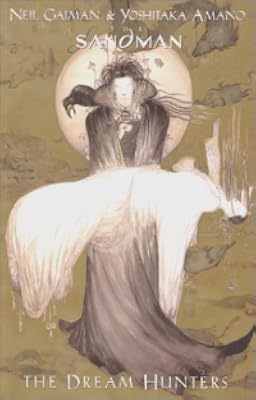
The Sandman: The Dream Hunters [Novella]
by Neil Gaiman, Yoshitaka Amano (Illustrator)
The Sandman (Additional — The Dream Hunters novella)
On This Page
Description
Set in ancient Japan, this lyrical tale follows the ill-fated romance between a humble young monk and a magical, shape-changing she-fox. When the fox stumbles upon a band of demons discussing a plot to steal the monk's life through a dream trap, it will take all the fox's craftiness-and the intervention of Morpheus-to save him. Combining prose with stunning full-page paintings, The Dream Hunters also showcases Amano's art with an eight-page gatefold bringing an ethereal beauty to Morpheus show more and other classic Sandman characters. show lessTags
Recommendations





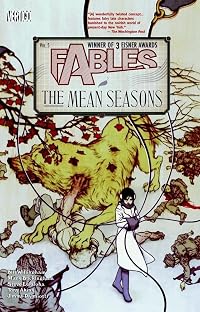
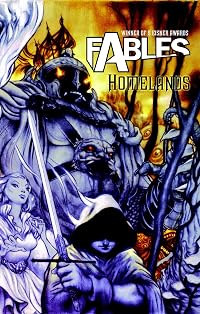
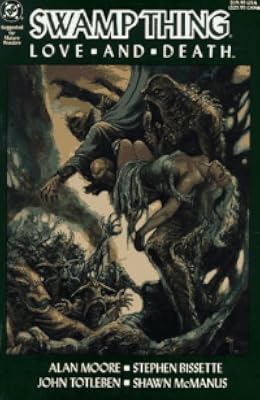
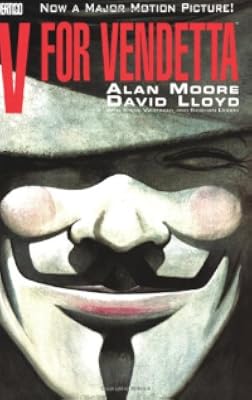




Member Recommendations
Jannes Japanese-inspired mythology of dream and unreality. Valente and Gaiman are both masters of their craft, each with a unique and powerful voice and an inventiveness that leaves you awe-struck and wishing for more.

DisassemblyOfReason If you enjoyed The Dream Hunters, "The Foxwife" by Jane Yolen in Moonsinger's Friends features another fox spirit who falls in love with a mortal man.
Member Reviews
The Sandman, as written by Neil Gaiman and penciled and inked by a phenomonal cast (Sam Keith, Mike Dringenberg, and so many more) has a justified place in the list of all-time greatest works in comic book history. We can and should revise our assessment of art when the artist has failed us, but the experience of Sandman is a work of many hearts, all of them carrying their own secret pain, and one of them is me.
If I remember right, this is Neil Gaiman's first return to The Sandman after the series concluded its venerable run. It's not a comic book, but a prose novella with illustrations on almost every page. And it's brilliant-- possibly the second-best Sandman story after Brief Lives. It's a fairy tale in a vaguely Japenese style about a monk and the fox who loves him. Like many Gaiman stories, it doesn't know what its focus is, but that works so well here, as the story gently drifts from tangent to tangent, showing love at its best and its worse. The illustrations by Yoshitaka Amano are gorgeous, and invite the eye to linger over them slowly. It's hard to explain why I liked this so much; it just hits that primal nerve good stories should show more hit-- you feel like you've learned something new that you've always known.
Neil Gaiman's The Sandman Spin-Offs: « Previous in sequence | Next in sequence » show less
Neil Gaiman's The Sandman Spin-Offs: « Previous in sequence | Next in sequence » show less
3 years after the Sandman called it quits, and just over 10 years after issue #1 hit the stands, the Dream Hunters was the best return the King of All Night's Dreaming could've asked for.
[N.B. This review includes images, and was formatted for my site, dendrobibliography -- located here.]
I was nervous about this story: It's structure is a departure for the Dreaming, being a novella with accompanying illustrations instead of a 'comic book.' I didn't expect it could capture Dream's trademark twinkle nearly so well--and I was wrong. This is the Sandman, and it's one of Dream's most powerful stories. Gaiman spent years evoking the style of myths of all colors to tell stories about--well--stories, and this is him exercising that experience show more to pay homage to Japanese and Chinese folklore.*
This isn't a continuation of the original series, either, making it a safe read for new-comers. The nods are there--and satisfying--but they're unimportant to the story itself. The Dream Hunters is all Morpheus and his fatal hubris from beginning to end. He guides two potential lovers, a fox-spirit and a monk, to care for one another despite their doomed situation. Theirs is a sly, sad defense of forbidden love only Morpheus could deliver.
The illustrations decorating every other page were provided by Yoshitaka Amano, best known for his iconic Final Fantasy artwork. Amano's simple, yet complex images go hand-in-hand with Gaiman's prose. They're both detached and maybe a bit cold in the same fairy-tale way, gently carrying a story for any time and as old as time to the reader. His pencil lines are sparse, but still provide fine details to strike humanity in his characters. (& his ethereal style captures the '80s goth-punk vibe of Morpheus' (contextually-ridiculous) figure so well!)
I loved it. It was sad, tender, cute 'n' sweet, and oh-so-powerful: The best collaboration you could want from these two artists.
*The Dream Hunters has a Japanese flavor. Gaiman cites a collection (pub. 1908) of Japanese myths by Yei Theodora Ozaki as the source (with minimal alterations to fit in with the Dreaming) in the afterword. He was wrong, for whatever reason; it's source is Pu Songling (c. 1700) of the Qing Dynasty--though how similar it is, I have no idea. show less
[N.B. This review includes images, and was formatted for my site, dendrobibliography -- located here.]
I was nervous about this story: It's structure is a departure for the Dreaming, being a novella with accompanying illustrations instead of a 'comic book.' I didn't expect it could capture Dream's trademark twinkle nearly so well--and I was wrong. This is the Sandman, and it's one of Dream's most powerful stories. Gaiman spent years evoking the style of myths of all colors to tell stories about--well--stories, and this is him exercising that experience show more to pay homage to Japanese and Chinese folklore.*
This isn't a continuation of the original series, either, making it a safe read for new-comers. The nods are there--and satisfying--but they're unimportant to the story itself. The Dream Hunters is all Morpheus and his fatal hubris from beginning to end. He guides two potential lovers, a fox-spirit and a monk, to care for one another despite their doomed situation. Theirs is a sly, sad defense of forbidden love only Morpheus could deliver.
The illustrations decorating every other page were provided by Yoshitaka Amano, best known for his iconic Final Fantasy artwork. Amano's simple, yet complex images go hand-in-hand with Gaiman's prose. They're both detached and maybe a bit cold in the same fairy-tale way, gently carrying a story for any time and as old as time to the reader. His pencil lines are sparse, but still provide fine details to strike humanity in his characters. (& his ethereal style captures the '80s goth-punk vibe of Morpheus' (contextually-ridiculous) figure so well!)
I loved it. It was sad, tender, cute 'n' sweet, and oh-so-powerful: The best collaboration you could want from these two artists.
*The Dream Hunters has a Japanese flavor. Gaiman cites a collection (pub. 1908) of Japanese myths by Yei Theodora Ozaki as the source (with minimal alterations to fit in with the Dreaming) in the afterword. He was wrong, for whatever reason; it's source is Pu Songling (c. 1700) of the Qing Dynasty--though how similar it is, I have no idea. show less
Compared to the full Sandman story arc, this sideline story is often forgotten in my mind because it doesn't constribute to the resurrection and subsequent destruction of Morpheus, but it's actually a wonderful little story on its own. Folklore, and especially reworked folklore, is one of my favourite literary motifs, and Gaiman shows his skill clearly in this strange tale about a fox spirit and a monk who fall in love. The original story doens't seem to have anything to do with the Dream King, but the method of the monks downfall is through dreams, so it is rather fitting that Morpheus takes a more central role in the story. Yoshitaka Amano's illustrations are a perfect counterpart as well, since he utilizes styles which hark back to show more Japenese artistic traditions, but which are a little bit more dreamlike and whimsical. The story has also been illustrated in a more traditional graphic novel style, but I much prefer Amano's more traditional illustrations and the more novel-like structure of the story in this format. show less
In The Sandman: The Dream Hunters, Neil Gaiman returns to the Dreaming and Morpheus, its lord, in a story based on Rev. B.W. Ashton's story "The Fox, the Monk, and the Mikado of All Night's Dreaming", originally published in his Fairy Tales of Old Japan. The story fits perfectly with the mythology that Gaiman had previously crafted in his regular Sandman series and reads like one of the many interludes that Gaiman set during Morpheus' life prior to his captivity. Yoshitaka Amano's artwork is gorgeous and works perfectly to reflect and forward the tone of Gaiman's writing. As Gaiman's first return to The Sandman following completion of the regular series, this set the bar high and continued to show how Gaiman drives the medium of comics show more into new territory. The end result is something both gorgeous and haunting. show less
Summary: The Dream Hunters is a lavishly told and gorgeously illustrated take of the Japanese folk tale "The Fox, The Monk, and The Mikado of All Night's Dreaming", set in the Sandman universe. In it, a fox falls in love with a monk who lives alone in a remote temple, and she is willing to sacrifice her life to save his - even if it means invoking the Dream King's help. The tale is told in prose, not in typical graphic-novel format, but Yoshitaka Amano's ethereal illustrations adorn every facing page.
Review: A beautiful little book that should be enjoyed by Sandman fans and non-Sandman fans alike. While a fair bit of this does take place in the Dreaming, and several familiar faces other than Morpheus make an appearance, it would show more certainly be understandable and enjoyable without having read the ten volumes that make up the "main" Sandman canon. It's a lovely tale, and I loved how Gaiman retained the Japanese folk-tale feeling while still working it into the Sandman universe - particularly when Cain and Abel showed up. The artwork similarly treads the border between the two worlds, giving us a vision of the Dream King who is simultaneously recognizable yet new, and who acts a reminder of the universality of the emotions if not the experiences of the tale. 4.5 out of 5 stars.
Recommendation: An excellent introduction to Japanese folklore, the Sandman universe, or Gaiman's storytelling in general. It's a fast read, and so lovely that it shouldn't be missed. show less
Review: A beautiful little book that should be enjoyed by Sandman fans and non-Sandman fans alike. While a fair bit of this does take place in the Dreaming, and several familiar faces other than Morpheus make an appearance, it would show more certainly be understandable and enjoyable without having read the ten volumes that make up the "main" Sandman canon. It's a lovely tale, and I loved how Gaiman retained the Japanese folk-tale feeling while still working it into the Sandman universe - particularly when Cain and Abel showed up. The artwork similarly treads the border between the two worlds, giving us a vision of the Dream King who is simultaneously recognizable yet new, and who acts a reminder of the universality of the emotions if not the experiences of the tale. 4.5 out of 5 stars.
Recommendation: An excellent introduction to Japanese folklore, the Sandman universe, or Gaiman's storytelling in general. It's a fast read, and so lovely that it shouldn't be missed. show less
Initially I felt this was a real left turn for the series, but it truly wasn't. I know it was based on a Japanese fable, but it really fit in nicely with the rest of the series.
I also enjoyed that this was more of an illustrated narrative instead of the standard panels with dialogue. The writing was, of course, beautiful (can Gaiman do any less?) and the art, was gorgeous.
I think a work of this type--being an adaptation of an old fable, breaking with the standard graphic novel formula, and still fitting perfectly with the rest of the Sandman mythos--speaks to the brilliance of Gaiman.
The Sandman is often a bit player in his own title. Gaiman is never scared to let other characters command the stage, letting the titular character show show more only when he actually has a part to play. It allows for a massive world and much richer and deeper stories.
Well done. show less
I also enjoyed that this was more of an illustrated narrative instead of the standard panels with dialogue. The writing was, of course, beautiful (can Gaiman do any less?) and the art, was gorgeous.
I think a work of this type--being an adaptation of an old fable, breaking with the standard graphic novel formula, and still fitting perfectly with the rest of the Sandman mythos--speaks to the brilliance of Gaiman.
The Sandman is often a bit player in his own title. Gaiman is never scared to let other characters command the stage, letting the titular character show show more only when he actually has a part to play. It allows for a massive world and much richer and deeper stories.
Well done. show less
Members
- Recently Added By
Lists

Best Mythic Fiction
35 works; 6 members

Prose Fiction Recommendations Based On WATCHMEN
10 works; 1 member

Slipstream or Interstitial Fiction
160 works; 19 members

Speculative Fiction to Read
706 works; 32 members

Bram Stoker Award
238 works; 5 members
Author Information

843+ Works 449,689 Members
Neil Gaiman was born in Portchester, England on November 10, 1960. He worked as a journalist and freelance writer for a time, before deciding to try his hand at comic books. Some of his work has appeared in publications such as Time Out, The Sunday Times, Punch, and The Observer. His first comic endeavor was the graphic novel series The Sandman. show more The series has won every major industry award including nine Will Eisner Comic Industry Awards, three Harvey Awards, and the 1991 World Fantasy Award for best short story, making it the first comic ever to win a literary award. He writes both children and adult books. His adult books include The Ocean at the End of the Lane, which won a British National Book Awards, and the Locus Award for Best Fantasy Novel for 2014; Stardust, which won the Mythopoeic Award as best novel for adults in 1999; American Gods, which won the Hugo, Nebula, Bram Stoker, SFX, and Locus awards; Anansi Boys; Trigger Warning: Short Fictions and Disturbances; and The View from the Cheap Seats: Selected Nonfiction, which is a New York Times Bestseller. His children's books include The Day I Swapped My Dad for Two Goldfish; Coraline, which won the Elizabeth Burr/Worzalla, the BSFA, the Hugo, the Nebula, and the Bram Stoker awards; The Wolves in the Walls; Odd and the Frost Giants; The Graveyard Book, which won the Newbery Award in 2009 and The Sandman: Overture which won the 2016 Hugo Awards Best Graphic Story. (Bowker Author Biography) show less

Awards and Honors
Awards
Series

Belongs to Publisher Series
Work Relationships
Common Knowledge
- Canonical title
- The Sandman: The Dream Hunters [Novella]
- Original title
- The Dream Hunters
- Original publication date
- 1999-10-27
- People/Characters
- Dream (Morpheus)
- Important places
- The Dreaming; Kyoto, Japan; Honshū, Japan; Japan
- First words
- A monk lived in solitude beside a temple on the side of a mountain.
- Last words
- (Click to show. Warning: May contain spoilers.)But dreams are strange things, and none of us but the King of All Night's Dreaming can say if they are true or not, nor of what they are able to tell any of us about the times that are still to come.
- Disambiguation notice
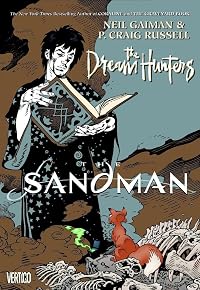
- This is the illustrated novel version The Dream Hunters by Neil Gaiman and Yoshitaka Amano, which is different from the Graphic Novel adaptation by Neil Gaiman and P. Craig Russel.
Please, don't combine them.
Classifications
Statistics
- Members
- 3,284
- Popularity
- 5,187
- Reviews
- 55
- Rating
- (4.30)
- Languages
- 9 — Czech, English, French, German, Greek, Italian, Russian, Spanish, Portuguese (Brazil)
- Media
- Paper, Ebook
- ISBNs
- 27
- ASINs
- 9