The Articulate Mammal: An Introduction to Psycholinguistics
by Jean Aitchison
On This Page
Description
This Routledge Classics edition includes a new foreword by the author.'An excellent and very welcome guide to psycholinguistics...highly recommended.' The Washington Post A classic in its field for almost forty years, The Articulate Mammal is a brilliant introduction to psycholinguistics. In lucid prose Jean Aitchison introduces and demystifies a complex and controversial subject: What is language and is it restricted to humans? How do children acquire language so quickly? Is language innate show more or learned? She explains the pioneering work of Noam Chomsky; how ch show lessTags
Recommendations












Member Reviews
This book oscillated between interesting and interesting-yet-outdated. It was a quick and entertaining read, but on the whole it could do with a thorough update and with a little more precision.
Like most of Aitchison's popular science books about language and linguistics, this book was written quite some time ago, and subsequent editions have been revised only slightly to reflect advances in the field. Most of the references are to studies from the sixties and the eighties, which is frankly unacceptable from an introductory textbook in psycholinguistics (or any of the cognitive sciences). To take a particular egregious example, much of the discussion on Chomsky's views and chomskyan theories take the Standard Theory as a starting point show more -- which was formulated in 1965, and which has been more or less abandoned a long time ago.
Another irritable trait of Aitchison's is to start a chapter off with a retorical question: 'Is this matter best explainable by Theory Ultra-White or by Theory Extremely Black?', only to end on a predictable golden middle discussion of "neither though possibly both". Many of the chapters in this book are organised in this way, and it gets old pretty quick.
Aside from these complaints, I've got to admit that Aitchison takes pains to present matters straightforwardly and accessably. In a field riddled with controversies and unsettled debates about some pretty basic problems, that is a big plus.
In short: this book provides a basic and a simplistic look at some of the issues under discussion in the field of psycholinguistics. If you're looking for something quick and dirty and something accessible, this is the book for you. If you want something meaty, avoid this one. show less
Like most of Aitchison's popular science books about language and linguistics, this book was written quite some time ago, and subsequent editions have been revised only slightly to reflect advances in the field. Most of the references are to studies from the sixties and the eighties, which is frankly unacceptable from an introductory textbook in psycholinguistics (or any of the cognitive sciences). To take a particular egregious example, much of the discussion on Chomsky's views and chomskyan theories take the Standard Theory as a starting point show more -- which was formulated in 1965, and which has been more or less abandoned a long time ago.
Another irritable trait of Aitchison's is to start a chapter off with a retorical question: 'Is this matter best explainable by Theory Ultra-White or by Theory Extremely Black?', only to end on a predictable golden middle discussion of "neither though possibly both". Many of the chapters in this book are organised in this way, and it gets old pretty quick.
Aside from these complaints, I've got to admit that Aitchison takes pains to present matters straightforwardly and accessably. In a field riddled with controversies and unsettled debates about some pretty basic problems, that is a big plus.
In short: this book provides a basic and a simplistic look at some of the issues under discussion in the field of psycholinguistics. If you're looking for something quick and dirty and something accessible, this is the book for you. If you want something meaty, avoid this one. show less
More in depth than what I had expected, which makes it even more fascinating. Starting with defining and describing grammar, the author goes on to discuss what language in animals can teach us, heading then straight into how children acquire speech, and, finally, rounding it all up with a journey into neurosciences. 'Talking' animals, children's language development, brain science... It all revolves around Chomsky's ideas (displaying not only his, but some of his detractors as well) in a very articulate and engaging way. Here's an excellent introduction to psycholinguistics.
Ratings
Members
- Recently Added By
Lists

Non-Fiction Worth Reading
1,025 works; 258 members
Author Information

15+ Works 1,154 Members
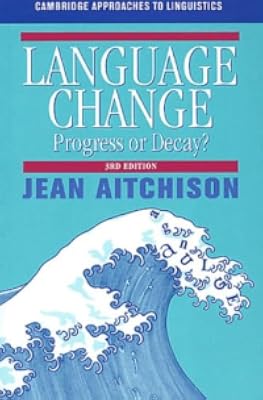
Jean Aitchison is Emeritus Rupert Murdoch Professor of Language and Communication at the University of Oxford. She is the author of numerous books on language, including Language Change: Progress or Decay? (Third Edition, 2001), The Word Weavers: Newshounds and Wordsmiths (2007), Aitchison's Linguistics (Seventh Edition, 2010), and The Articulate show more Mammal (Routledge Classics Edition, 2011). show less
Common Knowledge
- Canonical title*
- The articulate mammal
- Original title
- The Articulate Mammal: An Introduction to Psycholinguistics
- Original publication date
- 1976
- People/Characters
- Noam Chomsky; B. F. Skinner; rats; Charles Hockett; Dr Jarvis Bastion; Doris the Dolphin (show all 29); Buzz the Dolphin; dolphins; mynah birds; chimpanzees; Gua the Chimpanzee; Viki the Chimpanzee; Washoe (chimpanzee); Sarah the Chimpanzee; Loulis; Dr David Premack; Lana; Koko; Nim Chimpsy; Penny Patterson; Herbert Terrace; Phoenix the Dolphin; Akeakami the Dolphin; Marc Dax; John Hughlings Jackson; Phineas Gage; Ogden Nash; Process Peggy; Concept Cuthbert
- Important places
- University of California, Santa Barbera; Yerkes Regional Primate Research Centre, Atlanta, Georgia; Stanford University, Stanford, California, USA; Columbia University, New York, New York, USA; Tracton
- Epigraph
- I find my position as an articulate mammal bewildering and awesome
Would to God I were a tender apple blawssom
Ogden Nash - First words
- [Introduction] Psycholinguistics is sometimes defined as the study of language and the mind. As the name suggests, it is a subject which links psychology and linguistics. The common aim of all who call themselves psycholingui... (show all)sts is to find out about the structures and processes which underlie a human’s ability to speak and understand language.
[Chapter 1] Every normal human being can talk. So the average person tends to think that there is little or nothing mysterious about language. - Last words
- (Click to show. Warning: May contain spoilers.)The words of the folklorist A.L. Lloyd are as applicable to psycholinguistics as they are to traditional music. Like the local song tradition, it has: "proved robust enough to receive all kinds of new nourishment and to digest it satisfactorily. Only a moribund tradition is dominated by the past; a living tradition is constantly sprouting new leaves on old wood and sometimes quite suddenly the bush is ablaze with blossom of a novel shade."
- Original language
- English
*Some information comes from Common Knowledge in other languages. Click "Edit" for more information.
Classifications
Statistics
- Members
- 179
- Popularity
- 183,748
- Reviews
- 2
- Rating
- (3.41)
- Languages
- Dutch, English
- Media
- Paper, Ebook
- ISBNs
- 19
- ASINs
- 3