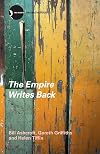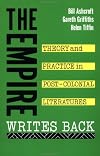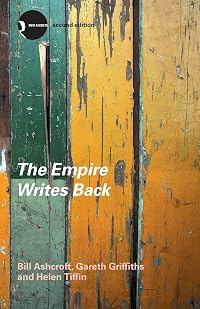
The Empire Writes Back: Theory and Practice in Post-Colonial Literatures (New Accents)
by Bill Ashcroft, Gareth Griffiths, Helen Tiffin
On This Page
Description
This was the first major theoretical account of a wide range of post-colonial texts and their relation to the larger issues of post-colonial culture, and remains one of the most significant works published in this field.Tags
Recommendations



Member Reviews
Taking its title from an article by Salman Rushdie in the Times in 1982, this classic of literary theory was the first proper undergraduate-ready guide to post-colonial literatures. And it's still in print - and therefore presumably still on the syllabus - thirty years after it originally came out in 1989.
Like many famous books, it turns out to be much thinner than you expect - just over 220 pages of text (plus bibliography, index and notes) in the 2002 second edition. After setting out what post-colonial literature is and going through the main issues it has to deal with, the authors look in more detail at the ways post-colonial writers in English have tackled the tricky problem of their relationship with the language of the former show more colonial power. Then we get a chapter of case-studies of half a dozen very different post-colonial works, and two chapters on theory, one dealing with the ways post-colonial critics have applied indigenous theoretical models (old, e.g. the Indian tradition of Sanskrit scholarship; and new, e.g. Fanon's négritude) to post-colonial writing, the other with ways post-colonial writing fits into - or undermines - western literary theory (marxism, poststructuralism, feminism, ...).
The second edition concludes with a new chapter responding to problems readers raised about the original book in 1989, and also bringing us up to date on some of the new ways post-colonial theory has been applied since then, e.g. to environmental problems in the developing world (Arundhati Roy, Ken Saro-Wiwa).
The Australian authors insist on a very wide definition of "post-colonial": "all the culture affected by the imperial process from the moment of colonisation to the present day". And they spend a good page and a half defending that hyphen - these things matter (to the sort of people who earn their living writing books about literary theory, if not to the rest of us...). But it is important to know that they think of that "post" as being rather different from the "post" in postmodern. As far as they are concerned, colonialism has started to exert its effect the moment someone plants a flag on your beach and says "we are more important than you are", and it keeps on doing it indefinitely. As long as the experience of having been colonised is relevant to the work we're discussing, we are free to discuss it as a post-colonial work, even if it's from one of the famous borderline cases, like Ireland or the USA or Mexico. Slavery is definitely on-topic, and so is oppression of indigenous peoples or minorities within (post-)colonial places. But obviously, we're most likely to be applying the lessons of The empire writes back to writing from Africa, South Asia, or the Caribbean (the explicit coverage of the book is limited to writings in English, but they acknowledge that writings in non-European languages and in the languages of other colonial powers, especially Spanish, would be very relevant).
Because of its concise and sometimes rather dense format and its focus on sometimes quite abstract theoretical issues, this is more likely to be a book you turn to when writing essays than something you would choose to read for pleasure. But it is clearly a very influential book in its field. If you haven't heard of it, you probably don't need it, and if you have heard of it then you know what you're getting into... show less
Like many famous books, it turns out to be much thinner than you expect - just over 220 pages of text (plus bibliography, index and notes) in the 2002 second edition. After setting out what post-colonial literature is and going through the main issues it has to deal with, the authors look in more detail at the ways post-colonial writers in English have tackled the tricky problem of their relationship with the language of the former show more colonial power. Then we get a chapter of case-studies of half a dozen very different post-colonial works, and two chapters on theory, one dealing with the ways post-colonial critics have applied indigenous theoretical models (old, e.g. the Indian tradition of Sanskrit scholarship; and new, e.g. Fanon's négritude) to post-colonial writing, the other with ways post-colonial writing fits into - or undermines - western literary theory (marxism, poststructuralism, feminism, ...).
The second edition concludes with a new chapter responding to problems readers raised about the original book in 1989, and also bringing us up to date on some of the new ways post-colonial theory has been applied since then, e.g. to environmental problems in the developing world (Arundhati Roy, Ken Saro-Wiwa).
The Australian authors insist on a very wide definition of "post-colonial": "all the culture affected by the imperial process from the moment of colonisation to the present day". And they spend a good page and a half defending that hyphen - these things matter (to the sort of people who earn their living writing books about literary theory, if not to the rest of us...). But it is important to know that they think of that "post" as being rather different from the "post" in postmodern. As far as they are concerned, colonialism has started to exert its effect the moment someone plants a flag on your beach and says "we are more important than you are", and it keeps on doing it indefinitely. As long as the experience of having been colonised is relevant to the work we're discussing, we are free to discuss it as a post-colonial work, even if it's from one of the famous borderline cases, like Ireland or the USA or Mexico. Slavery is definitely on-topic, and so is oppression of indigenous peoples or minorities within (post-)colonial places. But obviously, we're most likely to be applying the lessons of The empire writes back to writing from Africa, South Asia, or the Caribbean (the explicit coverage of the book is limited to writings in English, but they acknowledge that writings in non-European languages and in the languages of other colonial powers, especially Spanish, would be very relevant).
Because of its concise and sometimes rather dense format and its focus on sometimes quite abstract theoretical issues, this is more likely to be a book you turn to when writing essays than something you would choose to read for pleasure. But it is clearly a very influential book in its field. If you haven't heard of it, you probably don't need it, and if you have heard of it then you know what you're getting into... show less
Ratings
Members
- Recently Added By
Lists

Oxford Online: Literary Theory Recommended Reading
35 works; 2 members
Author Information

15+ Works 968 Members
Bill Ashcroft teaches English at the University of New South Wales.
12+ Works 309 Members
Gareth Griffiths is Professor of English at the University of Western Australia
4+ Works 289 Members
Series
Belongs to Publisher Series
Classifications
- Genres
- Literature Studies and Criticism, Nonfiction, Fiction and Literature
- DDC/MDS
- 820.9 — Literature & rhetoric English & Old English literatures English and Old English (Anglo-Saxon) literatures History, description, critical appraisal of works in more than one form
- LCC
- PR9080 .A85 — Language and Literature English English Literature English literature: Provincial, local, etc.
- BISAC
Statistics
- Members
- 283
- Popularity
- 114,139
- Reviews
- 1
- Rating
- (3.96)
- Languages
- Chinese, English, Russian
- Media
- Paper, Ebook
- ISBNs
- 12
- ASINs
- 3