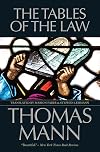
The Tables of the Law
by Thomas Mann 
On This Page
Description
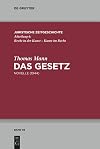
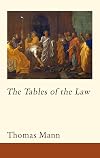
thomas Mann's novella, "The Law" portrays the events of the Exodus of the Children of Israel from Egypt in a similar fashion as Mann told the story of Joseph in his Joseph novels - with gentle rationality and delicate irony. The commentaries by Volker Ladenthin and Thomas Vormbaum take up specific aspects of the story from a literary and judicial perspective.Tags
Recommendations


























Member Reviews
A short work described in a way by the author as a sort of clearing out residuals left after completing his massive novel Joseph and his brothers. My impression after one reading is that it is not one of his better efforts, but Mann always neds several readings, so take my rating with reservation...
Vida de Moisés y cómo éste se entregó a la misión de convertirse en el guía de su pueblo; el éxodo, las dificultades y, por fin, la inscripción de todas las enseñanzas, extracto de la eterna moral de los hombres.
Nov 29, 2022Spanish
Sterke novelle over Mozes.
Oct 26, 2009Dutch
Ratings
Members
- Recently Added By
Lists

Exodus in literature
12 works; 3 members
Author Information

Thomas Mann was born into a well-to-do upper class family in Lubeck, Germany. His mother was a talented musician and his father a successful merchant. From this background, Mann derived one of his dominant themes, the clash of views between the artist and the merchant. Mann's novel, Buddenbrooks (1901), traces the declining fortunes of a merchant show more family much like his own as it gradually loses interest in business but gains an increasing artistic awareness. Mann was only 26 years old when this novel made him one of Germany's leading writers. Mann went on to write The Magic Mountain (1924), in which he studies the isolated world of the tuberculosis sanitarium. The novel was based on his wife's confinement in such an institution. Doctor Faustus (1947), his masterpiece, describes the life of a composer who sells his soul to the devil as a price for musical genius. Mann is also well known for Death in Venice (1912) and Mario the Magician (1930), both of which portray the tensions and disturbances in the lives of artists. His last unfinished work is The Confessions of Felix Krull, Confidence Man (1954), a brilliantly ironic story about a nineteenth-century swindler. An avowed anti-Nazi, Mann left Germany and lived in the United States during World War II. He returned to Switzerland after the war and became a celebrated literary figure in both East and West Germany. In 1929 he was awarded the Nobel Prize for literature. (Bowker Author Biography) show less
Thomas Mann has a Legacy Library. Legacy libraries are the personal libraries of famous readers, entered by LibraryThing members from the Legacy Libraries group.
Some Editions
Series
Belongs to Publisher Series
Work Relationships
Is contained in
Common Knowledge
- Canonical title
- The Tables of the Law
- Original title
- Das Gesetz
- Original publication date
- 1944 (original German) (original German); 1945 (English|Lowe-Porter) (English | Lowe-Porter)
- People/Characters
- Moses
- Important places
- Egypt
- Original language
- German
Classifications
- Genres
- Fiction and Literature, General Fiction, Historical Fiction
- DDC/MDS
- 833.912 — Literature & rhetoric German & related literatures German fiction 1900- 1900-1990 1900-1945
- LCC
- PT2625 .A44 — Language and Literature German, Dutch and Scandinavian literatures German literature Individual authors or works 1860/70-1960
- BISAC
Statistics
- Members
- 153
- Popularity
- 214,961
- Reviews
- 3
- Rating
- (3.44)
- Languages
- 12 — Catalan, Danish, Dutch, English, Estonian, French, German, Hungarian, Italian, Japanese, Multiple languages, Norwegian (Bokmål)
- Media
- Paper, Ebook
- ISBNs
- 16
- ASINs
- 5