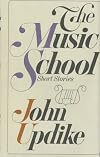
The Music School: Short Stories
by John Updike
On This Page
Description
A collection of short stories by John Updike.Tags
Recommendations




















Member Reviews
Naples, FL 2023 #1 - I spent way too much time on this book.....but i did enjoy it. Updike has a sparseness of language in these short stories, yet he speaks mountains. Overall, these were about relationships....imperfect relationships......stuck in the mud relationships, perhaps?. Not an overly upbeat book, but more often than not, glimmers of hope.....or at least peaceful acceptance of situations flickered at the ends. I really enjoyed 'Giving Blood,' 'The Stare,' 'The Rescue,' & 'The Hermit.' Of course the story after which the collection was named, 'The Music School,' which i looked forward to thinking it would be a highlight, sadly left me cold.....as did 'The Bulgarian Poetess,,' 'Four Sides of One Story,' & 'Avec la Bebe-sitter.' show more Some other worthy honorable mentions exist as well. Liked something in almost all.....did not really love any.....no regrets. show less
Personal favourites from this collection are: 'The Bulgarian Poetess", a story that features Henry Bech, a star in Updike's fiction, who experiences a brief and impossible love on the opposite side of the world: "A Madman" is a good story about Oxford and its human curiosities: and "The Hermit". However, not all the stories have sustained the passage of time. One particular low point is "At A Bar in Charlotte Amalie"
Pain and guilt, as a result of adultery feature in several stories; so does the mysterious lives of our children. These both are regular themes in Updike's fiction.
Pain and guilt, as a result of adultery feature in several stories; so does the mysterious lives of our children. These both are regular themes in Updike's fiction.
Ratings
Members
- Recently Added By
Author Information

339+ Works 53,362 Members
American novelist, poet, and critic John Updike was born in Reading, Pennsylvania on March 18, 1932. He received an A.B. degree from Harvard University, which he attended on a scholarship, in 1954. After graduation, he accepted a one-year fellowship to study painting at the Ruskin School of Drawing and Fine Art in Oxford, England. After returning show more from England in 1955, he worked for two years on the staff of The New Yorker. This marked the beginning of a long relationship with the magazine, during which he has contributed numerous short stories, poems, and book reviews. Although Updike's first published book was a collection of verse, The Carpentered Hen and Other Tame Creatures (1958), his renown as a writer is based on his fiction, beginning with The Poorhouse Fair (1959). During his lifetime, he wrote more than 50 books and primarily focused on middle-class America and their major concerns---marriage, divorce, religion, materialism, and sex. Among his best-known works are the Rabbit tetrology---Rabbit, Run (1960), Rabbit Redux (1971), Rabbit Is Rich (1981), and Rabbit at Rest (1988). Rabbit, Run introduces Harry "Rabbit" Angstrom as a 26-year-old salesman of dime-store gadgets trapped in an unhappy marriage in a dismal Pennsylvania town, looking back wistfully on his days as a high school basketball star. Rabbit Redux takes up the story 10 years later, and Rabbit's relationship with representative figures of the 1960s enables Updike to provide social commentary in a story marked by mellow wisdom and compassion in spite of some shocking jolts. In Rabbit Is Rich, Harry is comfortably middle-aged and complacent, and much of the book seems to satirize the country-club set and the swinging sexual/social life of Rabbit and his friends. Finally, in Rabbit at Rest, Harry arrives at the age where he must confront his mortality. Updike won the Pulitzer Prize for both Rabbit Is Rich and Rabbit at Rest. Updike's other novels range widely in subject and locale, from The Poorhouse Fair, about a home for the aged that seems to be a microcosm for society as a whole, through The Court (1978), about a revolution in Africa, to The Witches of Eastwick (1984), in which Updike tries to write from inside the sensibilities of three witches in contemporary New England. The Centaur (1963) is a subtle, complicated allegorical novel that won Updike the National Book Award in 1964. In addition to his novels, Updike also has written short stories, poems, critical essays, and reviews. Self-Consciousness (1989) is a memoir of his early life, his thoughts on issues such as the Vietnam War, and his attitude toward religion. He was elected to the American Academy of Arts and Letters in 1977. He died of lung cancer on January 27, 2009 at the age of 76. (Bowker Author Biography) John Updike was born in 1932, in Shillington, Pennsylvania. Since 1957 he has lived in Massachusetts. His novels have won the Pulitzer Prize, the National Book Award, the National Book Critics Circle Award, & the Howells Medal. (Publisher Provided) John Updike was born in 1932 and attended Harvard College and the Ruskin School of Drawing and Fine Art in Oxford, England. Form 1955 to 1957 he was a staff member of The New Yorker, which he contributed numerous writings. Updike's art criticism has appeared in publications including Arts and Antiques, The New Republic, The New York Times Book Review, and Realites, among many others. He is the author of such best-selling novels as Rabbit Run and Rabbit is Rich. His many works of fiction, poetry and criticism have been awarded the Pulitzer Prize, the National Book Award, the American Book Award, and the National Book Critics Circle Award. For the past 40 years he has lived in Massachusetts. (Publisher Provided) John Updike is the author of some 50 books, including collections of short stories, poems, & criticism. His novels have won the Pulitzer Prize, the National Book Award, the National Book Critics Circle Award, & the Howells Medal. Born in Shillington, Pennsylvania, in 1932, he has lived in Massachusetts since 1957. (Publisher Provided) show less
Common Knowledge
- Canonical title
- The Music School: Short Stories
- Original publication date
- 1966
- Epigraph
- Now, of the music summoned by the birth/That separates us from the wind and sea,/Yet leaves us in them, until earth becomes,/By being so much of the things we are,/Gross effigy and simulacrum, none/Gives motion to perfection ... (show all)more serene/Than yours, out of your imperfections wrought,/Most rare, or ever of more kindred air/In the laborious weaving that you wear. --Wallace Stevens, "To the One of Fictive Music."
- First words
- Do you remember a fragrance girls acquire in autumn? ("In Football Season")
- Quotations
- In the end each life wears its events with a geological inevitability. ("The Music School")
It is caring that makes mysteries. As you grow indifferent, they lift. ("The Indian") - Last words
- (Click to show. Warning: May contain spoilers.)Then they came rapidly toward him, and there was a thumping, a bumbling, a clumsy crushing clamor. ("The Hermit")
Classifications
Statistics
- Members
- 269
- Popularity
- 119,676
- Reviews
- 2
- Rating
- (3.50)
- Languages
- 6 — Danish, Dutch, English, French, Hungarian, Portuguese
- Media
- Paper, Ebook
- ISBNs
- 11
- ASINs
- 11