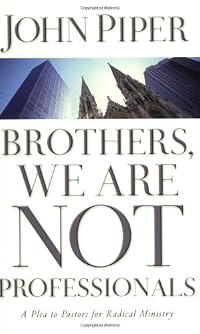
Brothers, We Are Not Professionals: A Plea to Pastors for Radical Ministry
by John Piper
On This Page
Description
In this revised and expanded edition of Brothers, We Are Not Professionals that includes a new introduction and select all-new chapters, best-selling author John Piper pleads through a series of thoughtful essays with fellow pastors to abandon the professionalization of the pastorate and pursue the prophetic call of the Bible for radical ministry. "We pastors are being killed by the professionalizing of the pastoral ministry," he writes. "The mentality of the professional is not the show more mentality of the prophet. It is not the mentality of the slave of Christ. Professionalism has nothing to do with the essence and heart of the Christian ministry. The more professional we long to be, the more spiritual death we will leave in our wake. For there is no professional childlikeness, there is no professional tenderheartedness, there is no professional panting after God. "Brothers, we are not professionals. We are outcasts. We are aliens and exiles in the world. Our citizenship is in Heaven, and we wait with eager expectation for the Lord (Phil. 3:20). you cannot professionalize the love for His appearing without killing it. And it is being killed. "The world sets the agenda of the professional man; God sets the agenda of the spiritual man. The strong wine of Jesus Christ explodes the wine- skins of professionalism.". show lessTags
Recommendations





Member Reviews
I found this book to be amazing. I'm not a pastor, but was interested in this book, because feel that non-pastors play a role in helping others around them see God's love. While that obviously wasn't the point of this book, which is definitely geared toward people who are active pastors -- teaching, leading and counselling flocks -- it was still very helpful. Instead of a 'how to speak well' book, it emphasized the import of a good Christian walk, of how to set aside contemporary 'wisdom' and pursue God wholeheartedly both personally in a one-on-one relationship with Christ through prayer, humility, study, etc. etc. and outwardly, sharing with others the love and learning that the personal relationship provides. I really enjoyed his show more affirmation of things I'd considered before and encountered, but never really thought too much about or tried to find coherence in, such as reading Christian biography and studying the original languages. His chapter on defending the unborn against abortion was mind boggling to me. I had never heard or considered a lot of his points and it is definitely something I'll being praying about. Even before finishing this awesome book, I asked my husband if we could reread it again together, because it was obviously that great. At first I was a little bored or perhaps extremely confused and thought maybe this would be an 'I and Thou' sort of experience, but decided to step back and stick to one chapter at a time and that helped immensely, mulling over concepts for a day or more and praying for understanding. Not saying I understood everything, because I definitely didn't, but the book was well-written and the scriptural references made it easier to see truths, even when I don't quite understand. I'm very interested in whether pastor at our church has read this book since there are factors that make him stand out compared to our previous pastor, a depth, which I never noticed was missing perhaps. Thank you very much for the opportunity to read this!! show less
 This review was written for LibraryThing Early Reviewers.
Brothers we are not Professionals, John Piper, Broadman & Holman, 2002, 286 pgs.
Piper has a wonderful collection of articles from magazines that were written for church leaders. They are easy to read, and generally press in on the reader to evaluate and refine the character found within. This is a wonderful book of encouragement and challenge, wrapped up often times in the same paragraph!
“Beware of the Debtors Ethic” was a chapter that particularly struck with me. The idea that often enters into the conversation of Christian life is that “the Christian life is pictured as an effort to pay back the debt we owe to God.”(pg34) What a fallacy, what a trap. People strive to find ways to pay back the free gift of salvation. The show more question that haunts me is ... how much of that what I hear is due in part to my teaching, and my example of a life? The encouragement that we do not owe anything for the free gift of salvation (yet we owe everything!), and the challenge is to fight this thought process to the bitter end!
Another chapter that worked me over was; “Don’t confuse uncertainty with humility”. In this section Piper really cut into me and my attitudes. He presented five points on humility;
- begins with a sense of subordination to God in Christ
- does not feel a right to better treatment than Jesus got.
- asserts truth not to bolster the ego with control or with triumphs in debate, but as service to Christ and love to the adversary.
- knows it is dependent on grace for all knowing, believing, living and acting.
- knows it is fallible and so considers criticism and learns from it, but it also knows that God has made provision for unshakable human conviction and that He calls us to persuade others.
Five simple points, and not one of them was a simple read for me ... each one convicted, and at the same time spurs me on to walk out the privilege of pastoral leadership with greater humility!
“Tell them that copper will do” is the next chapter, and again it is a reading that causes discomfort. Here the root of my selfishness and greed was laid on the table. “God is not glorified when we keep for ourselves (not matter how thankfully) what we ought to be using to alleviate the misery of unevangelized and uneducated and unhoused and unfed millions” (pg 169). How often am I unwilling to give, to share the great gifts that God so graciously gives to me? Even worst yet how often do I grumble about the things that I do have?
But not every chapter was a hard reading on the areas I am lacking. “Read Christina biography” is a chapter that encourages the practise for reading the stories of those have gone before us. This I do as a practise, but again it is something that I can grow in, doing a better job of gleaning and implementing positivity habits into my life and ministry for the glory of God.
That is what this book is about; giving God glory as we work through whatever field He has placed us to plow! show less
Piper has a wonderful collection of articles from magazines that were written for church leaders. They are easy to read, and generally press in on the reader to evaluate and refine the character found within. This is a wonderful book of encouragement and challenge, wrapped up often times in the same paragraph!
“Beware of the Debtors Ethic” was a chapter that particularly struck with me. The idea that often enters into the conversation of Christian life is that “the Christian life is pictured as an effort to pay back the debt we owe to God.”(pg34) What a fallacy, what a trap. People strive to find ways to pay back the free gift of salvation. The show more question that haunts me is ... how much of that what I hear is due in part to my teaching, and my example of a life? The encouragement that we do not owe anything for the free gift of salvation (yet we owe everything!), and the challenge is to fight this thought process to the bitter end!
Another chapter that worked me over was; “Don’t confuse uncertainty with humility”. In this section Piper really cut into me and my attitudes. He presented five points on humility;
- begins with a sense of subordination to God in Christ
- does not feel a right to better treatment than Jesus got.
- asserts truth not to bolster the ego with control or with triumphs in debate, but as service to Christ and love to the adversary.
- knows it is dependent on grace for all knowing, believing, living and acting.
- knows it is fallible and so considers criticism and learns from it, but it also knows that God has made provision for unshakable human conviction and that He calls us to persuade others.
Five simple points, and not one of them was a simple read for me ... each one convicted, and at the same time spurs me on to walk out the privilege of pastoral leadership with greater humility!
“Tell them that copper will do” is the next chapter, and again it is a reading that causes discomfort. Here the root of my selfishness and greed was laid on the table. “God is not glorified when we keep for ourselves (not matter how thankfully) what we ought to be using to alleviate the misery of unevangelized and uneducated and unhoused and unfed millions” (pg 169). How often am I unwilling to give, to share the great gifts that God so graciously gives to me? Even worst yet how often do I grumble about the things that I do have?
But not every chapter was a hard reading on the areas I am lacking. “Read Christina biography” is a chapter that encourages the practise for reading the stories of those have gone before us. This I do as a practise, but again it is something that I can grow in, doing a better job of gleaning and implementing positivity habits into my life and ministry for the glory of God.
That is what this book is about; giving God glory as we work through whatever field He has placed us to plow! show less
Brothers, We Are Not Professionals is a distillation of what pastor and author John Piper believes are the most crucial doctrines and practices for effective, Christ-exalting ministry. Piper is an excellent communicator with a gift for inspiring his hearers to pursue the joy he himself has found in cherishing Christ. As he says many times, "God is most glorified in us when we are most satisfied in Him." So what does that mean for those in pastoral ministry?
The core idea driving the book is that pastoral ministry is not something to be pursued with all the performance and cold impersonality that professionalism implies. In the preface, Piper asks, "Is there professional praying? Professional trusting in God's promises? Professional show more weeping over souls? Professional musing on the depths of revelation? Professional rejoicing in the truth? Professional praising God's name? Professional treasuring the riches of Christ?... These are not marginal activities in the pastoral life. They are central. They are the essence... Professionalism is not supernatural. The heart of ministry is" (ix–x). Pastors should resist the pressure to professionalize their work and instead chase hard after the kind of ministry modeled in the New Testament.
I am not a pastor, but I requested this book through the LibraryThing Early Reviewers program because I was curious what Piper would say to his peers about what is absolutely non-negotiable in ministry. I found that although this message is written to his pastoral brothers, the truths he teaches are applicable to me and every other believer in Christ. I was deeply challenged by many of the chapters, most notably "Beware of the Debtor's Ethic" (about how we can so easily fall into the trap of trying to pay God back) and "Tell Them Copper Will Do" (about sacrificial giving and living with a joyful, wartime simplicity to escape materialism and be copper, not gold, conduits of provision and grace to others — ouch). His message is both profoundly theological and insistently practical; in addition to arguing against the joyless philosophy of Immanuel Kant, Piper challenges us to blow the trumpet for the unborn and to sever racism at the root. He strives for a definition of worship to help churches survive the "worship wars" over style and form, while also urging pastors to know and teach how God loves His glory. It is all interconnected.
Piper delights in saying old things in fresh new ways, with arresting chapter titles as "Tell Them Not to Serve God," "Fight for Your Life," "Bitzer Was a Banker," "Lead Them to Repentance through Their Pleasure," and more. He writes with passion and clarity, and is not afraid to dissect hard passages to drill down to their rich depths.
What else stood out to me? Piper's challenge to pastors to study Greek and Hebrew is stirring and right ("when we fail to stress the use of Greek and Hebrew as valuable in the pastoral office, we create an eldership of professional academicians" [101]). I loved his discussion of why God inspired hard texts (they create desperation: a sense of utter dependence on God's enablement; supplication: prayer to God for help; cogitation: thinking hard about biblical texts; and education: training young people and adults to pray earnestly, read well, and think hard). And of course Piper's signature emphasis on joy permeates everything, how it is the best and only motive for pursuing God ("As Christian hedonists we know that every listener longs for happiness. And we will never tell them to deny or repress that desire. Their problem is not that they want to be satisfied but that they are far too easily satisfied. We will instruct them how to glut their soul-hunger on the grace of God" [66]).
The chapters are short and easy to read, but left me meditating on their truths and often rereading some of the more eye-opening passages several times to really understand the implications for my life. I heartily recommend this to all Christians (since we are all ministers, really) and especially pastors, as a quick compendium of the biblical teachings that have formed the basis of Piper's 30-year ministry. There is a lot of wisdom here and I certainly see myself rereading. How many ministries and churches have been exhorted and encouraged by this book? Thank You, Lord, for John Piper! show less
The core idea driving the book is that pastoral ministry is not something to be pursued with all the performance and cold impersonality that professionalism implies. In the preface, Piper asks, "Is there professional praying? Professional trusting in God's promises? Professional show more weeping over souls? Professional musing on the depths of revelation? Professional rejoicing in the truth? Professional praising God's name? Professional treasuring the riches of Christ?... These are not marginal activities in the pastoral life. They are central. They are the essence... Professionalism is not supernatural. The heart of ministry is" (ix–x). Pastors should resist the pressure to professionalize their work and instead chase hard after the kind of ministry modeled in the New Testament.
I am not a pastor, but I requested this book through the LibraryThing Early Reviewers program because I was curious what Piper would say to his peers about what is absolutely non-negotiable in ministry. I found that although this message is written to his pastoral brothers, the truths he teaches are applicable to me and every other believer in Christ. I was deeply challenged by many of the chapters, most notably "Beware of the Debtor's Ethic" (about how we can so easily fall into the trap of trying to pay God back) and "Tell Them Copper Will Do" (about sacrificial giving and living with a joyful, wartime simplicity to escape materialism and be copper, not gold, conduits of provision and grace to others — ouch). His message is both profoundly theological and insistently practical; in addition to arguing against the joyless philosophy of Immanuel Kant, Piper challenges us to blow the trumpet for the unborn and to sever racism at the root. He strives for a definition of worship to help churches survive the "worship wars" over style and form, while also urging pastors to know and teach how God loves His glory. It is all interconnected.
Piper delights in saying old things in fresh new ways, with arresting chapter titles as "Tell Them Not to Serve God," "Fight for Your Life," "Bitzer Was a Banker," "Lead Them to Repentance through Their Pleasure," and more. He writes with passion and clarity, and is not afraid to dissect hard passages to drill down to their rich depths.
What else stood out to me? Piper's challenge to pastors to study Greek and Hebrew is stirring and right ("when we fail to stress the use of Greek and Hebrew as valuable in the pastoral office, we create an eldership of professional academicians" [101]). I loved his discussion of why God inspired hard texts (they create desperation: a sense of utter dependence on God's enablement; supplication: prayer to God for help; cogitation: thinking hard about biblical texts; and education: training young people and adults to pray earnestly, read well, and think hard). And of course Piper's signature emphasis on joy permeates everything, how it is the best and only motive for pursuing God ("As Christian hedonists we know that every listener longs for happiness. And we will never tell them to deny or repress that desire. Their problem is not that they want to be satisfied but that they are far too easily satisfied. We will instruct them how to glut their soul-hunger on the grace of God" [66]).
The chapters are short and easy to read, but left me meditating on their truths and often rereading some of the more eye-opening passages several times to really understand the implications for my life. I heartily recommend this to all Christians (since we are all ministers, really) and especially pastors, as a quick compendium of the biblical teachings that have formed the basis of Piper's 30-year ministry. There is a lot of wisdom here and I certainly see myself rereading. How many ministries and churches have been exhorted and encouraged by this book? Thank You, Lord, for John Piper! show less
This review was written for LibraryThing Early Reviewers.I have a confession to make. I don't really get all the fuss over John Piper's books.
I've read quite a few of them. Every time I finish one, I think, "What was all the fuss about?" I think the issue, at least for me, is mostly stylistic. His writing style just doesn't appeal to me. There is something about the cadence and the droning lists that just irk me. Having said that, I'm deeply appreciative of his biblical insights and his passion (that often overwhelms me and irks me even more).
In Brothers, We are Not Professionals, Piper breaks the mold. As far as I'm concerned, this is his magnum opus. Forget Desiring God and . Those things are rags compared to Brothers!! Following in the path of Spurgeon's Lectures to My Students, Piper show more offers up simple essays that challenge ministers in just about every conceivable way! He addresses everything from the minister's marriage to the need to preach justification by faith. Each chapter tackles a unique topic and could be read on its own. Piper has penned an offering that is sure to mentor young ministers well beyond his own lifetime. I found myself evaluating my own life with each chapter. More than a few blindspots were revealed! I can honestly say that this book has inspired me to (among other things) be more faithful in my study of original biblical languages, to read more Christian biographies, to tell my people "that copper will do" (read chapter 29- you'll agree with me!), and to be more prayerful. I am immensely thankful to John Piper for this offering!
I guess I should admit that, at least in this instance, I DO get all of the fuss! show less
I've read quite a few of them. Every time I finish one, I think, "What was all the fuss about?" I think the issue, at least for me, is mostly stylistic. His writing style just doesn't appeal to me. There is something about the cadence and the droning lists that just irk me. Having said that, I'm deeply appreciative of his biblical insights and his passion (that often overwhelms me and irks me even more).
In Brothers, We are Not Professionals, Piper breaks the mold. As far as I'm concerned, this is his magnum opus. Forget Desiring God and . Those things are rags compared to Brothers!! Following in the path of Spurgeon's Lectures to My Students, Piper show more offers up simple essays that challenge ministers in just about every conceivable way! He addresses everything from the minister's marriage to the need to preach justification by faith. Each chapter tackles a unique topic and could be read on its own. Piper has penned an offering that is sure to mentor young ministers well beyond his own lifetime. I found myself evaluating my own life with each chapter. More than a few blindspots were revealed! I can honestly say that this book has inspired me to (among other things) be more faithful in my study of original biblical languages, to read more Christian biographies, to tell my people "that copper will do" (read chapter 29- you'll agree with me!), and to be more prayerful. I am immensely thankful to John Piper for this offering!
I guess I should admit that, at least in this instance, I DO get all of the fuss! show less
From the title alone you can probably figure out that the intended audience of this book is pastors. I am no pastor. I do not have the desire nor have I ever felt the calling to be one. I am, however, a layman with a passion to be used by God and I have learned over the years that books addressed to pastors are very often quite good for this purpose. This book, in particular, I found to be extremely helpful because John Piper writes to pastors but he writes in a style that any layman can easily understand. Piper is more interested in communicating an important message effectively than he is in writing a tome full of big theological terms. For this I am extremely grateful!
This book is laid out in very short but profound chapters, and in show more each one Piper calls upon his fellow pastors to engage differently with his flock. Every chapter stays true to the overall theme of the book, which is Piper's call for pastors to stop thinking of themselves as members of the pastoral profession and instead to look at themselves as outcasts. He states in the very beginning that "[w]e are aliens and exiles in the world (1 Pet 2:11). Our citizenship is in heaven, and we wait with eager expectation for the Lord (Phil 3:20). You cannot professionalize the love for His appearing without killing it. And it is being killed." Piper urges pastors to do away with the mentality of the professional and instead hold on to the mentality of a prophet.
I love this. I have met way too many professional pastors and so pitifully few prophetic ones. I have met too many men that stand behind the pulpit who care more for professional organizations than they do for the hurting sheep and for the lost of the world. I think this book should be read by every pastor. Furthermore, I think this book should be read by all Believers, because the challenge in its pages is for all Christians and not just those called to preach His Word from the pulpits of the churches.
Chapters with titles like:
"Brothers, Be Bible-Oriented- Not Entertainment-Oriented- Preachers"
"Brothers, Query the Text"
"Brothers, Show Your People Why God Inspired Hard Texts"
"Brothers, Feel the Truth of Hell"
Chapters like this and many others are guaranteed to at least challenge us into critically regarding the complacency into which so many of us have fallen.
So, please. If you are a pastor, read this book. Please, if you are a Christian, seriously consider reading this book. I cannot recommend it highly enough. show less
This book is laid out in very short but profound chapters, and in show more each one Piper calls upon his fellow pastors to engage differently with his flock. Every chapter stays true to the overall theme of the book, which is Piper's call for pastors to stop thinking of themselves as members of the pastoral profession and instead to look at themselves as outcasts. He states in the very beginning that "[w]e are aliens and exiles in the world (1 Pet 2:11). Our citizenship is in heaven, and we wait with eager expectation for the Lord (Phil 3:20). You cannot professionalize the love for His appearing without killing it. And it is being killed." Piper urges pastors to do away with the mentality of the professional and instead hold on to the mentality of a prophet.
I love this. I have met way too many professional pastors and so pitifully few prophetic ones. I have met too many men that stand behind the pulpit who care more for professional organizations than they do for the hurting sheep and for the lost of the world. I think this book should be read by every pastor. Furthermore, I think this book should be read by all Believers, because the challenge in its pages is for all Christians and not just those called to preach His Word from the pulpits of the churches.
Chapters with titles like:
"Brothers, Be Bible-Oriented- Not Entertainment-Oriented- Preachers"
"Brothers, Query the Text"
"Brothers, Show Your People Why God Inspired Hard Texts"
"Brothers, Feel the Truth of Hell"
Chapters like this and many others are guaranteed to at least challenge us into critically regarding the complacency into which so many of us have fallen.
So, please. If you are a pastor, read this book. Please, if you are a Christian, seriously consider reading this book. I cannot recommend it highly enough. show less
This review was written for LibraryThing Early Reviewers.Having read the first edition back in 2002, I was eager to see what had been added. Chapters like "Bitzer was a Banker" and "Beware of the Debtors Ethic" were etched into my heart upon the first reading of them. This is one of my all-time favorite books by John Piper.
The second edition improves on the first, by adding six new chapters on God's love for His people (4), the glory of God is the highest good of the Gospel (6), the task of preaching the Bible with authority (13), the duty to preach in accord with the tone of the text (18), the necessity of fighting habitual sins (22), and the need to watch your body, as well as your heart, in order to maximize your ministry (27). These chapters are strong additions to what was already a show more wonderful and heart-searching read.
My only critique would be that the additional chapters being interspersed through the book results in page numbering and chapter numbers being quite different. For the individual reader, this is not a challenge, but when read as a group, its important to ensure that either (a) everyone has the same edition, or (b) the chapter titles of what's being read are communicated so that each person reads the correct pages. show less
The second edition improves on the first, by adding six new chapters on God's love for His people (4), the glory of God is the highest good of the Gospel (6), the task of preaching the Bible with authority (13), the duty to preach in accord with the tone of the text (18), the necessity of fighting habitual sins (22), and the need to watch your body, as well as your heart, in order to maximize your ministry (27). These chapters are strong additions to what was already a show more wonderful and heart-searching read.
My only critique would be that the additional chapters being interspersed through the book results in page numbering and chapter numbers being quite different. For the individual reader, this is not a challenge, but when read as a group, its important to ensure that either (a) everyone has the same edition, or (b) the chapter titles of what's being read are communicated so that each person reads the correct pages. show less
This review was written for LibraryThing Early Reviewers.What is the nature of the vocation known as “pastor”? While the pastoral calling has many facets and characteristics, one that John Piper adamantly believes should be avoided at all costs is the idea of pastor as a ministry professional. This is the focal point around which the revised edition of his book, Brothers, We Are Not Professionals (Nashville: Crossway, 2013), revolves around. While a pastor may possess a particular skill set Piper’s vision of ministry is more concerned with the primacy of serving as one called by God to minister among God’s people, reliant on God’s power rather than anything else.
Piper draws from his 30+ years of pastoral ministry to offer encouragement and wisdom to all who are called to serve as show more pastors today. He addresses matters of character, theology and culture, providing insights into ways in which the pastor needs to tend their own person in order to tend God’s people well. The book is saturated with scripture, as Piper draws extensively from the Old and New Testaments to ground his lines of reasoning, as well as citing references from throughout the church’s history.
There are two issues that may dissuade certain readers from picking up this book and drawing from its wisdom. One is that Piper is a Baptist, known for embracing a complentarian model of ministry, rather than an egalitarian one. While he uses the form “Brothers,…” as the title for each chapter I believe that the wisdom included in each chapter is of equal value for women serving in pastoral ministry. Additionally, as a Baptist, he holds to baptism as an ordinance, rather than a sacrament. As someone who fully embraces orthodox Reformed theology I found that Piper’s words on baptism could be used constructively not only in reference to baptism, but also within a covenantal understanding of the Lord’s Supper.
In the past few years I have read a few of Piper’s books and listened to him speak on several occasions. His mantra, if you will, has been and remains, “God is most glorified in us when we are most satisfied in Him.” In Brothers, We Are Not Professionals Piper ‘s overarching goal is for pastors to more fully pursue glorifying God in their personal lives and public ministries, so that those they minister among are enabled to do the same. He accomplishes this purpose and I highly commend this book. show less
Piper draws from his 30+ years of pastoral ministry to offer encouragement and wisdom to all who are called to serve as show more pastors today. He addresses matters of character, theology and culture, providing insights into ways in which the pastor needs to tend their own person in order to tend God’s people well. The book is saturated with scripture, as Piper draws extensively from the Old and New Testaments to ground his lines of reasoning, as well as citing references from throughout the church’s history.
There are two issues that may dissuade certain readers from picking up this book and drawing from its wisdom. One is that Piper is a Baptist, known for embracing a complentarian model of ministry, rather than an egalitarian one. While he uses the form “Brothers,…” as the title for each chapter I believe that the wisdom included in each chapter is of equal value for women serving in pastoral ministry. Additionally, as a Baptist, he holds to baptism as an ordinance, rather than a sacrament. As someone who fully embraces orthodox Reformed theology I found that Piper’s words on baptism could be used constructively not only in reference to baptism, but also within a covenantal understanding of the Lord’s Supper.
In the past few years I have read a few of Piper’s books and listened to him speak on several occasions. His mantra, if you will, has been and remains, “God is most glorified in us when we are most satisfied in Him.” In Brothers, We Are Not Professionals Piper ‘s overarching goal is for pastors to more fully pursue glorifying God in their personal lives and public ministries, so that those they minister among are enabled to do the same. He accomplishes this purpose and I highly commend this book. show less
This review was written for LibraryThing Early Reviewers.Members
- Recently Added By
Lists

Christianity Books You've Read
179 works; 18 members

Top Five Books of 2013
1,562 works; 715 members

Non-Fiction Worth Reading
1,015 works; 261 members

Recommend the 20 best books you've read in the last five years
2,168 works; 606 members
Author Information

396+ Works 98,047 Members
Work Relationships
Common Knowledge
- Original publication date
- 2002
- Epigraph
- The preacher . . . is not a professional man;
his ministry is not a profession;
it is a divine institution, a divine devotion.
-- E. M. Bounds - First words
- [Preface to the New Edition] Nothing has happened in the last ten years to make me think this book is less needed.
We pastors are being killed by the professionalizing of pastoral ministry. - Last words
- (Click to show. Warning: May contain spoilers.)[Preface to the New Edition] It has been a taste o heaven to worship and serve among you.
(Click to show. Warning: May contain spoilers.)Therefore, brothers, let us pray for the seminaries.
Classifications
Statistics
- Members
- 2,798
- Popularity
- 6,482
- Reviews
- 31
- Rating
- (4.24)
- Languages
- English, Spanish
- Media
- Paper, Audiobook, Ebook
- ISBNs
- 9
- ASINs
- 10
