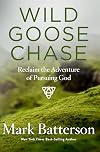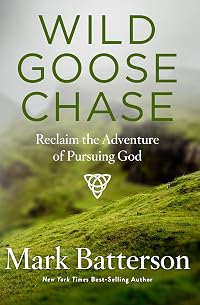
Wild Goose Chase: Reclaim the Adventure of Pursuing God
by Mark Batterson
On This Page
Description
Most people have no idea where we're going most of the time. Perfect. Celtic Christians had a name for the Holy Spirit: An Geadh-Glas, or 'the Wild Goose.' The name hints at mystery. Much like a wild goose, the Spirit of God cannot be tracked or tamed. An element of danger, an air of unpredictability surround Him. And while the name may sound a little sacrilegious, I cannot think of a better description of what it's like to follow the Spirit through life. I think the Celtic Christians were show more on to. show lessTags
Recommendations




Member Reviews
In elaborating his title metaphor, drawn from Celtic Christian origins, Batterson is quick to point out the subtle yet crucial difference between a Wild Goose chase (a pointless endeavor) and the act of chasing the Wild Goose, by which he means seeking to know the Holy Spirit. Chasing the Goose, he says, allows God to work His plan for you, and is an adventuresome undertaking that can take you to new and rewarding places. He warns the reader that the adventure may be “unnerving or disorienting” – a warning which proves apt when he goes on to challenge institutionalized Christianity in a few ways, including what he calls inverted Christianity, in which the misguided wish for God to serve their purposes, instead of the other way show more around. He also holds a dim view of cut and paste Christianity, the practice of taking some parts of scripture and leaving others. But taking it all in is arguably, as warned, disorienting. And in the stories he tells about remarkable characters, both biblical figures and modern day people, who have taken great risks in the service of good, there too are unnerving moments - leaps of faith with potentially disastrous consequences.
Before recounting the extraordinary life choices of the individuals who are the meat of this book, Batterson takes us briefly to the Gallapagos islands, a locale he likens to Eden, where the abundance and variety of wild animals causes him to speculate about how challenging it must have been for Adam to follow God's command that he name them. Visiting a zoo after this trip, he is struck by the difference between the animals he saw in the wild and the caged animals on display. Gingerly, he brings this observation to his thinking on Christianity, proposing that maybe the church has a way of turning us into caged birds, removing the danger and challenge from our lives. To some extent, Batterson welcomes danger, even to be dangerous (to the Enemy). And the modern-day heroes he shows us do put themselves in harm's way in pursuit of ending injustice and human suffering. These are not caged birds, but wild goose-chasers!
Batterson identifies six types of cages to be avoided: responsibility, routine, assumptions, guilt, failure, and fear. He speaks out strongly against complacency in general, and he goes on to give some counsel on how to fight it. He wants us not to grow bored by allowing our daily responsibilities to supercede our obligation to follow the passion that God has given us. He states that he hopes reading his book will not be a casual experience, but will inspire us to action, to take chances, maybe even change our lives. This is an inspiring book. Yet if we all took the author's advice and followed God-ordained passions rather than pursuing a humble, responsible, routine career, I have to wonder who would keep the homefires burning, so to speak: do the simple if sometimes boring work that needs to be done. As in so many areas of life, it behooves one to seek balance. And if Batterson seems sometimes to be overbalanced on the side of adventure, perhaps he is just compensating for a day and age in which most of us are leaning fairly heavily the other way.
Within his framework of six cages, Batterson displays people whose lives stand as examples of overcoming the confining forces he warns against. The first of these practices responsible irresponsibility. The author is quite fond of such seemingly paradoxical language. He also talks about successful failures. And in addressing the second cage, routine, he says that the Holy Spirit both comforts the afflicted and afflicts the comfortable. Growing accustomed to such turns of phrase, we are not surprised when, addressing his third cage, assumptions, he points out the dual nature of God, being at once Most High and Most Nigh. Personally, I find Batterson's penchant for conflating what might be considered mutually exclusive concepts to be stimulating. Meanwhile, his many stories of heroic people flesh out the narrative and keep it moving along.
A skillful writer and motivator, Batterson keeps us a little off balance. Some of his admonitions are just what we expect from a pastor, and some are not. He reminds us not to point the finger of blame or judgment at our neighbors. He tells us that we are surrounded by miracles. These are pretty standard-issue assertions. But then he uses modern and sometimes scientific terms and metaphors, and throws in a dash of self-deprecating humor, mentioning, for example, picking up his dog's poop. Through it all, his crux exhortation to chase the Wild Goose rings clearly. He says that there is a time to pray, and then there is a time to stop praying and take action. Christianity, he says, is not a noun, but a verb. And an action verb at that. He tells us not to wait for a sign from God before acting, but to act first. God, he says, will sanctify our expectations. Simultaneously, yet somehow without seeming to contradict himself, he advises against rushing things. “Hurry,” he writes, “kills everything from compassion to creativity.” Don't wait around too long but don't make too much haste. Pace is important to Batterson, and in the cadence of his writing and his variations of voice, as well as the gist of his advice, there is a certain... syncopation.
Act spontaneously! Pray imaginitvely! Wade in! Throw down your staff! Everywhere in this book, Batterson challenges us to take chances and to challenge ourselves. Peppered throughout the text and arranged neatly at sections' ends are lists of questions for the reader, which I found a welcome aid in cementing concepts in mind and bringing Batterson's arguments home to my own circumstances and life. I could imagine responding to these questions in a small group environment, and indeed I think this book is designed to lend itself well to a study group or book club.
Three cages remain: guilt, failure, and fear. In offering means of escaping the fetters these emotions bind us with, Batterson writes of learning better to forgive oneself, of recognizing the transforming power present when things don't go our way or according to our plans, and of directing our natural trepidation into proper, productive channels such as fearing missed opportunities instead of fearing failure. As he continues to illustrate his points with examples of human heroism, we come to the unlikely story of a man named Mike Foster passing out bibles at a pornography convention in Las Vegas. The daring of the man! Batterson goes on to discuss the difference between dumb courage and smart courage, and I am impressed by a sense as the book draws to a close that this author has displayed a daring of his own, has taken some calculated risks with his prose and maybe even flown by the seat of his pants a little. The Wild Goose, he writes, is eternally elusive. It will not let us down. In the same spirit, I will say that with this brave, intelligent book, Batterson does not let his readers down.
Eugene Uttley 12/26/2012 show less
Before recounting the extraordinary life choices of the individuals who are the meat of this book, Batterson takes us briefly to the Gallapagos islands, a locale he likens to Eden, where the abundance and variety of wild animals causes him to speculate about how challenging it must have been for Adam to follow God's command that he name them. Visiting a zoo after this trip, he is struck by the difference between the animals he saw in the wild and the caged animals on display. Gingerly, he brings this observation to his thinking on Christianity, proposing that maybe the church has a way of turning us into caged birds, removing the danger and challenge from our lives. To some extent, Batterson welcomes danger, even to be dangerous (to the Enemy). And the modern-day heroes he shows us do put themselves in harm's way in pursuit of ending injustice and human suffering. These are not caged birds, but wild goose-chasers!
Batterson identifies six types of cages to be avoided: responsibility, routine, assumptions, guilt, failure, and fear. He speaks out strongly against complacency in general, and he goes on to give some counsel on how to fight it. He wants us not to grow bored by allowing our daily responsibilities to supercede our obligation to follow the passion that God has given us. He states that he hopes reading his book will not be a casual experience, but will inspire us to action, to take chances, maybe even change our lives. This is an inspiring book. Yet if we all took the author's advice and followed God-ordained passions rather than pursuing a humble, responsible, routine career, I have to wonder who would keep the homefires burning, so to speak: do the simple if sometimes boring work that needs to be done. As in so many areas of life, it behooves one to seek balance. And if Batterson seems sometimes to be overbalanced on the side of adventure, perhaps he is just compensating for a day and age in which most of us are leaning fairly heavily the other way.
Within his framework of six cages, Batterson displays people whose lives stand as examples of overcoming the confining forces he warns against. The first of these practices responsible irresponsibility. The author is quite fond of such seemingly paradoxical language. He also talks about successful failures. And in addressing the second cage, routine, he says that the Holy Spirit both comforts the afflicted and afflicts the comfortable. Growing accustomed to such turns of phrase, we are not surprised when, addressing his third cage, assumptions, he points out the dual nature of God, being at once Most High and Most Nigh. Personally, I find Batterson's penchant for conflating what might be considered mutually exclusive concepts to be stimulating. Meanwhile, his many stories of heroic people flesh out the narrative and keep it moving along.
A skillful writer and motivator, Batterson keeps us a little off balance. Some of his admonitions are just what we expect from a pastor, and some are not. He reminds us not to point the finger of blame or judgment at our neighbors. He tells us that we are surrounded by miracles. These are pretty standard-issue assertions. But then he uses modern and sometimes scientific terms and metaphors, and throws in a dash of self-deprecating humor, mentioning, for example, picking up his dog's poop. Through it all, his crux exhortation to chase the Wild Goose rings clearly. He says that there is a time to pray, and then there is a time to stop praying and take action. Christianity, he says, is not a noun, but a verb. And an action verb at that. He tells us not to wait for a sign from God before acting, but to act first. God, he says, will sanctify our expectations. Simultaneously, yet somehow without seeming to contradict himself, he advises against rushing things. “Hurry,” he writes, “kills everything from compassion to creativity.” Don't wait around too long but don't make too much haste. Pace is important to Batterson, and in the cadence of his writing and his variations of voice, as well as the gist of his advice, there is a certain... syncopation.
Act spontaneously! Pray imaginitvely! Wade in! Throw down your staff! Everywhere in this book, Batterson challenges us to take chances and to challenge ourselves. Peppered throughout the text and arranged neatly at sections' ends are lists of questions for the reader, which I found a welcome aid in cementing concepts in mind and bringing Batterson's arguments home to my own circumstances and life. I could imagine responding to these questions in a small group environment, and indeed I think this book is designed to lend itself well to a study group or book club.
Three cages remain: guilt, failure, and fear. In offering means of escaping the fetters these emotions bind us with, Batterson writes of learning better to forgive oneself, of recognizing the transforming power present when things don't go our way or according to our plans, and of directing our natural trepidation into proper, productive channels such as fearing missed opportunities instead of fearing failure. As he continues to illustrate his points with examples of human heroism, we come to the unlikely story of a man named Mike Foster passing out bibles at a pornography convention in Las Vegas. The daring of the man! Batterson goes on to discuss the difference between dumb courage and smart courage, and I am impressed by a sense as the book draws to a close that this author has displayed a daring of his own, has taken some calculated risks with his prose and maybe even flown by the seat of his pants a little. The Wild Goose, he writes, is eternally elusive. It will not let us down. In the same spirit, I will say that with this brave, intelligent book, Batterson does not let his readers down.
Eugene Uttley 12/26/2012 show less
A challenging book for us "Bilbo Baggins" types, who tend to enjoy our comforts and shun anything remotely dangerous. Batterson's book is a wake-up call!
Mark Batterson has a heart for God, a fact apparent to anyone willing to delve into his written work, whether his books or his blog. Wild Goose Chase is his second non-fiction title, which Batterson describes as a sequel to his first book, In the Pit With a Lion on a Snowy Day. Not having read his first title, I can assure that Wild Goose Chase stands on it’s own – complete within itself.
Celtic Christians had a name for the Holy Spirit, the Gaelic phrase – “An Geadh-Glas” which translates into “The Wild Goose” in English. This clever synchronicity provides the premise for a book that revolves around the need to pursue the Holy Spirit. We are very familiar with the notion of a Wild Goose Chase in our culture, but unlike the show more chase we commonly associate these words with — a fruitless escapade that ultimately leads nowhere of importance — chasing the Holy Spirit is vital to the Christian life. When He is pursued much fruit will result and a sense of spiritual adventure will pervade each believer’s life.
Batterson doesn’t dig into the foundations of knowing the Holy Spirit, or elaborate much on how to hear His voice. While he encourages prayer and contemplation of God’s word, the focus of Wild Goose Chase is in identifying common excuses that we use to avoid following the Spirit. Batterson identifies six ‘cages’ or areas of restraint in the lives of Christians, based mainly on his own experience as a pastor working with real people, rather than being strictly informed by scripture. To each cage — responsibility, routine, assumptions, guilt, failure and fear — Batterson devotes a chapter.
In these chapters each cage is identified and explored. A Bible hero who broke free from his own cage, or who was possibly never subject to that weakness is shared with us in each chapter. From these examples, along with those from Batterson’s life, and those of friends, a vision forms of the possibilities that abound for those able to break free of the restraints the Enemy has placed around them. Probing, personal questions are included at the end of each chapter, leading readers to the places in their lives that God may be calling them to change.
Wild Goose Chase is a clarion call to pursue the Holy Spirit and is written in a personal, high-energy and upbeat style. The pace is rapid, the reading smooth, preventing readers from stalling out mid-way. Batterson is driven to equip believers with the motivation to break free from whatever is holding them back from serving God whole-heartedly, from whatever is preventing them from pursuing the Goose with wild abandon.
Moreover, Batterson and his church have been praying that this book will touch the lives of those who read it in a mighty way. Translation? They sincerely hope that this slender volume will serve as a spiritual kick in the pants to get an often-apathetic church moving into the world for Christ. Batterson is surprisingly gentle in his reprimand and call to action; I was expecting a much more strident and radical manifesto. That he is able to communicate passionately while avoiding personal offense speaks to his popularity as an innovative young leader in the church today.
I resonate with his desire, to see a world on fire for Jesus – ironically, reading a book will not accomplish that goal, only the Holy Spirit Himself can perform that work in the hearts of those who seek Him. However, it’s quite likely that the challenge put forth in the book — to break free of the cages of restraint — will resonate with many, resulting in self-examination, the desire to deepen personal relationships with the Lord, and hopefully end with believers putting feet on their faith.
Reviewed at http://quiverfullfamily.com show less
Celtic Christians had a name for the Holy Spirit, the Gaelic phrase – “An Geadh-Glas” which translates into “The Wild Goose” in English. This clever synchronicity provides the premise for a book that revolves around the need to pursue the Holy Spirit. We are very familiar with the notion of a Wild Goose Chase in our culture, but unlike the show more chase we commonly associate these words with — a fruitless escapade that ultimately leads nowhere of importance — chasing the Holy Spirit is vital to the Christian life. When He is pursued much fruit will result and a sense of spiritual adventure will pervade each believer’s life.
Batterson doesn’t dig into the foundations of knowing the Holy Spirit, or elaborate much on how to hear His voice. While he encourages prayer and contemplation of God’s word, the focus of Wild Goose Chase is in identifying common excuses that we use to avoid following the Spirit. Batterson identifies six ‘cages’ or areas of restraint in the lives of Christians, based mainly on his own experience as a pastor working with real people, rather than being strictly informed by scripture. To each cage — responsibility, routine, assumptions, guilt, failure and fear — Batterson devotes a chapter.
In these chapters each cage is identified and explored. A Bible hero who broke free from his own cage, or who was possibly never subject to that weakness is shared with us in each chapter. From these examples, along with those from Batterson’s life, and those of friends, a vision forms of the possibilities that abound for those able to break free of the restraints the Enemy has placed around them. Probing, personal questions are included at the end of each chapter, leading readers to the places in their lives that God may be calling them to change.
Wild Goose Chase is a clarion call to pursue the Holy Spirit and is written in a personal, high-energy and upbeat style. The pace is rapid, the reading smooth, preventing readers from stalling out mid-way. Batterson is driven to equip believers with the motivation to break free from whatever is holding them back from serving God whole-heartedly, from whatever is preventing them from pursuing the Goose with wild abandon.
Moreover, Batterson and his church have been praying that this book will touch the lives of those who read it in a mighty way. Translation? They sincerely hope that this slender volume will serve as a spiritual kick in the pants to get an often-apathetic church moving into the world for Christ. Batterson is surprisingly gentle in his reprimand and call to action; I was expecting a much more strident and radical manifesto. That he is able to communicate passionately while avoiding personal offense speaks to his popularity as an innovative young leader in the church today.
I resonate with his desire, to see a world on fire for Jesus – ironically, reading a book will not accomplish that goal, only the Holy Spirit Himself can perform that work in the hearts of those who seek Him. However, it’s quite likely that the challenge put forth in the book — to break free of the cages of restraint — will resonate with many, resulting in self-examination, the desire to deepen personal relationships with the Lord, and hopefully end with believers putting feet on their faith.
Reviewed at http://quiverfullfamily.com show less
I won this book in a giveaway. I read that the author is a pastor of National Community Church in Washington, DC--a happening church. Since I was raised in DC, I entered the giveaway. Boy, am I glad that I won!
Chock full of wisdom, this small book is filled with sermon-type discussions on the things of God. The author surprises with chapter 2 "Goose Bumps," when he tells the reader to stop praying. He challenges with chapter 4 "Eight-foot Ceilings," with the background story of the Wright Brothers. And he encourages with chapter 6 "Sometimes It Takes a Shipwreck" when he tells of a disappointment in his life.
This is a good devotional book for an individual, an excellent source for a Bible study group to use chapter by chapter, and an show more all-around worthy read. show less
Chock full of wisdom, this small book is filled with sermon-type discussions on the things of God. The author surprises with chapter 2 "Goose Bumps," when he tells the reader to stop praying. He challenges with chapter 4 "Eight-foot Ceilings," with the background story of the Wright Brothers. And he encourages with chapter 6 "Sometimes It Takes a Shipwreck" when he tells of a disappointment in his life.
This is a good devotional book for an individual, an excellent source for a Bible study group to use chapter by chapter, and an show more all-around worthy read. show less
This book is awakening my spirit again. I'm experiencing church burn out. Mark got me with the quote "I don't know a single Christ follower who hasn't gotten totally stressed out trying to figure out the will of God." What a statement. Thank you Mark Batterson.
Enjoyed this look at passionately following the Holy Spirit. Some of my favorite quotes include:
But in my experience, intellectual analysis usually results in spiritual paralysis…Nothing is more unnerving or disorienting than passionately pursuing God.
Instead of following the Spirit, we invite the Spirit to follow us.
I wonder if churches do to people what zoos do to animals.
We try to remove the danger. We try to remove the struggle. And what we end up with is a caged Christian.
we are trying our best to live our lives within the guardrails of God's good, pleasing, and perfect will. But still we have a gnawing feeling that something is missing.
responsible irresponsibility means refusing to allow your human responsibilities to get in the show more way of pursuing the passions God puts in your heart.
There are some things you don’t need to pray about. You don’t need to pray about whether you should love your neighbor. You don’t need to pray about whether you should give generously or serve sacrificially. You don’t need to pray whether you should bless someone when it is within your power to do so. God has already spoken. What you need to do is quit praying and start acting.
Peter Marshall, former chaplain of the US Senate:
"I wonder what would happen if we all agreed to read one of the Gospels until we came to a place that told us to do something, then went out to do it, and only after we had done it, began reading again? There are aspects of the Gospel that are puzzling and difficult to understand. But our problems are not centered around the things we don't understand, but rather in the things we do understand, the things we could not possibly misunderstand. Our problem is not so much that we don't know what we should do. We know perfectly well, but we don't want to do it."
It's not the book of ideas or theories or words. It's the book of acts. If the twenty-first century church said less and did more, maybe we would have the same kind of impact the first century church did.
Some of us live as if we expect to hear God say, "Well thought, good and faithful servant." or "Well said, good and faithful servant." God is not going to say either of those things. There is only one commendation and it is the by-product of carrying out God-ordained passions: "Well DONE. good and faithful servant."
You know why some of us have never seen God part a river? Because our feet are still firmly planted on dry ground. We're waiting on God while God is waiting on us!
One of the greatest acts of worship is keeping a good attitude in a bad situation. And doing a good job at a bad job honors God.
But over the years I've come to appreciate a unique dimension of the Holy Spirit's personality. Jesus called him The Counselor. He comforts the afflicted. But like a good counselor, He also afflicts the comfortable. And I came to a place in my life where I was uncomfortable with my level of comfort.
We sit in the same padded pew, week in and week out, listening to stories about Jesus calming the wind and the waves. The disciples had a totally different experience. They were in the boat on the lake when the skies grew dark and hurricane winds started to blow. They walked beaches, climbed mountains, and trekked across the wilderness with Jesus. Their experience was four-dimensional, while ours is one-dimensional. So when we read the Bible, we tend to focus on theology, overlooking the Meteorology, the psychology, and even the geology that shaped the stories we read.
If you're in a spiritual slump, let me give you a prescription: Go on a mission trip. There is no better or sure way of coming out of the cage of routine.
I know from experience that you can do the work of God at a pace that destroys the work of God in you. And I want to do ministry at a sustainable pace.
One of my greatest challenges is keeping the fourth commandment. I have a tough time taking a Sabbath. ..I feel like I owe it to my family, and I owe it to God.
Hurry kills everything from compassion to creativity and when you are in a hurry you don't have time to get out of your routine, do you? No room for Spirit-led spontaneity. Sponteneity is an underappreciated dimension of spirituality. In fact, spiritual maturity had less to do with long range visions than it does with moment-by-moment sensitivity to the promptings of the Holy Spirit. And it is our moment-by-moment sensitivity to the Holy Spirit that turns life into an everyday adventure.
spiritual maturity has less to do with long-range visions than it does with moment-by-moment sensitivity to the promptings of the Holy Spirit.
Logic questions God. Faith questions assumptions. At the end of the day, faith is trusting God more than you trust your own assumptions.
Your worst days are never so bad that you are beyond the reach of His grace. And your best days are never so good that you are beyond the need of God's grace. Every day should be a day of relating to God on the basis of His grace alone.
It is much easier to act like a Christian than it is to react like one.
We have a core value at National Community Church, love people when they least expect it and least deserve it.
Jesus didn't do orientations. Jesus did disorientations. Doesn't it seem like His disciples were in a constant state of disorientation? We think it’s because of their spiritual immaturity, but maybe it models the way God makes disciples. Sometimes God needs to disorient us so He can reorient us.
Lord, thank You that You want us to get where You want us to go more than we want to get where You want us to go.
God seems to be far less concerned with where I'm going than with who I'm becoming. I think some of us want to know the will of God more than we want to know God.
We need people who are more afraid of missing opportunities than making mistakes. People who are more afraid of lifelong regrets than temporary failure.
I think Foxe's Book of Martyrs should be required reading for every twenty-first century Christian living in a first-world country because most of us fail to fully appreciate the extreme sacrifices that were made and the courageous risks that were taken by our spiritual predecessors.
“The difference between where you are and where God wants you to be, may be the painful decision you refuse to make.”—Craig Groeschel
I think vision is the cure for sin. One reason many of us get entangled in sin is because we don’t have enough God-ordained vision to keep us busy. The more vision you have, the less you will sin. It is vision from God that keeps us playing offense spiritually. show less
But in my experience, intellectual analysis usually results in spiritual paralysis…Nothing is more unnerving or disorienting than passionately pursuing God.
Instead of following the Spirit, we invite the Spirit to follow us.
I wonder if churches do to people what zoos do to animals.
We try to remove the danger. We try to remove the struggle. And what we end up with is a caged Christian.
we are trying our best to live our lives within the guardrails of God's good, pleasing, and perfect will. But still we have a gnawing feeling that something is missing.
responsible irresponsibility means refusing to allow your human responsibilities to get in the show more way of pursuing the passions God puts in your heart.
There are some things you don’t need to pray about. You don’t need to pray about whether you should love your neighbor. You don’t need to pray about whether you should give generously or serve sacrificially. You don’t need to pray whether you should bless someone when it is within your power to do so. God has already spoken. What you need to do is quit praying and start acting.
Peter Marshall, former chaplain of the US Senate:
"I wonder what would happen if we all agreed to read one of the Gospels until we came to a place that told us to do something, then went out to do it, and only after we had done it, began reading again? There are aspects of the Gospel that are puzzling and difficult to understand. But our problems are not centered around the things we don't understand, but rather in the things we do understand, the things we could not possibly misunderstand. Our problem is not so much that we don't know what we should do. We know perfectly well, but we don't want to do it."
It's not the book of ideas or theories or words. It's the book of acts. If the twenty-first century church said less and did more, maybe we would have the same kind of impact the first century church did.
Some of us live as if we expect to hear God say, "Well thought, good and faithful servant." or "Well said, good and faithful servant." God is not going to say either of those things. There is only one commendation and it is the by-product of carrying out God-ordained passions: "Well DONE. good and faithful servant."
You know why some of us have never seen God part a river? Because our feet are still firmly planted on dry ground. We're waiting on God while God is waiting on us!
One of the greatest acts of worship is keeping a good attitude in a bad situation. And doing a good job at a bad job honors God.
But over the years I've come to appreciate a unique dimension of the Holy Spirit's personality. Jesus called him The Counselor. He comforts the afflicted. But like a good counselor, He also afflicts the comfortable. And I came to a place in my life where I was uncomfortable with my level of comfort.
We sit in the same padded pew, week in and week out, listening to stories about Jesus calming the wind and the waves. The disciples had a totally different experience. They were in the boat on the lake when the skies grew dark and hurricane winds started to blow. They walked beaches, climbed mountains, and trekked across the wilderness with Jesus. Their experience was four-dimensional, while ours is one-dimensional. So when we read the Bible, we tend to focus on theology, overlooking the Meteorology, the psychology, and even the geology that shaped the stories we read.
If you're in a spiritual slump, let me give you a prescription: Go on a mission trip. There is no better or sure way of coming out of the cage of routine.
I know from experience that you can do the work of God at a pace that destroys the work of God in you. And I want to do ministry at a sustainable pace.
One of my greatest challenges is keeping the fourth commandment. I have a tough time taking a Sabbath. ..I feel like I owe it to my family, and I owe it to God.
Hurry kills everything from compassion to creativity and when you are in a hurry you don't have time to get out of your routine, do you? No room for Spirit-led spontaneity. Sponteneity is an underappreciated dimension of spirituality. In fact, spiritual maturity had less to do with long range visions than it does with moment-by-moment sensitivity to the promptings of the Holy Spirit. And it is our moment-by-moment sensitivity to the Holy Spirit that turns life into an everyday adventure.
spiritual maturity has less to do with long-range visions than it does with moment-by-moment sensitivity to the promptings of the Holy Spirit.
Logic questions God. Faith questions assumptions. At the end of the day, faith is trusting God more than you trust your own assumptions.
Your worst days are never so bad that you are beyond the reach of His grace. And your best days are never so good that you are beyond the need of God's grace. Every day should be a day of relating to God on the basis of His grace alone.
It is much easier to act like a Christian than it is to react like one.
We have a core value at National Community Church, love people when they least expect it and least deserve it.
Jesus didn't do orientations. Jesus did disorientations. Doesn't it seem like His disciples were in a constant state of disorientation? We think it’s because of their spiritual immaturity, but maybe it models the way God makes disciples. Sometimes God needs to disorient us so He can reorient us.
Lord, thank You that You want us to get where You want us to go more than we want to get where You want us to go.
God seems to be far less concerned with where I'm going than with who I'm becoming. I think some of us want to know the will of God more than we want to know God.
We need people who are more afraid of missing opportunities than making mistakes. People who are more afraid of lifelong regrets than temporary failure.
I think Foxe's Book of Martyrs should be required reading for every twenty-first century Christian living in a first-world country because most of us fail to fully appreciate the extreme sacrifices that were made and the courageous risks that were taken by our spiritual predecessors.
“The difference between where you are and where God wants you to be, may be the painful decision you refuse to make.”—Craig Groeschel
I think vision is the cure for sin. One reason many of us get entangled in sin is because we don’t have enough God-ordained vision to keep us busy. The more vision you have, the less you will sin. It is vision from God that keeps us playing offense spiritually. show less
Ratings
Members
- Recently Added By
Author Information

99+ Works 6,874 Members
Mark Batterson was born in Minneapolis, MN. He serves as lead pastor of National Community Church in Washington, DC. He has two Masters Degrees from Trinity Evangelical Divinity School in Chicago, Illinois. Mark is the author of the best-selling books: In a Pit with a Lion on a Snowy Day, Wild Goose Chase, Primal: A Quest for the Lost Soul of show more Christianity, Soulprint and The Circle Maker: Praying Circles Around Your Biggest Dreams and Greatest Fears and If: Trading Your If Only Regrets for God's What If Possibilities. (Bowker Author Biography) show less
Classifications
Statistics
- Members
- 445
- Popularity
- 68,777
- Reviews
- 6
- Rating
- (4.31)
- Languages
- English
- Media
- Paper, Audiobook, Ebook
- ISBNs
- 3
- ASINs
- 4