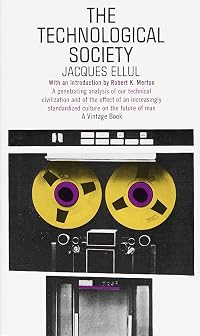
The Technological Society
by Jacques Ellul
On This Page
Description
As insightful and wise today as it was when originally published in 1954, Jacques Ellul's The Technological Society has become a classic in its field, laying the groundwork for all other studies of technology and society that have followed. Ellul offers a penetrating analysis of our technological civilization, showing how technology--which began innocuously enough as a servant of humankind--threatens to overthrow humanity itself in its ongoing creation of an environment that meets its own show more ends. No conversation about the dangers of technology and its unavoidable effects on society can begin without a careful reading of this book. "A magnificent book . . . He goes through one human activity after another and shows how it has been technicized, rendered efficient, and diminished in the process."--Harper's "One of the most important books of the second half of the twentieth-century. In it, Jacques Ellul convincingly demonstrates that technology, which we continue to conceptualize as the servant of man, will overthrow everything that prevents the internal logic of its development, including humanity itself--unless we take necessary steps to move human society out of the environment that 'technique' is creating to meet its own needs."--The Nation "A description of the way in which technology has become completely autonomous and is in the process of taking over the traditional values of every society without exception, subverting and suppressing these values to produce at last a monolithic world culture in which all non-technological difference and variety are mere appearance."--Los Angeles Free Press show lessTags
Recommendations













Member Recommendations

The Age of Surveillance Capitalism: The Fight for a Human Future at the New Frontier of Power by Shoshana Zuboff
kukulaj Ellul describes the seeds.... Zuboff the hardy sapling. Anybody's guess where it goes from here!
Member Reviews
This book was published in French in 1950, and then in English translation in 1960. The English translation had some updates.
This is a very peculiar combination of being quite dated and being almost timeless. Ellul is describing a transformation of society that has been underway since probably WW1 or so. Maybe more like 1860. The core notion is like Frederick Taylor's "One Best Way". The criterion for action is efficiency. What's lost is any depth, any recognition that efficiency is about moving quickly, without reflection on where one might or ought to be headed.
Ellul portrays our world as one where systematically measured and controlled processes build on each other and intertwine with each other, to the point where the individual show more person is reduced to some kind of robot. It's quite remarkable to read a book like this that is 60 or 70 years old, but as fresh as the morning dew. What he describes so thoroughly is surely the world we live in.
The book is certainly dated. For example, computers barely existed then. And in 1950 Stalin was still alive. Ellul treats Soviet Communism as a full player in the dialog of technical living.
Ellul pretty much says that our technological society has its own dynamism that is really beyond any human control. There is surely no cabal at the nucleus, steering events along the technological track. Maybe 150 years ago some steering was possible, but by now the train has its own momentum.
Another aspect of the datedness of the book is that there is very little discussion of ecological limits. Our technological train certainly looks to be headed over a cliff. That's not exactly steering, but it's a shift in dynamics all the same. Ellul doesn't really spend time on futurology. His book is about what was happening at the time. For the most part, what was happening then is happening just so much more nowadays. Actually his notion that the train cannot be steered, that helps explain why the whole climate change business is such a mess. People complain about the huge corporations that pump petroleum out of the ground, but go on pumping the refined products into their vehicles. This is the pervasive web of technology that Ellul examines in this book.
A nice little tidbit - in Joanna Macy's memoir Widening Circles, she mentions that she studied with Ellul when she was a grad student in the 1950s. show less
This is a very peculiar combination of being quite dated and being almost timeless. Ellul is describing a transformation of society that has been underway since probably WW1 or so. Maybe more like 1860. The core notion is like Frederick Taylor's "One Best Way". The criterion for action is efficiency. What's lost is any depth, any recognition that efficiency is about moving quickly, without reflection on where one might or ought to be headed.
Ellul portrays our world as one where systematically measured and controlled processes build on each other and intertwine with each other, to the point where the individual show more person is reduced to some kind of robot. It's quite remarkable to read a book like this that is 60 or 70 years old, but as fresh as the morning dew. What he describes so thoroughly is surely the world we live in.
The book is certainly dated. For example, computers barely existed then. And in 1950 Stalin was still alive. Ellul treats Soviet Communism as a full player in the dialog of technical living.
Ellul pretty much says that our technological society has its own dynamism that is really beyond any human control. There is surely no cabal at the nucleus, steering events along the technological track. Maybe 150 years ago some steering was possible, but by now the train has its own momentum.
Another aspect of the datedness of the book is that there is very little discussion of ecological limits. Our technological train certainly looks to be headed over a cliff. That's not exactly steering, but it's a shift in dynamics all the same. Ellul doesn't really spend time on futurology. His book is about what was happening at the time. For the most part, what was happening then is happening just so much more nowadays. Actually his notion that the train cannot be steered, that helps explain why the whole climate change business is such a mess. People complain about the huge corporations that pump petroleum out of the ground, but go on pumping the refined products into their vehicles. This is the pervasive web of technology that Ellul examines in this book.
A nice little tidbit - in Joanna Macy's memoir Widening Circles, she mentions that she studied with Ellul when she was a grad student in the 1950s. show less
This is a very interesting book, and one not well know to many outside France. Ellul is one of the few philosophers who devoted much of his life to the understanding of technology as a stand-alone phenomenon. With great care, the author takes you through a detailed explanation of technology's manifestation, and how it goes on to transform the world we live in. There are different thoughts on how technology can be controlled, but in the end, Ellul feels there is no stopping it. We must simply learn to live with this thing that is both part of our human definition, and a transformative force unto itself.The writing style is fairly good, having been translated with care. However, one can not help but feel some level of awkwardness which show more hints to the original French manuscript. I would also advise that this book be read several times. One reading can only serve to introduce readers to the basic concepts and multitude of supporting authors that Ellul uses to both compare and contrast his ideas against. show less
Interesting as an early analysis of technology and society, and particularly for its (now disputed) claims about technological determinism.
Could've made the same point in 40-80 pages and with that getting your message across and not annoying your readers. With the premise the author sets, I am not sure all examples work as valid arguments, and many sound as if they're coming from a ludite.
Just glanced at
Ratings
Members
- Recently Added By
Lists

Shaykh Hamza's Book Recommendations
439 works; 3 members

Books in the Bibliography of The Alchemy of Us by Ainissa Ramirez
181 works; 1 member
Author Information

122+ Works 5,951 Members
Jacques Ellul, historian, theologian, and sociologist, is one of the foremost and widely known contemporary critics of modern technological society. Born in Bordeaux, France, Ellul received a doctorate in the history of law and social science in 1936 from the University of Bordeaux. In 1947 he was appointed professor of social history at the show more University of Bordeaux, remaining there until his retirement in 1980. Although influenced strongly by his early reading of the Bible Marx, Ellul has been unable to synthesize Marxist doctrine with Christianity. These readings and experiences have influenced his later philosophy and writing. Ellul has taught and written extensively in his areas of specialization - Roman law, the history and sociology of institutions, Marxism, propaganda, and technique in society. He also served in the French Resistance during World War II, worked as a lay pastor, and has been active with various theological organizations, including the World Council of Churches. In addition, Ellul has been active in the environmental movement and has worked to prevent juvenile delinquency and violence. Since 1969, he has been editor of Foi et Vie (Faith and Life). Although retired as a teacher, Ellul has continued writing. One of his writing projects is an autobiography to be published after his death. Ellul has provided a sociopolitical as well as a theological analysis of contemporary society in more than 40 books and 800 articles. The Technological Society (1954) established Ellul as a social critic. The book has had a major impact on the collective consciousness of a society just beginning to recognize the central role and force of technology. Here Ellul develops the notion of "technique," a concept much broader than technology: "Technique is the totality of methods rationally arrived at." In Ellul's view, technology in this sense tends to become all-encompassing. His subsequent books, especially The Political Illusion (1965) and Propaganda (1962), further develop and refine elements of this central theme. This "trilogy" of books reflects Ellul's desire to alert readers to the dangers of technological determinism and thereby help them transcend it. Because of a dialectical approach separating his sociopolitical and theological studies, Ellul has often been criticized as overly pessimistic in his sociologically based writings. His theological works, however, provide a more positive perspective and counterpoint to his sociological work. Most notable are The Politics of God and the Politics of Man (1966), The Meaning of the City (1970), and especially The Ethics of Freedom (1973). The main body of Ellul's sociopolitical critique of technical society is reflected by The Technological Society, The Political Illusion, Propaganda, and The Technological System. Among his other works are Autopsy of Revolution (1969), which questions what kind of revolution is realistically possible, The Humiliation of the Word (1981), which expands upon the concept of "human techniques", and The Technological Bluff (1990), which discusses the state of contemporary society, especially in regard to such technologies as computers and genetic engineering and the progressive "discourse" that surrounds their societal incorporation. (Bowker Author Biography) show less
Some Editions
Awards and Honors
Awards
Notable Lists
Series
Belongs to Publisher Series
Vintage Books (V-390)
Classifications
Statistics
- Members
- 987
- Popularity
- 26,624
- Reviews
- 5
- Rating
- (4.13)
- Languages
- English, French
- Media
- Paper, Audiobook, Ebook
- ISBNs
- 7
- ASINs
- 9