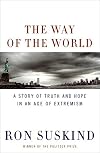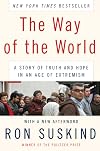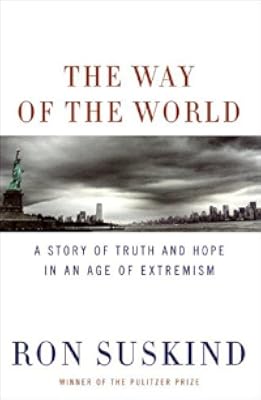
The Way of the World: A Story of Truth and Hope in an Age of Extremism
by Ron Suskind
On This Page
Description
A Pulitzer Prize-winning journalist and the author of "The Price of Loyalty" and "The One Percent Doctrine" returns with an election year account of the looming national security crisis that America faces right now.Tags
Recommendations
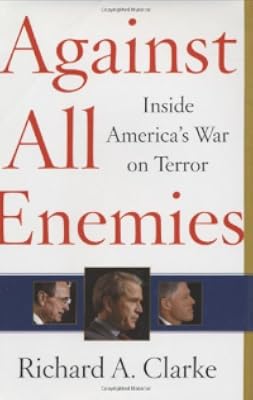
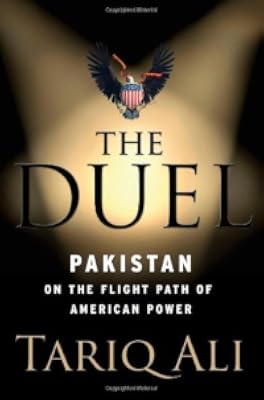

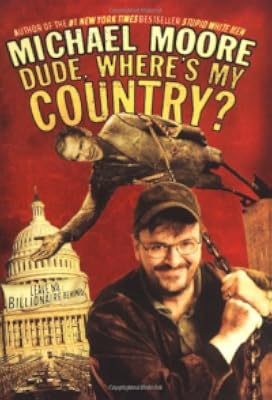






Member Recommendations
by anonymous user
Member Reviews
Who are the Extremists?
In this complex web of narratives, Pulitzer Prize winning author and journalist Ron Suskind navigates the paradoxes of democracy and globalization, multiculturalism and patriotism. Most reviews have focused narrowly on the few pages where Suskind discloses the "fake letter from Habbush" that implicates the Bush Administration in falsifying evidence to justify its war in Iraq, few have discussed the actual themes that Suskind is attempting to draw on.
On democracy and globalization, the story of Usman contrasts these two seemingly interrelated themes. What does democracy mean in the post-911 world, in the existential War on Terror? What is the identity of America? Is it not a nation made from immigrants, Ellis show more Island, Angel Island, etc... What about citizenship, how do we define citizenship in this global world?
On multiculturalism and patriotism. The story of the foreign exchange student Mohammad in Denver is one of xenophobia, tolerance and Americanism. Is America still the "melting pot" during 19th century fin de siècle? In this Globalization 2.0 era, what does it mean to be American? How about post-911?
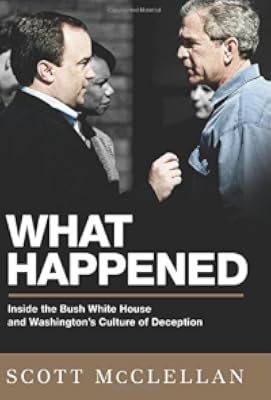
Intertwined in between these two narratives are stories from within the oval office inner circle, Bush, Cheney and Rice mainly. We hear about the intentional lack of accountability, the cloak of secrecy, the systematic attempt to clean up the trail of crumbs. Now, the question becomes, who are the extremists?
A lot of discussion has taken place since "The Way of the World" was released regarding what the CIA did or didn't do. Agents have since come out to dispute Suskind's inference of "the fake latter from Habbush". In my opinion, what was or wasn't done is not important, it's the overall philosophy that is flawed. It's an indictment of Bush's misplaced faith and his false doctrine of preemption.
This is a highly enjoyable read. Suskind remarks that it was one of the most challenging book projects he's ever worked on. This is much more than a Bush bashing book, it's about ordinary people and how we and others view America. show less
In this complex web of narratives, Pulitzer Prize winning author and journalist Ron Suskind navigates the paradoxes of democracy and globalization, multiculturalism and patriotism. Most reviews have focused narrowly on the few pages where Suskind discloses the "fake letter from Habbush" that implicates the Bush Administration in falsifying evidence to justify its war in Iraq, few have discussed the actual themes that Suskind is attempting to draw on.
On democracy and globalization, the story of Usman contrasts these two seemingly interrelated themes. What does democracy mean in the post-911 world, in the existential War on Terror? What is the identity of America? Is it not a nation made from immigrants, Ellis show more Island, Angel Island, etc... What about citizenship, how do we define citizenship in this global world?
On multiculturalism and patriotism. The story of the foreign exchange student Mohammad in Denver is one of xenophobia, tolerance and Americanism. Is America still the "melting pot" during 19th century fin de siècle? In this Globalization 2.0 era, what does it mean to be American? How about post-911?
Intertwined in between these two narratives are stories from within the oval office inner circle, Bush, Cheney and Rice mainly. We hear about the intentional lack of accountability, the cloak of secrecy, the systematic attempt to clean up the trail of crumbs. Now, the question becomes, who are the extremists?
A lot of discussion has taken place since "The Way of the World" was released regarding what the CIA did or didn't do. Agents have since come out to dispute Suskind's inference of "the fake latter from Habbush". In my opinion, what was or wasn't done is not important, it's the overall philosophy that is flawed. It's an indictment of Bush's misplaced faith and his false doctrine of preemption.
This is a highly enjoyable read. Suskind remarks that it was one of the most challenging book projects he's ever worked on. This is much more than a Bush bashing book, it's about ordinary people and how we and others view America. show less
A slow starter, but once you get into it, Suskind weaves a great story. His investigative work is second to none, and his ability to find and interview the people who were directly involved, rather than yet another interview with the high-level policymakers, makes this worth a read.
Suskind paints a vivid picture of the issues faced when terrorism puts democracy in conflict with secuirty. This books makes (more) public some of the outrageous breaches of freedom that have occured in the name of homeland security. It's a chilling read -- one that makes clear the inevitable abrogations of freedom when public safety is used as a reason to rewrite the Bill of Rights.
It also demonstrates the consequences of a foreign policy built on "US interests" and how that can put our desires in conflict with the desires of other peoples for free societies.
An impressive piece of research and a book all citizens should read. It may not change anyone's views, but it will make the tradeoffs more clear.
It also demonstrates the consequences of a foreign policy built on "US interests" and how that can put our desires in conflict with the desires of other peoples for free societies.
An impressive piece of research and a book all citizens should read. It may not change anyone's views, but it will make the tradeoffs more clear.
Interesting style. A telling of post-9/11 America through the stories of players in and outside the beltway. Very human, and has a more fictive narrative than a typical historical non-fiction. The chapters about Benazir Bhutto I think were the most interesting and most telling with regards to dirty-side of politics.
5819. The Way of the World A Story of Truth and Hoppe in an Age of Extremism, by Ron Suskind (read 26 2023) This was published in 2008 and should have been read then. It is a devastating account of the war against Iraq and how we were lied to in order to get into it. I have long deprecated George W. Bush and his minions for that war and this book reinforces my views on Bush and that war. There is a lot in the book reinforcing what I felt in the years of that event. but the book has much seemingly little to do with the events of that war. So the early part of the book was a drag. And we of course have an even worse former Republican president to deprecate now.
This is a "big picture" book. It covers a large slice of the world, and builds up the large picture by creating a series of small pictures. The topic is power, how it is used and abused and in surprising ways is impotent. It is also about democratic ideals and how true America is to them, and how the rest of the world views them. One piece of the story is Benazir Bhutto, and how she began to understand democracy and move towareds it only to end in the tragedy of her death. Pakistan is a nexis point in the book. One story is that of a young Pakistani Muslim who lives in the US, and how he deals with issues of faith and democracy.
Much of it concerns the intelligence community and the information they know or are desperately searching for, show more the information to prevent new attacks. One concentrates on finding out how much loose nuclear material there is, who is offering to sell it and who to buy it. Another met with the head of Iraqi intelligence in the months before the U.S. invasion of Iraq, and found out Saddam Hussein had no WMD. That same Iraqi was paid by the U.S. to forge a letter claiming the 9/11 hijackers were trained in Iraq and that there was a WMD program.
It is a book where terror and freedom strive against each other. One of the goals of Al Quaeda is to get the U.S. to react in fear and against its own beliefs:
"The aim of the al Quaeda leadership for the present phase of their campaign is not just to attack us. It is to try to create the impression throughout the Muslim world that a global struggle against oppression is under way in which violent jihad against us is a personal duty since, in their eyes, the policies of the U.S and its allies towards the Muslim world are incurably discriminatory and at heart colonial. Through constantly tempting us into over-reaction, they want to expose our values as fragile and hypocritical, suppressing civil rights at home and supporting apostate and repressive government overseas. We should recognize their motive as the well-understood tactic of the revolutionary through the ages, and not fall for it." (quote from David Omand, p. 198-199).
in the end, Suskind sees hope in the longing for people from around the world to recreate the world and make it new and hopeful. show less
Much of it concerns the intelligence community and the information they know or are desperately searching for, show more the information to prevent new attacks. One concentrates on finding out how much loose nuclear material there is, who is offering to sell it and who to buy it. Another met with the head of Iraqi intelligence in the months before the U.S. invasion of Iraq, and found out Saddam Hussein had no WMD. That same Iraqi was paid by the U.S. to forge a letter claiming the 9/11 hijackers were trained in Iraq and that there was a WMD program.
It is a book where terror and freedom strive against each other. One of the goals of Al Quaeda is to get the U.S. to react in fear and against its own beliefs:
"The aim of the al Quaeda leadership for the present phase of their campaign is not just to attack us. It is to try to create the impression throughout the Muslim world that a global struggle against oppression is under way in which violent jihad against us is a personal duty since, in their eyes, the policies of the U.S and its allies towards the Muslim world are incurably discriminatory and at heart colonial. Through constantly tempting us into over-reaction, they want to expose our values as fragile and hypocritical, suppressing civil rights at home and supporting apostate and repressive government overseas. We should recognize their motive as the well-understood tactic of the revolutionary through the ages, and not fall for it." (quote from David Omand, p. 198-199).
in the end, Suskind sees hope in the longing for people from around the world to recreate the world and make it new and hopeful. show less
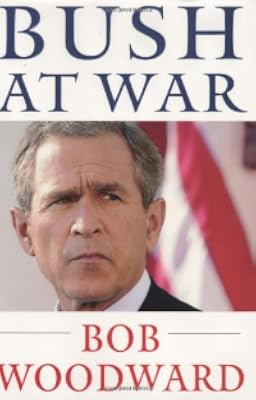
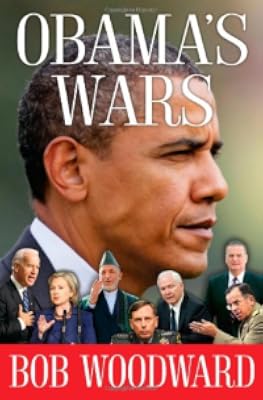
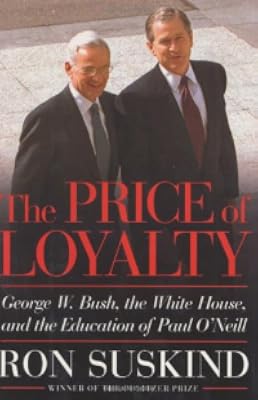
As Bob Woodward has been sort of the official chronicler of the Bush Administration, Ron Suskind has been the shadow chronicler, exposing the dark side in his two previous books, The Price of Loyalty and The One Percent Doctrine. Both of those books revealed the failings of the Bush White House, and there is some of that in The Way of the World but most of the book explores the growth of alternatives to the endless war, beyond the reach of the Administration, even among career public servants.
Members
- Recently Added By
Author Information

7+ Works 3,764 Members
Ron Suskind is the author of The Way of the World, The One Percent Doctrine, The Price of Loyalty, and A Hope in the Unseen. From 1993 to 2000 he was the senior national affairs writer for The Wall Street Journal, where he won a Pulitzer Prize. He lives in Washington, D.C.
Awards and Honors
Awards
Distinctions
Common Knowledge
- Canonical title
- The Way of the World: A Story of Truth and Hope in an Age of Extremism
- Original publication date
- 2008
- People/Characters
- George W. Bush (President)
- Important places
- Iraq
- Important events
- Iraq War; War on Terrorism
- Epigraph
- As a general rule, even the wicked, are much more naive and simple-hearted than we suppose. And weourselves are, too. --Fyodor Dostoyevsky, The Brothers Karamazov
- Dedication
- To Cornelia, who inspires hope
Classifications
- Genres
- Nonfiction, Politics and Government, General Nonfiction, History
- DDC/MDS
- 973.931 — History & geography History of North America United States 1901- New Millennium, Post 9/11 (2001-Present) George W. Bush (2001-2009) Sept 11 Attacks, Iraq War, Patriot Act
- LCC
- HV6432 .S875 — Social sciences Social pathology. Social and public welfare. Criminology Social pathology. Social and public welfare. Criminology Crimes and offenses
- BISAC
Statistics
- Members
- 540
- Popularity
- 55,373
- Reviews
- 8
- Rating
- (3.83)
- Languages
- English
- Media
- Paper, Audiobook, Ebook
- ISBNs
- 18
- ASINs
- 7