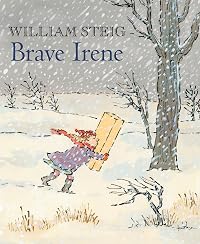
Brave Irene
by William Steig
On This Page
Description
Plucky Irene, a dressmaker's daughter, braves a fierce snowstorm to deliver a new gown to the duchess in time for the ball.Tags
Recommendations





Member Reviews
Sweet story of a little girl who braves a fierce wind and snowstorm to help out her sick mom, a dressmaker, by delivering a dress to the duchess. Particular highlights included the little girl's caretaking of her mom, and the descriptions of her trudging through the snow despite the efforts of the wind -- including the wind literally sweeping the dress away from her. I also liked the drawings, which are not fairy tale glamorous, but funny lumpy. [return][return]All the characters were white, and the "kind nobility" thing is not my bag. But this is certainly a good substitute for a lot of fairy tales.
Brave Irene is Irene Bobbin, the dressmaker's daughter. Her mother, Mrs. Bobbin, isn't feeling so well and can't possibly deliver the beautiful ball gown she's made for the duchess to wear that very evening. So plucky Irene volunteers to get the gown to the palace on time, in spite of the fierce snowstorm that's brewing-- quite an errand for a little girl.
But where there's a will, there's a way, as Irene proves in the danger-fraught adventure that follows. She must defy the wiles of the wicked wind, her most formidable opponent, and overcome many obstacles before she completes her mission.
But where there's a will, there's a way, as Irene proves in the danger-fraught adventure that follows. She must defy the wiles of the wicked wind, her most formidable opponent, and overcome many obstacles before she completes her mission.
After reading Dominic I wanted to include a William Steig book in my collection. This is the story of Irene, who decides to deliver a dress that her mother has made to a duchess. Irene’s mother has taken ill and the duchess needs the dress for a party that evening. Unfortunately for Irene, there is a terrible snowstorm and it is very difficult for her to get to the duchess’ home.
Steig’s writing once again impressed—inspired is a better word—me. His word choice (coaxed, whirled, woe) is of course perfect. But I was also taken with his sentence structure. Steig knows how to tell a story. One example is near the beginning when Mrs. Bobbin, Irene’s mother, is trying to dissuade her from making the trek. “It’s cold out show more there, and windy,” she says. The addition of “add windy” after a comma at the end of the sentence is unusual and more complex syntax than is ordinarily found in many children’s books. Its effect is the give the character and the book voice and it just sounds better! Another example of Steig’s complexity is this sentence: “Then—oh, woe!—the box was wrenched from her mittened grasp and sent bumbling along in the snow.” Here we find words such as woe, grasp, and bumbling along with the insertion of an exclamation (showing Irene’s emotion) within a declarative sentence. Wow! This is the kind of writing I think we should all be privy to reading. Perhaps my favorite line in the book is on the penultimate page when Steig most directly assumes the role of storyteller and asks his reader, “Would you like to hear the rest?”
I want preservice teachers to revel in this book’s writing and then I want them to talk about what examples of great writing it yields they might lift within a writing workshop. How would they distill its brilliance into examples for minilessons? And how would they do so while still maintaining the book as a piece of wonderful literature, first to be enjoyed? I think there are many lessons we can learn from reading William Steig, but his books also deserve to be savored. show less
Steig’s writing once again impressed—inspired is a better word—me. His word choice (coaxed, whirled, woe) is of course perfect. But I was also taken with his sentence structure. Steig knows how to tell a story. One example is near the beginning when Mrs. Bobbin, Irene’s mother, is trying to dissuade her from making the trek. “It’s cold out show more there, and windy,” she says. The addition of “add windy” after a comma at the end of the sentence is unusual and more complex syntax than is ordinarily found in many children’s books. Its effect is the give the character and the book voice and it just sounds better! Another example of Steig’s complexity is this sentence: “Then—oh, woe!—the box was wrenched from her mittened grasp and sent bumbling along in the snow.” Here we find words such as woe, grasp, and bumbling along with the insertion of an exclamation (showing Irene’s emotion) within a declarative sentence. Wow! This is the kind of writing I think we should all be privy to reading. Perhaps my favorite line in the book is on the penultimate page when Steig most directly assumes the role of storyteller and asks his reader, “Would you like to hear the rest?”
I want preservice teachers to revel in this book’s writing and then I want them to talk about what examples of great writing it yields they might lift within a writing workshop. How would they distill its brilliance into examples for minilessons? And how would they do so while still maintaining the book as a piece of wonderful literature, first to be enjoyed? I think there are many lessons we can learn from reading William Steig, but his books also deserve to be savored. show less
Brave Irene is Irene Bobbin, the dressmaker's daughter. Her mother, Mrs. Bobbin, isn't feeling so well and can't possibly deliver the beautiful ball gown she's made for the duchess to wear that very evening. So plucky Irene volunteers to get the gown to the palace on time, in spite of the fierce snowstorm that's brewing-- quite an errand for a little girl.
But where there's a will, there's a way, as Irene proves in the danger-fraught adventure that follows. She must defy the wiles of the wicked wind, her most formidable opponent, and overcome many obstacles before she completes her mission.
But where there's a will, there's a way, as Irene proves in the danger-fraught adventure that follows. She must defy the wiles of the wicked wind, her most formidable opponent, and overcome many obstacles before she completes her mission.
Neither snow, nor snow, nor more snow, nor hella snow shall keep the dressmaker's daughter from delivering a commissioned gown. It's a slow slog for Irene and me both.
Brave Irene is a cute story of a little girl full of tenacity that is not going to let a little snow storm get in the way of delivering a dress to a duchess. What is interesting about this book is that the vocabulary doesn't always seem to match the grade level, which I'd put at 2nd grade. This might look like a typical children's story, but on careful review, there are some words that don't seem to fit the level of this book; delirious and hastening just don't seem to fit the level this story would be most appropriate for. An enjoyable story, despite it small flaws.
This was one of my favorite stories that I have read. Irene wants to help her mother in any way that she can, even if it means walking for miles in the middle of a snow storm, and that shows real love and devotion. Her trek through that blizzard shows that she never gives up for what she believes in, even if it means risking her life. Irene is someone to look up to, an example for all who read this book, because she shows that we must always do the right thing, even if it means making sacrifices, for if we help people out (like her mother), we will in turn get helped out in the end (like the duchess's kindness).
Members
- Recently Added By
Lists

Winter Books
127 works; 17 members

Honey For a Child's Heart
1,152 works; 25 members

Female Protagonist
1,056 works; 57 members

75 Books for Literacy Block: Fall 2016
75 works; 2 members

ELED 460 Book List
61 works; 1 member

Beautiful Feet Books
304 works; 7 members

Read in 2022
31 works; 1 member

Early Picture Books
467 works; 9 members

Read Aloud Revival
108 works; 4 members
Author Information

73+ Works 31,443 Members
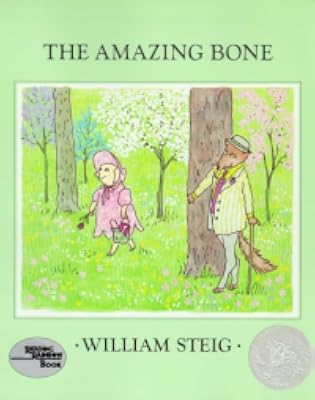
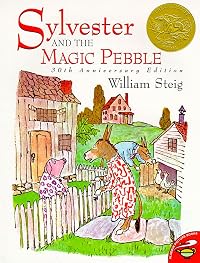
William Steig was born in Brooklyn, New York, on November 14, 1907, and spent his childhood in the Bronx. Steig found an outlet for his talent by creating cartoons for the high school newspaper. After high school graduation, Steig spent two years at City College, three years at the National Academy, and five days at the Yale School of Fine Arts show more before dropping out. During his early days as a free-lance artist, he supplemented his income with work in advertising, although he intensely disliked it. He illustrated for the The New Yorker, beginning in 1930. During the 1940s, Steig's creativity found a more agreeable outlet when he began carving figurines in wood; his sculptures are on display as part of the collection in the historic home of Franklin D. Roosevelt in Hyde Park, New York, and in several museums in New England. In 1967, Bob Kraus, a fellow cartoonist at The New Yorker, was in the process of organizing Windmill Books, an imprint for Harper & Row. Kraus suggested that Steig try writing and illustrating a book for a young audience. The result was Steig's letter-puzzle book entitled C D B!, published in 1968. Roland the Minstrel Pig, was published the same year. With his very next title, Sylvester and the Magic Pebble, he won the Caldecott Medal. The Amazing Bone was also a Caldecott Honor Book.In 1972, Steig published his first children's novel, Dominic, which won the Christopher Award. Abel's Island followed and was a Newberry Honor Book. William Steig died in October 3, 2003 in Boston Massachusettes. (Bowker Author Biography) show less
Awards and Honors
Awards
Notable Lists
Work Relationships
Is contained in
Common Knowledge
- Canonical title
- Brave Irene
- Original publication date
- 1986
- People/Characters
- Irene Bobbin; Mrs. Bobbin; Duchess
- Related movies
- Brave Irene (1989 | IMDb)
- Dedication
- For Jeanne
- First words
- Mrs. Bobbin, the dressmaker, was tired and had a bad headache, but she still managed to sew the last stitches in the gown she was making.
- Last words
- (Click to show. Warning: May contain spoilers.)Which, of course, Mrs. Bobbin knew. Better than the duchess.
- Original language
- English
Classifications
- Genres
- Picture Books, Children's Books
- DDC/MDS
- 808.068 — Literature & rhetoric Literature, rhetoric & criticism Rhetoric and collections of literary texts from more than two literatures Rhetoric and anthologies By Type Of Writing Children's literature
- LCC
- PZ7 .S8177 .B — Language and Literature Fiction and juvenile belles lettres Fiction and juvenile belles lettres Juvenile belles lettres
- BISAC
Statistics
- Members
- 2,411
- Popularity
- 8,123
- Reviews
- 50
- Rating
- (4.06)
- Languages
- 7 — Chinese, Dutch, English, French, Italian, Korean, Spanish
- Media
- Paper, Audiobook, Ebook
- ISBNs
- 52
- ASINs
- 15