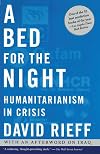
A Bed for the Night: Humanitarianism in Crisis
by David Rieff
On This Page
Description
Timely and controversial, A Bed for the Night reveals how humanitarian organizations trying to bring relief in an ever more violent and dangerous world are often betrayed and misused, and have increasingly lost sight of their purpose. Humanitarian relief workers, writes David Rieff, are the last of the just. And in the Bosnias, the Rwandas, and the Afghanistans of this world, humanitarianism remains the vocation of helping people when they most desperately need help, when they have lost or show more stand at risk of losing everything they have, including their lives. Although humanitarianism's accomplishments have been tremendous, including saving countless lives, the lesson of the past ten years of civil wars and ethnic cleansing is that it can do only so much to alleviate suffering. Aid workers have discovered that while trying to do good, their efforts may also cause harm. Drawing on firsthand reporting from hot war zones around the world -- Bosnia, Rwanda, Congo, Kosovo, Sudan, and most recently Afghanistan -- Rieff describes how the International Committee of the Red Cross, Doctors Without Borders, the International Rescue Committee, CARE, Oxfam, and other humanitarian organizations have moved from their founding principle of political neutrality, which gave them access to victims of wars, to encouraging the international community to take action to stop civil wars and ethnic cleansing. This advocacy has come at a high price. By calling for intervention -- whether by the United Nations or by "coalitions of the willing"--Humanitarian organizations risk being seen as taking sides in a conflict and thus jeopardizing their access to victims. And by overreaching, the humanitarian movement has allowed itself to be hijacked by the major powers, at times becoming a fig leaf for actions those powers wish to take for their own interests, or for the major powers' inaction. Rieff concludes that if humanitarian organizations are to do what they do best -- alleviate suffering -- they must reclaim their independence. Except for relief workers themselves, no one has looked at humanitarian action as seriously or as unflinchingly, or has had such unparalleled access to its inner workings, as Rieff, who has traveled and lived with aid workers over many years and four continents. A cogent, hard-hitting report from the front lines, A Bed for the Night shows what international aid organizations must do if they are to continue to care for the victims of humanitarian disasters. show lessTags
Recommendations















































Member Reviews
Pulling no punches, Rieff has written a damning insight into the current humanitarian care industry (and it has become an industry) has lost its way in the modern day. While showing great admiration for people who believe they are doing the right thing, Rieff exposes the problems with the current methods and thinking behind humanitarian intervention and aid, especially the loss of neutrality and the growth of advocacy for military intervention.
This is a fascinating book, and one that should be read by those who hold beliefs on either side of the humanitarian intervention debate. While this reader came to this book in the context of studying International Security, including the issue of humanitarian intervention, it would be of interest show more to anyone who has thought about the continuing humanitarian crises throughout the world and what should be done about them. Occasionally Rieff comes across as hyperbolic, and he almost loses the reader's sympathies, but he has the facts and experiences to back up what he is saying. Covering a breadth of organizations, situations and viewpoints, this is a powerful book that at the very least will make you think next time you hear calls for peacekeepers to intervene or are asked to donate to one of the multitude of relief organizations at work today. show less
This is a fascinating book, and one that should be read by those who hold beliefs on either side of the humanitarian intervention debate. While this reader came to this book in the context of studying International Security, including the issue of humanitarian intervention, it would be of interest show more to anyone who has thought about the continuing humanitarian crises throughout the world and what should be done about them. Occasionally Rieff comes across as hyperbolic, and he almost loses the reader's sympathies, but he has the facts and experiences to back up what he is saying. Covering a breadth of organizations, situations and viewpoints, this is a powerful book that at the very least will make you think next time you hear calls for peacekeepers to intervene or are asked to donate to one of the multitude of relief organizations at work today. show less
Ratings
Members
- Recently Added By
Published Reviews
ThingScore 13
As an exercise in reporting, the book is curious. Although based on Rieff’s firsthand experience in the field, it contains little reportage and hence lacks a sense of conditions on the ground, so that the humanitarianism he is talking about remains strangely disembodied, a phantom of the seminar room rather than a gritty reality. The book leaves one asking: What do aid workers actually do? . show more . . So there is much in Rieff’s book that illuminates the real dilemmas faced by aid workers and by people who espouse humanitarianism in general. But his writing is sometimes more effective at creating his own persona—as gloomy scourge of conventional wisdom—than at making clear arguments which would show us what he would do differently. The chief weakness of the book is that he wants to be on both sides of some central arguments. show less
added by aprille
That Rieff is not afraid of contradicting himself is often refreshing. He is a supple thinker, turning over some of the most vexing puzzles of morality and politics. But in a book of this complexity, and so polemical a tone, he can also make your head spin. ''A Bed for the Night'' is challenging in every sense of the word. Rieff is right to caution against moral messianism on the part of the show more rich world, and he is right to question simplistic fables about distant conflicts. Although he supported NATO action in Bosnia, Kosovo and Afghanistan, Rieff insists that those who advocate an unrestrained right of humanitarian intervention do not promote a regime of peace but one of perpetual war. show less
added by aprille
Lists

Books Read in 2021
5,361 works; 113 members
Author Information

22+ Works 904 Members
David Rieff is the author of Swimming in a Sea of Death; At the Point of a Gun; A Bed for the Night: Humanitarianism in Crisis; and Slaughterhouse: Bosnia and the Failure of the West. He lives in New York City.
Common Knowledge
- Original publication date
- 2002
- Important places
- Bosnia; Afghanistan; Rwanda; Kosovo; Iraq
Classifications
- Genres
- Nonfiction, General Nonfiction, Politics and Government
- DDC/MDS
- 361.26 — Society, government, & culture Social problems and social services Social problems and services Social Action
- LCC
- HV639 .R54 — Social sciences Social pathology. Social and public welfare. Criminology Social pathology. Social and public welfare. Emergency management Relief in case of disasters Special types of disasters
- BISAC
Statistics
- Members
- 169
- Popularity
- 193,682
- Reviews
- 1
- Rating
- (3.42)
- Languages
- English, Spanish
- Media
- Paper, Ebook
- ISBNs
- 8
- ASINs
- 2