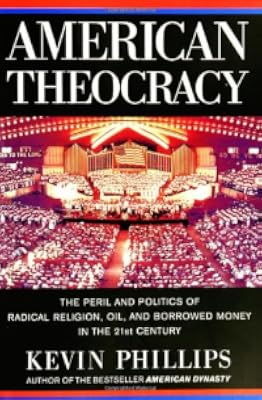
American Theocracy: The Peril and Politics of Radical Religion, Oil and Borrowed Money in the 21st Century
by Kevin Phillips
On This Page
Description
Former Republican strategist Phillips takes an uncompromising view of the political coalition, led by radical religion, that is driving America to the brink of disaster. From Ancient Rome to the British Empire, Phillips demonstrates that every world-dominating power has been brought down by a related set of causes: a lethal combination of global over-reach, militant religion, resource problems, and ballooning debt. It is this same axis of ills that has come to define America's political and show more economic identity in the past decade. Military miscalculations in the Middle East, the surge of fundamentalist religion, the staggering national debt, the costs of U.S. oil dependence--together these factors are undermining our nation's security, solvency, and standing in the world. If left unchecked, the same forces will bring a debt-bloated, preachy, energy-starved America to its knees.--From publisher description. show lessTags
Recommendations






Member Reviews
Every so often I get the craving to read political texts. The problem with this urge is that I have no interest in picking up the edited transcript/ghost written crap put out by Rush Limbaugh or Bill O’Reilly, the frankly embarrassing Dinesh D’Souza, or the “Look at me! Look at me! Look at MEEEE!” shrillness that passes for the corporeal form of Ann Coulter. That’s what’s on offer on the right side of the spectrum.Too frequently when I read a lefty’s political book of any kind, I find it dully confirming a great number of my already held prejudices and regurgitating things I read on the blogs months ago. Rarely do any of these books enlighten or educate me in any real fashion. Oh, I may pick up an anecdote here or there or show more may recall one or two unfamiliar facts to buttress my earlier beliefs, but it’s hardly the same as learning. What a revelation then Kevin Phillips’ American Theocracy, a book I entirely put into the category of prejudice bolstering anti-fundamentalist GOP tract.I had always meant to read the book, the conjunction of religion and power an all too often unacknowledged aspect of American politics. By this I mean, people may discuss how Republicans court the religious right and kowtow to the fundamentalist line on all sexual matters (gays, women’s rights, abortion), but exactly how much of the GOP platform is dictated by the Religious Right is hardly ever outright discussed (outside of the same mentioned lefty blogs).When the author ranks fundamentalist Jewish and Christian sects on the same level as Jihadism and refers to the GOP as America’s first religious party, you’d be tempted to believe that the author was a Democrat, or even an unaffiliated liberal. How surprising then to find that Phillips was a member of the Nixon Administration and author of the seminal electoral text The Emerging Republican Majority. He has also written extensively on a range of historical subjects from the presidency of William McKinley to the English Civil War, the American Revolution, and the American Civil War in The Cousins War.Phillips’ range of comparison is convincing, illustrating the collapses of the Roman Empire, the Spanish Hapsburg Empire, the Dutch naval empire, and the well-known British Empire with intricate detail, demonstrating how financial strain, badly managed resources, and religious intolerance were sizable factors in each one, aggravating already existing problems.Which is to say, Phillips brings an impressive historical scope to his analysis of where the American Empire is headed. In short, disaster. Having made the case of how those problems were instrumental, he then bluntly lays into modern American political culture with bruising clarity and straightforwardness demonstrating over the past several decades how get-rich-quick attitudes and short-term gain have sacrificed long-term stability, most commonly abetted by the Republican Party and their corporate backers and Taliban-like fundie ground troops.Perhaps the most common criticism against Phillips’ book is the eye-rolling toward the notion that Bush and the GOP lead us into the Iraq quagmire based on oil dreams. It always strikes me as patently ridiculous that anyone could argue that other motivations were as strong as that single one. After all, weapons of mass destruction and democracy fostering could be even more strongly argued for North Korea or Iran, yet neither of those is sitting on oil reserves the size of Iraq’s.Part of how Phillips demolishes arguments that counter the rather obvious one he makes — oil was the primary and overwhelming motive for war in Iraq — is to consult the historical record. Even his detractors can’t argue that the man is not thorough. In considering the American economy’s relationship with oil, Phillips returns to the industry of whaling and starts from there, building his case for the energy industry’s outlandish power from the ground up. In considering imperial designs on the Fertile Crescent, he returns to Rome, though most of his global focus rests on the British Empire and their colonial inheritors of hegemony.“Think of Iraq as a military base with a very large oil reserve underneath,” Phillips quotes an oil analyst from a couple of years ago. “You can’t ask for better than that.” And while Iraq remains a central front in this particular petro-war (it being of significant note that in 2000 Baghdad switched from the dollar standard for oil export to the Euro, a move reversed post-invasion), Phillips points out the recent clustering of semi-temporary American military bases and/or the presence of U.S. military advisors near Kazakhastan, Colombia, the Caucasian republic of Georgia, Senegal, Ghana, Mali, Sao Tome, Indonesia, the Strait of Malaca, the Balkans, and any other region that just so coincidentally happens to run along oil and gas pipelines or be possessed of sizable oil fields. Such maps, one historian notes, bear a striking resemblance to the global span of imperial Britain’s protected collieries.It is one of the book’s ironies to learn that the likely greatest failure of the British Empire was its heavy dependence on coal and its refusal to adjust its coal-based infrastructure and mindset. This spectacular myopia lead them to sort of overlook and underestimate petroleum. King Coal would always rule, they believed.Such mindsets were behind another feature of declining empire, the overtaking of actual manufacturing as a base of the economy in favor of finance-based speculative markets. Heavy borrowing, stock-trading, futures markets, all of these non-productive types of wealth accumulation and management have come to dominate the American business sector, with solid manufacturing jobs being shipped out to slave-wage-labor third-world sweatshops. As wealth becomes more and more speculative and less and less based on solid material growth, empires overextend themselves and the merest of financial catastrophes balloon.This is well illustrated by Phillips’ consideration of personal, corporate, and government debt, handily summarized by American’s net savings for the first time in history showing a negative balance. We now, as a nation and as family units, spend more than we earn. While it’s clear Phillips abhors this practice at the individual level, he is ruthless in his excoriation of the architects of such economies, epitomized in the person of former Fed Chair Alan Greenspan. Phillips stops just short of suggesting Greenspan should be burned in effigy in the streets or tarred and feathered, but such notions probably aren’t far from his mind.But nowhere in the book is Phillips more scathing and venomous than in lambasting the hucksterism of the Religious Right, a group he compares unfavorably with radical Muslim clerics, as well as frauds and opportunists looking to cash in on the credulous. Tying this into the petroleum dilemmas, Phillips takes us inside what the Coors Beer family fortune has wrought, the staffing of “the principal units charged with resources stewardship (the Environmental Protection Agency and the departments of the Interior and Energy)” with cronies from: the GOP’s business-religious axis: the Washington-based Heritage Foundation, the Mountain States Legal Foundation, the Council for National Policy…, and, more marginally, the Coalition on Revival (bridging the theological gap between the rapture believers and the Christian Reconstructionists who believe a theocratic type of government must be built before Jesus will return).As if you needed a better reason not to drink the Coors family’s shitty beer.With the third group in that category, the Council for National Policy, Phillips takes special attention toward Tim LaHaye, a hilariously inept favorite here on this site, and quotes one analysis of the novels LaHaye “co-wrote” with draftsman Jerry B. Jenkins as “And God so loved the world that He sent World War Three.” Phillips considers his influence to have “warped the Republican party” which is putting it mildly to say the least and heaps scorn on this sizable GOP constituency. You can almost hear the sneer when he notes that such among the faithful believe as soon as a sperm fertilizes an egg — “pop” god slips in a soul.That Phillips is a Republican attacking Republicans does not mean that he has suddenly become sympathetic to liberal ideas; he merely embraces science over religious tenets in decision making. He also doesn’t appear to have any reactions to the hot button issues of conservative fundamentalists (abortion, evolution, climate change, sex education). It’s refreshing to hear a GOP man discuss favorably how union labor lifted the American population by and large into the middle class, whereas today’s current money markets are pushing in the opposite direction. It is likewise a sign of his rationality that he finds fault with the Reagan years lust for deregulation which allowed for all kinds of economic mischief.To read American Theocracy is to have your eyes opened repeatedly with an erudition more entertaining political tracts lack. When the author mixes these three dangerous strands of his book together, the result promises a combustible future on this continent.Phillips has no great praise for Democrats in general, but to hear his concerns, his favorable impressions, his economic insights and views on what is needed to save America from ruinous collapse, you’d think you were hearing someone slightly to the right of Ralph Nader.And if that ain’t a sign of how warped the Republican Party has become, I don’t know what would demonstrate it better. show less
And for my first non-fiction review we have Kevin Phillip's 'American Theocracy'. It helps of course if you agree with his 3 main premises (which I do--and as it happens I also agree with many of his minor ones too). Phillip's is definitely in 'mea culpa' mode. From my own vantage what I consider conservative viewpoints are not all bad things for instance No. 1 would be you don't buy things you cannot afford--or if you do borrow you do so with the object of paying it back in short order or that balancing your checkbook is a good thing. More or less this is a principle that Phillip's past as Republican party know it all would rest upon. So the 3 main principles are this--that the oil well has run dry (with the exception of Alaska) in the show more USA and has peaked in many other parts of the world but most notably not in Iraq which is the principle reason why U.S. troops are today patrolling the streets of Baghdad. The suggestion is there that the need for the more or less unilateral strike against the Hussein regime was to cut certain countries out when it came to divvying up the oil. Certain of the present president's and vice-president's past associations in the energy field are used to fill out the picture. An analysis that neglect in other evolving energy fields (such as wind, solar or even fuel based) may lead us in the future into what he describes as 'resource wars' which will be dressed in patriotic colors. Hard for me to argue with that.
So does God exist or not? Good question. The next several chapters of Phillip's book pertain to the rise of a particularly pigheaded kind of fundamentalist christianity which Bush and by extension his political party pander to--even when it comes to pandering to absurdities. They are his base. They have kept him in power. Phillip's believes that many of them believe that the 'Anti-christ' is here right now and the Apocalypse is right around the corner. No doubt that there are those who are dim-witted enough (and I suspect I know some; but I'm not in any hurry to get to know these suspects better) to believe anything that their earthly representative with God's ear will tell them. Phillip's calculates the numbers of them and corresponds them regionally most strongly to the south and the southwest where the much more secular Democratic party is busy getting clobbered.
Which brings us to borrowed money. The Asian countries in particular China have been bankrolling our economy by buying US treasury bonds. Much about these last chapters is about how currency is manipulated--how manufacturing and industrial concerns vital to the nation are sold off piecemeal as profits are being made chasing paper credits and debits around the globe resulting in a few people making vast fortunes while less and less goes back to the population as a whole. Paralells are drawn here to other so-called world powers of the past (Spain In I believe its Golden Age; Holland which replaced it and in fact was replaced by Great Britain as the principal world power of the 18th and 19th century); countries also intent on de-industrializing while financializing their economies which Phillips contends (and to which I agree) is a recipe for disaster.
A couple other points he makes--that the policy of an unregulated Adam Smith type of free trade Capitalism is not going to work--that it does not bring costs down but leaves the population at the mercy of for instance the health care or energy industries just for two. That social safety net programs (demonized as socialism) while anathema to those of the religious right and the above mentioned free trade capitalists are essential to a nations' well being and part of the nations' fabric.
To finish off is the idea posited that a yahoo--any yahoo can spend his way to prosperity. So why not a country? Me too. One looks at our staggering trade deficit and then adds to it our staggering national budget deficit and wonders how in the world did this guy with a Harvard business degree ever get that degree or the present job that he has? We're paying for a war we cannot afford with money we cannot calculate in the present (so will have to be paid for by future administrations).???? It's quite like giving a 16 year old an unlimited credit card and encouraging him to go hog wild. With that for now I'm done. show less
So does God exist or not? Good question. The next several chapters of Phillip's book pertain to the rise of a particularly pigheaded kind of fundamentalist christianity which Bush and by extension his political party pander to--even when it comes to pandering to absurdities. They are his base. They have kept him in power. Phillip's believes that many of them believe that the 'Anti-christ' is here right now and the Apocalypse is right around the corner. No doubt that there are those who are dim-witted enough (and I suspect I know some; but I'm not in any hurry to get to know these suspects better) to believe anything that their earthly representative with God's ear will tell them. Phillip's calculates the numbers of them and corresponds them regionally most strongly to the south and the southwest where the much more secular Democratic party is busy getting clobbered.
Which brings us to borrowed money. The Asian countries in particular China have been bankrolling our economy by buying US treasury bonds. Much about these last chapters is about how currency is manipulated--how manufacturing and industrial concerns vital to the nation are sold off piecemeal as profits are being made chasing paper credits and debits around the globe resulting in a few people making vast fortunes while less and less goes back to the population as a whole. Paralells are drawn here to other so-called world powers of the past (Spain In I believe its Golden Age; Holland which replaced it and in fact was replaced by Great Britain as the principal world power of the 18th and 19th century); countries also intent on de-industrializing while financializing their economies which Phillips contends (and to which I agree) is a recipe for disaster.
A couple other points he makes--that the policy of an unregulated Adam Smith type of free trade Capitalism is not going to work--that it does not bring costs down but leaves the population at the mercy of for instance the health care or energy industries just for two. That social safety net programs (demonized as socialism) while anathema to those of the religious right and the above mentioned free trade capitalists are essential to a nations' well being and part of the nations' fabric.
To finish off is the idea posited that a yahoo--any yahoo can spend his way to prosperity. So why not a country? Me too. One looks at our staggering trade deficit and then adds to it our staggering national budget deficit and wonders how in the world did this guy with a Harvard business degree ever get that degree or the present job that he has? We're paying for a war we cannot afford with money we cannot calculate in the present (so will have to be paid for by future administrations).???? It's quite like giving a 16 year old an unlimited credit card and encouraging him to go hog wild. With that for now I'm done. show less
In his latest book, Kevin Phillips draws an alarming picture of where we are politically and where we are heading.
Unlike other best-selling polemics, “American Theocracy” is extensively researched and, for the most part, persuasive.
Phillips, a former Republican strategist and current media pundit, has an impressive tack record. Almost four decades ago as a young political strategist for the Republican Party, he wrote a remarkable book called “The Emerging Republican Majority.”
Published in 1969, he forecast the movement of people from the industrialized north to the south and the west would produce a conservative Republican majority that would dominate American politics for decades. The benefit, he wrote, was that it would show more restore stability and order to a society that was experiencing disorienting and at times violent change.
Although controversial at the time, it was the first book I read that forecast what, now, is history.
Shortly before publishing that book, the author joined the Nixon administration. He hoped to advance his forecast changes. Although a prolific political commentator, he has lost his enthusiasm during the ensuing decades for the Republican majority he forecast and helped create.
In his latest book, Phillips identifies three trends which threaten the United States’ future:
1. The defining, yet distorting role of oil in foreign and domestic policy.
2. Religion’s growing intrusion in politics and government.
3. Debt’s astonishing growth.
Using these three themes, Phillips weaves a convincing and well-written condemnation of the failure of our leaders to look beyond their self-interest and immediate ambitions to plan for the country’s future.
Although he continues the trend of his recent books to be critical of the policies of the current Bush Administration, for the most part, the author avoids inflammatory invectives
Rather he uses training as a lawyer, to deliver a skillful and thought-provoking indictment against this country’s leadership. However, unlike his first book, Phillips fails to offer the reader an original prescription for this country’s current problems.
Never-the less, this book’s broad and structural discussion of political and social changes makes it worth reading. Phillips’ passionless discussion draws a portrait of American society that readers may not welcome.
Yet, they will ignore it at their peril. show less
Unlike other best-selling polemics, “American Theocracy” is extensively researched and, for the most part, persuasive.
Phillips, a former Republican strategist and current media pundit, has an impressive tack record. Almost four decades ago as a young political strategist for the Republican Party, he wrote a remarkable book called “The Emerging Republican Majority.”
Published in 1969, he forecast the movement of people from the industrialized north to the south and the west would produce a conservative Republican majority that would dominate American politics for decades. The benefit, he wrote, was that it would show more restore stability and order to a society that was experiencing disorienting and at times violent change.
Although controversial at the time, it was the first book I read that forecast what, now, is history.
Shortly before publishing that book, the author joined the Nixon administration. He hoped to advance his forecast changes. Although a prolific political commentator, he has lost his enthusiasm during the ensuing decades for the Republican majority he forecast and helped create.
In his latest book, Phillips identifies three trends which threaten the United States’ future:
1. The defining, yet distorting role of oil in foreign and domestic policy.
2. Religion’s growing intrusion in politics and government.
3. Debt’s astonishing growth.
Using these three themes, Phillips weaves a convincing and well-written condemnation of the failure of our leaders to look beyond their self-interest and immediate ambitions to plan for the country’s future.
Although he continues the trend of his recent books to be critical of the policies of the current Bush Administration, for the most part, the author avoids inflammatory invectives
Rather he uses training as a lawyer, to deliver a skillful and thought-provoking indictment against this country’s leadership. However, unlike his first book, Phillips fails to offer the reader an original prescription for this country’s current problems.
Never-the less, this book’s broad and structural discussion of political and social changes makes it worth reading. Phillips’ passionless discussion draws a portrait of American society that readers may not welcome.
Yet, they will ignore it at their peril. show less
I'm pretty well read; therefore, I wasn't surprised that I was familiar with much of what was in Kevin Phillips' latest book when it came to the American theocracy. What did surprise me was how much I learned about the history and politics of American oil and about the inner workings of Wall Street. I was flabbergasted!
American Theocracy is a hefty tome, but it's well worth reading. You'll look at tomorrow's newspaper headlines in a whole different light after reading this book.
American Theocracy is a hefty tome, but it's well worth reading. You'll look at tomorrow's newspaper headlines in a whole different light after reading this book.
One of the best non-fiction books I have ever read. A Nixonite Republican bemoans the overtaking of his party by southern religious extremists. He describes how the depletion of world oil reserves, debt, and the placing of religion over science in our education system is leading to the end of the American Empire as we know it. Full of historical comparisons. I read this during the great financial melt down of 2008. In the end its the fault of every American. We want something for nothing and we elected a fool (twice) who told us what we wanted to hear.
If the details of the arguments of this work are not always persuasive the author nevertheless achieves his stated purpose: to demolish any illusion among his fellow Americans that the US is in any way "exceptional" in its place and role in the world. Rather, he argues that it is rapidly following in the wake of the demise of past imperial powers Spain, Holland and Britain. The extraordinary rise and influence of extremist religious tendencies; the financialization and extreme indebtedness of the economy as "real wealth production" is outsourced; and the inevitable decline and gradual replacement of the economy's main fuel resource, are the three main streams that Phillips sees as once having broken their banks over previous leading show more imperial powers and that are now beginning to deluge the US.
I'm not an American but do have an interest in understanding the nature of the power that is so dominant in the political and cultural life of my country (Australia), in particular with a view to better understanding how one might best address issues that I see as detrimental to our society -- such as rising religious fundamentalism, the determination of many in power to follow the more extreme attitudes of the Bush administration re war, climate, human rights despite widely expressed public opinion to the contrary.
Perhaps for this reason I found first section of Phillip's book detailing oil's role for the US in comparison with the roles of other energy sources (coal, wind, timber) in past empires (Britian, Holland, Spain) painful with its baroque level of descriptive detail.
But I did find most absorbing his discussion of the historical roots and evolution of the Southern "character" (my term) and in particular of the Southernization of the North, or of the US as a whole. The role of the Southern Baptist Convention is especially enlightening. It helps me see the current Bush president -- the less educated persona, the disdain for science and progressive values, the born again (revived) Christian, filled with sense of being besieged, responding with arrogance and aggression, imbued especially with a sense of exceptionalism, of a unique mission to play out in the world -- as a fulfilment of the final rise of The South after the "divine chastening in righteousness" of the Civil War and Reconstruction period. This gives an interesting perspective to think about after having read Lieven's America Right or Wrong (my review on this is yet to come) which analysed many such nationalistic traits and attitudes to the rest of the world from a more "whole" US perspective.
Phillips then attempts to link the rise of religious fundamentalisms as a principle motive in foreign policy decisions but I felt he did little more than reinforce the what most take as a given (albeit with much added detail from regional election statistics) -- that the Bush administration has relied heavily on the religious fundamentalist vote. Although he discusses Middle East policy in the context of apocalyptic beliefs of Bush himself I remain sceptical: if Iraq were the proverbial world's supplier of broccoli rather than oil does anyone really think Bush's religious imagination would be so exercised in that region? Indeed, it is in this discussion that Phillips lets some of his otherwise love of detail desert him, and the reader finds in its place the old conservative biological and psychic metaphors commonly attached to "decline and fall" motifs: in place of hard supporting documentation one reads of a nation's "hubris", its "high-wire walks", its "youth and early middle age", its "animal spirits" and "vitality", the "lesser resilience" of its "clogged arteries" (p.311).
This is a book rich in illustrations of "decline" and I personally find any hint that the US power is on such a brink both disturbing and encouraging. Disturbing because one fears the potential for more irrational and bloody responses from the superpower in misguided efforts to delay the inevitable, encouraging because one seeks the eventual end of Anglo-Saxon imperial domination and power rivalries with related European nations these past 200 years with what must be one of the most bloody and genocidal periods of human history. The only real regret I have with American Theocracy is that while its author can see signs of "the end" of the current "empire", he apparently fails to see that the whole exercise from the beginning was one not of "greatness" but of arrogrance, greed and inhumanity.
(This and other reviews on my blog at http://sweetreason.wordpress.com ) show less
I'm not an American but do have an interest in understanding the nature of the power that is so dominant in the political and cultural life of my country (Australia), in particular with a view to better understanding how one might best address issues that I see as detrimental to our society -- such as rising religious fundamentalism, the determination of many in power to follow the more extreme attitudes of the Bush administration re war, climate, human rights despite widely expressed public opinion to the contrary.
Perhaps for this reason I found first section of Phillip's book detailing oil's role for the US in comparison with the roles of other energy sources (coal, wind, timber) in past empires (Britian, Holland, Spain) painful with its baroque level of descriptive detail.
But I did find most absorbing his discussion of the historical roots and evolution of the Southern "character" (my term) and in particular of the Southernization of the North, or of the US as a whole. The role of the Southern Baptist Convention is especially enlightening. It helps me see the current Bush president -- the less educated persona, the disdain for science and progressive values, the born again (revived) Christian, filled with sense of being besieged, responding with arrogance and aggression, imbued especially with a sense of exceptionalism, of a unique mission to play out in the world -- as a fulfilment of the final rise of The South after the "divine chastening in righteousness" of the Civil War and Reconstruction period. This gives an interesting perspective to think about after having read Lieven's America Right or Wrong (my review on this is yet to come) which analysed many such nationalistic traits and attitudes to the rest of the world from a more "whole" US perspective.
Phillips then attempts to link the rise of religious fundamentalisms as a principle motive in foreign policy decisions but I felt he did little more than reinforce the what most take as a given (albeit with much added detail from regional election statistics) -- that the Bush administration has relied heavily on the religious fundamentalist vote. Although he discusses Middle East policy in the context of apocalyptic beliefs of Bush himself I remain sceptical: if Iraq were the proverbial world's supplier of broccoli rather than oil does anyone really think Bush's religious imagination would be so exercised in that region? Indeed, it is in this discussion that Phillips lets some of his otherwise love of detail desert him, and the reader finds in its place the old conservative biological and psychic metaphors commonly attached to "decline and fall" motifs: in place of hard supporting documentation one reads of a nation's "hubris", its "high-wire walks", its "youth and early middle age", its "animal spirits" and "vitality", the "lesser resilience" of its "clogged arteries" (p.311).
This is a book rich in illustrations of "decline" and I personally find any hint that the US power is on such a brink both disturbing and encouraging. Disturbing because one fears the potential for more irrational and bloody responses from the superpower in misguided efforts to delay the inevitable, encouraging because one seeks the eventual end of Anglo-Saxon imperial domination and power rivalries with related European nations these past 200 years with what must be one of the most bloody and genocidal periods of human history. The only real regret I have with American Theocracy is that while its author can see signs of "the end" of the current "empire", he apparently fails to see that the whole exercise from the beginning was one not of "greatness" but of arrogrance, greed and inhumanity.
(This and other reviews on my blog at http://sweetreason.wordpress.com ) show less
A very troubling recognition of the symptoms of the disease that was Bush's America. Why oh why didn't more people read this sooner.
Does focus a bit on Bushian policies, but also on broader societal trends that started in the 1970s, and some earlier. Deepening worries of consumerism, fundamentalism, religion as intermediary in political issues, the greed for oil as political motivator. All of these topics are covered in greater detail in other books, but this one provides a solid overview of them all.
I find it quite interesting that the author was a Nixon strategist - he was arguably one of the presidents most responsible for this deepening fissure in American society.
The author does accurately foresee the 'Great Recession' crash of show more 2007-8, and the continued resurgence of the Far Right in the current presidential election is troubling (if morbidly amusing) to watch. One wonders if the end is nigh yet. show less
Does focus a bit on Bushian policies, but also on broader societal trends that started in the 1970s, and some earlier. Deepening worries of consumerism, fundamentalism, religion as intermediary in political issues, the greed for oil as political motivator. All of these topics are covered in greater detail in other books, but this one provides a solid overview of them all.
I find it quite interesting that the author was a Nixon strategist - he was arguably one of the presidents most responsible for this deepening fissure in American society.
The author does accurately foresee the 'Great Recession' crash of show more 2007-8, and the continued resurgence of the Far Right in the current presidential election is troubling (if morbidly amusing) to watch. One wonders if the end is nigh yet. show less
Members
- Recently Added By
Published Reviews
Phillips (American Dynasty, 2004, etc.), the apostate former Republican strategist, once coined the term “Sun Belt” and envisioned the Southernization of American politics. He is now in the unhappy position of bearing witness to the birth of a Texas-fried, small-tent politics that blends religious orthodoxy and unwavering uncertainty in presidential infallibility with an economics show more predicated on indebtedness and extraction. The red state/blue state schism marks several old divides, he holds, one between “a preference for conspicuous consumption over energy efficiency and conservation,” one between secularism and theocracy. show less
added by Lemeritus
Phillips has remained a prolific and important political commentator in the decades since, but he long ago abandoned his enthusiasm for the Republican coalition he helped to build.... he presents a nightmarish vision of ideological extremism, catastrophic fiscal irresponsibility, rampant greed and dangerous shortsightedness. By describing a series of major transformations, by demonstrating the show more relationships among them and by discussing them with passionate restraint, Phillips has created a harrowing picture of national danger that no American reader will welcome, but that none should ignore. show less
added by Lemeritus
Author Information

11+ Works 4,694 Members
Awards and Honors
Distinctions
Common Knowledge
- Canonical title
- American Theocracy: The Peril and Politics of Radical Religion, Oil and Borrowed Money in the 21st Century
- Original publication date
- 2006
- People/Characters
- George W. Bush (President)
- Dedication
- This book is dedicated to the millions of Republicans, present and lapsed, who have opposed the Bush dynasty and the disenlightenment in the 2000 and 2004 election.
- First words
- The American people are not fools.
- Last words
- (Click to show. Warning: May contain spoilers.)I particularly regret this latest evolution under the two Bush presidents, and my last three major books—Wealth and Democracy (2002), American Dynasty (2004), and American Theocracy (2006)—could be said to represent a trilogy of indictments, something I never imagined when I started writing The Emerging Republican Majority back in 1966.
- Blurbers
- Yardley, Jonathan; Brinkley, Douglas; Krugman, Paul; Drew, Elizabeth
- Canonical DDC/MDS
- 973.931
- Canonical LCC
- E902
Classifications
- Genres
- General Nonfiction, Nonfiction, Politics and Government, Religion & Spirituality, History
- DDC/MDS
- 973.931 — History & geography History of North America United States 1901- New Millennium, Post 9/11 (2001-Present) George W. Bush (2001-2009) Sept 11 Attacks, Iraq War, Patriot Act
- LCC
- E902 — History of the United States George W. Bush's administrations, 2001-2009
- BISAC
Statistics
- Members
- 1,606
- Popularity
- 14,219
- Reviews
- 21
- Rating
- (3.79)
- Languages
- English
- Media
- Paper, Audiobook, Ebook
- ISBNs
- 10
- ASINs
- 9