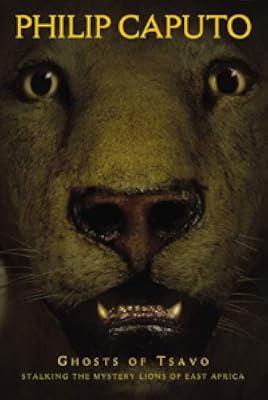
Ghosts of Tsavo: Tracking the Mythic Lions of East Africa
by Phillip Caputo
On This Page
Description
1898, Tsavo River Kenya, the British Empire has employed 140 workers to build a railroad bridge. The bridge's construction comes to a violent halt when two maneless lions devour all 140 workers in a savage feeding frenzy that would make headlinesand history-all over the world. Caputo's Ghosts of Tsavo is a new quest for truth about the origins of these near-mythical animals and how they became predators of human flesh.Tags
Recommendations



















Member Recommendations
Member Reviews
I put off reading Philip Caputo's Ghosts of Tsavo because it begins with a long recounting of Wayne Hosek's killing of the man-eating lions, Ghost and Darkness. Pushing further into the text, I found a wonderful stockpile of first class nature writing, safari lore, scientific examination of what exactly constitutes a species, and philosophizing on the dichotomy between the mysteries of nature and the science that seeks to explain them.
The book centers on the author's quest to learn whether the maneless lions of Tsavo National Park in Kenya are, in fact, a distinct species from their plains-dwelling maned cousins. Philip Caputo makes his first journey to Tsavo with an eccentric English guide and leaves convinced the maneless lions with show more a taste for human flesh are the direct descendents of Paleolithic cave-dwelling lions. At the Field Museum in Chicago, he digs deeper into the research of a self-taught big cat expert (formally employed as an ornithological specimen preparer). Then he returns to Africa with a scientific research team who take a narrow view of this speculative research. The varying viewpoints, coupled with the author's near-death experience and wild ramblings induced by malaria drugs, make for a compelling story and an atmospheric introduction to East Africa's charismatic cats. show less
The book centers on the author's quest to learn whether the maneless lions of Tsavo National Park in Kenya are, in fact, a distinct species from their plains-dwelling maned cousins. Philip Caputo makes his first journey to Tsavo with an eccentric English guide and leaves convinced the maneless lions with show more a taste for human flesh are the direct descendents of Paleolithic cave-dwelling lions. At the Field Museum in Chicago, he digs deeper into the research of a self-taught big cat expert (formally employed as an ornithological specimen preparer). Then he returns to Africa with a scientific research team who take a narrow view of this speculative research. The varying viewpoints, coupled with the author's near-death experience and wild ramblings induced by malaria drugs, make for a compelling story and an atmospheric introduction to East Africa's charismatic cats. show less
This is a sort of combination science and travel book. Unfortunately the "science" side was much weaker than the "travel" side.
The author writes of his trips to east-central Africa on photographic safari, tracking the lions of Tsavo, and his adventures. Apparently safari vacations, at least in the Tsavo, are not for the faint of heart -- it's close to 100 degrees all the time, you're very far from civilization, there's a real chance of getting mauled and/or eaten by some wild animal, and there are long periods of being bored to death punctuated by short periods of being frightened to death. Caputo had a ball, but I'm not sure I'd be willing to sign up for that trip.
The Tsavo lions are different from the lions further north in that they show more are larger, their skulls are shaped differently, they are more aggressive and much more likely to attack humans, and their manes are often sparse to non-existent (maybe that's why they're so aggressive: inferiority complex). Caputo wrote about the debate between biologists about this; some of them believe the Tsavo lions could be a different subspecies or species altogether, while others believe the differences aren't significant and can be accounted for by environmental factors. I think it's a very interesting question and would like to know the answer. However, not reaching any conclusions about this, Caputo is finally like, "Who cares, I'd rather it remain a mystery, they're awesome anyway." The affect, to me, was like slamming the door in my face.
I would still recommend this book, but for intrepid armchair travelers rather than armchair zoologists. show less
The author writes of his trips to east-central Africa on photographic safari, tracking the lions of Tsavo, and his adventures. Apparently safari vacations, at least in the Tsavo, are not for the faint of heart -- it's close to 100 degrees all the time, you're very far from civilization, there's a real chance of getting mauled and/or eaten by some wild animal, and there are long periods of being bored to death punctuated by short periods of being frightened to death. Caputo had a ball, but I'm not sure I'd be willing to sign up for that trip.
The Tsavo lions are different from the lions further north in that they show more are larger, their skulls are shaped differently, they are more aggressive and much more likely to attack humans, and their manes are often sparse to non-existent (maybe that's why they're so aggressive: inferiority complex). Caputo wrote about the debate between biologists about this; some of them believe the Tsavo lions could be a different subspecies or species altogether, while others believe the differences aren't significant and can be accounted for by environmental factors. I think it's a very interesting question and would like to know the answer. However, not reaching any conclusions about this, Caputo is finally like, "Who cares, I'd rather it remain a mystery, they're awesome anyway." The affect, to me, was like slamming the door in my face.
I would still recommend this book, but for intrepid armchair travelers rather than armchair zoologists. show less
Philip Caputo is the author of six novels and two memoirs, but I first encountered him in "The Ghosts of Tsavo" where he plays a substantial role , if not the main character. He is more of a narrator, capable of pulling us fully into the experience of encountering lions in an open, unreliable vehicle, and then sharing his Larium-induced nightmares with us. (It's an anti-malaria medicine) He faces peril frequently in this book, as the lions at Tsavo are not always accustomed to tourists, and react badly. He does whatever is necessary to pursue his story, in this case, uncovering some of the mystery that surrounds the Lions at Tsavo, in Africa. They are often maneless, and the area is famous for man-eating lions that had been hunted down show more after taking many lives. So he is brave, but he does not pretend that he is not scared, his musings ranging from comical to philosophical, Caputo could not be called boring.
Caputo introduces the reader to, not only the wildlife he encounters but also his traveling companions, all unique in their own right. They are all pioneers of a sort, as they live in inhospitable country in order to pursue as much knowledge as they can, by studying the lions up close. They face disease, violent death if they should let down their guard, and loneliness as they situate themselves in far outposts in an effort to observe lions in their natural habitat.. As fate would have t, I seem to have gathered about me, 3 or 4 books involving South Africa and/or Africa. It is an undiscovered country to me. show less
Caputo introduces the reader to, not only the wildlife he encounters but also his traveling companions, all unique in their own right. They are all pioneers of a sort, as they live in inhospitable country in order to pursue as much knowledge as they can, by studying the lions up close. They face disease, violent death if they should let down their guard, and loneliness as they situate themselves in far outposts in an effort to observe lions in their natural habitat.. As fate would have t, I seem to have gathered about me, 3 or 4 books involving South Africa and/or Africa. It is an undiscovered country to me. show less
While the science is enlightening and always well-written, I thought the author could get melodramatic if he wandered too far astray from the science. Still worth the read.
Squeezing one last one in here. This is a nonfiction book I chose off a list for a school. I've always been fascinated by the Tsavo man-eaters, Ghost and Darkness as they were called, and this seemed the apt choice. It was a very nice little read, kept me entertained and definitely enlightened me a lot about Serengeti lions and Tsavo lions and the research going on to determine their differences and similarities. I've seen Ghost and Darkness at the Field Museum, and this book was just a nice little way to pad my knowledge of the Tsavo "buffalo" lions. I might read Patterson's account of the actual experience with the two man-eaters in the near future.
Ratings
Members
- Recently Added By
Author Information

21+ Works 4,860 Members
Philip Caputo was born on June 10, 1941 in Chicago, Illinois. He received a B.A. from Loyola University in 1964. He served in the U.S. Marine Corps from 1964 to 1967. His first book, A Rumor of War (1977), recounts his military tour of Vietnam. He has written more than fifteen books including Horn of Africa, Indian Country, Equation for Evil, show more Crossers, and The Longest Road. His journalism career began in 1968, when he joined the staff of the Chicago Tribune, serving as a general assignment and team investigative reporter until 1972 and then as a foreign correspondent for the next five years. In 1972 he and Hugh Jones received a Pulitzer Prize for their coverage of election fraud in the primaries. He has also written for the New York Times, Washington Post, the Boston Globe, the Los Angeles Times, and many other publications. He has worked as a screenwriter for Paramount Pictures and Michael Douglas Productions. (Bowker Author Biography) show less
Series
Belongs to Publisher Series
Common Knowledge
Classifications
Statistics
- Members
- 198
- Popularity
- 164,831
- Reviews
- 5
- Rating
- (3.56)
- Languages
- Dutch, English, German
- Media
- Paper, Ebook
- ISBNs
- 6
- ASINs
- 2