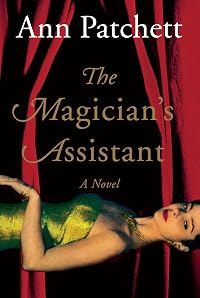
The Magician's Assistant
by Ann Patchett
On This Page
Description
When Parsifal, a handsome and charming magician, dies suddenly, his widow Sabine-who was also his faithful assistant for twenty years-learns that the family he claimed to have lost in a tragic accident is very much alive and well. Sabine is left to unravel his secrets, and the adventure she embarks upon, from sunny Los Angeles to the bitter windswept plains of Nebraska, will work its own magic on her. Sabine's extraordinary tale captures the hearts of its readers just as Sabine is captured show more by her quest. show lessTags
Recommendations





































Member Recommendations

Member Reviews
For the past twenty years, Sabine has been on the sidelines: the magician's assistant, there for looks and misdirection but "she was never the reason." The same holds true in her own life, as she has been hopelessly in love with her gay magician Parsifal, living platonically with him and his partner Phan. But when Parsifal dies unexpectedly, Sabine is on her own - nobody's assistant. Furthermore, Parsifal's death reveals that he lied about his family; they did not die in a car crash but still live in the same tiny town in Nebraska where Parsifal grew up. Sabine, without a purpose other than to know, must follow up on this news.
The small town inertia of Alliance, Nebraska serves as a foil for Sabine's former life in her glamorous LA show more home. Yet this tension drives character growth: the ambiguous interplay between past and present. Nobody can fully discard the past (as much as Parsifal tried and Sabine might grievingly long to) without throwing away an instrumental part of themselves, for better or for worse. On the flip side, to what extent can one cling to the past before it becomes inhibiting?
Sabine's arrival stirs her Nebraskan inlaws, who believe her to be a minor celebrity. The thrilling impossibility of magic mirrors the family's thrilling impossibility of change: if only she could leave her abusive husband, if only she were more confident in her relationship, if only the town were interested in expanding beyond its small town culture (read: a Walmart and little else). Yet change is scary, a drastic measure sometimes only forced by drastic times. And the equilibrium of continuity with the past and yielding to the future is difficult but necessary to strike. show less
The small town inertia of Alliance, Nebraska serves as a foil for Sabine's former life in her glamorous LA show more home. Yet this tension drives character growth: the ambiguous interplay between past and present. Nobody can fully discard the past (as much as Parsifal tried and Sabine might grievingly long to) without throwing away an instrumental part of themselves, for better or for worse. On the flip side, to what extent can one cling to the past before it becomes inhibiting?
Sabine's arrival stirs her Nebraskan inlaws, who believe her to be a minor celebrity. The thrilling impossibility of magic mirrors the family's thrilling impossibility of change: if only she could leave her abusive husband, if only she were more confident in her relationship, if only the town were interested in expanding beyond its small town culture (read: a Walmart and little else). Yet change is scary, a drastic measure sometimes only forced by drastic times. And the equilibrium of continuity with the past and yielding to the future is difficult but necessary to strike. show less
I'd read this book before, but it was chosen for the downtown reading group, and I was glad for the chance to reread it, especially since I remembered so little from the last read. And that is strange, because it is a wonderful story.
A woman, Sabine, who has been the assistant to a very dashing stage magician for the last 25 years, must face his sudden death. He was gay, and had a gay lover, Phan, who died of AIDS not very long before the story starts. The magician, Parsifal, has married his assistant to make sure she inherits the substantial estate the two men have accumulated.
Sabine was hopelessly in love with Parsifal from the beginning, and while she got on with her social life, she could only love him. So it is quite a shock when show more her deep mourning is interrupted by news that his backstory was nothing she was told, and there is a whole side of him, his entire childhood, that she must learn and grapple with.
It's important to recognize that the book is about Sabine, The Magician's Assistant, rather than Parsifal himself, who is such a magnet for everyone. It's her story of how she gets out of the box. Wonderful. show less
A woman, Sabine, who has been the assistant to a very dashing stage magician for the last 25 years, must face his sudden death. He was gay, and had a gay lover, Phan, who died of AIDS not very long before the story starts. The magician, Parsifal, has married his assistant to make sure she inherits the substantial estate the two men have accumulated.
Sabine was hopelessly in love with Parsifal from the beginning, and while she got on with her social life, she could only love him. So it is quite a shock when show more her deep mourning is interrupted by news that his backstory was nothing she was told, and there is a whole side of him, his entire childhood, that she must learn and grapple with.
It's important to recognize that the book is about Sabine, The Magician's Assistant, rather than Parsifal himself, who is such a magnet for everyone. It's her story of how she gets out of the box. Wonderful. show less
sometimes you read the exact right book at the exact right time. that happened with patchett's novel, the magician's assistant.
patchett handles the themes of love, loss, grief, family dynamics, how the past defines a person, and improbable relationships so wonderfully. there is a grace to her writing that pulls me in and, at moments, stops me in my tracks as i admire her prose. the ending was a bit of a disappointment, so i couldn't give this a full 5-stars.
patchett handles the themes of love, loss, grief, family dynamics, how the past defines a person, and improbable relationships so wonderfully. there is a grace to her writing that pulls me in and, at moments, stops me in my tracks as i admire her prose. the ending was a bit of a disappointment, so i couldn't give this a full 5-stars.
I'm not sure that I liked the ending (which was maybe meant to be open-ended but felt rather abrupt), but I loved the message the book sends out. Family is what you make it and love is what you make it. Yes, you can be straight, married to someone who is gay and happily in love with the other man in your house. They can love each other, you can love them and it isn't full of the typical love triangle junk that most books in this three-people-in-one-house situation will throw at you. Brilliant, just brilliant and such a welcome relief.
Family grief is the key of this book. A man's genetic family is missing him greatly, not just because he disappeared on them, but because he died and they have only just found out. What happens after they show more contact his wife is a pure journey in emotional discovery and acceptance, without being at all overpowering or so dripping with said emotions that the pages are soggy with your own tears. Easy to see how it got the attention of the Women's Prize list makers. show less
Family grief is the key of this book. A man's genetic family is missing him greatly, not just because he disappeared on them, but because he died and they have only just found out. What happens after they show more contact his wife is a pure journey in emotional discovery and acceptance, without being at all overpowering or so dripping with said emotions that the pages are soggy with your own tears. Easy to see how it got the attention of the Women's Prize list makers. show less
“It was one thing to have spent your life in love with a man who could not return the favor, but it was another thing entirely to love a man you didn’t even know.” — Ann Patchett, “The Magician’s Assistant”
For Sabine, the beautiful magician’s assistant, both of these things turn out to be true. She loved Parsifal, the magician, almost from the time he made her part of his act, and in time he married her. Yet he never loved her in the way he loved Phan, the wealthy Vietnamese man he slept with every night while Sabine slept alone. His marriage was just a part of his act.
As “The Magician’s Assistant,” Ann Patchett’s 1997 novel, begins, Sabine is alone in that big California house that is now hers. Both men have show more died, Phan from AIDS and Parsifal from a brain aneurism. Her husband had told her he was an orphan from Connecticut with no remaining family. Now she learns his mother and two sisters have been living in Nebraska all this time and that his real name was Guy Fetters.
Why had he lied to her? The mystery deepens when his mother, Dot Fetters, and one sister, Bertie, having been notified of his death by a lawyer, come to California to meet the wife they didn’t even know he had. Sabine finds them to be pleasant, quite ordinary women. So why had he pretended they didn't even exist?
A magician knows how to hide secrets, but a magician's assistant learns those secrets as she learns the act. Often she is the one who makes the magic happen while the magician waves his arms and keeps the audience focused elsewhere. And so Sabine, when she later visits the Fetters home in Nebraska, gradually learns the secrets Parsifal had tried so hard to keep hidden.
That home had been marked by discord and violence when Guy Fetters was a boy, and so it is now. Where before it was his father who was the source of the trouble, now it is Howard, the husband of Kitty, the older sister who looks so much like Parsifal. Howard's very presence in the house seems to put everyone on edge.
Sabine turns out to be a pretty good magician in her own right, but her most challenging trick may be trying to bring peace to this broken family, whose idea of a good time is watching a tape of an old Johnny Carson show on which Parsifal and Sabine had appeared years before. They watch it every night almost as an act of worship. Their idea of a night out is going to Wal-Mart. "It's a very romantic place, really," Kitty tells her.
While Sabine works her magic on the Fetters family, the family works its own magic on her, easing her sense of loss and abandonment.
This was Patchett's third novel, and two decades later it holds up very well. show less
For Sabine, the beautiful magician’s assistant, both of these things turn out to be true. She loved Parsifal, the magician, almost from the time he made her part of his act, and in time he married her. Yet he never loved her in the way he loved Phan, the wealthy Vietnamese man he slept with every night while Sabine slept alone. His marriage was just a part of his act.
As “The Magician’s Assistant,” Ann Patchett’s 1997 novel, begins, Sabine is alone in that big California house that is now hers. Both men have show more died, Phan from AIDS and Parsifal from a brain aneurism. Her husband had told her he was an orphan from Connecticut with no remaining family. Now she learns his mother and two sisters have been living in Nebraska all this time and that his real name was Guy Fetters.
Why had he lied to her? The mystery deepens when his mother, Dot Fetters, and one sister, Bertie, having been notified of his death by a lawyer, come to California to meet the wife they didn’t even know he had. Sabine finds them to be pleasant, quite ordinary women. So why had he pretended they didn't even exist?
A magician knows how to hide secrets, but a magician's assistant learns those secrets as she learns the act. Often she is the one who makes the magic happen while the magician waves his arms and keeps the audience focused elsewhere. And so Sabine, when she later visits the Fetters home in Nebraska, gradually learns the secrets Parsifal had tried so hard to keep hidden.
That home had been marked by discord and violence when Guy Fetters was a boy, and so it is now. Where before it was his father who was the source of the trouble, now it is Howard, the husband of Kitty, the older sister who looks so much like Parsifal. Howard's very presence in the house seems to put everyone on edge.
Sabine turns out to be a pretty good magician in her own right, but her most challenging trick may be trying to bring peace to this broken family, whose idea of a good time is watching a tape of an old Johnny Carson show on which Parsifal and Sabine had appeared years before. They watch it every night almost as an act of worship. Their idea of a night out is going to Wal-Mart. "It's a very romantic place, really," Kitty tells her.
While Sabine works her magic on the Fetters family, the family works its own magic on her, easing her sense of loss and abandonment.
This was Patchett's third novel, and two decades later it holds up very well. show less
This is an odd book that starts out with extraordinary circumstances that force the reader to continue the journey just to figure things out.
Parsifal the magician dies. His wife and assistant, Sabine, who played second fiddle to his lifetime with men and his particular bond with Phan, a Vietnamese/French man who died before him, discovers her husband had purposefully withheld information about his family from her, a family she discovers when half of his estate goes to them in the will.
Sabine meets Parsifal's family, first in California, then in Nebraska, trying to piece together the other half of the life of the man she was devoted to and still loves.
This book started out like an anchor sinking to the bottom of the ocean, pulling me show more into the narrative by force. I was kept captive for the majority of the book, trying to figure out what the point of the story was and prodding myself to move forward.
It was only until I reach the last 50 pages that things started to make sense, that the magic that had been thematic throughout the book started to work its way into the narrative to transform the events into a meaning beyond the page.
I have not read any other Ann Patchett books, but I may pick one up in the future if I am looking for a well-paced marathon rather than a sprint of a book. show less
Parsifal the magician dies. His wife and assistant, Sabine, who played second fiddle to his lifetime with men and his particular bond with Phan, a Vietnamese/French man who died before him, discovers her husband had purposefully withheld information about his family from her, a family she discovers when half of his estate goes to them in the will.
Sabine meets Parsifal's family, first in California, then in Nebraska, trying to piece together the other half of the life of the man she was devoted to and still loves.
This book started out like an anchor sinking to the bottom of the ocean, pulling me show more into the narrative by force. I was kept captive for the majority of the book, trying to figure out what the point of the story was and prodding myself to move forward.
It was only until I reach the last 50 pages that things started to make sense, that the magic that had been thematic throughout the book started to work its way into the narrative to transform the events into a meaning beyond the page.
I have not read any other Ann Patchett books, but I may pick one up in the future if I am looking for a well-paced marathon rather than a sprint of a book. show less
Sabine has spent her entire life pining after the one man she could never have. She’s spent years working as a magician’s assistant for Parsifal, but he is gay and can never return her love in the way she wants. She was close friends with both him and his partner Phan. After Phan’s death she and Parsifal marry for companionship and so that she will inherit his home. When he passes away she finds out he was not orphaned as he claimed, but has a whole family in Nebraska who want to meet her.
This strange premise is not at all what I was expecting. I think I thought it would be a bit like The Prestige or something, set in the 1800s and full of intrigue. Instead it’s a quiet story of grief and love and the many forms that both of show more those things come in. The grief aspect of the novel was actually the most interesting to me. I felt like Patchett captured its confusing nature well. One moment you’re in shock, another you’re unable to function, yet another you’re sappy with memories or regrets. Its mercurial forms can leave a person reeling and I think Sabine was struggling with that.
It’s a tribute to Patchett’s writing that I enjoyed this one as much as I did. It’s certainly not my favorite or her novels, but like her other books it’s so characters driven that the odd plot doesn’t really detract from it. I disliked the ending, which felt a bit too contrived for me, but that seems to be a trademark of Patchett’s. Many people felt the same way about Bel Canto.
BOTTOM LINE: Read it if you already love her work. If you’re new to her, start with Bel Canto, a gorgeously written story, or with her nonfiction book Truth & Beauty, an ode to her friendship with a fellow writer. This one isn’t bad, but it never comes together as well as those others. show less
This strange premise is not at all what I was expecting. I think I thought it would be a bit like The Prestige or something, set in the 1800s and full of intrigue. Instead it’s a quiet story of grief and love and the many forms that both of show more those things come in. The grief aspect of the novel was actually the most interesting to me. I felt like Patchett captured its confusing nature well. One moment you’re in shock, another you’re unable to function, yet another you’re sappy with memories or regrets. Its mercurial forms can leave a person reeling and I think Sabine was struggling with that.
It’s a tribute to Patchett’s writing that I enjoyed this one as much as I did. It’s certainly not my favorite or her novels, but like her other books it’s so characters driven that the odd plot doesn’t really detract from it. I disliked the ending, which felt a bit too contrived for me, but that seems to be a trademark of Patchett’s. Many people felt the same way about Bel Canto.
BOTTOM LINE: Read it if you already love her work. If you’re new to her, start with Bel Canto, a gorgeously written story, or with her nonfiction book Truth & Beauty, an ode to her friendship with a fellow writer. This one isn’t bad, but it never comes together as well as those others. show less
Members
- Recently Added By
Lists

Favourite Women's Prize for Fiction, Orange & Bailey's Prize contenders
132 works; 52 members

Books That Made Me Cry
199 works; 105 members

Female Author
1,234 works; 67 members

Carole's List
445 works; 13 members

Best books I read in 2013
152 works; 3 members

Books Tagged Abuse
152 works; 4 members
Author Information

31+ Works 55,686 Members
Ann Patchett was born on December 2, 1963. She received the Orange Prize for Fiction and the PEN/Faulkner Award in 2002 for her novel Bel Canto. Her other novels include The Patron Saint of Liars, Taft, The Magician's Assistant, and State of Wonder. She has also written several nonfiction works including Truth and Beauty: A Friendship, The Getaway show more Car, The Bookshop Strikes Back, and This Is the Story of a Happy Marriage. Ann's title's Commonweatlth and The Patron Saint of Liars made the New York Time bestseller list. (Bowker Author Biography) show less
Awards and Honors
Awards
Work Relationships
Is contained in
Common Knowledge
- Canonical title
- The Magician's Assistant
- Original publication date
- 1997-10-15
- People/Characters
- Sabine; Parsifal; Guy Fetters; Dot Fetters; Kitty Plate; Bertie Fetters (show all 9); Howard Plate; Phan Ardeau; Haas
- Important places
- USA; California, USA; Nebraska, USA; Los Angeles, California, USA
- Dedication
- to Lucy Grealy and Elizabeth McCracken
- First words
- Parsifal is dead.
- Quotations
- But now Sabine knew that the tragedy was living, there would be years and years to be alone. (p. 6)
Parcifal could mimic Phan's voice, perfect English sandwiched between layers of Vietnamese and French. (p.7)
In his life Parcifal, like his mother, probably did the best he could. But in his death he wants better. He looks back and sees where there could have been reconciliation, forgiveness. (p. 83)
No one could make out a whole sentence; but words, every one a free agent, fell against cutlery and made a kind of music. (p. 123)
The past was no longer his past and it slid away from him like anchor, unattached, to the mossy darkness of the ocean floor. (p. 175)
That everything is pretty much the same no matter where you are. That everyone has their problems, everyone has a couple of things that make them happy, and that if I went someplace else or knew other people it wouldn't reall... (show all)y change. (p. 275)
This was the very spot that Nebraska youth would come to re-imagine their lives. (p. 276) - Last words
- (Click to show. Warning: May contain spoilers.)He loved that trick.
- Blurbers
- Butler, Robert Olen
Classifications
Statistics
- Members
- 3,532
- Popularity
- 4,677
- Reviews
- 131
- Rating
- (3.76)
- Languages
- English, Polish
- Media
- Paper, Audiobook, Ebook
- ISBNs
- 13
- ASINs
- 22