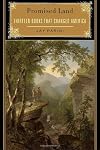
Promised Land: Thirteen Books That Changed America
by Jay Parini
On This Page
Description
From the Publisher: "These thirteen books must be seen as representative, not definitive, works. They are nodal points, places where vast areas of thought and feeling gathered and dispersed, creating a nation as various and vibrant as the United States, which must be considered one of the most successful nation-states in modern history, and a republic built firmly on ideas, which are contained in its major texts. Where we have been must, of course, determine where we are going. My hope is show more that this book helps to show us where we have been and engenders a lively conversation about our destination, which seems perpetually in dispute." Americans need periodic reminding that they are, to a great extent, people of the book-or, rather, books. In Promised Land, Jay Parini repossesses that vibrant, intellectual heritage by examining the life and times of thirteen "books that changed America." Each of the books has been a watershed, gathering intellectual currents already in motion and marking a turn in American life and thought. Their influence remains pervasive, however hidden, and in his essays Jay Parini demonstrates how these books entered American life and altered how we think and act in the world. The thirteen "books that changed America": Of Plymouth Plantation; The Federalist Papers; The Autobiography of Benjamin Franklin; The Journals of Lewis and Clark; Walden; Uncle Tom's Cabin; Adventures of Huckleberry Finn; The Souls of Black Folk; The Promised Land; How to Win Friends and Influence People; The Common Sense Book of Baby and Child Care; On the Road; The Feminine Mystique. Promised Land offers a reading of the American psyche, allowing us to reflect on what our past means for who we are now. It is a rich and immensely readable work of cultural history that will appeal to all book lovers and students of the American character alike. show lessTags
Recommendations









Member Reviews
Jay Parini is marvelous; he writes clearly, he's not afraid to be a bit irreverent, he can be funny, and his breadth of knowledge--historical and literary--is impressive. It doesn't hurt my appreciation of him to know that originally he came from the West Scranton neighborhoods I often drive through on my way to work. I believe I bought his novel, The Patch Boys, back in 1986 knowing nothing else about him, and not even really knowing exactly where "the patch" was located at the time. Where he shines for me these days is not in his poetry (fine though it is) or his fiction, but in his non-fiction, like his biography of Faulkner, and this insightful, highly readable and compelling examination of thirteen seminal works, from Of Plymouth show more Plantation and Ben Franklin's Autobiography to The Feminine Mystique and Dr. Spock's Common Sense Baby and Child Care, that helped create, shape and re-mold that peculiar entity we call America. Each book is treated to a preliminary discussion of its origins and context, a biographical sketch of its author, a more complete exploration of content, and a summation of its social or ideological impact on America at the time of its publication and going forward. Parini isn't just picking "great" books, but books with messages that were new, or startling, or just more clearly expressed than ever before, and he deals with their flaws as well as their strengths. I would go so far as to call his book essential reading for students of American history and literature. I got this book from the public library, and will definitely add it to my own permanent collection. It will be an invaluable resource as I read some of his top 13, (and some of the additional 100 influential books he mentions briefly in the appendix). show less
14 essays about important works published in 19th and 20th century United States, though one was written in and about the 17th century. The unexamined, though possibly correct, assumption is that the most influential books on the US would arise from within the US. Some of the essays, particularly the one about Adventures of Huckleberry Finn are paeans of love, while elements of distaste touch others, such as his cringing at the manipulative elements of How to Win Friends and Influence People although Parini almost celebrates Benjamin Franklin's frank wiliness, and some are a bit on the plodding descriptive side. Very readable, but not easy going, I was only moved to violent disagreement by his agreement with "Anxiety, as Friedan note, show more comes from the gap between yearning and fulfullment. Had anger or discontent been used instead of anxiety I would have passed over the statement, but I don't think that word means what they think it means - I don't think anxiety was a major problem for either Friedan or Parini despite they're having come into themselves in the "Age of Anxiety." show less
Parini has selected a baker’s dozen of books that significantly impacted U.S. history and culture, beginning with William Bradford’s Of Plymouth Plantation and concluding with Betty Friedan’s The Feminine Mystique. For each book, Parini provides a brief introduction, a biographical profile of the writer and the historical context of the book, a detailed description of the book, and a discussion of the book’s legacy. The appendix includes a list of 100 more books that didn’t make Parini’s top thirteen.
I heard my high school English teacher in this passage about the Adventure of Huckleberry Finn:
Huckleberry Finn is a book one reads in childhood for the adventure itself, the thrill of imagining a wild boy who runs away from show more home, lighting out for the territory. In young adulthood, the novel must be read again, for the questions it poses about the meaning of maturity, for the directions for living it offers. In middle age, the novel works magic in other ways, by dislodging us from our comfortable lives, offering alternative visions, including the vision of nature as a resource for rehabilitation. The hypocrisies of “civilized” life strike us freshly and force us to rethink our assumptions about what matters. In later life, it must be read again, for what it says about the ultimate nature of reality. A noel of this complexity and strength cannot be digested in a single reading or at one stage of life. It requires a lifelong devotion to its fluttering pages, to the shifting images of Huck and Jim in their encounters with the world in their experience of the big river and woods that sustain it, and with their own ample, contradictory natures. One rides the river with them, again and again, and the journey is never complete, as another bend in the river always appears. There is, indeed, the final lighting out for the territory, but this destination ultimately lies beyond human comprehension or confines, a glimmer on the horizon.
When I read The Adventure of Huckleberry Finn in high school, my English teacher told the class that we should reread it every five or ten years to see how much we’ve grown. Parini reminded me that it’s been too long since I’ve read Huck Finn, and that there are even more treasures to discover in the other books that have shaped America. show less
I heard my high school English teacher in this passage about the Adventure of Huckleberry Finn:
Huckleberry Finn is a book one reads in childhood for the adventure itself, the thrill of imagining a wild boy who runs away from show more home, lighting out for the territory. In young adulthood, the novel must be read again, for the questions it poses about the meaning of maturity, for the directions for living it offers. In middle age, the novel works magic in other ways, by dislodging us from our comfortable lives, offering alternative visions, including the vision of nature as a resource for rehabilitation. The hypocrisies of “civilized” life strike us freshly and force us to rethink our assumptions about what matters. In later life, it must be read again, for what it says about the ultimate nature of reality. A noel of this complexity and strength cannot be digested in a single reading or at one stage of life. It requires a lifelong devotion to its fluttering pages, to the shifting images of Huck and Jim in their encounters with the world in their experience of the big river and woods that sustain it, and with their own ample, contradictory natures. One rides the river with them, again and again, and the journey is never complete, as another bend in the river always appears. There is, indeed, the final lighting out for the territory, but this destination ultimately lies beyond human comprehension or confines, a glimmer on the horizon.
When I read The Adventure of Huckleberry Finn in high school, my English teacher told the class that we should reread it every five or ten years to see how much we’ve grown. Parini reminded me that it’s been too long since I’ve read Huck Finn, and that there are even more treasures to discover in the other books that have shaped America. show less
The book is a discussion and analysis of 13 books that the author argues changed America (i.e. what became the United States) in some way. The author picked out the thirteen books on the basis of how they illustrate the American character and the myths of the nation: values like self-reliance, self-invention, founding myths, race relations, so on.
The chapters have a very simple structure for each book presented in this work: an overview of the book; a look at the book's author or authors; description and summary of the work itself, and finally a statement on the book's influence over time with some mentions of other books that should be considered alongside the book being considered in a chapter. The book includes an appendix of 100 show more other books that the author considers important.
For me, the book was just ok. It is an academic tome, and I say that with the negative connotation that saying "academic tome" often carries: a dry book that is not very engaging to the casual reader. It reads a bit like a textbook. I can see this book being assigned in some American literature survey in college or a similar class. Also, I did not find as engaging because a lot of the stuff he was discussing I already knew about. I read a good number of the books he is discussing when I was in graduate school, so for me at least, I did not need to take the trip down memory lane again for things I had already discussed when I was in graduate school. However, if you are not familiar with the works described, and he does argue that the works should be read (or reread) once in a while to get a sense of the American myth and culture, this may be a book to pick up to at least get acquainted with things like The Federalist Papers or Uncle Tom's Cabin. show less
The chapters have a very simple structure for each book presented in this work: an overview of the book; a look at the book's author or authors; description and summary of the work itself, and finally a statement on the book's influence over time with some mentions of other books that should be considered alongside the book being considered in a chapter. The book includes an appendix of 100 show more other books that the author considers important.
For me, the book was just ok. It is an academic tome, and I say that with the negative connotation that saying "academic tome" often carries: a dry book that is not very engaging to the casual reader. It reads a bit like a textbook. I can see this book being assigned in some American literature survey in college or a similar class. Also, I did not find as engaging because a lot of the stuff he was discussing I already knew about. I read a good number of the books he is discussing when I was in graduate school, so for me at least, I did not need to take the trip down memory lane again for things I had already discussed when I was in graduate school. However, if you are not familiar with the works described, and he does argue that the works should be read (or reread) once in a while to get a sense of the American myth and culture, this may be a book to pick up to at least get acquainted with things like The Federalist Papers or Uncle Tom's Cabin. show less
I really enjoyed this book. It seems to read much faster than it really does because it moves along quickly. Parini's bias is a little more evident than it probably should be, and when it isn't, it's largely because he's acting as apologist for the books he's chosen (like Huck Finn, for instance) that are widely criticized by scholars on the left. It's well worth the read, if not so much for the literary criticism, then certainly for the cultural history. Certainly, there are lessons here pertinent to every American.
Since neither THIRTEEN BOOKS itself, nor the 100 more in the Appendix contain
TO KILL A MOCKINGBIRD,
but the latter DOES include that horrible piece of hate-filled Southern racist dung that reinforces stereotypes in every direction,
I gave up on Jay Parini.
TO KILL A MOCKINGBIRD,
but the latter DOES include that horrible piece of hate-filled Southern racist dung that reinforces stereotypes in every direction,
I gave up on Jay Parini.
This is an an excellent overview of books that, as the title says, "changed America." I recommend it to anyone who is interested in U. S. history and the ideas that helped to shape it.
Members
- Recently Added By
Lists

Books about Books
149 works; 23 members
Author Information

73+ Works 3,144 Members
Jay Parini was born in Pittston, Pennsylvania in 1948. In 1970 he graduated from Lafayette College and he received a doctorate from the University of St. Andrews in 1975. Before becoming a professor of Engliah and Creative Writing at Vermont's Middlebury College in 1982, Parini taught at Dartmouth College. Parini writes poetry, novels, show more biographies, and criticism, and he has published numerous reviews and essays in major journals and newspapers. He co-founded the New England Review in 1976. In 1995, he was appointed literary executor for author Gore Vidal. A film version of The Last Station, his 1990 novel, was released in 2009. Parini's novel, One Matchless Time: A Life of William Faulkner, made the New York Times bestseller list in 2015. (Bowker Author Biography) show less
Awards and Honors
Distinctions
Common Knowledge
- Original publication date
- 2008
- Blurbers
- Prose, Francine; Jong, Erica; Schroeder, Pat
- Disambiguation notice
- The thirteen books studied in this work:
Of Plymouth Plantation • The Federalist Papers • The Autobiography of Benjamin Franklin • The Journals of Lewis and Clark • Walden • Uncle Tom's Cabin • Adventures of H... (show all)uckleberry Finn • The Souls of Black Folk • The Promised Land • How to Win Friends and Influence People • The Common Sense Book of Baby and Child Care • On the Road • The Feminine Mystique
Classifications
- Genres
- Literature Studies and Criticism, Nonfiction, Fiction and Literature
- DDC/MDS
- 810.9 — Literature & rhetoric American literature in English American literature in English History and criticism of American literature
- LCC
- PS169 .N35 .P37 — Language and Literature American literature American literature Treatment of special subjects, classes
- BISAC
Statistics
- Members
- 246
- Popularity
- 131,524
- Reviews
- 9
- Rating
- (3.87)
- Languages
- English
- Media
- Paper, Ebook
- ISBNs
- 4
- ASINs
- 2