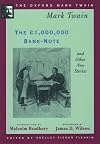
The £1,000,000 Bank Note and Other New Stories
by Mark Twain 
On This Page
Description
Arriving in London penniless, a young American uses his wits to turn the bet of two wealthy English gentlemen into the foundation of his own fortune.Tags
Recommendations
























Member Recommendations

Member Reviews
This book was originally published by Charles L. Webster and Company, which was owned by Twain and was an attempt to solve Twain's financial difficulties.
The title story is a gem, and deserves a much higher rating than I am giving to the book as a whole. The idea being a person with a single impossibly high value bank note and no other money being able to survive without ever having to pay for anything.
There second piece "Mental Telegraphy" - Telegraphy being what Twain calls Telepathy, is a piece where the reader can see Twain's interest in pseudo-science and provides some insight into the Man. However, it is not a humorous piece, nor does it offer much to the reader.
What really pulls the overall book down is the literary criticism show more piece "A Cure for the Blues" where Twain demolishes a very poorly written novella "The Enemy Conquered; Or, Love Triumphant" which quotes much too extensively from that novel, and so pads the piece extensively and while one can enjoy Twain's assessment of horrible writing between quotes, it is overly done.
The next piece is the full reprinting of "The Enemy Conquered; Or Love Triumphant", which the reader has already read much too much of, and again pads the book with writing which isn't even Twain. Between the critique and the Novella itself, over 30% of this book is taken up with very bad writing or a critique of very bad writing.
"About All Kinds of Ships" starts as a comparison of Twain's most recent experience on a luxury liner with what people endured a generation earlier. Stick with it though, as it does improve when he goes back to even earlier sea travel, before returning to the original tone.
"Playing Courier" is probably the second best piece in the book after the fantastic title piece, but there is considerable drop-off. That being said, if it were included with a better selection of writings it would still be a solid contributor.
"The German Chicago" is an essay about Berlin, and contains a rather forced comparison with Chicago. This piece doesn't have much to offer the reader.
"A Petition To The Queen of England" is a short, but humorous, piece where Twain puts forward the idea that he can treat royalty, including the Queen of England", in a familiar way in the discussion of taxes owed for his writing.
"A Majestic Literary Fossil" is Twain looking at science and is in some ways aligned with "Mental Telegraphy" as he looks at what he sees as the sciences of the time, in this case looking at the failures of people in using the scientific method.
When reading Mark Twain, the reader has come to expect excellence, and while they get it with the title piece and hints of it here and there in some of the other pieces, on the whole this collection doesn't hold up. show less
The title story is a gem, and deserves a much higher rating than I am giving to the book as a whole. The idea being a person with a single impossibly high value bank note and no other money being able to survive without ever having to pay for anything.
There second piece "Mental Telegraphy" - Telegraphy being what Twain calls Telepathy, is a piece where the reader can see Twain's interest in pseudo-science and provides some insight into the Man. However, it is not a humorous piece, nor does it offer much to the reader.
What really pulls the overall book down is the literary criticism show more piece "A Cure for the Blues" where Twain demolishes a very poorly written novella "The Enemy Conquered; Or, Love Triumphant" which quotes much too extensively from that novel, and so pads the piece extensively and while one can enjoy Twain's assessment of horrible writing between quotes, it is overly done.
The next piece is the full reprinting of "The Enemy Conquered; Or Love Triumphant", which the reader has already read much too much of, and again pads the book with writing which isn't even Twain. Between the critique and the Novella itself, over 30% of this book is taken up with very bad writing or a critique of very bad writing.
"About All Kinds of Ships" starts as a comparison of Twain's most recent experience on a luxury liner with what people endured a generation earlier. Stick with it though, as it does improve when he goes back to even earlier sea travel, before returning to the original tone.
"Playing Courier" is probably the second best piece in the book after the fantastic title piece, but there is considerable drop-off. That being said, if it were included with a better selection of writings it would still be a solid contributor.
"The German Chicago" is an essay about Berlin, and contains a rather forced comparison with Chicago. This piece doesn't have much to offer the reader.
"A Petition To The Queen of England" is a short, but humorous, piece where Twain puts forward the idea that he can treat royalty, including the Queen of England", in a familiar way in the discussion of taxes owed for his writing.
"A Majestic Literary Fossil" is Twain looking at science and is in some ways aligned with "Mental Telegraphy" as he looks at what he sees as the sciences of the time, in this case looking at the failures of people in using the scientific method.
When reading Mark Twain, the reader has come to expect excellence, and while they get it with the title piece and hints of it here and there in some of the other pieces, on the whole this collection doesn't hold up. show less
Amusing short story made into a good film starring Gregory Peck. All seems a bit irrelevant in the age of plastic money!
Overall a pretty amusing story and a solid part of Mark Twain's literary collection.
Almost fairy tale-esque. Not as wry as his normal fare.
...in assoluto il libro più ottimista della mia infanzia. Non vedevo l'ora di crescere per provare ad avere la stessa chance.
An excellent entertainer
Amusing film starring Gregory Peck, almost fairy tale-esque, not as wry as Mark Twain's normal fare. I say, though, doesn't all seem a bit irrelevant in the age of plastic money!?
Apr 3, 2025Portuguese (Brazil)
Members
- Recently Added By
Lists

Las mejores obras literarias leídas en 2023 -- Excelentes (R. D.)
21 works; 1 member
Author Information

2,746+ Works 208,371 Members
Mark Twain was born Samuel L. Clemens in Florida, Missouri on November 30, 1835. He worked as a printer, and then became a steamboat pilot. He traveled throughout the West, writing humorous sketches for newspapers. In 1865, he wrote the short story, The Celebrated Jumping Frog of Calaveras County, which was very well received. He then began a show more career as a humorous travel writer and lecturer, publishing The Innocents Abroad in 1869, Roughing It in 1872, and, Gilded Age in 1873, which was co-authored with Charles Dudley Warner. His best-known works are The Adventures of Tom Sawyer, Mississippi Writing: Life on the Mississippi, and The Adventures of Huckleberry Finn. He died of a heart attack on April 21, 1910. (Bowker Author Biography) show less
Mark Twain has a Legacy Library. Legacy libraries are the personal libraries of famous readers, entered by LibraryThing members from the Legacy Libraries group.
Some Editions
Series
Belongs to Publisher Series
Centopaginemillelire (112)
Work Relationships
Is contained in
Contains
Has the adaptation
Has as a student's study guide
Common Knowledge
- Canonical title
- The £1,000,000 Bank-Note and Other New Stories; The £1,000,000 Bank Note and Other New Stories
- Original title
- The Million Pound Bank Note
- Original publication date
- 1893
Classifications
Statistics
- Members
- 240
- Popularity
- 134,978
- Reviews
- 7
- Rating
- (3.64)
- Languages
- 11 — Catalan, Chinese, Czech, English, German, Greek, Hungarian, Italian, Romanian, Slovak, Spanish
- Media
- Paper, Ebook
- ISBNs
- 40
- ASINs
- 8