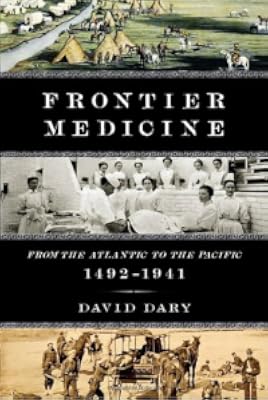
Frontier Medicine: From the Atlantic to the Pacific, 1492-1941
by David Dary
On This Page
Description
From the Publisher: In his new book, David Dary, one of our leading social historians, gives us a fascinating, informative account of American frontier medicine from our Indian past to the beginning of World War II, as the frontier moved steadily westward from the Atlantic coast to the Pacific Ocean. He begins with the early arrivals to our shores and explains how their combined European-taught medical skills and the Indians' well-developed knowledge of local herbal remedies and psychic show more healing formed the foundation of early American medicine. We then follow white settlement west, learning how, in the 1720s, seventy-five years before Edward Jenner's experiments with smallpox vaccine, a Boston doctor learned from an African slave how to vaccinate against the disease; how, in 1809, a backwoods Kentucky doctor performed the first successful abdominal surgery; how, around 1820, a Missouri doctor realized quinine could prevent as well as cure malaria and made a fortune from the resulting pills he invented. Using diaries, journals, newspapers, letters, advertisements, medical records, and pharmacological writings, Dary gives us firsthand accounts of Indian cures; the ingenious self-healings of mountain men; home remedies settlers carried across the plains; an early "HMO" formed by Wyoming ranchers and cowboys to provide themselves with medical care; the indispensable role of country doctors and midwives; the fortunes made from patent medicines and quack cures; the contributions of army medicine; Chinese herbalists; the formation of the American Medical Association; the first black doctors; the first women doctors; and finally the early-twentieth-century shift to a formal scientific approach to medicine that by the postwar period had for the most part eliminated the trial-and-error practical methods that were at the center of frontier medicine. A wonderful-often entertaining-overview of the complexity, energy, and inventiveness of the ways in which our forebears were doctored and how our medical system came into being. show lessTags
Recommendations

















Member Reviews
I had hoped that I might learn something from this book that would provide historical context for my family history. I thought I might find information about common illnesses, diseases, and epidemics that affected people living in frontier regions. Instead, I found a rather dull biographical survey of doctors in various eras and locations. The errors I was able to spot without specialized knowledge of the field (e.g., “omitted” used for “emitted”; a person referred to as “Roberts” and “Robertson” in the same paragraph) made me concerned that there might be factual errors that only a subject specialist would recognize. I did glean a few useful tidbits from the book, but not enough to recommend it to other readers.
Some good observations of medicine past and present and oogie descriptions of medical practices, but read too often like an outline.
In his new book, David Dary, one of our leading social historians, gives us a fascinating, informative account of American frontier medicine from our Indian past to the beginning of World War II, as the frontier moved steadily westward from the Atlantic coast to the Pacific Ocean.
He begins with the early arrivals to our shores and explains how their combined European-taught medical skills and the Indians’ well-developed knowledge of local herbal remedies and psychic healing formed the foundation of early American medicine.
We then follow white settlement west, learning how, in the 1720s, seventy-five years before Edward Jenner’s experiments with smallpox vaccine, a Boston doctor learned from an African slave how to vaccinate against show more the disease; how, in 1809, a backwoods Kentucky doctor performed the first successful abdominal surgery; how, around 1820, a Missouri doctor realized quinine could prevent as well as cure malaria and made a fortune from the resulting pills he invented.
Using diaries, journals, newspapers, letters, advertisements, medical records, and pharmacological writings, Dary gives us firsthand accounts of Indian cures; the ingenious self-healings of mountain men; home remedies settlers carried across the plains; an early “HMO” formed by Wyoming ranchers and cowboys to provide themselves with medical care; the indispensable role of country doctors and midwives; the fortunes made from patent medicines and quack cures; the contributions of army medicine; Chinese herbalists; the formation of the American Medical Association; the first black doctors; the first women doctors; and finally the early-twentieth-century shift to a formal scientific approach to medicine that by the postwar period had for the most part eliminated the trial-and-error practical methods that were at the center of frontier medicine.
A wonderful—often entertaining—overview of the complexity, energy, and inventiveness of the ways in which our forebears were doctored and how our medical system came into being. show less
He begins with the early arrivals to our shores and explains how their combined European-taught medical skills and the Indians’ well-developed knowledge of local herbal remedies and psychic healing formed the foundation of early American medicine.
We then follow white settlement west, learning how, in the 1720s, seventy-five years before Edward Jenner’s experiments with smallpox vaccine, a Boston doctor learned from an African slave how to vaccinate against show more the disease; how, in 1809, a backwoods Kentucky doctor performed the first successful abdominal surgery; how, around 1820, a Missouri doctor realized quinine could prevent as well as cure malaria and made a fortune from the resulting pills he invented.
Using diaries, journals, newspapers, letters, advertisements, medical records, and pharmacological writings, Dary gives us firsthand accounts of Indian cures; the ingenious self-healings of mountain men; home remedies settlers carried across the plains; an early “HMO” formed by Wyoming ranchers and cowboys to provide themselves with medical care; the indispensable role of country doctors and midwives; the fortunes made from patent medicines and quack cures; the contributions of army medicine; Chinese herbalists; the formation of the American Medical Association; the first black doctors; the first women doctors; and finally the early-twentieth-century shift to a formal scientific approach to medicine that by the postwar period had for the most part eliminated the trial-and-error practical methods that were at the center of frontier medicine.
A wonderful—often entertaining—overview of the complexity, energy, and inventiveness of the ways in which our forebears were doctored and how our medical system came into being. show less
Ratings
Members
- Recently Added By
Author Information

23+ Works 943 Members
David Dary is a writer, journalist, and social historian. Dary worked for newspapers in Kansas and Texas early on in his career and eventually moved on to work for both CBS and NBC news. He then took the position of professor at the William Allan White School of Journalism at the University of Kansas. The themes of Dary's books center on many show more aspects of life in the western United States. Dary has written Red Blood and Black Ink: Journalism in the Old West, Entrepreneurs of the Old West, and Seeking Pleasure in the Old West, which received a Western Writers of America Spur Award. He has also received a Cowboy Hall of Fame Wrangler Award and the Westerner's International Award for his book Cowboy Culture. (Bowker Author Biography) show less
Awards and Honors
Awards
Common Knowledge
- Important places
- USA
- Original language
- English
Classifications
Statistics
- Members
- 111
- Popularity
- 293,508
- Reviews
- 3
- Rating
- (2.64)
- Languages
- English
- Media
- Paper, Ebook
- ISBNs
- 3
- ASINs
- 1