On This Page
Description
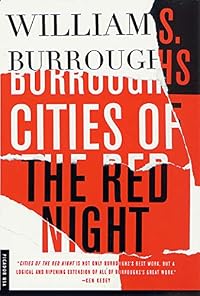
From one of the founders of the beat generation and the 1960s counterculture comes this opening novel of a series available now in audio for the first time. An opium addict is lost in the jungle; young men wage war against an empire of mutants; a handsome young pirate faces his execution; and the world's population is infected with a radioactive epidemic. These stories are woven together in a single tale of mayhem and chaos. In the first novel of the trilogy continued in The Place of Dead show more Roads and The Western Lands, William Burroughs sharply satirizes modern society in a poetic and shocking story of sex, drugs, disease, and adventure. show lessTags
Recommendations






Member Reviews
*Partial spoilers ahead*
Frustrating. After years of blah, increasingly half-hearted experimental novels and a relatively short (though brutal) period of writer's block, Burroughs almost staged a comeback with Cities of the Red Night. Almost, but not quite. The first half of the book is the most ambitious thing he ever wrote, and the array of characters and situations is very impressive; it's obvious that he was taking greater pains with the material, and found it interesting and engaging. There's a story here, and you actually want to turn the page and find out what happens next. (This is extremely rare in WSB's oeuvre; he was by nature a writer, yet not a natural storyteller.)
So why did Burroughs allow this extraordinarily promising show more beginning to go to hell in the book's second half? Why did he abandon the various threads of the plot to churn out 160-odd pages of dreary, Naked Lunch-style routines? (You know the stuff I mean: young red-haired boy bends over and farts righteous green flame, setting fire to a bunch of screaming Southern bigots as Doc Benway looks on and mutters, "Most interesting case indeed," etc. This goes on for page after page after page, almost as if Burroughs intended to confound the reader's expectations.) Did he find himself unable to write a coherent ending? Was he only trying to give his audience the obscenity-by-numbers that he thought they demanded? Your guess is as good as mine, but the unfulfilled potential of Cities drives me crazy. I do feel that it's worth reading for the excellent first half; just enter into it with the understanding that the whole thing collapses rather abruptly and never recovers.
Burroughs was mixing with a dark, dangerous crowd during the years that this novel was being written, and the influence of the Magickal Childe scene is evident in the subplot involving New York private eye Clem Snide and the supernatural forces he encounters while investigating a cult murder case. If memory serves, the macabre death of the Jerry Green character was based on a real-life incident briefly described in a book by English travel writer Bruce Chatwin, and which actually did occur on the Greek island of Spetses or Spetsai. That island was the setting for John Fowles's critically acclaimed The Magus, to which Burroughs makes direct reference in Cities of the Red Night. It's interesting to note that horror novelist Peter Straub, who likewise appears to have rubbed elbows with some frightening folk during this same period, based his bestselling Shadowland (published the year before Cities) on the Fowles novel. show less
Frustrating. After years of blah, increasingly half-hearted experimental novels and a relatively short (though brutal) period of writer's block, Burroughs almost staged a comeback with Cities of the Red Night. Almost, but not quite. The first half of the book is the most ambitious thing he ever wrote, and the array of characters and situations is very impressive; it's obvious that he was taking greater pains with the material, and found it interesting and engaging. There's a story here, and you actually want to turn the page and find out what happens next. (This is extremely rare in WSB's oeuvre; he was by nature a writer, yet not a natural storyteller.)
So why did Burroughs allow this extraordinarily promising show more beginning to go to hell in the book's second half? Why did he abandon the various threads of the plot to churn out 160-odd pages of dreary, Naked Lunch-style routines? (You know the stuff I mean: young red-haired boy bends over and farts righteous green flame, setting fire to a bunch of screaming Southern bigots as Doc Benway looks on and mutters, "Most interesting case indeed," etc. This goes on for page after page after page, almost as if Burroughs intended to confound the reader's expectations.) Did he find himself unable to write a coherent ending? Was he only trying to give his audience the obscenity-by-numbers that he thought they demanded? Your guess is as good as mine, but the unfulfilled potential of Cities drives me crazy. I do feel that it's worth reading for the excellent first half; just enter into it with the understanding that the whole thing collapses rather abruptly and never recovers.
Burroughs was mixing with a dark, dangerous crowd during the years that this novel was being written, and the influence of the Magickal Childe scene is evident in the subplot involving New York private eye Clem Snide and the supernatural forces he encounters while investigating a cult murder case. If memory serves, the macabre death of the Jerry Green character was based on a real-life incident briefly described in a book by English travel writer Bruce Chatwin, and which actually did occur on the Greek island of Spetses or Spetsai. That island was the setting for John Fowles's critically acclaimed The Magus, to which Burroughs makes direct reference in Cities of the Red Night. It's interesting to note that horror novelist Peter Straub, who likewise appears to have rubbed elbows with some frightening folk during this same period, based his bestselling Shadowland (published the year before Cities) on the Fowles novel. show less
Burroughs' best. Incendiary. Lunatic. Surreal. Anyone who doubts the man's intrinsic genius or associates him with cut-ups, dissing him as an "experimenter" should read the first thirty or forty pages of COTRN. This is the grand ol' mugwump at the top of his game...
Burroughs’ plot may be confusing with characters that morph into each other, but otherwise this book shines with wit and poetry disguised as filthy trash. One has only to imagine him reading the book aloud to get a glimpse of some genius.
The past decade or two, I've kept up with WSB more through various spoken word, audio collage, or similar projects (viz, Material's Seven Souls album) than from texts. I recognised several excerpts here, evidently WSB gave readings while the work was in progress, and perhaps afterward, as well. I'm confident this novel is my first encounter with Clem Snide, for example, though this character featured in various recordings I've heard. Notably, these early encounters help me focus on themes I might not have grasped on first reading: Virus-B23 and biowarfare, or the addictive dynamics of consumer capitalism.
Other themes I don't recall from audio work: piracy's Articles of Freedom in contrast with democratic republics; time travel and show more references to extraterrestrials on Earth; personality transplants. "I wonder what tyranny had led him to leave his native planet and take refuge under the Articles." [265]
Novel is structured in three Books: the first two each feature distinct sets of characters and timelines (modern day, 18th century), though suggestions of characters reappearing in different guises as though time traveling or reincarnating. The third is increasingly episodic, with dream logic and a cut-up grammar predominant. Novel ends without any plot resolution, and in fact it's unclear to me who is narrating in the final chapter.
At a couple points WSB alludes to the influence of six cities, armies fighting between them, and the impact of a black hole on Earth (suggesting to me the Black Hole of Calcutta). These Cities of the Red Night are linked to Hassan i Sabbah's notorious words: "Nothing is true. Everything is permitted." Does each city somehow embody a variation of Sabbah's meaning? Were it not for the title drawing attention to these references, it's likely I would not have noted them, fleeting as they were. show less
Other themes I don't recall from audio work: piracy's Articles of Freedom in contrast with democratic republics; time travel and show more references to extraterrestrials on Earth; personality transplants. "I wonder what tyranny had led him to leave his native planet and take refuge under the Articles." [265]
Novel is structured in three Books: the first two each feature distinct sets of characters and timelines (modern day, 18th century), though suggestions of characters reappearing in different guises as though time traveling or reincarnating. The third is increasingly episodic, with dream logic and a cut-up grammar predominant. Novel ends without any plot resolution, and in fact it's unclear to me who is narrating in the final chapter.
At a couple points WSB alludes to the influence of six cities, armies fighting between them, and the impact of a black hole on Earth (suggesting to me the Black Hole of Calcutta). These Cities of the Red Night are linked to Hassan i Sabbah's notorious words: "Nothing is true. Everything is permitted." Does each city somehow embody a variation of Sabbah's meaning? Were it not for the title drawing attention to these references, it's likely I would not have noted them, fleeting as they were. show less
Ο πειρατής του 16ου αιώνα Κάπταιν Μίσιον, σχεδόν έναν αιώνα πριν από τη Γαλλική και την Αμερικανική Επανάσταση, διακήρυξε την πλήρη ισότητα, την κατάργηση της δουλείας, των βασανιστηρίων και της θανατικής ποινής, την ελευθερία του θρησκεύματος και το τέλος κάθε τυραννίας. Ίδρυσε στις ακτές της Μαγαδασκάρης μια αποικία, τη Λιμπερτάτια, αλλά ιθαγενείς υποκινούμενοι από Άγγλους πράκτορες την κατέστρεψαν και show more ο Κάπταιν Μίσιον σκοτώθηκε. «Η ευκαιρία υπήρχε, η ευκαιρία χάθηκε». Αλλά τι θα γινόταν αν ο Κάπταιν Μίσιον είχε επιζήσει; show less
Burroughs can introduce himself:
"The usual costume is boots and chaps, bare ass and crotch. Some have tight-fitting chamois pants up to midthigh and shirts that come to the navel. Many are naked except for boots, gun belts, and hang-noose scarves. Nooses dangle every ten feet from a beam down the center of the room."
"Streaks of phosphorescent shit, a smell like rotten solder, burning shivering sick, he needs the Blue Stuff. Dry blue crystals of snow on the floor stir in an eddy of wind and a crystal spark boy takes shape, naked, radiant, his long needle fingertips dripping the deadly Joy Juice, bright red hair floating about his head, disk eyes flashing erogenous luminescence, his erect phallus smooth as seashell with a tip of pink show more crystal, he is like some dazzlingly beautiful undersea creature dripping deadly venom."
"Cities of the Red Night" is perpetually climaxing. Whereas, for other authors, it might prove a diverting or comical (unwritten) pastime to imagine what it might be like if all of their characters--from every time and space--were to meet over drinks, Burroughs can't seem to resist transporting his entire cast into hallucinatory, ritualistic, gay bacchanals, frequently spiced up with hangings or gun play and always featuring copious technicolor (and sometimes poisonous) ejaculations. During and in between these sensory explosions, his sex-ready, fringe-inhabiting adolescents wage war against the establishments that Burroughs doesn't like, for instance, the church, imperial forces and women.
The stories that drive the first two "books" of this novel are both gripping (and comparatively light on the orgies). A detective involves himself more and more deeply in the globe-trotting hunt for a missing rich boy and a trio of young men join a collective of revolutionaries in Central America who are fighting in the name of freedom (sexual and otherwise) to expel Spain and the Catholic church from the hemisphere.
Burroughs' prose is totally appropriate to the tough guy detective and the military strategizing of his commundards. But then, in book three, from which the novel takes its name, drugs start writing the book, which shifts into a world of five (entirely fictional) dueling cities. The anchors of the first 243 pages come loose and swirl around with fever victims, imaginary drugs, vendettas, hangings and sodomy. For a Burroughs purist, this might be quite satisfactory, since his dissociative methods and provocative subject matter trump representative story-telling. But, I was let down and disengaged.
Still, this was worth the read for the simple fact that Burroughs pulled together more than 200 consecutive pages of relatively logical and linear prose and he is a skillful, imaginative writer with an entirely decadent sense of humor. For anyone who wishes to continue from where this book leaves off, "The Place of Dead Roads" offers a sequel in the same vein that is not at all disappointing. show less
"The usual costume is boots and chaps, bare ass and crotch. Some have tight-fitting chamois pants up to midthigh and shirts that come to the navel. Many are naked except for boots, gun belts, and hang-noose scarves. Nooses dangle every ten feet from a beam down the center of the room."
"Streaks of phosphorescent shit, a smell like rotten solder, burning shivering sick, he needs the Blue Stuff. Dry blue crystals of snow on the floor stir in an eddy of wind and a crystal spark boy takes shape, naked, radiant, his long needle fingertips dripping the deadly Joy Juice, bright red hair floating about his head, disk eyes flashing erogenous luminescence, his erect phallus smooth as seashell with a tip of pink show more crystal, he is like some dazzlingly beautiful undersea creature dripping deadly venom."
"Cities of the Red Night" is perpetually climaxing. Whereas, for other authors, it might prove a diverting or comical (unwritten) pastime to imagine what it might be like if all of their characters--from every time and space--were to meet over drinks, Burroughs can't seem to resist transporting his entire cast into hallucinatory, ritualistic, gay bacchanals, frequently spiced up with hangings or gun play and always featuring copious technicolor (and sometimes poisonous) ejaculations. During and in between these sensory explosions, his sex-ready, fringe-inhabiting adolescents wage war against the establishments that Burroughs doesn't like, for instance, the church, imperial forces and women.
The stories that drive the first two "books" of this novel are both gripping (and comparatively light on the orgies). A detective involves himself more and more deeply in the globe-trotting hunt for a missing rich boy and a trio of young men join a collective of revolutionaries in Central America who are fighting in the name of freedom (sexual and otherwise) to expel Spain and the Catholic church from the hemisphere.
Burroughs' prose is totally appropriate to the tough guy detective and the military strategizing of his commundards. But then, in book three, from which the novel takes its name, drugs start writing the book, which shifts into a world of five (entirely fictional) dueling cities. The anchors of the first 243 pages come loose and swirl around with fever victims, imaginary drugs, vendettas, hangings and sodomy. For a Burroughs purist, this might be quite satisfactory, since his dissociative methods and provocative subject matter trump representative story-telling. But, I was let down and disengaged.
Still, this was worth the read for the simple fact that Burroughs pulled together more than 200 consecutive pages of relatively logical and linear prose and he is a skillful, imaginative writer with an entirely decadent sense of humor. For anyone who wishes to continue from where this book leaves off, "The Place of Dead Roads" offers a sequel in the same vein that is not at all disappointing. show less
Just when a feller might've thought Burroughs didn't have it in him anymore, he comes out w/ a western trilogy that's refreshing by virtue of its less radical style & more substantial narative linearity. This is maybe the closest to Pynchon Burroughs ever came. Never underestimate the man. May I be as sharp as this as I rot.
Members
- Recently Added By
Lists

1001 Books You Must Read Before You Die
1,448 works; 1,132 members

Novels from The Guardian's Great American Novelist Tournament
148 works; 24 members

A Rainbow of Books: Colors in the Title
570 works; 24 members

David Pringle's Modern Fantasy: The 100 Best Novels
100 works; 5 members
Author Information

361+ Works 38,921 Members
William S. Burroughs was a primary figure of the Beat Generation who wrote in the postmodern paranoid fiction genre. Jack Kerouac called Burroughs the "greatest satirical writer since Jonathan Swift," while Norman Mailer declared him "the only American writer who may be conceivably possessed by genius." While he is best known for the novels Naked show more Lunch, Queer, and Junkie, he also collaborated with artists such as Laurie Anderson, Tom Waits, Nick Cave, Gus Van Sant, David Cronen-berg, and Sonic Youth to produce films, music, and performance pieces. show less
Some Editions
Awards and Honors
Notable Lists
Series

Common Knowledge
- Canonical title*
- Steden van de rode nacht
- Original title
- Cities of the Red Night
- Original publication date
- 1981
- People/Characters
- Clem Williamson Snide; Noah Blake; Juan Cocuera de Fuentes; María Cocuera de Fuentes; Adam North; Arn West (show all 28); Bert Hansen; Dink Rivers; Clinch Todd; Opium Jones; Hassan i Sabbah; Marty Blum; Howard Benson; Lola La Chata; Bernabé Aboyado; Countess Minsky Stahlinhof de Gulpa; Countess de Vile; Cupid Mount Etna; Rubble Blood Pu; Krup von Nordenholz; Jimmy Lee; Jerry Lee; John Everson; Steve Ellisor; Guy Star; Audrey Carsons; John Alastair Peterson; Nimun
- Blurbers
- Kesey, Ken; Isherwood, Christopher; Williams, Heathcote; Ackroyd, Peter; Herr, Michael
*Some information comes from Common Knowledge in other languages. Click "Edit" for more information.
Classifications
Statistics
- Members
- 1,572
- Popularity
- 14,441
- Reviews
- 16
- Rating
- (3.77)
- Languages
- 14 — Dutch, English, Finnish, French, German, Greek, Hungarian, Italian, Japanese, Russian, Serbian, Spanish, Swedish, Portuguese (Portugal)
- Media
- Paper, Audiobook, Ebook
- ISBNs
- 45
- ASINs
- 14