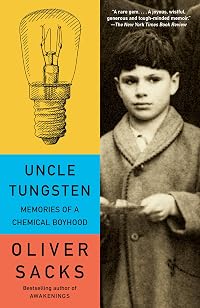
Uncle Tungsten: Memories of a Chemical Boyhood
by Oliver Sacks
On This Page
Description
Long before Oliver Sacks became a distinguished neurologist and bestselling writer, he was a small English boy fascinated by metals-also by chemical reactions (the louder and smellier the better), photography, squids and cuttlefish, H.G. Wells, and the periodic table. In this endlessly charming and eloquent memoir, the author chronicles his love affair with science and the magnificently odd and sometimes harrowing childhood in which that love affair unfolded. In Uncle Tungsten we meet Sacks' show more extraordinary family, from his surgeon mother, who introduces the fourteen-year-old Oliver to the art of human dissection, and his father, a family doctor who imbues in his son an early enthusiasm for housecalls, to his "Uncle Tungsten," whose factory produces tungsten-filament light bulbs. We follow the young Oliver as he is exiled at the age of six to a grim, sadistic boarding school to escape the London Blitz, and later watch as he sets about passionately reliving the exploits of his chemical heroes, in his own home laboratory. Uncle Tungsten is a crystalline view of a brilliant young mind springing to life, a story of growing up which is by turns elegiac, comic, and wistful, full of the electrifying joy of discovery. show lessTags
Recommendations




Member Recommendations
Member Reviews
You might have been a precocious child in your day, but you probably weren't as precocious as Oliver Sacks, whose interest in -- and talent for -- science seems to have manifested itself shortly after he learned to talk. This book is two things: a personal history of an obsession with all things metallic and chemical and a clever, informative, and superbly well-written account of the history of science as told through one British child's home-brewed education. These are both unlikely subjects, so I doubt that "Uncle Tungsten" will be to everyone's taste, but scientific near-illiterates -- like myself -- may find this highly personalized guided tour around the history of science and the periodic table rather charming. Young Sacks's own show more scientific explorations seem to have closely followed the development of scientific thought itself: to hear him tell it, he raised himself on Victorian-era scientific texts. Whether this was the result of coincidence or some subtle manipulations by his family, many of whose members were also deeply invested in the sciences, is never quite clear. But it, in any event, it makes for a good read. Sacks is particularly good at explaining how each successive refinement of atomic theory or the periodic table transformed our view of the universe. I knew a bit about the evolution of the atomic model, but Sacks explains very clearly why each advance was so shocking and so important to the scientists of that day. While it's obvious that he relishes remembering his happy, active childhood, he also wants us to see the big picture.
It's perhaps inevitable that "Uncle Tungsten" would have something of a nostalgic air, and I found this pretty agreeable. Sacks lovingly describes his parents, aunts, and uncles and fondly recounts their own scientific interests and contributions. Surprisingly, Unlikely as it may seem, Uncle Tungsten wasn't the author's only relative who had a lifelong obsession with a metal or compound. This book reads like a tribute to his large and loving family, whose guiding values seem to have been education and curiosity. It's also an elegy for a lost boyhood community, one in which science brought together and provided a sort of safe haven for all manner of misfits and odd ducks, kids who could be expected to be bullied mercilessly in most boarding-school environments. As a child, Sacks was as much a collector as an experimenter, building up a large collection of all sorts of scientific materials. He laments that most of the houses that sold these raw materials for scientific play have since disappeared. It's sometimes a bit alarming to read about Sack's adventures with potentially explosive chemicals, conducted mostly while he was still in short pants, but it made me question what we've lost now that, these days, of nerdy kids often get into computer games, or programming, or less explicitly physical kinds of intellectual play. "Uncle Tungsten" isn't quite what I expected, and it's an odd amalgam of personal and scientific history, but I'm still glad I picked it up. show less
It's perhaps inevitable that "Uncle Tungsten" would have something of a nostalgic air, and I found this pretty agreeable. Sacks lovingly describes his parents, aunts, and uncles and fondly recounts their own scientific interests and contributions. Surprisingly, Unlikely as it may seem, Uncle Tungsten wasn't the author's only relative who had a lifelong obsession with a metal or compound. This book reads like a tribute to his large and loving family, whose guiding values seem to have been education and curiosity. It's also an elegy for a lost boyhood community, one in which science brought together and provided a sort of safe haven for all manner of misfits and odd ducks, kids who could be expected to be bullied mercilessly in most boarding-school environments. As a child, Sacks was as much a collector as an experimenter, building up a large collection of all sorts of scientific materials. He laments that most of the houses that sold these raw materials for scientific play have since disappeared. It's sometimes a bit alarming to read about Sack's adventures with potentially explosive chemicals, conducted mostly while he was still in short pants, but it made me question what we've lost now that, these days, of nerdy kids often get into computer games, or programming, or less explicitly physical kinds of intellectual play. "Uncle Tungsten" isn't quite what I expected, and it's an odd amalgam of personal and scientific history, but I'm still glad I picked it up. show less
Summary: A memoir of Sacks boyhood and his explorations of chemistry encouraged by an uncle who used tungsten to manufacture incandescent bulbs.
I’ve enjoyed several of Oliver Sacks books recounting various neurological conditions and the workings of the human brain. I had not been aware of this book until receiving it as a gift. Sacks employs his gifts in telling the story of his childhood, and particularly his fascination with chemistry. In some ways, it came with the territory. His parents were both doctors, who saw patients at their home or permitted Oliver to come on house calls his father would make.
From childhood, Sacks was fascinated with metals and other substances, their color, their weight, how they responded to heating, to show more being combined with other chemicals. This fascination was fed by by his “Uncle Tungsten” a.k.a Uncle Dave. He was called Uncle Tungsten not only because he made incandescent lamps using tungsten wire, but because he was truly enamored of tungsten, thinking it quite a wonderful metal. He shared this wonder with young Oliver, as well as showing him other metals including aluminum and what happened when you applied mercury to its surface.
Eventually Uncle Tungsten showed him how to set up his own lab bench with the apparatus he needed and how to use it safely. Inevitably there were “stinks and bangs” including an episode with a cuttlefish that made a dwelling uninhabitable for a time. The story is one of curious, self-directed learning that studied spectra, chemical reactions, and families of elements. His discovery of the periodic table, Mendeleev’s Garden, helped make sense of why certain elements were similar in character to others, and even helped predict the character of elements yet to be discovered.
Perhaps the most fascinating chapters were those on “cold” light–fluorescent and phosphorescent elements–and that on X-rays and how they were produced. Here it was Uncle Abe who exposed him to things like radium, at a time when people were only beginning to understand the detrimental effects of radiation on the human body. He speaks of viewing a grain of radium through a spinthariscope and the “shooting stars” he saw through the eyepiece. One wonders if there was any connection between these youthful explorations and the ocular melanoma that resulted in Sacks death.
Sacks did not take up a career in chemistry, obviously. But in this memoir we see the curiosity that fueled his neurological research, his quest to understand how things worked. What a wonderful thing that there were adults in his life who nurtured that curiosity while allowing him the space to pursue self-directed learning. He was a “researcher” long before he became a researcher. And this led to the wonder beyond laws and equations and tables to memorize, the wonder of color, of order, of chemical reactions, and so much more. For Sacks, science became a matter of wonder and wondering.
In our own era of mistrust of science, one wonders if we’ve missed something in science education. What if, instead of mistrust of “authorities” we worked to foster curiosity and wonder? What if, instead of making pronouncements, we worked to foster curiosity? What if instead of endless encouragements of vaccines and masks, we invited curiosity about how COVID is so cussedly good at infecting its human hosts and what happens in the body when it does?
I don’t know if that would change any of our discussions, but I do wonder if a healthy dose of curiosity and wonder, like that which characterized Oliver Sacks “chemical boyhood,” might do us all a bit of good. show less
I’ve enjoyed several of Oliver Sacks books recounting various neurological conditions and the workings of the human brain. I had not been aware of this book until receiving it as a gift. Sacks employs his gifts in telling the story of his childhood, and particularly his fascination with chemistry. In some ways, it came with the territory. His parents were both doctors, who saw patients at their home or permitted Oliver to come on house calls his father would make.
From childhood, Sacks was fascinated with metals and other substances, their color, their weight, how they responded to heating, to show more being combined with other chemicals. This fascination was fed by by his “Uncle Tungsten” a.k.a Uncle Dave. He was called Uncle Tungsten not only because he made incandescent lamps using tungsten wire, but because he was truly enamored of tungsten, thinking it quite a wonderful metal. He shared this wonder with young Oliver, as well as showing him other metals including aluminum and what happened when you applied mercury to its surface.
Eventually Uncle Tungsten showed him how to set up his own lab bench with the apparatus he needed and how to use it safely. Inevitably there were “stinks and bangs” including an episode with a cuttlefish that made a dwelling uninhabitable for a time. The story is one of curious, self-directed learning that studied spectra, chemical reactions, and families of elements. His discovery of the periodic table, Mendeleev’s Garden, helped make sense of why certain elements were similar in character to others, and even helped predict the character of elements yet to be discovered.
Perhaps the most fascinating chapters were those on “cold” light–fluorescent and phosphorescent elements–and that on X-rays and how they were produced. Here it was Uncle Abe who exposed him to things like radium, at a time when people were only beginning to understand the detrimental effects of radiation on the human body. He speaks of viewing a grain of radium through a spinthariscope and the “shooting stars” he saw through the eyepiece. One wonders if there was any connection between these youthful explorations and the ocular melanoma that resulted in Sacks death.
Sacks did not take up a career in chemistry, obviously. But in this memoir we see the curiosity that fueled his neurological research, his quest to understand how things worked. What a wonderful thing that there were adults in his life who nurtured that curiosity while allowing him the space to pursue self-directed learning. He was a “researcher” long before he became a researcher. And this led to the wonder beyond laws and equations and tables to memorize, the wonder of color, of order, of chemical reactions, and so much more. For Sacks, science became a matter of wonder and wondering.
In our own era of mistrust of science, one wonders if we’ve missed something in science education. What if, instead of mistrust of “authorities” we worked to foster curiosity and wonder? What if, instead of making pronouncements, we worked to foster curiosity? What if instead of endless encouragements of vaccines and masks, we invited curiosity about how COVID is so cussedly good at infecting its human hosts and what happens in the body when it does?
I don’t know if that would change any of our discussions, but I do wonder if a healthy dose of curiosity and wonder, like that which characterized Oliver Sacks “chemical boyhood,” might do us all a bit of good. show less
Well written. My surprise was this was actually mostly a book concerning the history of chemistry, and not so much a biography of Oliver Wolf Sacks. It only covers his childhood briefly. I guess I should have looked at the index instead of the blurb to be forewarned. I was pleased to learn that Sacks was influenced by H G Wells's stories, and surprised Sacks' Monopoly board had a purple-coloured Old Kent Road. I enjoyed picturing his Radium clock, and Spinthariscope "toy". Some of the chemicals his played with in his home lab were quite something!
Took me a lot longer to read than I expected, mostly because each chapter contained some fascinating bit of science history or some phenomena that I would then spend time researching to learn more about. Sacks had an incredible childhood, but I was mostly there for the science, so for me the stories of his life were a means to an end. Definitely recommended for anyone who loves the physical sciences, but it may be too slow moving for those who don't.
After reading this book, I'm still not sure if it was intended as a memoire, or as a brief history of chemistry. The author gives us glimpses of his family life, especially the role his mother and uncles played in encouraging his love of chemistry. He spends a lot more time talking about chemistry and scientific discoveries, which was less interesting to me.
I found the book rather sad at the end. All the love of chemistry that permeated Oliver Sacks' life was repressed when he reached adolescence as it was expected he would become a doctor. Which he did -- and where he has made a large difference to many lives. But what would have happened had he followed his heart?
I found the book rather sad at the end. All the love of chemistry that permeated Oliver Sacks' life was repressed when he reached adolescence as it was expected he would become a doctor. Which he did -- and where he has made a large difference to many lives. But what would have happened had he followed his heart?
Wonderfully engaging memoir. Sacks’s conveys with deceptive simplicity and clarity the wonders of chemistry and the excitement (and the history of the last couple of centuries, no mean feat to do this so clearly and concisely!) of scientific discovery, as well as his joyous inquisitiveness as a child and his excitement at discovering this world of science. At the same time, it’s sad to read about the abuse and isolation he and his brother endured at the school they were sent to during WW2.
Typical of his generous, positive view is that even these sad times (like his brother’s eventual mental illness, and his parents’ unawareness of his own suffering at the horrible school and their inexplicably thoughtless, even insensitive, show more behavior, and his own anxieties and isolation) never sound regretful or self-centeredly whiny, though he describes them forthrightly. He’s generous and direct and loving in his description of his passions, as well as his depiction of his enormously engaging, supportive and remarkable family. It’s refreshing to read a personal account that is not tortured or blaming. show less
Typical of his generous, positive view is that even these sad times (like his brother’s eventual mental illness, and his parents’ unawareness of his own suffering at the horrible school and their inexplicably thoughtless, even insensitive, show more behavior, and his own anxieties and isolation) never sound regretful or self-centeredly whiny, though he describes them forthrightly. He’s generous and direct and loving in his description of his passions, as well as his depiction of his enormously engaging, supportive and remarkable family. It’s refreshing to read a personal account that is not tortured or blaming. show less
This is an unusual sort of memoir. Sacks' family was extensive and largely of a technical turn of mind. Both parents were doctors, his aunts and uncles included a lightbulb manufacturer and a biologist. And so he becomes interested in chemistry almost as a result of being surrounded by it. Uncle Dave, the lightbulb manufacturer, had samples of all sorts of filament materials and so he introduces the young Oliver to metals, their origins, their ores and their properties. From here is a brief step to general chemistry. His parents let him set up a chemistry lab in a spare room on the back of the house and from this report its a wonder that any of them made it out alive!
There is quite a lot of the history of science in here, the move from show more alchemy to chemistry, the development of the periodic table, the discoveries of different elements and the structure of the atom. There is a lot less about Sacks' childhood. It is almost mentioned in passing along side the shifting interest in all things chemical. He describes his school being evacuated during the first art of the war and the dreadful experience he had there, but it barely makes more than a paragraph. His brother's response to the school and the impact on him mental health is hardly more than a couple of lines. Which makes for an odd read, if I'm honest. It's not a memoir of childhood, more a memoir of an interest in chemistry. As a scientist myself, I knew (or once knew) most of the technical detail in here. In which case, for me, it was more a refresher and reminder of what makes science so enthralling. I'm not sure what the non-technical reader would make of it. show less
There is quite a lot of the history of science in here, the move from show more alchemy to chemistry, the development of the periodic table, the discoveries of different elements and the structure of the atom. There is a lot less about Sacks' childhood. It is almost mentioned in passing along side the shifting interest in all things chemical. He describes his school being evacuated during the first art of the war and the dreadful experience he had there, but it barely makes more than a paragraph. His brother's response to the school and the impact on him mental health is hardly more than a couple of lines. Which makes for an odd read, if I'm honest. It's not a memoir of childhood, more a memoir of an interest in chemistry. As a scientist myself, I knew (or once knew) most of the technical detail in here. In which case, for me, it was more a refresher and reminder of what makes science so enthralling. I'm not sure what the non-technical reader would make of it. show less
Members
- Recently Added By
Published Reviews
ThingScore 92
Romantic chemistry sounds like a contradiction in terms, but the two words pair naturally in this book.
added by Katya0133
When Mr. Sacks departs from the narrative of his childhood to serve up lengthy digressions on the finer points of rare earth metals or electromagnetic reactions, his writing can lapse into textbook lecturing, but even these dense, scientific passages are enlivened by his boyish wonder at the amazing logic and strangeness of the world.
added by Katya0133
Thus this is both the story of a particular English boy's life just before, during, and after World War II and a maximally engaging, personalized overview of chemistry, from Robert Boyle to Madame Curie.
added by Katya0133
Lists

Best Biographies, Autobiographies and Memoirs
465 works; 160 members

Chemistry
53 works; 3 members

The r/Chemistry Recommended Books
87 works; 1 member

John Carey's Sunday Best
82 works; 3 members
Author Information

68+ Works 43,761 Members
Oliver Sacks was born in London, England on July 9, 1933. He received a medical degree from Queen's College, Oxford University and performed his internship at Middlesex Hospital in London and Mount Zion Hospital in San Francisco. He completed his residency at UCLA. In 1965, he became a clinical neurologist to the Little Sisters of the Poor and show more Beth Abraham Hospital. His work in a Bronx charity hospital led him to write the book Awakenings in 1973. The book inspired a play by Harold Pinter and became a film starring Robert De Niro and Robin Williams. His other works included An Anthropologist on Mars, The Mind's Eye, The Man Who Mistook His Wife for a Hat, Uncle Tungsten, Musicophilia, A Leg to Stand On, On the Move: A Life, and Gratitude. In 2007, he ended his 42-year relationship with the Albert Einstein College of Medicine to accept an interdisciplinary teaching position at Columbia. In 2012, he returned to the New York University School of Medicine as a professor of neurology. He died of cancer on August 30, 2015 at the age of 82. (Bowker Author Biography) show less
Some Editions
Awards and Honors
Awards
Work Relationships
Is abridged in
Has as a commentary on the text
Common Knowledge
- Canonical title*
- Volframin hehku : muistoja kemiallisesta lapsuudestani
- Original title
- Uncle Tungsten. Memories of a Chemical Childhood
- Original publication date
- 2001
- People/Characters
- Oliver Sacks
- Important places
- London, England, UK
- Important events
- Wartime evacuation of children from London (1939-1943); World War II, British Home Front; The Blitz
- Dedication
- for Roald
- First words
- Many of my childhood memories are of metals: these seemed to exert a power on me from the start.
- Quotations
- He loved doing housecalls more than anything else, for they were social and sociable as well as medical, would allow him to enter a family and home, get to know everybody and their circumstances, see the whole complexion and ... (show all)context of a condition. Medicine, for him, was never just diagnosing a disease, but had to be seen and understood in the context of patients' lives, the particularities of their personalities, their feelings, their reactions.
- Last words
- (Click to show. Warning: May contain spoilers.)But my favorite dream is of going to the opera (I am Hafnium), sharing a box at the Met with the other heavy transition metals - my old and valued friends - Tantalum, Rhenium, Osmium, Iridium, Platinum, Gold and Tungsten.
- Publisher's editor
- Frank, Dan
- Blurbers
- Greene, Brian; Gould, Stephen Jay; Gleick, James; Theroux, Paul
- Original language
- English
*Some information comes from Common Knowledge in other languages. Click "Edit" for more information.
Classifications
- Genres
- Biography & Memoir, Science & Nature, Nonfiction, General Nonfiction
- DDC/MDS
- 616.8092 — Applied science & technology Medicine & health Diseases, Allergies, Skin Conditions Nervous Disorders: Autism, Anorexia, OCD
- LCC
- RC339.52 .S23 .A3 — Medicine Internal medicine Internal medicine Neurosciences. Biological psychiatry. Neuropsychiatry
- BISAC
Statistics
- Members
- 2,429
- Popularity
- 8,074
- Reviews
- 58
- Rating
- (3.97)
- Languages
- 13 — Dutch, English, Finnish, French, German, Italian, Japanese, Norwegian (Bokmål), Romanian, Spanish, Swedish, Turkish, Portuguese (Portugal)
- Media
- Paper, Audiobook, Ebook
- ISBNs
- 47
- ASINs
- 17