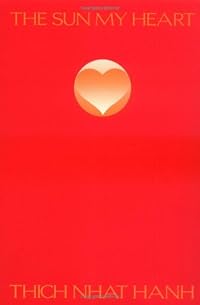
The Sun My Heart
by Thich Nhat Hanh
On This Page
Description
The sequel to the bestselling Miracle of Mindfulness. A "friend rather than a book," The Sun My Heart is a true spiritual classic with wisdom for any situation. One of Thich Nhat Hanh's most beloved books, The Sun My Heart contains the journey, on the path of everyday practice, from mindfulness to insight. Using the objects and events of everyday life in his hermitage in Plum Village-the gradual settling of the pulp in a glass of apple juice or the wind blowing into the room and scattering show more papers about-Thich Nhat Hanh draws from Buddhist psychology, epistemology, and the world of contemporary literature and science to guide the reader along the path of clarity and understanding. A companion guide for meditators, The Sun My Heart contains many of Thich Nhat Hanh's core teachings, and encourages readers to use their practice to discover their own insights. As he writes: "Wisdom is a living stream, not an icon to be preserved in a museum.". show lessTags
Recommendations











Member Reviews
With chapters like “Sunshine and Green Leaves” and “Look Deeply At Your Hand”, this book might invite mockery and not be for everyone, but there are real words of wisdom from Zen master Thich Nhat Hanh here, told in a simple, accessible, compassionate style.
Quotes:
On appreciating life:
“We do not have to be swept along by circumstances. We are not just a leaf or a log in a rushing river. With awareness, each of our daily acts takes on a new meaning, and we discover that we are more than machines, that our activities are not just mindless repetitions. We find that life is a miracle, the universe is a miracle, and we too are a miracle.”
“Around us, life bursts forth with miracles – a glass of water, a ray of sunshine, a show more leaf, a caterpillar, a flower, laughter, raindrops. If you live in awareness, it is easy to see miracles everywhere. Each human being is a multiplicity of miracles. Eyes that see thousands of colors, shapes, and forms; ears that hear a bee flying or a thunderclap; a brain that ponders a speck of dust as easily as the entire cosmos; a heart that beats in rhythm with heartbeat of all things. When we are tired and feel discouraged by life’s daily struggles, we may not notice these miracles, but they are always there.”
On knowledge:
“Understanding is not an accumulation of knowledge. To the contrary, it is the result of the struggle to become free of knowledge.”
“We must not regard ‘knowing’ as something from the outside which comes to breathe life into the universe. It is the life of the universe itself. The dance and the dancer are one.”
On oneness:
“We can say, ‘Wind,’ and that is enough. The presence of wind indicates the presence of knowing, and the presence of the action of blowing. If we reduce the sentence ‘I know the wind is blowing’ to simply ‘Wind,’ we can avoid grammatical mistakes and approach reality. In daily life, we have grown used to a way of thinking and expressing ourselves that is based on the idea that everything is independent of everything else. This way of thinking and speaking makes it difficult to penetrate non-dualistic, non-discriminatory reality, a reality which cannot be contained in concepts.”
“Continue practicing until you see yourself in the most cruel and inhumane political leader, in the most devastatingly tortured political prisoner, in the wealthiest man, and in the child starving, all skin and bones. Practice until you recognize your presence in everyone else on the bus, in the subway, in the concentration camp, working in the fields, in a leaf, in a caterpillar, in a dew drop, in a ray of sunshine. Meditate until you see yourself in a speck of dust and in the most distant galaxy.”
On peace:
“Our world does not lack people willing to throw themselves into action. What we need are people who are capable of loving, of not taking sides so that they can embrace the whole of reality as a mother hen embraces all her chicks, with two fully spread wings.”
On truth:
“The sword of conceptual thinking only cuts truth into small, lifeless pieces all seemingly independent of each other.”
“Our mind creates categories – space and time, above and below, inside and outside, myself and others, cause and effect, birth and death, one and many – and puts all physical and psychological phenomena into categories like these before examining them and trying to find their true nature. It is like filling many different shapes and sizes of bottles with water in order to find out the shape and size of water. Truth itself transcends these concepts, so if you want to penetrate it you must break all the conceptual categories you use in normal daily life.” show less
Quotes:
On appreciating life:
“We do not have to be swept along by circumstances. We are not just a leaf or a log in a rushing river. With awareness, each of our daily acts takes on a new meaning, and we discover that we are more than machines, that our activities are not just mindless repetitions. We find that life is a miracle, the universe is a miracle, and we too are a miracle.”
“Around us, life bursts forth with miracles – a glass of water, a ray of sunshine, a show more leaf, a caterpillar, a flower, laughter, raindrops. If you live in awareness, it is easy to see miracles everywhere. Each human being is a multiplicity of miracles. Eyes that see thousands of colors, shapes, and forms; ears that hear a bee flying or a thunderclap; a brain that ponders a speck of dust as easily as the entire cosmos; a heart that beats in rhythm with heartbeat of all things. When we are tired and feel discouraged by life’s daily struggles, we may not notice these miracles, but they are always there.”
On knowledge:
“Understanding is not an accumulation of knowledge. To the contrary, it is the result of the struggle to become free of knowledge.”
“We must not regard ‘knowing’ as something from the outside which comes to breathe life into the universe. It is the life of the universe itself. The dance and the dancer are one.”
On oneness:
“We can say, ‘Wind,’ and that is enough. The presence of wind indicates the presence of knowing, and the presence of the action of blowing. If we reduce the sentence ‘I know the wind is blowing’ to simply ‘Wind,’ we can avoid grammatical mistakes and approach reality. In daily life, we have grown used to a way of thinking and expressing ourselves that is based on the idea that everything is independent of everything else. This way of thinking and speaking makes it difficult to penetrate non-dualistic, non-discriminatory reality, a reality which cannot be contained in concepts.”
“Continue practicing until you see yourself in the most cruel and inhumane political leader, in the most devastatingly tortured political prisoner, in the wealthiest man, and in the child starving, all skin and bones. Practice until you recognize your presence in everyone else on the bus, in the subway, in the concentration camp, working in the fields, in a leaf, in a caterpillar, in a dew drop, in a ray of sunshine. Meditate until you see yourself in a speck of dust and in the most distant galaxy.”
On peace:
“Our world does not lack people willing to throw themselves into action. What we need are people who are capable of loving, of not taking sides so that they can embrace the whole of reality as a mother hen embraces all her chicks, with two fully spread wings.”
On truth:
“The sword of conceptual thinking only cuts truth into small, lifeless pieces all seemingly independent of each other.”
“Our mind creates categories – space and time, above and below, inside and outside, myself and others, cause and effect, birth and death, one and many – and puts all physical and psychological phenomena into categories like these before examining them and trying to find their true nature. It is like filling many different shapes and sizes of bottles with water in order to find out the shape and size of water. Truth itself transcends these concepts, so if you want to penetrate it you must break all the conceptual categories you use in normal daily life.” show less
I was somewhat disappointed in this book, since I was expecting something along the lines of previous little books by this author on mindfulness. This book proved different, though of course the subjects of mindfulness, breathing exercises and so on do come up. I suppose one could say that the topic of this book is the same as that of the others, this book just goes deeper (infinitely deeper).
This book shows a highly intellectual, philosophical side of the author: He teaches us that mind and object are one, that "one is all, all is one". He thus discusses the interdependence of all phenomena, leading us to understand, for instance, that the fate of the underdeveloped countries cannot be separated from that of the wealthy countries. Each show more war involves all countries.
He refers to the Avatamsaka Sutra, which states that a speck of dust contains in itself infinite space and endless time. Time and space contain each other and are interdependent. This is backed by Einstein's theory of relativity, which he also analyzes.
He discusses form and emptiness and concludes that "reality is beyond these two concepts". He also introduces a concept called "the miraculousness of existence", to be aware that the universe is contained in each thing and could not exist otherwise. We thus cannot say that something exists, or does not exist, thus the term "miraculous existence".
He refers back and forth to various Sutras and modern science, demonstrating that the authors of the Sutras and scientists, such as Oppemheimer and Einstein, are saying the same thing, Thus, Oppenheimer indicated that electrons were beyond the concepts of being and non-being.
The final chapter reverts to the discussion of meditation, mindfulness and happiness, as discoursed upon in his other books, and proved to be more easily comprehensible. Hanh refers to the "Four Immeasurables" . lovingkindness, compassion, sympathetic joy and non-attachment. In so far as you are developing these virtues in yourself, you are proceeding in the right direction.
He provides us with a valuable topic of meditation - "If you want peace, peace is with you immediately". He tells us that our strength is in the peace within us. This peace empowers us to go out into the world and do what we want to do to help the downtrodden.
This ia a valuable book, but a bit too intellectully challenging to my taste. Read it if you want to delve deeply into the nature of reality, both intellectually and via meditation. show less
This book shows a highly intellectual, philosophical side of the author: He teaches us that mind and object are one, that "one is all, all is one". He thus discusses the interdependence of all phenomena, leading us to understand, for instance, that the fate of the underdeveloped countries cannot be separated from that of the wealthy countries. Each show more war involves all countries.
He refers to the Avatamsaka Sutra, which states that a speck of dust contains in itself infinite space and endless time. Time and space contain each other and are interdependent. This is backed by Einstein's theory of relativity, which he also analyzes.
He discusses form and emptiness and concludes that "reality is beyond these two concepts". He also introduces a concept called "the miraculousness of existence", to be aware that the universe is contained in each thing and could not exist otherwise. We thus cannot say that something exists, or does not exist, thus the term "miraculous existence".
He refers back and forth to various Sutras and modern science, demonstrating that the authors of the Sutras and scientists, such as Oppemheimer and Einstein, are saying the same thing, Thus, Oppenheimer indicated that electrons were beyond the concepts of being and non-being.
The final chapter reverts to the discussion of meditation, mindfulness and happiness, as discoursed upon in his other books, and proved to be more easily comprehensible. Hanh refers to the "Four Immeasurables" . lovingkindness, compassion, sympathetic joy and non-attachment. In so far as you are developing these virtues in yourself, you are proceeding in the right direction.
He provides us with a valuable topic of meditation - "If you want peace, peace is with you immediately". He tells us that our strength is in the peace within us. This peace empowers us to go out into the world and do what we want to do to help the downtrodden.
This ia a valuable book, but a bit too intellectully challenging to my taste. Read it if you want to delve deeply into the nature of reality, both intellectually and via meditation. show less
> LA VISION PROFONDE De la pleine conscience à la contemplation intérieure, de Thich Nhat Hanh (Albin Michel, 1995). — Thich Nhat Hanh, maître vietnamien, s’inspirant à la fois de la psychologie bouddhique, de l’épistémologie et des principes de la physique contemporaine, propose ici au lecteur de parcourir les chemins qui mènent à la découverte de la réalité ultime. (Spiritualités Vivantes)
> Babelio : https://www.babelio.com/livres/Hanh-La-Vision-profonde--De-la-pleine-conscience-...
> Bibliographie : https://www.librarything.fr/catalog.php?view=Joop-le-philosophe&author=hanht...
> Voir un extrait : https://books.google.fr/books?id=CUB_BAAAQBAJ&hl=fr&printsec=frontcover&...
> Babelio : https://www.babelio.com/livres/Hanh-La-Vision-profonde--De-la-pleine-conscience-...
> Bibliographie : https://www.librarything.fr/catalog.php?view=Joop-le-philosophe&author=hanht...
> Voir un extrait : https://books.google.fr/books?id=CUB_BAAAQBAJ&hl=fr&printsec=frontcover&...
Feb 17, 2021 (Edited)French
Ratings
Members
- Recently Added By
Author Information

497+ Works 42,797 Members
Thich Nhat Hanh was born in central Vietnam on October 11, 1926. He entered Tu Hieu Temple as a novice monk at the age of sixteen. During the Vietnam War, he was part of a movement called "engaged Buddhism", which combines traditional practices with nonviolent civil disobedience. For this, he was exiled by both the Communist and non-Communist show more governments and was nominated by Martin Luther King, Jr. for the Nobel Peace Prize in 1967 for his efforts to reconcile North and South Vietnam. He is a teacher, author, poet, and peace activist. He has written over 100 titles on meditation, mindfulness and Engaged Buddhism, as well as poems, children's stories, and commentaries on ancient Buddhist texts. His books include The Heart of the Buddha's Teaching: An Introduction to Buddhism, Peace Is Every Step, The Miracle of Mindfulness, The Art of Power, True Love and Anger, Vietnam: Lotus in a Sea of Fire, and Living Buddha, Living Christ. He founded a retreat in France called Plum Village. (Bowker Author Biography) show less
Common Knowledge
- Original publication date
- 1988
- Original language
- Vietnamese
Classifications
Statistics
- Members
- 369
- Popularity
- 84,702
- Reviews
- 4
- Rating
- (4.18)
- Languages
- 8 — Danish, Dutch, English, French, German, Italian, Polish, Spanish
- Media
- Paper, Audiobook, Ebook
- ISBNs
- 19
- ASINs
- 8