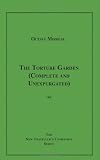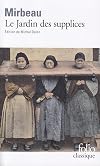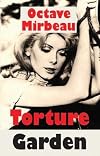
The Torture Garden (The New Traveller's Companion Series)
by Octave Mirbeau
On This Page
Description
"A century after its first publication, this book is still capable of shocking. The opening satire is probably meaningful only to scholars of French political history, but the subsequent journey into the Far East accentuates connections between love and death, sex and depravity, fastidiousness and pleasure. And the petty, parochial corruptions of the narrator are put into context by the immersion into the Sadeian world of the Torture Garden." The TimesTags
Recommendations






















Member Recommendations
Member Reviews
In this review I mainly want to recommend Michael Richardson's translation over Alvah Bessie's. Bessie's (the translation used in the Re-Search and the Citadel editions) is not only dated, but scoured.
Torture Garden is an ornately arranged collection of horrors. It is a satire - a Mundane Comedy (a black one, that begins and ends in Purgatory.) - cruel and beautiful as a flower, to paraphrase the garden's poet-torturer. Mirbeau seems to sneer at his reader, presumably the over-cultivated, over-sated, over-educated flower of modern society: True decadence, real perversity, culminates in you, dear readers - the produce of a civilized society, which is essentially a criminal and contrived garden of forms (religion, art, law, philosophy, show more etc.), seeded and nourished in a bed of rapine and slaughter, where attar is a distillate of gore. The history, character, and late-blooming fine feelings of the narrator, incidentally, are very much to the point.
Mirbeau has never been very popular. He doesn't have very nice things to say. Nice people, just societies, serve a higher purpose. They do not exist simply to mate and die. Nor do they torture - much less make an art of it (no, they have "theme parks" instead). Maiming and killing are unlawful, strictly apportioned to the office of the state - and then applied only as an exigency of official business or, rather, of national security.
In brief, all good and gentle people have arrived at smug enlightenment on a trail of corpses, and that enlightenment itself has its occult roots in crime. More than this, in a world where the interests of corporations and governments are basically one and the same, and entertainment is a multibillion dollar industry, Mirbeau still has something useful and nasty to tell us. show less
Torture Garden is an ornately arranged collection of horrors. It is a satire - a Mundane Comedy (a black one, that begins and ends in Purgatory.) - cruel and beautiful as a flower, to paraphrase the garden's poet-torturer. Mirbeau seems to sneer at his reader, presumably the over-cultivated, over-sated, over-educated flower of modern society: True decadence, real perversity, culminates in you, dear readers - the produce of a civilized society, which is essentially a criminal and contrived garden of forms (religion, art, law, philosophy, show more etc.), seeded and nourished in a bed of rapine and slaughter, where attar is a distillate of gore. The history, character, and late-blooming fine feelings of the narrator, incidentally, are very much to the point.
Mirbeau has never been very popular. He doesn't have very nice things to say. Nice people, just societies, serve a higher purpose. They do not exist simply to mate and die. Nor do they torture - much less make an art of it (no, they have "theme parks" instead). Maiming and killing are unlawful, strictly apportioned to the office of the state - and then applied only as an exigency of official business or, rather, of national security.
In brief, all good and gentle people have arrived at smug enlightenment on a trail of corpses, and that enlightenment itself has its occult roots in crime. More than this, in a world where the interests of corporations and governments are basically one and the same, and entertainment is a multibillion dollar industry, Mirbeau still has something useful and nasty to tell us. show less
This is a remarkable book, a brilliant book, a powerful book but two warnings are in order for the general reader.
The first is the more obvious one. The second half contains descriptions of sadistic torture and of erotic responses to cruelty that are remarkably frank and will be disturbing to most people.
Nothing is spared. Do not pick up this book if you cannot draw the essential mental distinction between reality and the imagination.
As for the second, it is also only fair to warn that this is a political and social satire that is firmly set in the decadent and corrupt milieu of the Third French Republic.
The first pages in the book will read a little dully to most people uninterested in the politics of corruption and sleaze.
These two show more aspects - political satire and sexual 'depravity' - are connected but the modern reader might find it hard to make that connection if he is not a specialist in the period.
These aspects collide to great and troubling effect only once our hero and his new girlfriend arrive in China and Mirbeau cleverly makes a sharp and decisive break between the two halves of the book.
One moment we are in Ceylon where the weak hero gives up all for his girl and the next we are in a Chinese palace with a long back story of bisexual adventure.
We find a passionate and tormented relationship with a lengthy history scarcely referred to before the woman drags the 'hero' off to the torture garden.
Now we see the angry nihilism of a radical anarchist merge with the repressed and torrid sexuality of the apparently misogynistic decadent. This is, after all, 1898.
The modern reader may be repelled more by the apparent misogyny of the book than he or she is by the cruelty but we should consider that the 'bourgeois' sexual mores of the period not only involved exploitation of women by men but equally gross exploitation of men by women.
And, as I will suggest below, we should make a distinction between the opinion of the weak narrator of the tale and what the author, Octave Mirbeau, was trying to convey.
Bourgeois morality seems to have been perfected in late nineteenth century France to ensure that the mass of any population could be held in psychological pens to be shorn by psychopaths. This book merely suggests that an erotic psychopath might as easily be a woman as a man.
We have a very weak, almost contemptible, male telling the story but the heroine is Clara, a monster of the first order but a monster whose engagement with sex and death is told in such poetic terms that we are in danger of becoming enthralled by it.
There is thus not only an essential misogyny in the book insofar as our narrator seems to think that Clara's cruelty is shared by all women but also an ambiguous orientalism in which the western empires are condemned as barbarous just as we see a refinement of cruelty in the prisons of the East.
The tortures of the Chinese are reversed psychologically, not as merely the excesses of some 'yellow peril' (the meme of the era to be presented later as 'Fu Manchu'), but as an authentic form of artistic sensibility which is refined and cultured. Very 1898 and very decadent!
The brutal achievement of the book lies in its ambiguities but the most evident ambiguity is that this monster of a woman also evidently 'suffers' from her experience, trapped into a cycle of depravity.
She achieves an ecstatic state that leaves us with the conclusion that she is truly alive within that cycle whereas her male companion is nothing but an insipid petit-bourgeois without will or use except as observer of her dark pleasures.
Of course, we have to stand back here and remember that this is not a book about a 'real' China but a book about male rage in a France where the scrabble for profit and the deadening hypocrisy of middle class society has created a need for this fantasy of violence and sex.
The writing is, regardless of what it writes about, superb. The description of the journey to the East match anything by Maugham but this is capped with the most exquisite accounts of the prison and the garden. We can more than visualise it. We are there 'in the flesh'.
When both the horrors and the sexual excesses appear, they really do enter into our own minds as parts of our own fantasy world which we can then either choose to reject or engage with.
We are observing these things alongside our cruel voyeuse and her horrified, sickened and fascinated partner. Mirbeau cleverly forces us to mirror their positions - we can either be like him and weak or like her and strong.
But what we are, in reading this book, is a voyeur of cruelty and only better in that we must presume that they are looking at the pain and death of real Chinese people, although, of course, they are not. It is only a story and we are as implicated as they are by that fact.
The final section, set in what must be a very high class tantric brothel and opium den, describes scenes wholly reminiscent of Crowley's account of eroto-comatose lucidity.
This eroticism may be judged rather attractive stuff if we forget that the pleasure appears only because the woman has required the close observation of Sadean levels of cruelty in order to overwhelm her senses. The touch of death has been required for this ecstasy.
She is not unaware of the enormity of what is going on. She takes the vision of observable and real horror as a path to 'ekstasis' beyond good and evil. There is every indication that she knows what she is doing.
He, on the other hand, is the worst sort of inadequate whiner, totally subject to her strange psychology.
This may be no surprise in an era that brought us Sacher-Masoch's Severin but his lapdog-like loyalty should make any 'real' man feel very uncomfortable as he reads the book.
So, the book works at multiple levels - opening up our imaginal realm but under conditions where our observation of events is not allowed to be wholly detached by the sheer horror of what we are perceiving.
Both hero and 'heroine' do little but observe during the book and we observe them observing. If they are 'guilty', then we are guilty. After all, they condemned no one themselves and they took no part in the tortures. They merely watched as we watch them watching.
In this dark dream, the man is led through horrors and erotic experiences as a passive creature who has no real comprehension of his situation. He comes across, bluntly, as not very bright. She comes across as interesting. That is disturbing in itself.
To her, he is one up on her dog, someone to witness her engagement with horror, loved as a tool of pleasure when near but as disposable as all the other creatures who adore her. Her callous remembrance of her dead lesbian lover sets the tone here.
One superficial implication, from the beginning of the book, is that this is what all women are at heart (this is the apparent misogyny that I referred to earlier) but I think that Mirbeau is actually honouring women with a back-handed compliment.
This is not what women are like (he is really saying) but what humanity is really like if you look at it dispassionately. It is simply that women can be as cruel and as erotically exploitative as any man.
We have to go back to 1898 to understand this point. It is too simplistic to say that men are good and women vile - or vice versa as we get from some of the more primitive feminists.
Humanity is a pretty unpleasant species all round (he dwells on one or two nasty Western cases of cruelty with no artistic merit or erotic component).
The attempt to turn middle class women into little saints to be worshipped while treating working class women as sluts is futile and hypocritical. Clara is definitely upper middle class English with decidely angry and radical views on empire herself.
We are, he is saying in 1898, utterly hypocritical in covering up our cruelties and sexual desires and that these cruelties and desires are as strong in women as they are in men.
The hint about Clara is that her cycle of depravity is a salve for the despair that follows a righteous radical anger - a feeling not uncommonly found by many young radicals when their eyes are opened to the nature of humanity in the round.
Whatever Mirbeau meant, the book is well worth reading for the luscious descriptions, even of the barbarities, but I do repeat my warning, do not even open this book if you confuse what is imagined with what is real. You may have nightmares.
In summary, this is a brilliant insight into a nihilistic psyche expressed through a game of extreme imagination. It merges sexual ekstasis and cruelty in a Sadean manner.
But it is angry rather than psychopathic. We might even say that this is what happens when a well-meaning moral man discovers that the world deserves to be seen in nihilistic terms. It is the reaction that Nietzsche had feared only a couple of decades before.
We hear here the scream of a complicated man who has seen too much of the world but who knows what is right and what is wrong. But this man also knows that, thanks to weak men and cruelty within the species, nothing can put the world to rights. Syria today might confirm that.
And so the most immoral of stories, in terms of decadent style and incident, is surreptiously the most moral of stories, pointing out that failure to be more than human as a society means that the solipsistic narcissism of the worst forms of the blond beast becomes possible. show less
The first is the more obvious one. The second half contains descriptions of sadistic torture and of erotic responses to cruelty that are remarkably frank and will be disturbing to most people.
Nothing is spared. Do not pick up this book if you cannot draw the essential mental distinction between reality and the imagination.
As for the second, it is also only fair to warn that this is a political and social satire that is firmly set in the decadent and corrupt milieu of the Third French Republic.
The first pages in the book will read a little dully to most people uninterested in the politics of corruption and sleaze.
These two show more aspects - political satire and sexual 'depravity' - are connected but the modern reader might find it hard to make that connection if he is not a specialist in the period.
These aspects collide to great and troubling effect only once our hero and his new girlfriend arrive in China and Mirbeau cleverly makes a sharp and decisive break between the two halves of the book.
One moment we are in Ceylon where the weak hero gives up all for his girl and the next we are in a Chinese palace with a long back story of bisexual adventure.
We find a passionate and tormented relationship with a lengthy history scarcely referred to before the woman drags the 'hero' off to the torture garden.
Now we see the angry nihilism of a radical anarchist merge with the repressed and torrid sexuality of the apparently misogynistic decadent. This is, after all, 1898.
The modern reader may be repelled more by the apparent misogyny of the book than he or she is by the cruelty but we should consider that the 'bourgeois' sexual mores of the period not only involved exploitation of women by men but equally gross exploitation of men by women.
And, as I will suggest below, we should make a distinction between the opinion of the weak narrator of the tale and what the author, Octave Mirbeau, was trying to convey.
Bourgeois morality seems to have been perfected in late nineteenth century France to ensure that the mass of any population could be held in psychological pens to be shorn by psychopaths. This book merely suggests that an erotic psychopath might as easily be a woman as a man.
We have a very weak, almost contemptible, male telling the story but the heroine is Clara, a monster of the first order but a monster whose engagement with sex and death is told in such poetic terms that we are in danger of becoming enthralled by it.
There is thus not only an essential misogyny in the book insofar as our narrator seems to think that Clara's cruelty is shared by all women but also an ambiguous orientalism in which the western empires are condemned as barbarous just as we see a refinement of cruelty in the prisons of the East.
The tortures of the Chinese are reversed psychologically, not as merely the excesses of some 'yellow peril' (the meme of the era to be presented later as 'Fu Manchu'), but as an authentic form of artistic sensibility which is refined and cultured. Very 1898 and very decadent!
The brutal achievement of the book lies in its ambiguities but the most evident ambiguity is that this monster of a woman also evidently 'suffers' from her experience, trapped into a cycle of depravity.
She achieves an ecstatic state that leaves us with the conclusion that she is truly alive within that cycle whereas her male companion is nothing but an insipid petit-bourgeois without will or use except as observer of her dark pleasures.
Of course, we have to stand back here and remember that this is not a book about a 'real' China but a book about male rage in a France where the scrabble for profit and the deadening hypocrisy of middle class society has created a need for this fantasy of violence and sex.
The writing is, regardless of what it writes about, superb. The description of the journey to the East match anything by Maugham but this is capped with the most exquisite accounts of the prison and the garden. We can more than visualise it. We are there 'in the flesh'.
When both the horrors and the sexual excesses appear, they really do enter into our own minds as parts of our own fantasy world which we can then either choose to reject or engage with.
We are observing these things alongside our cruel voyeuse and her horrified, sickened and fascinated partner. Mirbeau cleverly forces us to mirror their positions - we can either be like him and weak or like her and strong.
But what we are, in reading this book, is a voyeur of cruelty and only better in that we must presume that they are looking at the pain and death of real Chinese people, although, of course, they are not. It is only a story and we are as implicated as they are by that fact.
The final section, set in what must be a very high class tantric brothel and opium den, describes scenes wholly reminiscent of Crowley's account of eroto-comatose lucidity.
This eroticism may be judged rather attractive stuff if we forget that the pleasure appears only because the woman has required the close observation of Sadean levels of cruelty in order to overwhelm her senses. The touch of death has been required for this ecstasy.
She is not unaware of the enormity of what is going on. She takes the vision of observable and real horror as a path to 'ekstasis' beyond good and evil. There is every indication that she knows what she is doing.
He, on the other hand, is the worst sort of inadequate whiner, totally subject to her strange psychology.
This may be no surprise in an era that brought us Sacher-Masoch's Severin but his lapdog-like loyalty should make any 'real' man feel very uncomfortable as he reads the book.
So, the book works at multiple levels - opening up our imaginal realm but under conditions where our observation of events is not allowed to be wholly detached by the sheer horror of what we are perceiving.
Both hero and 'heroine' do little but observe during the book and we observe them observing. If they are 'guilty', then we are guilty. After all, they condemned no one themselves and they took no part in the tortures. They merely watched as we watch them watching.
In this dark dream, the man is led through horrors and erotic experiences as a passive creature who has no real comprehension of his situation. He comes across, bluntly, as not very bright. She comes across as interesting. That is disturbing in itself.
To her, he is one up on her dog, someone to witness her engagement with horror, loved as a tool of pleasure when near but as disposable as all the other creatures who adore her. Her callous remembrance of her dead lesbian lover sets the tone here.
One superficial implication, from the beginning of the book, is that this is what all women are at heart (this is the apparent misogyny that I referred to earlier) but I think that Mirbeau is actually honouring women with a back-handed compliment.
This is not what women are like (he is really saying) but what humanity is really like if you look at it dispassionately. It is simply that women can be as cruel and as erotically exploitative as any man.
We have to go back to 1898 to understand this point. It is too simplistic to say that men are good and women vile - or vice versa as we get from some of the more primitive feminists.
Humanity is a pretty unpleasant species all round (he dwells on one or two nasty Western cases of cruelty with no artistic merit or erotic component).
The attempt to turn middle class women into little saints to be worshipped while treating working class women as sluts is futile and hypocritical. Clara is definitely upper middle class English with decidely angry and radical views on empire herself.
We are, he is saying in 1898, utterly hypocritical in covering up our cruelties and sexual desires and that these cruelties and desires are as strong in women as they are in men.
The hint about Clara is that her cycle of depravity is a salve for the despair that follows a righteous radical anger - a feeling not uncommonly found by many young radicals when their eyes are opened to the nature of humanity in the round.
Whatever Mirbeau meant, the book is well worth reading for the luscious descriptions, even of the barbarities, but I do repeat my warning, do not even open this book if you confuse what is imagined with what is real. You may have nightmares.
In summary, this is a brilliant insight into a nihilistic psyche expressed through a game of extreme imagination. It merges sexual ekstasis and cruelty in a Sadean manner.
But it is angry rather than psychopathic. We might even say that this is what happens when a well-meaning moral man discovers that the world deserves to be seen in nihilistic terms. It is the reaction that Nietzsche had feared only a couple of decades before.
We hear here the scream of a complicated man who has seen too much of the world but who knows what is right and what is wrong. But this man also knows that, thanks to weak men and cruelty within the species, nothing can put the world to rights. Syria today might confirm that.
And so the most immoral of stories, in terms of decadent style and incident, is surreptiously the most moral of stories, pointing out that failure to be more than human as a society means that the solipsistic narcissism of the worst forms of the blond beast becomes possible. show less
‘Here and there in the indentations of the palisade, appearing like halls of verdure and flower-beds, were wooden benches equipped with chains and bronze necklaces, iron tables shaped like crosses, blocks and racks, gibbets, automatic quartering machines, beds laden with cutting blades, bristling with steel points, fixed chokers, props and wheels, boilers and basins above extinguished hearth, all the implements of sacrifice and torture covered in blood—in some places dried and darkish, in others sticky and red. Puddles of blood filled the hollows in the ground and long tears of congealed blood hung from the dismantled mechanisms. Around these machines the ground had absorbed the blood. But blood still stained the whiteness of the show more jasmines and flecked the coral-pink of the honeysuckles and the mauve of the passion flowers. And small fragments of human flesh, caught by whips and leather lashes, had flown here and there on to the tops of petals and leaves. Noticing that I was feeling faint and that I flinched at these puddles whose stain had enlarged and reached the middle of the avenue, Clara, in a gentle voice, encouraged me: “That’s nothing yet, darling… Let’s go on!”’
Octave Mirbeau’s Torture Garden is the most hideously brutal, debauched, splenetic, and disturbing piece of fiction I have ever encountered. It reads, on one level, as a catalog of the most odious, shamelessly rococo sadism known to imagination; but Mirbeau's vision is broader than that: ultimately, the novel is an allegory of political and moral corruption: a seething and merciless satire of the hypocrisies that blight the human race from beneath the sheep’s-clothing called ‘civilization.’ Wilde described it as ‘revolting’ and as ‘a sort of grey adder;’ his assessment is fitting: Torture Garden is an appallingly perverse, venomous, and decimating novel.
Written at the height of the Dreyfus Affair, Mirbeau’s scathing attack on the sanctimonious sophism of the governing elite is, at times, overpoweringly mephitic: it smells of pus and rotten meat and old urine; it tastes of bile and gall and shit. But intermingled with this miasma of death and miserable suffering, there is the insistent perfume of the countless flowers that Mirbeau has painted in luxuriant, almost indulgent, detail: and this is no paradox: because amid the corruption of life, amid the charnel-house and the devouring flies, there is a kind of haunted beauty that is fertilized by this horror and this filth: the blossoms of the Torture Garden are fed by the same flesh and blood that is flayed, molested, and slaughtered within it; the inescapable fact is that this beauty could not thrive without the repugnance that both envelops and is enveloped by it.
The plot details the exploits of a French debauchee who, after meandering through the vapid hypocrisies of political life in fin de siècle Paris, chances to meet a beautiful, recondite Englishwoman, Clara, at sea; deeply attracted to the veil of innocence that cloaks what he perceives to be a curiously ‘well-educated’ immorality, our narrator sets up house with her in her adopted homeland of China. It is only upon their visit to the Torture Garden, however, that our narrator comes to comprehend the sheer depths of Clara’s iniquity: of her lust, filth, and ultimate evil.
This is an incredibly challenging book; and while it has become a near-cliché to caution ‘the faint of heart,’ it is important to warn prospective readers of Torture Garden that, while nearly one-hundred-and-fifteen-years-old, Mirbeau’s masterpiece remains one of the more luridly depraved novels ever published. I’ve read Sade, Mandiargues, and others of their proclivity: Torture Garden, much more than rakish pornography, reduces their prurience to curiosity. But Mirbeau's novel exists in three dimensions: in Torture Garden we glimpse the malice that flickers within the heart of real evil, as page after page eviscerates the miserable flowers of bureaucracy, social imperialism, xenophobia, and moral hypocrisy while exposing their contemporary roots in the manners and mores of European ideas of 'civilization,' effectively contrasting them against a highly orientalized, 'barbarous' East that is ultimately more a mirror of the West than a foil. Some of the more disturbing episodes in the novel do not play out in the Torture Garden at all: the conversation between a British officer and a French explorer about the disposability of human beings—of Dum-Dum bullets and ‘civilized’ cannibalism, of the imminent goal of entirely eliminating both the physical and intangible existence of an abstract ‘enemy’—remain as strikingly and singularly appalling as any gruesomely reprobate episode detailed from within the Torture Garden itself: and this despite the obvious satire (or perhaps even because of it) with which the scene is suffused. These pages drip with blood, yes—but also with cyanide.
I have discovered that Torture Garden’s ability to shock, stupefy, and disgust loses little upon rereading, even as its message becomes more apparent. It remains unavoidably relevant; and while it may turn our stomachs and challenge our patience for debauchery, the compelling employment of revulsion is a major component of Torture Garden's success as an allegory, underlining repeatedly its express purpose: to awaken us to the moral dilemmas often left unexamined within a 'governed' existence, lest we should forget or—far worse—choose to ignore the half-buried incongruities used to measure deception and truth, murder and inevitability. It is not with mere irony, after all, that Mirbeau prefaced his novel thusly: ‘To the priests, the soldiers, the judges: to those people who educate, instruct and govern men: I dedicate these pages of Murder and Blood.’
With its airy exoticism and heartless cruelty, its juxtaposition of indescribably violent torture and indescribably beautiful flowers, its excoriating anger and its electrifying sensuality, Torture Garden is not merely a classic of the Decadence, but a classic of the human soul. These grotesque and poisonous pages have etched themselves, for both better and worse, indelibly upon my brain: and for the bravest of readers, they will open onto vistas of incomparable truth: for beyond the Torture Garden lies a beauty that cannot be grasped without first glimpsing the barbarity with which it is inextricably bound. show less
Octave Mirbeau’s Torture Garden is the most hideously brutal, debauched, splenetic, and disturbing piece of fiction I have ever encountered. It reads, on one level, as a catalog of the most odious, shamelessly rococo sadism known to imagination; but Mirbeau's vision is broader than that: ultimately, the novel is an allegory of political and moral corruption: a seething and merciless satire of the hypocrisies that blight the human race from beneath the sheep’s-clothing called ‘civilization.’ Wilde described it as ‘revolting’ and as ‘a sort of grey adder;’ his assessment is fitting: Torture Garden is an appallingly perverse, venomous, and decimating novel.
Written at the height of the Dreyfus Affair, Mirbeau’s scathing attack on the sanctimonious sophism of the governing elite is, at times, overpoweringly mephitic: it smells of pus and rotten meat and old urine; it tastes of bile and gall and shit. But intermingled with this miasma of death and miserable suffering, there is the insistent perfume of the countless flowers that Mirbeau has painted in luxuriant, almost indulgent, detail: and this is no paradox: because amid the corruption of life, amid the charnel-house and the devouring flies, there is a kind of haunted beauty that is fertilized by this horror and this filth: the blossoms of the Torture Garden are fed by the same flesh and blood that is flayed, molested, and slaughtered within it; the inescapable fact is that this beauty could not thrive without the repugnance that both envelops and is enveloped by it.
The plot details the exploits of a French debauchee who, after meandering through the vapid hypocrisies of political life in fin de siècle Paris, chances to meet a beautiful, recondite Englishwoman, Clara, at sea; deeply attracted to the veil of innocence that cloaks what he perceives to be a curiously ‘well-educated’ immorality, our narrator sets up house with her in her adopted homeland of China. It is only upon their visit to the Torture Garden, however, that our narrator comes to comprehend the sheer depths of Clara’s iniquity: of her lust, filth, and ultimate evil.
This is an incredibly challenging book; and while it has become a near-cliché to caution ‘the faint of heart,’ it is important to warn prospective readers of Torture Garden that, while nearly one-hundred-and-fifteen-years-old, Mirbeau’s masterpiece remains one of the more luridly depraved novels ever published. I’ve read Sade, Mandiargues, and others of their proclivity: Torture Garden, much more than rakish pornography, reduces their prurience to curiosity. But Mirbeau's novel exists in three dimensions: in Torture Garden we glimpse the malice that flickers within the heart of real evil, as page after page eviscerates the miserable flowers of bureaucracy, social imperialism, xenophobia, and moral hypocrisy while exposing their contemporary roots in the manners and mores of European ideas of 'civilization,' effectively contrasting them against a highly orientalized, 'barbarous' East that is ultimately more a mirror of the West than a foil. Some of the more disturbing episodes in the novel do not play out in the Torture Garden at all: the conversation between a British officer and a French explorer about the disposability of human beings—of Dum-Dum bullets and ‘civilized’ cannibalism, of the imminent goal of entirely eliminating both the physical and intangible existence of an abstract ‘enemy’—remain as strikingly and singularly appalling as any gruesomely reprobate episode detailed from within the Torture Garden itself: and this despite the obvious satire (or perhaps even because of it) with which the scene is suffused. These pages drip with blood, yes—but also with cyanide.
I have discovered that Torture Garden’s ability to shock, stupefy, and disgust loses little upon rereading, even as its message becomes more apparent. It remains unavoidably relevant; and while it may turn our stomachs and challenge our patience for debauchery, the compelling employment of revulsion is a major component of Torture Garden's success as an allegory, underlining repeatedly its express purpose: to awaken us to the moral dilemmas often left unexamined within a 'governed' existence, lest we should forget or—far worse—choose to ignore the half-buried incongruities used to measure deception and truth, murder and inevitability. It is not with mere irony, after all, that Mirbeau prefaced his novel thusly: ‘To the priests, the soldiers, the judges: to those people who educate, instruct and govern men: I dedicate these pages of Murder and Blood.’
With its airy exoticism and heartless cruelty, its juxtaposition of indescribably violent torture and indescribably beautiful flowers, its excoriating anger and its electrifying sensuality, Torture Garden is not merely a classic of the Decadence, but a classic of the human soul. These grotesque and poisonous pages have etched themselves, for both better and worse, indelibly upon my brain: and for the bravest of readers, they will open onto vistas of incomparable truth: for beyond the Torture Garden lies a beauty that cannot be grasped without first glimpsing the barbarity with which it is inextricably bound. show less
Monsters, monsters! But there are no monsters! What you call monsters are superior forms, or forms beyond your understanding. Aren't the gods monsters? Isn't a man of genius a monster, like a tiger or a spider, like all individuals who live beyond social lies, in the dazzling and divine immortality of things? Why, I too then, am a monster.
Curious about The Torture Garden? You may need a tall absinthe and a dearth of holiday cheer for a proper appreciation. That is not entirely accurate. Unlike the thrust of the decadent lettres, there isn't a default pose of ennui on display.
Passion pulses here. The manifestations of such are irregular, to say the least.
Such desire is maintained, and the novel remains, well, beautiful. The lush show more descriptions of the garden itself are exaustive and totalizing: a horticultural Eden despite the deaths of a thousand cuts and the carrion being offered to the deliriously starved.
I was impressed by the tone, which isn't sensational, but grounded and appreciative. show less
Curious about The Torture Garden? You may need a tall absinthe and a dearth of holiday cheer for a proper appreciation. That is not entirely accurate. Unlike the thrust of the decadent lettres, there isn't a default pose of ennui on display.
Passion pulses here. The manifestations of such are irregular, to say the least.
Such desire is maintained, and the novel remains, well, beautiful. The lush show more descriptions of the garden itself are exaustive and totalizing: a horticultural Eden despite the deaths of a thousand cuts and the carrion being offered to the deliriously starved.
I was impressed by the tone, which isn't sensational, but grounded and appreciative. show less
I found this book interesting in its attempt to falsely moralize. This book was clearly intended to titilate, but is uses a patently false moral premise to paint its lurid tale of the beauty of torture and pain. The setting is China, in a time when this was a most exotic and strange part of the world. Westerners visit a prison where Clara is brought to almost orgasmic pleasure by viewing the sufeering of chinese prisoners. It is not really political or moral. That is just the veneer for telling a story of violence with a hint of sadism.
The book is very queer because in place of fear of reverse colonization, Clara and the Weak Boy go to China. Their purpose isn't to colonize it. their purpose to preserve its cruelties. (Mirbeau is fetishizing China of course) The last part of the book reads more like the movie The Exorcist which according to the book is a weekly affair. The strangeness of this book deserves great indepth analysis.
What concerns basic punctuation and outlook, this edition is not the best one. The Torture Garden is of curiosity value, but I was annoyed by the moralistic overtone and the strict polarity between good and evil the main character felt it was imperative to demonstrate ever so often. Interesting, but telling the story through the mouth of a self-obsessed bourgeois man makes the outcome a bit thin.
Members
- Recently Added By
Lists

Books
85 works; 1 member
Author Information

88+ Works 1,694 Members
Some Editions
Series
Belongs to Publisher Series
Common Knowledge
- Canonical title*
- De tuin der folteringen
- Original title
- Le jardin des supplices
- Alternate titles
- O jardim dos suplícios (PT) (PT)
- Original publication date
- 1899
- Dedication
- To Priests, Soldiers, Judges -
to men who rear, lead or govern men
I dedicate these pages of muder and blood. - First words
- One evening some friends were gathered at the home of one of our most celebrated writers.
*Some information comes from Common Knowledge in other languages. Click "Edit" for more information.
Classifications
Statistics
- Members
- 809
- Popularity
- 34,293
- Reviews
- 11
- Rating
- (3.59)
- Languages
- 10 — Dutch, English, French, German, Hungarian, Italian, Portuguese, Spanish, Swedish, Turkish
- Media
- Paper, Ebook
- ISBNs
- 50
- ASINs
- 27