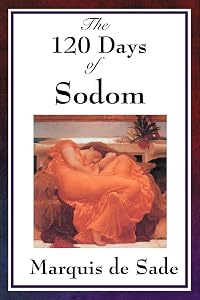
The 120 Days of Sodom
by Marquis de Sade 
On This Page
Description
The 120 Days of Sodom by Marquis de Sade relates the story of four wealthy men who enslave 24 mostly teenaged victims and sexually torture them while listening to stories told by old prostitutes. The book was written while Sade was imprisoned in the Bastille and the manuscript was lost during the storming of the Bastille. Sade wrote that he "wept tears of blood" over the manuscript's loss. Many consider this to be Sade crowing acheivment.Tags
Recommendations



































Member Recommendations

Member Reviews
“Now, dear reader, you must prepare your heart and your mind for the most impure story that has ever been written since the world existed, such a book being found neither among the ancients nor among the moderns.”
It sounds like a very cheap excuse (like reading Playboy for the interviews), but I read this primarily out of historical interest (and okay, maybe a little curiosity too). I'm just going to say it straight: this is gross, but really gross, extremely gross, in ways you can barely imagine. And it is not only the unimaginable sexual escapades that de Sade describes, but mainly the ever-increasing violence, and the sickening way in which other people (especially women and children) are degraded to mere objects.
To be honest: I show more mainly read the run-up to the book and most of the 'stories' of the first cycle (the first of 4), and even then, gradually I began to read diagonally, skipping the worst passages. I didn't have the stomach for it to begin with (some scenes really make you feel sick), and also, after a while the endless descriptions of the excesses really started to get boring. That also says something. Moreover, according to de Sade, that first cycle only contains a description of the “simple passions”. From the schematic overviews of the next three cycles (which he did not write out, thanks heaven), it can be concluded that after that first ‘simple’ cycle, it only goes crescendo into gruesome torture, up to and including the most beastly mutilations and even murder.
Curiously, all this is presented by de Sade as a kind of scientific experiment. The core of the story is that 4 friends (rich and powerful men) isolate themselves in a Swiss castle, together with about 30 victims, and for 4 months indulge themselves in an endless series of sexual and violent deeds, and while doing that, meticulously recording and sharing all their emotions and experiences. Regularly they debate on, for instance, what brings the greatest pleasure (the act or the desire for it), and its moral implications (or rather, the lack thereof), almost like in a Platonic dialogue.
So, even amidst these excesses occasionally interesting things can be found, I mean on a philosophical level (imagine!). For instance, they conclude that their happiness comes from the fact that others (their victims) cannot enjoy what they can, in other words: inequality and domination are basic goods. Or that good and evil are completely arbitrary, and that therefore everything is allowed. Striking, but not unexpected, are the fierce attacks against the church and against religion in general: only Nature (with a capital) counts, because, by making possible the most terrible acts, nothing (and certainly not God) stands in the way of doing just that, and therefor every evil is justified. It is the libertine “natural philosophy” that de Sade keeps coming back to.
Now, one of the points I was curious about is to what extent de Sade can be seen as an exponent of the Enlightenment of the 18th century, a thorny issue. Ok, he was part of the nobility, and therefore thoroughly rooted in the ‘Ancien Regime’, but so were other Enlightenment philosophers. And agreed, his focus was certainly not on higher reason, but on the contrary on the dark side of the human species. But his approach exudes the rationalistic-mechanistic view that is so typical of the French 'philosophes' of that period. Only look at the thoroughness with which the four ‘masters’ perform their brutal deeds, in a systematic-premeditated order, report on them and discuss them. In a way you can surely say that de Sade also exposes the dark side of Enlightened rationalism, eventually leading to the Holocaust (I'm not saying anything new, here).
Naturally you wonder: what was the personal motivation of de Sade to write all this, and especially why in that excessively explicit way? I know: libraries have already been written about it. And the views on this range from “de Sade just had a sick mind”, to “he wanted to provide a brilliant insight into the seething, stinking pit that hides inside each of us, but which we usually keep hidden”. I guess, all these views are valid. And so I definitely came to understand why the figure of Sade, and his writings, continue to fascinate, even after more than 2 centuries. But if you want my (completely non-binding) advice: beware, if you want to read this, know what you're getting into.
Annex: I have now also read his Justine ou Les Malheurs de la vertu (the reworked version from 1797), and I must say that it is on a much higher literary level (ok, this sounds very “I read Playboy for the interviews”-ish), it is a little bit less explicit, and, actually contains a little less violence, although it remains very rude and particularly derogatory of the female species. But above all it contains many more well-developed passages that philosophize about the (im)moral aspects of libertine behavior, and in that sense it is much more interesting. show less
It sounds like a very cheap excuse (like reading Playboy for the interviews), but I read this primarily out of historical interest (and okay, maybe a little curiosity too). I'm just going to say it straight: this is gross, but really gross, extremely gross, in ways you can barely imagine. And it is not only the unimaginable sexual escapades that de Sade describes, but mainly the ever-increasing violence, and the sickening way in which other people (especially women and children) are degraded to mere objects.
To be honest: I show more mainly read the run-up to the book and most of the 'stories' of the first cycle (the first of 4), and even then, gradually I began to read diagonally, skipping the worst passages. I didn't have the stomach for it to begin with (some scenes really make you feel sick), and also, after a while the endless descriptions of the excesses really started to get boring. That also says something. Moreover, according to de Sade, that first cycle only contains a description of the “simple passions”. From the schematic overviews of the next three cycles (which he did not write out, thanks heaven), it can be concluded that after that first ‘simple’ cycle, it only goes crescendo into gruesome torture, up to and including the most beastly mutilations and even murder.
Curiously, all this is presented by de Sade as a kind of scientific experiment. The core of the story is that 4 friends (rich and powerful men) isolate themselves in a Swiss castle, together with about 30 victims, and for 4 months indulge themselves in an endless series of sexual and violent deeds, and while doing that, meticulously recording and sharing all their emotions and experiences. Regularly they debate on, for instance, what brings the greatest pleasure (the act or the desire for it), and its moral implications (or rather, the lack thereof), almost like in a Platonic dialogue.
So, even amidst these excesses occasionally interesting things can be found, I mean on a philosophical level (imagine!). For instance, they conclude that their happiness comes from the fact that others (their victims) cannot enjoy what they can, in other words: inequality and domination are basic goods. Or that good and evil are completely arbitrary, and that therefore everything is allowed. Striking, but not unexpected, are the fierce attacks against the church and against religion in general: only Nature (with a capital) counts, because, by making possible the most terrible acts, nothing (and certainly not God) stands in the way of doing just that, and therefor every evil is justified. It is the libertine “natural philosophy” that de Sade keeps coming back to.
Now, one of the points I was curious about is to what extent de Sade can be seen as an exponent of the Enlightenment of the 18th century, a thorny issue. Ok, he was part of the nobility, and therefore thoroughly rooted in the ‘Ancien Regime’, but so were other Enlightenment philosophers. And agreed, his focus was certainly not on higher reason, but on the contrary on the dark side of the human species. But his approach exudes the rationalistic-mechanistic view that is so typical of the French 'philosophes' of that period. Only look at the thoroughness with which the four ‘masters’ perform their brutal deeds, in a systematic-premeditated order, report on them and discuss them. In a way you can surely say that de Sade also exposes the dark side of Enlightened rationalism, eventually leading to the Holocaust (I'm not saying anything new, here).
Naturally you wonder: what was the personal motivation of de Sade to write all this, and especially why in that excessively explicit way? I know: libraries have already been written about it. And the views on this range from “de Sade just had a sick mind”, to “he wanted to provide a brilliant insight into the seething, stinking pit that hides inside each of us, but which we usually keep hidden”. I guess, all these views are valid. And so I definitely came to understand why the figure of Sade, and his writings, continue to fascinate, even after more than 2 centuries. But if you want my (completely non-binding) advice: beware, if you want to read this, know what you're getting into.
Annex: I have now also read his Justine ou Les Malheurs de la vertu (the reworked version from 1797), and I must say that it is on a much higher literary level (ok, this sounds very “I read Playboy for the interviews”-ish), it is a little bit less explicit, and, actually contains a little less violence, although it remains very rude and particularly derogatory of the female species. But above all it contains many more well-developed passages that philosophize about the (im)moral aspects of libertine behavior, and in that sense it is much more interesting. show less
I have in my hands now the 2008 English translation by James Hovoc. (I shall review some of Havoc’s wild work in another review.) Alas, since I suck at French, this is as close as I can get to the Master’s original manuscripts. But I trust in Havoc and this newest translation is by far the best translation any English speaker could hope to find.
I’ve read most everything one can by and on de Sade in English and I never cease to tire of either him or his work. Most friends and colleagues I known simply can’t handle him though. Even those who are into the swinging scene, BDSM, cuckoldry, or whatever, are turned off by his writings. Perhaps I hang out with boring people. It seems that even when we puritan Americans attempt to do the show more edgy thing, we are only really fooling ourselves? Forsooth, if you value equality in sexual “play” than de Sade is not for you. However, if you can dial down those liberal democratic values hammered into you since preschool, de Sade is a healthy escape.
For example, a quick excerpt:
“Durcet had Augustine shit in his mouth, and the Bishop made Fanny suck the tip of his throbbing cock while she spread her buttocks and dropped a turd down his throat. Its flavor drove him to a violent orgasm, and as he sprayed his cock-juice over her gums he also mangled her flanks between his clenched fists; but as much as he wished to see her punished further, he could find no grounds to sentence her. Such was the Bishop’s mercurial nature; no sooner had he come inside his pleasure-object, than he wished to see it dashed to the Devil. Everyone knew of his vicious temperament, and the young girls, the wives and the young boys all dreaded nothing so much as being the recipient of his lust and loathing.”
Beautiful prose, eh?
Ass-Worship
Like all good writers de Sade is able to expand the meaning of some words that we take for granted. The word sodomy from that stupid tale in Christian and Jewish mythology (Genesis 19:4) is a great example. Not only does sodomy mean a man inserting a turgid cock into an asshole, male or female, but it also means all things having to do with the utter worship of the buttocks over all other parts of the body (especially the vagina), including what comes out of it.
Thus, coprophagia (the eating of poo-poo) or scatology (the obsessive playing with shit) is as much a part of sodomy as is traditional buggery. For the characters in this book, any other sexual excess serves at best as side dishes to the main course of limitless ass-worship.
Plot
Just a whole lot of butt-fuckery which increases in amount, variance, artfulness, sadism, and satire: the book’s plotline is subdivided into a pre-story introduction called “The Masterplan”, followed by the four months, each as a part, and then ending with “The Aftermath.” The most interesting element of the 120 days that really has something of a story happens in the First Month. Here we have a running narrative of one girl’s corruption over an entire lifetime. From a storytelling perspective this is where de Sade really excels and keeps the book moving forward. Learning about how the French girl is slowly molested at a preteen age by the monkhood, later encouraged to join a brothel, then becomes proprietress of the establishment after poisoning her employer all make for great reading!
The second to third months are not fleshed out in anywhere the same amount of detail as the first month. I’m not sure if this is because de Sade became bored with his own story or because he just didn’t have time to fill in the last bits. If one reads his Juliette, then you will know that it is probably not the former.
Philosophy
I have yet to read the Leo Straussian tome on de Sade. Most accounts on de Sade as a philosopher I find are a bit boring to say the least. This is because most writers on de Sade take out all the fun vocab. One can’t talk about de Sade as the philosopher and also eschew diction/expressions like “cock-wanker”, “fuck my eyes”, “catamite”, “cock-beating”, “semen-splashing mania”, “smegma”, “scatology”, “libidinal fury”, “tight-ringed asshole”, “shit-befouled haunches”, and on and on. In short, I always like to argue that how de Sade says what he says is as important as what he says.
The following will be a longish quotation, but it serves as a great example of how de Sade’s philosophy mixes freely with his potty mouth:
“‘That notion does not conform to the libertine viewpoint,’ opined Durcet. ‘For how can you be happy if you are constantly able to satisfy yourself? It is not in the consummation of desire that happiness exists, but in the desire itself, in the destruction of all obstacles that stand in the way of that desire. Whereas here, one only has to make a wish, and it is granted. I swear to you,’ he continued, ‘that since my arrival here my cock has not exploded once because of the fuck-toys I find about me in the château. No; every time I have discharged it has been because of what is not here, what is absent from this place. And so it is that, according to my belief, there is one essential element lacking to our happiness. It is the pleasure of comparison, the pleasure one derives from seeing wretched, normal men; here, one sees none at all. It is the sight of one who does not in the least enjoy what we enjoy—and who suffers because of it—that affords us the pleasure of being able to say: “I am therefore happier than he.” Wherever all men are found equal, and where differences do not exist, true happiness shall not exist either. It is the example of the man who only truly appreciates good health after a lengthy bout of illness.’”
The above quotation has this blending of moral philosophy and scandalous language that I and, I’m sure, many other readers have found eminently enchanting over the past three-hundred years. A shorter quotation that illustrates the same point is as follows:
“[A]ny relief given to misfortune, any gesture that lightens the burden of the oppressed, is a heinous crime against the natural state of things…only the crushing of the poor and needy is worthy of a hard-on.”
Or, perhaps try this other short quotation:
“It’s ridiculous to think one owes anything to one’s mother. For what would such gratitude be based upon? Are we to be thankful that she allowed some lout to fire his seed into her cunt?”
Naturally, the above examples crack me up. But they also make great prompts for a Socratic discussion. Give it a whirl in your next Anglo-American analytic philosophy class…ha!
Read me!
Indeed, read de Sade’s work. This particular book is a fun one with which to begin. Cannot recommend it enough.
Love, -Virginia de Sade
http://virginiadesade.blogspot.com/2015/02/review-of-120-days-of-sodom-by-de-sad... ;) show less
I’ve read most everything one can by and on de Sade in English and I never cease to tire of either him or his work. Most friends and colleagues I known simply can’t handle him though. Even those who are into the swinging scene, BDSM, cuckoldry, or whatever, are turned off by his writings. Perhaps I hang out with boring people. It seems that even when we puritan Americans attempt to do the show more edgy thing, we are only really fooling ourselves? Forsooth, if you value equality in sexual “play” than de Sade is not for you. However, if you can dial down those liberal democratic values hammered into you since preschool, de Sade is a healthy escape.
For example, a quick excerpt:
“Durcet had Augustine shit in his mouth, and the Bishop made Fanny suck the tip of his throbbing cock while she spread her buttocks and dropped a turd down his throat. Its flavor drove him to a violent orgasm, and as he sprayed his cock-juice over her gums he also mangled her flanks between his clenched fists; but as much as he wished to see her punished further, he could find no grounds to sentence her. Such was the Bishop’s mercurial nature; no sooner had he come inside his pleasure-object, than he wished to see it dashed to the Devil. Everyone knew of his vicious temperament, and the young girls, the wives and the young boys all dreaded nothing so much as being the recipient of his lust and loathing.”
Beautiful prose, eh?
Ass-Worship
Like all good writers de Sade is able to expand the meaning of some words that we take for granted. The word sodomy from that stupid tale in Christian and Jewish mythology (Genesis 19:4) is a great example. Not only does sodomy mean a man inserting a turgid cock into an asshole, male or female, but it also means all things having to do with the utter worship of the buttocks over all other parts of the body (especially the vagina), including what comes out of it.
Thus, coprophagia (the eating of poo-poo) or scatology (the obsessive playing with shit) is as much a part of sodomy as is traditional buggery. For the characters in this book, any other sexual excess serves at best as side dishes to the main course of limitless ass-worship.
Plot
Just a whole lot of butt-fuckery which increases in amount, variance, artfulness, sadism, and satire: the book’s plotline is subdivided into a pre-story introduction called “The Masterplan”, followed by the four months, each as a part, and then ending with “The Aftermath.” The most interesting element of the 120 days that really has something of a story happens in the First Month. Here we have a running narrative of one girl’s corruption over an entire lifetime. From a storytelling perspective this is where de Sade really excels and keeps the book moving forward. Learning about how the French girl is slowly molested at a preteen age by the monkhood, later encouraged to join a brothel, then becomes proprietress of the establishment after poisoning her employer all make for great reading!
The second to third months are not fleshed out in anywhere the same amount of detail as the first month. I’m not sure if this is because de Sade became bored with his own story or because he just didn’t have time to fill in the last bits. If one reads his Juliette, then you will know that it is probably not the former.
Philosophy
I have yet to read the Leo Straussian tome on de Sade. Most accounts on de Sade as a philosopher I find are a bit boring to say the least. This is because most writers on de Sade take out all the fun vocab. One can’t talk about de Sade as the philosopher and also eschew diction/expressions like “cock-wanker”, “fuck my eyes”, “catamite”, “cock-beating”, “semen-splashing mania”, “smegma”, “scatology”, “libidinal fury”, “tight-ringed asshole”, “shit-befouled haunches”, and on and on. In short, I always like to argue that how de Sade says what he says is as important as what he says.
The following will be a longish quotation, but it serves as a great example of how de Sade’s philosophy mixes freely with his potty mouth:
“‘That notion does not conform to the libertine viewpoint,’ opined Durcet. ‘For how can you be happy if you are constantly able to satisfy yourself? It is not in the consummation of desire that happiness exists, but in the desire itself, in the destruction of all obstacles that stand in the way of that desire. Whereas here, one only has to make a wish, and it is granted. I swear to you,’ he continued, ‘that since my arrival here my cock has not exploded once because of the fuck-toys I find about me in the château. No; every time I have discharged it has been because of what is not here, what is absent from this place. And so it is that, according to my belief, there is one essential element lacking to our happiness. It is the pleasure of comparison, the pleasure one derives from seeing wretched, normal men; here, one sees none at all. It is the sight of one who does not in the least enjoy what we enjoy—and who suffers because of it—that affords us the pleasure of being able to say: “I am therefore happier than he.” Wherever all men are found equal, and where differences do not exist, true happiness shall not exist either. It is the example of the man who only truly appreciates good health after a lengthy bout of illness.’”
The above quotation has this blending of moral philosophy and scandalous language that I and, I’m sure, many other readers have found eminently enchanting over the past three-hundred years. A shorter quotation that illustrates the same point is as follows:
“[A]ny relief given to misfortune, any gesture that lightens the burden of the oppressed, is a heinous crime against the natural state of things…only the crushing of the poor and needy is worthy of a hard-on.”
Or, perhaps try this other short quotation:
“It’s ridiculous to think one owes anything to one’s mother. For what would such gratitude be based upon? Are we to be thankful that she allowed some lout to fire his seed into her cunt?”
Naturally, the above examples crack me up. But they also make great prompts for a Socratic discussion. Give it a whirl in your next Anglo-American analytic philosophy class…ha!
Read me!
Indeed, read de Sade’s work. This particular book is a fun one with which to begin. Cannot recommend it enough.
Love, -Virginia de Sade
http://virginiadesade.blogspot.com/2015/02/review-of-120-days-of-sodom-by-de-sad... ;) show less
(Original Review, 2008)
Good old erotica. Instead of just 'lets do it'.....wine and dine, ballroom dance, see the city lights, drink some coffee, and then 'lets do it'.
The book is quite mildly interesting regarding the psychology of sexuality. It describes the the progression/escalation of some types of non-normative types of sexuality and sexual fetishes to serious deviations from the norm. One example in the book is the evolution from 'normal' sexual penetration in the first part to full-scale mass piquerism in the last part. Which is why Bloch, Hirschfeld and Eulenberg found the book very relative to their studies of human sexuality.
On the other hand, this book is deeply unpleasant, I forced myself to read almost all of it and show more somewhat regret the experience. It took me some time ( years ) to get over it, 120 Days is certainly not a titillating pornographic novel like American Psycho, which is disturbing as you can 'get off' on the sex and murder thinly veiled as literature. Arguing over whether it is literature misses the point. Philosophically, it describes a particular point on the map. A brutal, bleak, horrifying philosophical space, but a space nonetheless. The main characters in Sade don't just torture people to death, they describe in great detail why they are doing it. It's a description of what happens when power ends up in very bad people's hands, at the same time as it's a rational refutation of religion and superstition.
Personally,I think the way to understand De Sade is as a global pioneer in the art of trolling. His actual sexual acts were fairly tame in the broad scheme of things - 15 year-old servants, but people were getting married at that age in his time. As far as history records, his actual practical sexual tastes didn't extend much further than a little light flagellation and buggery. What he really loved was to shock and upset people with what he wrote, and he was extraordinarily good at it. In 'Philosophy in the Bedroom', he extends the theory that God must want us to have anal sex, or he wouldn't have made our arseholes so deliciously tight. In one paragraph he lands a perfect hit on both sexually prudish Christians and atheistic, Rousseau-ite Pangloss / Natural Man types. Troll perfection! But it's more about unpacking what the concept of 'troll' might mean. There have always been people who enjoy poking away at society's dark places through transgressive writing. De Sade was very good at spotting the hypocrisy of the morality and dogma of his time, and at picking it to pieces and laying it bare. During the period, Christians (as some do now) were prone to explaining the world in terms of God's intentions, within a tradition that goes back to Boethius. But Rousseau had painted a picture of a world in which everything is as nature intends, and that if we follow nature, all will be well. In the example I gave, De Sade managed to poke fun at both parties in one go, pointing out by implication that all of the distasteful things in life might also be made the way God or nature intended, including the most distasteful human desires. I used the term 'troll' because I think that De Sade would have loved the internet, and would have totally understood the urge to get a reaction by giving calculated offence. But I also think that you can see a broader picture around the people who do that now if you put it into historical context. Many contemporary 'trolls' probably also feel that they are exposing hypocrisy and broadening minds.
De Sade was 'lucky' enough to exist at a time of great personal affluence in his class, and huge personal peril. I think he would have loved the internet with its infinite possibilities.
Bottom-line: No, the book is not really aiming to be titillating at all. It's an experiment to see how far boundaries and morality can be pushed...and then push a step further, and a step further, on and on to see what the logical conclusion is. I think I'm pretty unflappable but I couldn't make it through it. Nauseating. Very boring reading, out of this world monologues and almost no smut. show less
Good old erotica. Instead of just 'lets do it'.....wine and dine, ballroom dance, see the city lights, drink some coffee, and then 'lets do it'.
The book is quite mildly interesting regarding the psychology of sexuality. It describes the the progression/escalation of some types of non-normative types of sexuality and sexual fetishes to serious deviations from the norm. One example in the book is the evolution from 'normal' sexual penetration in the first part to full-scale mass piquerism in the last part. Which is why Bloch, Hirschfeld and Eulenberg found the book very relative to their studies of human sexuality.
On the other hand, this book is deeply unpleasant, I forced myself to read almost all of it and show more somewhat regret the experience. It took me some time ( years ) to get over it, 120 Days is certainly not a titillating pornographic novel like American Psycho, which is disturbing as you can 'get off' on the sex and murder thinly veiled as literature. Arguing over whether it is literature misses the point. Philosophically, it describes a particular point on the map. A brutal, bleak, horrifying philosophical space, but a space nonetheless. The main characters in Sade don't just torture people to death, they describe in great detail why they are doing it. It's a description of what happens when power ends up in very bad people's hands, at the same time as it's a rational refutation of religion and superstition.
Personally,I think the way to understand De Sade is as a global pioneer in the art of trolling. His actual sexual acts were fairly tame in the broad scheme of things - 15 year-old servants, but people were getting married at that age in his time. As far as history records, his actual practical sexual tastes didn't extend much further than a little light flagellation and buggery. What he really loved was to shock and upset people with what he wrote, and he was extraordinarily good at it. In 'Philosophy in the Bedroom', he extends the theory that God must want us to have anal sex, or he wouldn't have made our arseholes so deliciously tight. In one paragraph he lands a perfect hit on both sexually prudish Christians and atheistic, Rousseau-ite Pangloss / Natural Man types. Troll perfection! But it's more about unpacking what the concept of 'troll' might mean. There have always been people who enjoy poking away at society's dark places through transgressive writing. De Sade was very good at spotting the hypocrisy of the morality and dogma of his time, and at picking it to pieces and laying it bare. During the period, Christians (as some do now) were prone to explaining the world in terms of God's intentions, within a tradition that goes back to Boethius. But Rousseau had painted a picture of a world in which everything is as nature intends, and that if we follow nature, all will be well. In the example I gave, De Sade managed to poke fun at both parties in one go, pointing out by implication that all of the distasteful things in life might also be made the way God or nature intended, including the most distasteful human desires. I used the term 'troll' because I think that De Sade would have loved the internet, and would have totally understood the urge to get a reaction by giving calculated offence. But I also think that you can see a broader picture around the people who do that now if you put it into historical context. Many contemporary 'trolls' probably also feel that they are exposing hypocrisy and broadening minds.
De Sade was 'lucky' enough to exist at a time of great personal affluence in his class, and huge personal peril. I think he would have loved the internet with its infinite possibilities.
Bottom-line: No, the book is not really aiming to be titillating at all. It's an experiment to see how far boundaries and morality can be pushed...and then push a step further, and a step further, on and on to see what the logical conclusion is. I think I'm pretty unflappable but I couldn't make it through it. Nauseating. Very boring reading, out of this world monologues and almost no smut. show less
Whatever you may have heard, its worse. The frame story is about 4 of the vilest men to walk the earth. They retreat to a remote castle to be able to indulge themselves without fear of interruption. Those they take with them include 16 kidnapped teens aged 12-15, 8 boys and 8 girls. The main point of the story is a catalogue of every sexual fetish the author can imagine. Some are told each day by 4 storytellers who accompany the group.
Only the first 30 days are told in detail the rest is just sketched as the work was never finished. Just to give some idea of how dark things get, the majority of characters don't make it out alive.
The score i've given this is only based on the quality of the writing NOT on the content.
NO ONE should show more read this except maybe people who want to be Profilers like on 'Criminal Minds'. show less
Only the first 30 days are told in detail the rest is just sketched as the work was never finished. Just to give some idea of how dark things get, the majority of characters don't make it out alive.
The score i've given this is only based on the quality of the writing NOT on the content.
NO ONE should show more read this except maybe people who want to be Profilers like on 'Criminal Minds'. show less
A word to those who put this on their to-read list: I'm fairly certain this version of the book is the watered down version. If you want to read the original, there's an e-book version floating around online. That's what I read.
Of course I didn't like it. This was the most disgusting book I've ever read, and I doubt there is any as vile out there in the world. For grammar and wording it would receive 5 stars; de Sade is certainly intelligent...the more to fear him.
Th...more A word to those who put this on their to-read list: I'm fairly certain this version of the book is the watered down version. If you want to read the original, there's an e-book version floating around online. That's what I read.
Of course I didn't like it. This was show more the most disgusting book I've ever read, and I doubt there is any as vile out there in the world. For grammar and wording it would receive 5 stars; de Sade is certainly intelligent...the more to fear him.
The book is about four disgusting men who decide to assign men to kidnap hundreds of children, choose from ten young boys and girls (the others are sold as prostitutes), then hole themselves in a secluded location. Along with them are four old women (employed to keep watch over the chilren), several well-endowed men used for the purpose of you-guess-what to the four men in charge and the children, and four women storytellers who amuse the main men (the self-proclaimed libertines) by recalling stories from their lives of prostitution.
The libertines are disgusting...in the introduction we are told of how they've killed their own children and raped all of them, as well as killed many others, so you know what's in store for later. However, they like to prolong everything, which is why they don't deflower the children from the very beginning, and why the stories start out only slightly shocking. As time goes on, the stories get more disgusting (bodily functions come into play), but still readable. After the stories are told, the libertines like to re-enact much of that told in the stories.
Over time one begins to feel like Sade exhausted all of his perverse ideas...this is a false security. The real horrors begin in the second-to-last chapter, the forty-third day, in which violence begins to mingle with sexual acts. It's like a Saw series from the 1700s, but with violence AND sex, which makes it all the worse in my opinion. There are innumerable horrors done to pregnant women, toddlers and even an infant mentioned to have been raped, teeth being pulled out to be replaced with red-hot nails, arms twisted...I'm only scratching the surface here.
As I read, I felt like I was going to faint from horror, disgust, and shock, or puke...whichever came first. There was even a point where I felt like screaming in terror because of what I read. I had to use my courage to press on, and even then I had to skim sometimes. The whole thing is more terrifying if you imagine what went through the children's minds during those months of sexual and violent torture. Of course, the libertines can't control their violent lust, so the elders, the studs, the storytellers, their own wives, and even some of the hired help are tortured. They start declaring who's to die each day: one of the deaths is described in great detail and is probably one of the most squeamish events in the book. At the very end, de Sade lists the number of all those holed up in this secluded place, and the number who survived: 16 out of 46, and not one of those survivors left without missing some fingers, an eye, a broken bone, etc.
Most who end up reading this story, like me, did so just to prove they can finish. I sincerely hope there weren't any who got enjoyment out of it...if you can masturbate to this, you should feel guilty. This is one of the books people read and come away feeling a complete despair for humanity; most can only stomach a chapter a day. If you want to sicken your friends at a party, whip the book out and have them read a certain portion out loud. show less
Of course I didn't like it. This was the most disgusting book I've ever read, and I doubt there is any as vile out there in the world. For grammar and wording it would receive 5 stars; de Sade is certainly intelligent...the more to fear him.
Th...more A word to those who put this on their to-read list: I'm fairly certain this version of the book is the watered down version. If you want to read the original, there's an e-book version floating around online. That's what I read.
Of course I didn't like it. This was show more the most disgusting book I've ever read, and I doubt there is any as vile out there in the world. For grammar and wording it would receive 5 stars; de Sade is certainly intelligent...the more to fear him.
The book is about four disgusting men who decide to assign men to kidnap hundreds of children, choose from ten young boys and girls (the others are sold as prostitutes), then hole themselves in a secluded location. Along with them are four old women (employed to keep watch over the chilren), several well-endowed men used for the purpose of you-guess-what to the four men in charge and the children, and four women storytellers who amuse the main men (the self-proclaimed libertines) by recalling stories from their lives of prostitution.
The libertines are disgusting...in the introduction we are told of how they've killed their own children and raped all of them, as well as killed many others, so you know what's in store for later. However, they like to prolong everything, which is why they don't deflower the children from the very beginning, and why the stories start out only slightly shocking. As time goes on, the stories get more disgusting (bodily functions come into play), but still readable. After the stories are told, the libertines like to re-enact much of that told in the stories.
Over time one begins to feel like Sade exhausted all of his perverse ideas...this is a false security. The real horrors begin in the second-to-last chapter, the forty-third day, in which violence begins to mingle with sexual acts. It's like a Saw series from the 1700s, but with violence AND sex, which makes it all the worse in my opinion. There are innumerable horrors done to pregnant women, toddlers and even an infant mentioned to have been raped, teeth being pulled out to be replaced with red-hot nails, arms twisted...I'm only scratching the surface here.
As I read, I felt like I was going to faint from horror, disgust, and shock, or puke...whichever came first. There was even a point where I felt like screaming in terror because of what I read. I had to use my courage to press on, and even then I had to skim sometimes. The whole thing is more terrifying if you imagine what went through the children's minds during those months of sexual and violent torture. Of course, the libertines can't control their violent lust, so the elders, the studs, the storytellers, their own wives, and even some of the hired help are tortured. They start declaring who's to die each day: one of the deaths is described in great detail and is probably one of the most squeamish events in the book. At the very end, de Sade lists the number of all those holed up in this secluded place, and the number who survived: 16 out of 46, and not one of those survivors left without missing some fingers, an eye, a broken bone, etc.
Most who end up reading this story, like me, did so just to prove they can finish. I sincerely hope there weren't any who got enjoyment out of it...if you can masturbate to this, you should feel guilty. This is one of the books people read and come away feeling a complete despair for humanity; most can only stomach a chapter a day. If you want to sicken your friends at a party, whip the book out and have them read a certain portion out loud. show less
Underrated classic. It's too bad that it's only a draft and he never got to finish the whole thing. Despite this, it's interesting to see it at this stage of writing. I would have liked to see more detail in the last three parts. Based on the other reviews of this book, I can see that even today Marquis de Sade continues to shock and piss off the weaklings who can't handle his philosophy, by disrespecting and tearing apart all of their strongest core beliefs.
Ok ok, so I know the Marquis De Sade is known for his graphic and sometimes skewed depictions of sexuality, but I found this to be a bit much. Don't get me wrong, I highly respect the fact that he did a lot for freedom and sexual expression, but from an English standpoint, I found the book to be very repetitive (though I understand this was a draft copy and the final would have probably been much better). Some parts went on much to long. Case in point, the coprophilia. I found the novel to be one of the most graphic I have ever read. Overall, I give De Sade credit because the novel brought a lot of weird tastes forward and helped pave the way for modern erotica, though I don't have any desire to read the novel again...
Members
- Recently Added By
Lists

You Couldn't Pay Me to Read That (Take 2)
203 works; 82 members

Most Disturbing Books
124 works; 27 members

1,001 BYMRBYD Concensus
723 works; 27 members

Cooper
79 works; 1 member

recalling favorites...
105 works; 2 members

Books
85 works; 1 member

Jones & Newman: Best Horror Books Further Recommended Reading
577 works; 4 members

Weird and Weirder Fiction
270 works; 35 members
Author Information

543+ Works 12,416 Members
The Marquis De Sade was born in Paris, France on June 2, 1740. He fought in the French Army during the Seven Years War before being tried and sentenced to death in 1772 for a series of sexual crimes. He escaped to Italy but upon his return to France in 1777, he was recaptured and thrown into the prison at Vincennes. De Sade spent six years at show more Vincennes before being transferred first to the Bastille and then to Charenton lunatic asylum in 1789. He was released from the asylum in 1790 but was arrested again in 1801. He was moved from prison to prison before returning to Charenton in 1803, where he later died on December 2, 1814. A French novelist and playwright, he is largely known for his pathological sexual views and ethical nihilism. His works include Justine, Philosophy in the Bedroom, Juliette, and Aline and Valcourt or The Philosophic Novel. (Bowker Author Biography) show less
Marquis de Sade has a Legacy Library. Legacy libraries are the personal libraries of famous readers, entered by LibraryThing members from the Legacy Libraries group.
Some Editions
Awards and Honors
Series
Belongs to Publisher Series
Work Relationships
Is contained in
Has the adaptation
Has as a concordance
Common Knowledge
- Canonical title
- The 120 Days of Sodom
- Original title
- Les cent vingt journées de sodome, ou l'école du libertinage; Les 120 Journées de Sodome
- Alternate titles*
- De 120 dagen van Sodom, of De school der losbandigheid; De honderdtwintig dagen van Sodom
- Original publication date
- 1904; ms. 1785
- People/Characters
- Madame Francon Duclos; The Duc de Blangis; The Bishop "l’Évêque"; The Président de Curval; Durcet
- Important places
- France
- Related movies
- Salò o le 120 giornate di Sodoma (1975 | IMDb)
- Dedication
- To the memory of Maurice Heine, who freed Sade from the prison wherein he was held captive for over a century after his death, and to Gilbert Lely, who has unselfishly devoted himself to the same task of liberation and restit... (show all)ution.
- Original language*
- Frans
- Canonical DDC/MDS
- 843.5
- Disambiguation notice*
- Please do not combine and keep separated the "120 days of Sodome" from the "120 days of Sodome and other writings".
*Some information comes from Common Knowledge in other languages. Click "Edit" for more information.
Classifications
Statistics
- Members
- 1,587
- Popularity
- 14,334
- Reviews
- 28
- Rating
- (3.01)
- Languages
- 14 — Czech, Dutch, English, Finnish, French, German, Greek, Italian, Japanese, Romanian, Spanish, Swedish, Turkish, Portuguese (Portugal)
- Media
- Paper, Ebook
- ISBNs
- 93
- ASINs
- 42