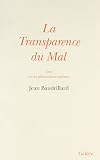
The Transparency of Evil: Essays on Extreme Phenomena
by Jean Baudrillard
On This Page
Description
In this, his most important collection of essays since Le systeme des objets, Jean Baudrillard contemplates Western culture "after the orgy"—the orgy, that is, of the revolutions of the 1960s. The sexual revolution has led, he argues, not to sexual liberation but to a reign of transvestism, to a confusion of the categories of man and woman—to the "androgenous and Frankenstein appeal of a Michael Jackson." The revolution in art has led to a "transaesthetic realm of indifference." The show more cybernetic revolution has blurred the distinction between man and machine, while the political revolution has led to a 'transpolitics' that merely simulates old political forms. Such are the points of Baudrillard's compass as he steers his way through the mental landscape of this febrile fin de siecle. show lessTags
Recommendations





























Member Reviews
The Transparency of Evil was written in the late 1980s, and first published in French in 1990. But as I read it in 2020 it often felt up-to-the-minute. It was hard to believe that some of these observations were not rooted in the internet-mediated social environment of the 21st century.
"This society now produces only ill-defined events whose ultimate clarification is unlikely. In earlier times an event was something that happened--now it is something that is designed to happen. It occurs, therefore, as a virtual artifact, as a reflection of pre-existing media-defined forms" (41). "The new technologies, with their new machines, new images and interactive screens, do not alienate me. Rather, they form an integrated circuit with me. ... show more We have left the hell of other people for the ecstasy of the same, the purgatory of otherness for the artificial paradises of identity" (58-9).
Moreover, Baudrillard's frequent attention to epidemics and virality, composed in the 1980s under the cognizance of AIDS, sounds today with the amplifying echoes of novel coronavirus. His identification of terrorism as the paradigmatic form of the "transpolitical" was likewise both current and prescient.
The book is divided into two parts. The first part is untitled but has epigrams relating to the book's subtitle of "extreme phenomena." It is chiefly oriented to describing a historical moment "after the orgy" of the liberation movements that followed the middle of the 20th century. He outlines a situation characterized by "gross systemic conjunction and malfunction caused by hypertelia--by an excess of functional imperatives, by a sort of saturation" (31).
In both the first and second parts of the book, Baudrillard references the work of the French ethnographer and critic Victor Segalen (1878–1919). While The Transparency of Evil is clearly informed by Baudrillard's own signature concepts of simulation, hyperreality, and so forth, these are not called out explicitly, and there is no scholarly intertextual apparatus.
Much as I enjoyed the first part of the book, I got more out of the shorter second part titled "Radical Otherness." In it, he returns to the theme of Evil that he raised late in the first part, and he coordinates this focus with a distinction between difference and otherness. Difference allows for, perhaps even demands, assimilation through the positing of a shared continuum, whereas otherness presents genuine discontinuity. Baudrillard identifies otherness with the foreign, and relates it to traditional concepts of hospitality. He proposes that ritual and seduction are counterstrategies by which the other can and will preserve itself in the face of coercive regimes of reconciliation.
"Whereas the Good presupposes a dialectical involvement of Evil, Evil is founded on itself alone, in pure incompatibility. Evil is thus master of the game, and it is the principle of Evil, the reign of eternal antagonism, that must eventually carry off the victory" (139). Is this--optimism? show less
"This society now produces only ill-defined events whose ultimate clarification is unlikely. In earlier times an event was something that happened--now it is something that is designed to happen. It occurs, therefore, as a virtual artifact, as a reflection of pre-existing media-defined forms" (41). "The new technologies, with their new machines, new images and interactive screens, do not alienate me. Rather, they form an integrated circuit with me. ... show more We have left the hell of other people for the ecstasy of the same, the purgatory of otherness for the artificial paradises of identity" (58-9).
Moreover, Baudrillard's frequent attention to epidemics and virality, composed in the 1980s under the cognizance of AIDS, sounds today with the amplifying echoes of novel coronavirus. His identification of terrorism as the paradigmatic form of the "transpolitical" was likewise both current and prescient.
The book is divided into two parts. The first part is untitled but has epigrams relating to the book's subtitle of "extreme phenomena." It is chiefly oriented to describing a historical moment "after the orgy" of the liberation movements that followed the middle of the 20th century. He outlines a situation characterized by "gross systemic conjunction and malfunction caused by hypertelia--by an excess of functional imperatives, by a sort of saturation" (31).
In both the first and second parts of the book, Baudrillard references the work of the French ethnographer and critic Victor Segalen (1878–1919). While The Transparency of Evil is clearly informed by Baudrillard's own signature concepts of simulation, hyperreality, and so forth, these are not called out explicitly, and there is no scholarly intertextual apparatus.
Much as I enjoyed the first part of the book, I got more out of the shorter second part titled "Radical Otherness." In it, he returns to the theme of Evil that he raised late in the first part, and he coordinates this focus with a distinction between difference and otherness. Difference allows for, perhaps even demands, assimilation through the positing of a shared continuum, whereas otherness presents genuine discontinuity. Baudrillard identifies otherness with the foreign, and relates it to traditional concepts of hospitality. He proposes that ritual and seduction are counterstrategies by which the other can and will preserve itself in the face of coercive regimes of reconciliation.
"Whereas the Good presupposes a dialectical involvement of Evil, Evil is founded on itself alone, in pure incompatibility. Evil is thus master of the game, and it is the principle of Evil, the reign of eternal antagonism, that must eventually carry off the victory" (139). Is this--optimism? show less
I am going to have to make an admission - I got through 80% of this before finally cracking and skim-reading the rest just so that I could go get a life. This is not to say that Baudrillard does not make some very interesting and fertile points but only that this is a dreadful presentation of them.
I suspect a certain type of continental philosophy groupie will have been slavering over this back in 1990 but it is mostly no more than an exercise in quasi-nihilist ranting by a grumpy old man whose gods had failed and who now wants to take this fact out on the world.
Where he scores is in being prescient about 'hyperreality' - the whizzy world of signs taking off into an unhinged world of their own. He would not have been surprised in the show more least, I suspect, by the emergence eventually of that artistic abortion, the mickey mouse NFT.
But there is more going on here than seeing what few saw then and what most of us see now - the imagined world of humanity detaching itself from humanity itself and even from material reality to spin completely out of control and create increasing levels of absurdity.
My view on this is relaxed and sanguine. This is what our species is. Some of it is only a democratisation of what once went on in aristocratic courts. It is absurd and wasteful but then that is what we humans and society are. There is no point in getting too gloomy about it.
Baudrillard, however, is a French intellectual. He takes everything dreadfully seriously. He has to explain it in abstract terms because if he does not do so what is his point. He has done structuralism, situationism and Marxism and been post-structuralist so where next?
As all his gods failed, he ages and humanity refuses to fit into any model he may come up with (he is clearly very cross that we are as we are) so he ends up with a sort of sub-Heideggerian mish-mash of personal near-nihilism and Lacanian reflections.
And the style? This is a rant in obscure tongue with the most strained and almost anthropomorphic uses of scientific theory to make his point as sets of extended metaphor. This is not philosophy - it needs to be filed under 'Experimental French Literature' instead.
The frustration is that there are some good ideas here that, if they were clearly expressed and less 'emotional' (the emotion masked by the claim to be a 'philosophe'), would help us understand better not only what we are but where we were going to go in the following thirty years.
As a description of the world and of our human nature it constantly just misses, not because he is 'wrong' but because he has let style and performance overwhelm the content and become, in fact, part of the problem he is describing rather than part of any possible solution.
He is, of course, a fatalist. He thinks there is no 'solution'. He may be right. If he is right, then perhaps acceptance is the best strategy. His raging against the dying of the light unfortunately suggests that tendency to moralism that is the most unattractive aspect of French thought.
He does not really like us and, because he cannot avoid being one of us by dint of being human, he logically does not like himself very much. Yet he is no Olympian in reality, able to look down upon us and himself from on high even if that is the pretension of the modern intellectual.
Nevertheless, Baudrillard has been influential and it is right that he has been. When you can get through the rant and obscurity and general guff, there is an analysis hidden here that escapes the nonsense about objects and subjects and mirrors and the repressed rage. It strikes home.
His cold rage expresses something lost which goes further than the loss of status and importance of the intellectual class (we suspect that this is a real driver here) but is a loss of the bounded-ness of being repressed and constrained by a world lost to us forever by technological innovation.
Humanity fears freedom because it does not know what to do with it. Baudrillard at least thinks about what we may become when abundance and freedom are general, a prospect that now looks theoretically possible with the emergence of artificial intelligence.
It is going to take nerves of steel for us to survive the arrival of true freedom. A lot of people are going to be broken during the transition. It is why so many older people find the miserable 1970s a matter for nostalgia - there was something to fight for and now we have it, it tastes ashen.
Baudrillard is also suggestive of something we have been seeing more of over the last decade - the revolt against reason, technocracy and the happiness-merchants as our impotence becomes increasingly demonstrable. Social bonds had created the illusion of potential agency.
Reason in society requires that everything be connected like Newton's clockwork universe. When reasoning heads for uncertainty as the norm and social bonds are unravelled, the belief that levers can be pulled by autonomous agents begins to die to be replaced by atoms in motion.
And that is what we and our environment have become - bodies and signs in constant motion, with an increasingly problematic relationship to trust because trusted connections have been broken. This is not going to get better in the coming age of deep fakery.
Some of Baudrillard's psychology is quite acute in this context - especially about our invention of -isms like racism that allows the scientific oppression of 'others' and the loss to us created by sexual freedoms that are illusory and have lost us the seductions enabled by difference.
There is social truth too. The sheer proliferation of forms and signs is noted although what we really need is an analysis of what this means in practice to the conduct of our lives rather than what we get ... an implicitly outraged 'horreur' at the facts of the matter.
We can safely say that we are now in the middle of what Tooze has called a 'polycrisis' whose nature lies (in part) in the fact that rampant proliferation has made it impossible for elites to control the Frankensteinian monsters they created out of neo-liberalism and liberal imperialism.
Baudrillard (rather typically) calls this proliferation cancerous and these are his best passages fairly early in the book. But, sadly, some very real insights are buried in 'style', obscurantist posturing, ranting and dubious analogy. show less
I suspect a certain type of continental philosophy groupie will have been slavering over this back in 1990 but it is mostly no more than an exercise in quasi-nihilist ranting by a grumpy old man whose gods had failed and who now wants to take this fact out on the world.
Where he scores is in being prescient about 'hyperreality' - the whizzy world of signs taking off into an unhinged world of their own. He would not have been surprised in the show more least, I suspect, by the emergence eventually of that artistic abortion, the mickey mouse NFT.
But there is more going on here than seeing what few saw then and what most of us see now - the imagined world of humanity detaching itself from humanity itself and even from material reality to spin completely out of control and create increasing levels of absurdity.
My view on this is relaxed and sanguine. This is what our species is. Some of it is only a democratisation of what once went on in aristocratic courts. It is absurd and wasteful but then that is what we humans and society are. There is no point in getting too gloomy about it.
Baudrillard, however, is a French intellectual. He takes everything dreadfully seriously. He has to explain it in abstract terms because if he does not do so what is his point. He has done structuralism, situationism and Marxism and been post-structuralist so where next?
As all his gods failed, he ages and humanity refuses to fit into any model he may come up with (he is clearly very cross that we are as we are) so he ends up with a sort of sub-Heideggerian mish-mash of personal near-nihilism and Lacanian reflections.
And the style? This is a rant in obscure tongue with the most strained and almost anthropomorphic uses of scientific theory to make his point as sets of extended metaphor. This is not philosophy - it needs to be filed under 'Experimental French Literature' instead.
The frustration is that there are some good ideas here that, if they were clearly expressed and less 'emotional' (the emotion masked by the claim to be a 'philosophe'), would help us understand better not only what we are but where we were going to go in the following thirty years.
As a description of the world and of our human nature it constantly just misses, not because he is 'wrong' but because he has let style and performance overwhelm the content and become, in fact, part of the problem he is describing rather than part of any possible solution.
He is, of course, a fatalist. He thinks there is no 'solution'. He may be right. If he is right, then perhaps acceptance is the best strategy. His raging against the dying of the light unfortunately suggests that tendency to moralism that is the most unattractive aspect of French thought.
He does not really like us and, because he cannot avoid being one of us by dint of being human, he logically does not like himself very much. Yet he is no Olympian in reality, able to look down upon us and himself from on high even if that is the pretension of the modern intellectual.
Nevertheless, Baudrillard has been influential and it is right that he has been. When you can get through the rant and obscurity and general guff, there is an analysis hidden here that escapes the nonsense about objects and subjects and mirrors and the repressed rage. It strikes home.
His cold rage expresses something lost which goes further than the loss of status and importance of the intellectual class (we suspect that this is a real driver here) but is a loss of the bounded-ness of being repressed and constrained by a world lost to us forever by technological innovation.
Humanity fears freedom because it does not know what to do with it. Baudrillard at least thinks about what we may become when abundance and freedom are general, a prospect that now looks theoretically possible with the emergence of artificial intelligence.
It is going to take nerves of steel for us to survive the arrival of true freedom. A lot of people are going to be broken during the transition. It is why so many older people find the miserable 1970s a matter for nostalgia - there was something to fight for and now we have it, it tastes ashen.
Baudrillard is also suggestive of something we have been seeing more of over the last decade - the revolt against reason, technocracy and the happiness-merchants as our impotence becomes increasingly demonstrable. Social bonds had created the illusion of potential agency.
Reason in society requires that everything be connected like Newton's clockwork universe. When reasoning heads for uncertainty as the norm and social bonds are unravelled, the belief that levers can be pulled by autonomous agents begins to die to be replaced by atoms in motion.
And that is what we and our environment have become - bodies and signs in constant motion, with an increasingly problematic relationship to trust because trusted connections have been broken. This is not going to get better in the coming age of deep fakery.
Some of Baudrillard's psychology is quite acute in this context - especially about our invention of -isms like racism that allows the scientific oppression of 'others' and the loss to us created by sexual freedoms that are illusory and have lost us the seductions enabled by difference.
There is social truth too. The sheer proliferation of forms and signs is noted although what we really need is an analysis of what this means in practice to the conduct of our lives rather than what we get ... an implicitly outraged 'horreur' at the facts of the matter.
We can safely say that we are now in the middle of what Tooze has called a 'polycrisis' whose nature lies (in part) in the fact that rampant proliferation has made it impossible for elites to control the Frankensteinian monsters they created out of neo-liberalism and liberal imperialism.
Baudrillard (rather typically) calls this proliferation cancerous and these are his best passages fairly early in the book. But, sadly, some very real insights are buried in 'style', obscurantist posturing, ranting and dubious analogy. show less
Jean Baudrillard was probably one of the contemporary French postmodern philosophers and sociologists whose ideas were most accessible (relatively speaking) and well-received in the United States. This was my first time reading Baudrillard first-hand, and some of the ideas were surprising. This book is from the Verso Radical Thinkers imprint, which always has me expecting politically revolutionary ideas, or overt Marxism, neither of which Baudrillard embraces. In fact, he explicitly identifies himself as a post-Marxist.
I sometimes have a problem with shorter pieces (not just in philosophy), and this book can at times seem to be a mile wide and only an inch deep. In only two-hundred pages, there are twenty-two chapters, although there show more are a few general ideas that he keeps hammering home: he is infatuated with scientific and especially medical metaphors, and continually uses them in trying to diagnose the postmodern society; AIDS, cancer, and computer viruses pop up over and over again throughout the essays. He argues that instead of destroying organisms, these things just change the way they function – AIDS inhibits sexual behavior, cancer is rooted in regular cellular division except that it has gone radically metastatic, et cetera. He also sees all areas of discourse which have previously been separated from one another as bleeding into one another indiscriminately: the aesthetic is now trans-aesthetic, the economic is now trans-economic, any formerly balkanized category can apply to anything else.
I mentioned Baudrillard’s post-Marxism earlier. In fact, he might even describe himself as post-political, since he seems to think that even politics itself has come to an end. Applying his idea of simulacra and simulation to the political sphere, he says “But what can we do? This is the state of simulation, a state in which we are obliged to replay all scenarios precisely because they have taken place already, whether actually or potentially. The state of utopia realized, of all utopias realized, wherein paradoxically we must continue to live as though they had not been. But since they have, and since we can no longer, therefore, nourish the hope of realizing them, we can only ‘hyper-realize’ them through interminable simulation” (p. 4). This almost reads like a conservative kind of cynicism or nihilism, which sort of caught me off guard.
Some of the observations struck me as bizarre and wrong-headed, like what he has to say about AIDS. “AIDS is not the reflection not so much of an excess of sex or sexual pleasure as of sex’s decompensation through its general spread into all areas of life, its venting through all the trivial variants of sexual incantation. The real loss of immunity concerns sex as a whole, with the disappearance of sexual difference and hence of sexuality per se. It is in this diffraction of the sexual reality principle, at the fractal, micrological and non-human level, that the essential confusion of the epidemic takes hold” (p. 9). I’m sorry, but this is simply false. The virus responsible for causing AIDS knows nothing about the “sexuality reality principle,” and even saying something like this sounds silly.
Sweeping statements like the one on AIDS occasionally stud and inevitably mar the power of any critical philosophy Baudrillard has to offer, if he wants to offer one at all. It makes for wonderfully audacious and exciting theory, but shoddy philosophy. Maybe Baudrillard wouldn’t draw such a definitive line between the two, but I think with the former, metaphorical or analogical thought can help push theory along into unknown realms and aid in understanding things in different ways. Philosophy, being more closely related to logic, has to be more careful. And Baudrillard is working analogically here: saying that X resembles A in some sense and Y resembles A in another sense, therefore X is Y. This opens up new vistas of understanding, but when presented as philosophy can do just as much to obscure as it can to clarify.
These quibbles aside, this is probably one of the better introductions to Baudrillard’s large output. You don’t have to be overly familiar with all of his work to walk away from the essays feeling that you’ve learned something about him. And for those just getting their feet wet, this isn’t full of the obfuscatory prose we’re familiar with from other continental philosophy “Of Grammatology” or “Difference and Repetition,” and for that we can all be grateful. show less
I sometimes have a problem with shorter pieces (not just in philosophy), and this book can at times seem to be a mile wide and only an inch deep. In only two-hundred pages, there are twenty-two chapters, although there show more are a few general ideas that he keeps hammering home: he is infatuated with scientific and especially medical metaphors, and continually uses them in trying to diagnose the postmodern society; AIDS, cancer, and computer viruses pop up over and over again throughout the essays. He argues that instead of destroying organisms, these things just change the way they function – AIDS inhibits sexual behavior, cancer is rooted in regular cellular division except that it has gone radically metastatic, et cetera. He also sees all areas of discourse which have previously been separated from one another as bleeding into one another indiscriminately: the aesthetic is now trans-aesthetic, the economic is now trans-economic, any formerly balkanized category can apply to anything else.
I mentioned Baudrillard’s post-Marxism earlier. In fact, he might even describe himself as post-political, since he seems to think that even politics itself has come to an end. Applying his idea of simulacra and simulation to the political sphere, he says “But what can we do? This is the state of simulation, a state in which we are obliged to replay all scenarios precisely because they have taken place already, whether actually or potentially. The state of utopia realized, of all utopias realized, wherein paradoxically we must continue to live as though they had not been. But since they have, and since we can no longer, therefore, nourish the hope of realizing them, we can only ‘hyper-realize’ them through interminable simulation” (p. 4). This almost reads like a conservative kind of cynicism or nihilism, which sort of caught me off guard.
Some of the observations struck me as bizarre and wrong-headed, like what he has to say about AIDS. “AIDS is not the reflection not so much of an excess of sex or sexual pleasure as of sex’s decompensation through its general spread into all areas of life, its venting through all the trivial variants of sexual incantation. The real loss of immunity concerns sex as a whole, with the disappearance of sexual difference and hence of sexuality per se. It is in this diffraction of the sexual reality principle, at the fractal, micrological and non-human level, that the essential confusion of the epidemic takes hold” (p. 9). I’m sorry, but this is simply false. The virus responsible for causing AIDS knows nothing about the “sexuality reality principle,” and even saying something like this sounds silly.
Sweeping statements like the one on AIDS occasionally stud and inevitably mar the power of any critical philosophy Baudrillard has to offer, if he wants to offer one at all. It makes for wonderfully audacious and exciting theory, but shoddy philosophy. Maybe Baudrillard wouldn’t draw such a definitive line between the two, but I think with the former, metaphorical or analogical thought can help push theory along into unknown realms and aid in understanding things in different ways. Philosophy, being more closely related to logic, has to be more careful. And Baudrillard is working analogically here: saying that X resembles A in some sense and Y resembles A in another sense, therefore X is Y. This opens up new vistas of understanding, but when presented as philosophy can do just as much to obscure as it can to clarify.
These quibbles aside, this is probably one of the better introductions to Baudrillard’s large output. You don’t have to be overly familiar with all of his work to walk away from the essays feeling that you’ve learned something about him. And for those just getting their feet wet, this isn’t full of the obfuscatory prose we’re familiar with from other continental philosophy “Of Grammatology” or “Difference and Repetition,” and for that we can all be grateful. show less
Ratings
Members
- Recently Added By
Author Information

167+ Works 11,661 Members
Jean Baudrillard (1929-2007) was a philosopher, sociologist, cultural critic, and theorist of postmodernity who challenged all existing theories of contemporary society with humor and precision. An outsider in the French intellectual establishment, he was internationally renowned as a twenty-first century visionary, reporter, and provocateur.
Series
Belongs to Publisher Series
Radical Thinkers (39 - Set 4(3))
Common Knowledge
- Original title
- La Transparence du Mal: Essai sur les Phénomenes
- Original publication date
- 1990
Classifications
Statistics
- Members
- 341
- Popularity
- 93,300
- Reviews
- 3
- Rating
- (3.95)
- Languages
- 11 — English, French, German, Hungarian, Italian, Japanese, Polish, Portuguese, Russian, Spanish, Turkish
- Media
- Paper
- ISBNs
- 14