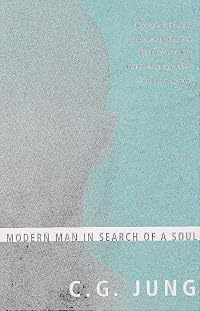
Modern Man in Search of a Soul
by C. G. Jung
On This Page
Description
*Modern Man in Search of a Soul* by Carl Jung is a well-known book in psychology that introduces readers to his key ideas. Jung explores many topics, including dream analysis, the purpose of psychotherapy, and his theory of personality types. He also discusses different stages of life, compares his ideas with Freuds, and reflects on psychologys connection to literature. Towards the end, Jung addresses the spiritual struggles of modern life after World War I, comparing it to ancient beliefs show more like gnosticism. He even touches on the role of therapists and their similarities to spiritual guides. This special edition is thoughtfully designed with large, easy-to-read fonts, ensuring a comfortable reading experience for everyone, especially those who prefer larger text. show lessTags
Recommendations











Member Reviews
The eleven chapters in this work are, save one, lectures delivered by Jung prior to its 1933 publication. Carl Jung snipes at times at the wide target of Freud’s narrowly focused psychology, such as observing that free association merely leads to projecting one’s own complexes. But, at times it seems the crowded dreamscape of Jung’s own archetypes may be a projection of his own issues. Still, I enjoy reading vintage Jung since his relentless probing of the human psyche seems to have given him a sagacity causing such wise observation as from "Stages of Life,"
"The nearer we approach to the middle of life, and the better we have succeeded in entrenching ourselves in our personal attitudes and social positions, the more it appears as show more if we had discovered the right course and the right ideals and principles of behavior. For this reason we suppose them to be eternally valid, and make a virtue of unchangeably clinging to them. We overlook the essential fact that the social goal is attained only at the cost of a diminution of personality. Many -- far too many -- aspects of life which should also have been experienced lie in the lumber-room among dusty memories; but sometimes, too, they are glowing coals under grey ashes."
And from “Psychology and Literature”: “It is always dangerous to speak of one’s own times, because what is at stake in the present is too vast for comprehension.”
I also love his take on the criticism process: “The truth is that poets are human beings, and that what a poet has to say about his is often far from being the most illuminating word on the subject. What is required of us, then, is nothing less than to defend the importance of the visionary experience against the poet himself… the personal life of the poet cannot be held essential to his art — but at most a help or a hindrance to his creative task. He may go the way of a Philistine, a good citizen, a neurotic, a fool or a criminal. His personal career may be inevitable and interesting, but it does not explain the poet."
Jung also dives into the materialism vs. dualism argument: “The objection has already been raised that this approach reduces psychic happenings to a kind of activity of the glands; thoughts are regarded as secretions of the brain, and so we achieve a psychology without the psyche. From this standpoint, it must be confessed, the psyche does not exist in its own right; it is nothing in itself, but is the mere expression of physical processes. That these processes have the qualities of consciousness is just an irreducible fact — were it otherwise, so the argument runs, we could not speak of the psyche at all; there would be no consciousness, and so we should have nothing to say about anything. Consciousness, therefore, is taken as the sine qua non of psychic life — that is to say, as the psyche itself. And so it comes about that all modern "psychologies without the psyche” are studies of consciousness which ignore the existence of unconscious psychic life.” Thus, Jung is revealed as a subtle spiritualist.
Finally, from “The Basic Postulates of Analytical Psychology”, Chapter IX of Modern Man in Search of a Soul, Jung nearly wins me over to his archetypes idea. Perhaps it is true … indulging and reading his arguments reminds me of the feeling I get watching a really good cable TV U.F.O. documentary, I want to believe:
“It would be positively grotesque for us to call this immense system of experience of the unconscious psyche an illusion, for our visible and tangible body itself is just such a system. It still carries within it the discernible traces of primeval evolution, and it is certainly a whole that functions purposively — for otherwise we could not live. It would never occur to anyone to look upon comparative anatomy or physiology as nonsense. And so we cannot dismiss the collective unconscious as illusion, or refuse to recognize and study it as a valuable source of knowledge…
It would certainly show perversity if we tried to explain the lives of our ancestors in terms of their late descendants; and it is just as wrong, in my opinion, to regard the unconscious as a derivative of consciousness. We are nearer the truth if we put it the other way round.” show less
"The nearer we approach to the middle of life, and the better we have succeeded in entrenching ourselves in our personal attitudes and social positions, the more it appears as show more if we had discovered the right course and the right ideals and principles of behavior. For this reason we suppose them to be eternally valid, and make a virtue of unchangeably clinging to them. We overlook the essential fact that the social goal is attained only at the cost of a diminution of personality. Many -- far too many -- aspects of life which should also have been experienced lie in the lumber-room among dusty memories; but sometimes, too, they are glowing coals under grey ashes."
And from “Psychology and Literature”: “It is always dangerous to speak of one’s own times, because what is at stake in the present is too vast for comprehension.”
I also love his take on the criticism process: “The truth is that poets are human beings, and that what a poet has to say about his is often far from being the most illuminating word on the subject. What is required of us, then, is nothing less than to defend the importance of the visionary experience against the poet himself… the personal life of the poet cannot be held essential to his art — but at most a help or a hindrance to his creative task. He may go the way of a Philistine, a good citizen, a neurotic, a fool or a criminal. His personal career may be inevitable and interesting, but it does not explain the poet."
Jung also dives into the materialism vs. dualism argument: “The objection has already been raised that this approach reduces psychic happenings to a kind of activity of the glands; thoughts are regarded as secretions of the brain, and so we achieve a psychology without the psyche. From this standpoint, it must be confessed, the psyche does not exist in its own right; it is nothing in itself, but is the mere expression of physical processes. That these processes have the qualities of consciousness is just an irreducible fact — were it otherwise, so the argument runs, we could not speak of the psyche at all; there would be no consciousness, and so we should have nothing to say about anything. Consciousness, therefore, is taken as the sine qua non of psychic life — that is to say, as the psyche itself. And so it comes about that all modern "psychologies without the psyche” are studies of consciousness which ignore the existence of unconscious psychic life.” Thus, Jung is revealed as a subtle spiritualist.
Finally, from “The Basic Postulates of Analytical Psychology”, Chapter IX of Modern Man in Search of a Soul, Jung nearly wins me over to his archetypes idea. Perhaps it is true … indulging and reading his arguments reminds me of the feeling I get watching a really good cable TV U.F.O. documentary, I want to believe:
“It would be positively grotesque for us to call this immense system of experience of the unconscious psyche an illusion, for our visible and tangible body itself is just such a system. It still carries within it the discernible traces of primeval evolution, and it is certainly a whole that functions purposively — for otherwise we could not live. It would never occur to anyone to look upon comparative anatomy or physiology as nonsense. And so we cannot dismiss the collective unconscious as illusion, or refuse to recognize and study it as a valuable source of knowledge…
It would certainly show perversity if we tried to explain the lives of our ancestors in terms of their late descendants; and it is just as wrong, in my opinion, to regard the unconscious as a derivative of consciousness. We are nearer the truth if we put it the other way round.” show less
Modern Man in Search of a Soul collects ten lectures on psychotherapy, cultural mentalities, and religion, given by Jung in the late inter-war period. They were translated into English by Baynes in 1933 and supplemented with an essay by Jung on the distinctions between his psychology and that of Freud. My copy is a Harvest/HBJ mass-market paperback that I can easily imagine littering college campuses in the 1960s.
Jung says,"To the psyche, the spirit is no less the spirit even though it be called sexuality" (73), and in this point he seems to be opposing the Freudian focus on "sexuality" to Jung's own preference for construing issues in terms of "spirit." The key subtext here, however, is the critical identity and continuity between show more spiritual and sexual phenomena. Since Jung avoids mentioning sex at least as often as Freud insists upon it, this continuity is useful to keep in mind when reading either thinker.
Although I have been accustomed to seeing Jung as the primary representative of the "right wing" of the psychoanalytic tradition (contrasted with Reich and Marcuse on the left), there are passages here which prompt me to suspend that judgment. For example he declares, "My aim is to bring about a psychic state in which my patient begins to experiment with his own nature--a state of fluidity, change and growth, in which there is no longer anything eternally fixed and hopelessly petrified" (66). Thus Jung identifies his therapeutic goal with the loosening of character, and the subjection of identity to a changeable individual will.
In the lecture "The Stages of Life," Jung presents a theory of climacteric personal development. Very significantly he uses a solar metaphor identifying birth with dawn and death with sunset. He also remarks--with particular reference to his patients--that 20th-century Western culture suffers a poverty of institutions capable of psychically orienting individuals to the "afternoon" of life, and claims that "Our religions were always such schools in the past" (109). In this last point, I think he errs. Religions have always had a much wider range of functions, and it is in particular the orders of initiation (most often embedded in religious contexts) that supplied the desideratum.
The individual passage of the book that made the most striking impression on me was in "The Basic Postulates of Analytical Psychology," where I take Jung to be painting an eloquent picture of what Eliphas Levi called The Baphomet of Mendes, a pantheistic and magical figure of the absolute: "If it were permissible to personify the unconscious, we might call it a collective human being combining the characteristics of both sexes, transcending youth and age, birth and death, and, from having at his command a human experience of one or two million years, almost immortal. If such a being existed, he would be exalted above all temporal change ... he would be a dreamer of age-old dreams and, owing to his immeasurable experience, he would be an incomparable prognosticator. He would have lived countless times over the life of the individual, of the family, tribe and people, and he would possess the living sense of the rhythm of growth, flowering, and decay" (186).
Lectures of less esoteric interest include "Aims of Psychotherapy," which elaborates a context in which to situate Freudian, Adlerian, and Jungian approaches to the discipline, as well as "A Psychological Theory of Types," which expands Jung's introversion/extraversion polarity with the two additional dimensions of thinking/feeling and sensation/intuition, but without the perception/judging axis that would complete them in the now-ubiquitous MBTI. The lecture "Psychology and Literature" focuses on visionary literature, and is thus actually more concerned with spiritual states and phenomena than literary production as such. It even touches on one of my particular favorite works in this vein, the Hypnerotomachia Poliphili (157, 166).
The book's final two chapters stand out for Jung's discussion of religion as a barometer of collective spiritual states. In "The Spiritual Problem of Modern Man" he discusses the "deep affinity with Gnosticism" expressed by contemporary spirituality, and he also treats at length the extent to which the "repellent" strains of occultism, Theosophy, and imported Oriental mysticisms both demonstrate the obsolescence of established religious forms and may serve as the seedbeds for their successors. "Psychotherapists or the Clergy?" treats the conundrum of secular psychotherapists being preferred to clergy by clients whose actual demand is for what traditionally would have been considered spiritual direction. show less
Jung says,"To the psyche, the spirit is no less the spirit even though it be called sexuality" (73), and in this point he seems to be opposing the Freudian focus on "sexuality" to Jung's own preference for construing issues in terms of "spirit." The key subtext here, however, is the critical identity and continuity between show more spiritual and sexual phenomena. Since Jung avoids mentioning sex at least as often as Freud insists upon it, this continuity is useful to keep in mind when reading either thinker.
Although I have been accustomed to seeing Jung as the primary representative of the "right wing" of the psychoanalytic tradition (contrasted with Reich and Marcuse on the left), there are passages here which prompt me to suspend that judgment. For example he declares, "My aim is to bring about a psychic state in which my patient begins to experiment with his own nature--a state of fluidity, change and growth, in which there is no longer anything eternally fixed and hopelessly petrified" (66). Thus Jung identifies his therapeutic goal with the loosening of character, and the subjection of identity to a changeable individual will.
In the lecture "The Stages of Life," Jung presents a theory of climacteric personal development. Very significantly he uses a solar metaphor identifying birth with dawn and death with sunset. He also remarks--with particular reference to his patients--that 20th-century Western culture suffers a poverty of institutions capable of psychically orienting individuals to the "afternoon" of life, and claims that "Our religions were always such schools in the past" (109). In this last point, I think he errs. Religions have always had a much wider range of functions, and it is in particular the orders of initiation (most often embedded in religious contexts) that supplied the desideratum.
The individual passage of the book that made the most striking impression on me was in "The Basic Postulates of Analytical Psychology," where I take Jung to be painting an eloquent picture of what Eliphas Levi called The Baphomet of Mendes, a pantheistic and magical figure of the absolute: "If it were permissible to personify the unconscious, we might call it a collective human being combining the characteristics of both sexes, transcending youth and age, birth and death, and, from having at his command a human experience of one or two million years, almost immortal. If such a being existed, he would be exalted above all temporal change ... he would be a dreamer of age-old dreams and, owing to his immeasurable experience, he would be an incomparable prognosticator. He would have lived countless times over the life of the individual, of the family, tribe and people, and he would possess the living sense of the rhythm of growth, flowering, and decay" (186).
Lectures of less esoteric interest include "Aims of Psychotherapy," which elaborates a context in which to situate Freudian, Adlerian, and Jungian approaches to the discipline, as well as "A Psychological Theory of Types," which expands Jung's introversion/extraversion polarity with the two additional dimensions of thinking/feeling and sensation/intuition, but without the perception/judging axis that would complete them in the now-ubiquitous MBTI. The lecture "Psychology and Literature" focuses on visionary literature, and is thus actually more concerned with spiritual states and phenomena than literary production as such. It even touches on one of my particular favorite works in this vein, the Hypnerotomachia Poliphili (157, 166).
The book's final two chapters stand out for Jung's discussion of religion as a barometer of collective spiritual states. In "The Spiritual Problem of Modern Man" he discusses the "deep affinity with Gnosticism" expressed by contemporary spirituality, and he also treats at length the extent to which the "repellent" strains of occultism, Theosophy, and imported Oriental mysticisms both demonstrate the obsolescence of established religious forms and may serve as the seedbeds for their successors. "Psychotherapists or the Clergy?" treats the conundrum of secular psychotherapists being preferred to clergy by clients whose actual demand is for what traditionally would have been considered spiritual direction. show less
It's been almost eighty years since Carl Jung wrote "Modern Man in Search of a Soul," so it's not really surprising that some of the book's value is purely historical. Jung spends a lot of time carefully differentiating psychology from medical and arguing for its rigorousness and relevance. Even though a lot of this material will seem familiar to Western readers who've grown up in "psychologized" societies, it's still genuinely heartwarming to witness Jung's enthusiasm for psychic exploration. I get the impression that he saw the unconscious as a genuinely undiscovered territory brimming with wonders yet to be described. He was one of the founders of the science he described, but in "Modern Man," he makes it clear that he couldn't even show more venture a guess at all that the psyche contains. His sense of wonder is contagious; if nothing else, these essays remind the reader of the vast depth of the self and of the sheer variety of human experience.
The sections that I found most of "Modern Man in Search of a Soul" that I found most interesting were contained in the essays "Archaic Man" and "The Spiritual Problem of Modern Man." Part of this book's project seems to be to nudge Western, scientific models of the self from their preeminent position at the very center of modernity, and Jung writes sensitively of the time that he spent with indigenous tribes in sub-Saharan Africa and the American West. These experiences led Jung to conclude that the psyche exists, in a sense, both inside and outside ourselves. In his view, modern man's dependence on natural science to describe the physical world necessitated the development of an unconscious. In earlier eras, religion or an active relationship with the spirit world did the work that we now attribute to our unconscious self. Hysterias and many other common mental disorders, then, might be understood as externalized psychological objects. I found Jung's inversion of the usual psychological schematic – his contention that a person's unconscious is just one psychological object in a world filled with them – to be absolutely thrilling, an enormous idea and one that might change the way I look at myself and others. These essays, which are, as the jacket copy promises, accessible to the lay reader, bear repeated readings. If Jung believed in anything, he believed in the vastness and complexity of the self. With this in mind, it might just take a few decades for me to figure out how some of his ideas apply to my own day-to-day experience. show less
The sections that I found most of "Modern Man in Search of a Soul" that I found most interesting were contained in the essays "Archaic Man" and "The Spiritual Problem of Modern Man." Part of this book's project seems to be to nudge Western, scientific models of the self from their preeminent position at the very center of modernity, and Jung writes sensitively of the time that he spent with indigenous tribes in sub-Saharan Africa and the American West. These experiences led Jung to conclude that the psyche exists, in a sense, both inside and outside ourselves. In his view, modern man's dependence on natural science to describe the physical world necessitated the development of an unconscious. In earlier eras, religion or an active relationship with the spirit world did the work that we now attribute to our unconscious self. Hysterias and many other common mental disorders, then, might be understood as externalized psychological objects. I found Jung's inversion of the usual psychological schematic – his contention that a person's unconscious is just one psychological object in a world filled with them – to be absolutely thrilling, an enormous idea and one that might change the way I look at myself and others. These essays, which are, as the jacket copy promises, accessible to the lay reader, bear repeated readings. If Jung believed in anything, he believed in the vastness and complexity of the self. With this in mind, it might just take a few decades for me to figure out how some of his ideas apply to my own day-to-day experience. show less
Ugh. I get it, it’s important, a seminal text. But i found it dry, dated, and self-absorbed….
Modern Man in Search of a Soul is the basic introduction to the thought of Carl Gustav Jung, who, with Freud and Addler, was one of the chief founders of modern psychiatry.
In this book Jung examines some of the most contested and crucial areas in the field of analytical psychology: dream analysis, the primitive unconsious, and the relationship between psychology and religion. In addition, there is in this volume an analytical account of the differences between the theories of Jung and Freud.
'No one who is interested in modern scientific thought can afford to miss this brilliant, literally soul-searching volume.'-The New York Times
'The book is an exciting one, with something to say to every thoughtful person who has had his own show more experience in spiritual chaos'-New York Post
Contents
1 Dream analysis in its practical application
2 Problems of modern psychotherapy
3 The aims of psychotherapy
4 A psychological theory of types
5 The states of life
6 Freud and Jung-Contrasts
7 Archaic man
8 Psychology and literature
9 The basic postulates of analytical psychology
10 The spiritual problem of modern man
11 Psychotherapists or the clergy show less
In this book Jung examines some of the most contested and crucial areas in the field of analytical psychology: dream analysis, the primitive unconsious, and the relationship between psychology and religion. In addition, there is in this volume an analytical account of the differences between the theories of Jung and Freud.
'No one who is interested in modern scientific thought can afford to miss this brilliant, literally soul-searching volume.'-The New York Times
'The book is an exciting one, with something to say to every thoughtful person who has had his own show more experience in spiritual chaos'-New York Post
Contents
1 Dream analysis in its practical application
2 Problems of modern psychotherapy
3 The aims of psychotherapy
4 A psychological theory of types
5 The states of life
6 Freud and Jung-Contrasts
7 Archaic man
8 Psychology and literature
9 The basic postulates of analytical psychology
10 The spiritual problem of modern man
11 Psychotherapists or the clergy show less
Haven't quite finished it yet, but I'm giving it a solid four. It's Jung. It's all about the dreams. That's all I want to say.
A quote from this book:
"Among all my patienrs in the second half of life, that is, over thirty-five, there has not been one whose problem in the last resort was not that of finding a religious outlook on life. It is safe to say that every one of them fell ill because he had lost that which the living religions of every age have given their followers, and none of them has really been healed who did not regain his religious outlook."
"Among all my patienrs in the second half of life, that is, over thirty-five, there has not been one whose problem in the last resort was not that of finding a religious outlook on life. It is safe to say that every one of them fell ill because he had lost that which the living religions of every age have given their followers, and none of them has really been healed who did not regain his religious outlook."
Members
- Recently Added By
Lists

Jordan B. Peterson's Recommended Books
104 works; 5 members

My List
302 works; 1 member
Author Information

901+ Works 42,813 Members
Carl Gustav Jung was born in Switzerland on July 26, 1875. He originally set out to study archaeology, but switched to medicine and began practicing psychiatry in Basel after receiving his degree from the University of Basel in 1902. He became one of the most famous of modern psychologists and psychiatrists. Jung first met Sigmund Freud in 1907 show more when he became his foremost associate and disciple. The break came with the publication of Jung's Psychology of the Unconscious (1912), which did not follow Freud's theories of the libido and the unconscious. Jung eventually rejected Freud's system of psychoanalysis for his own "analytic psychology." This emphasizes present conflicts rather than those from childhood; it also takes into account the conflict arising from what Jung called the "collective unconscious"---evolutionary and cultural factors determining individual development. Jung invented the association word test and contributed the word complex to psychology, and first described the "introvert" and "extrovert" types. His interest in the human psyche, past and present, led him to study mythology, alchemy, oriental religions and philosophies, and traditional peoples. Later he became interested in parapsychology and the occult. He thought that unidentified flying objects (UFOs) might be a psychological projection of modern people's anxieties. He wrote several books including Studies in Word Association, Flying Saucers: A Modern Myth of Things Seen in the Skies, and Psychology and Alchemy. He died on June 6, 1961 after a short illness. (Bowker Author Biography) show less
Some Editions
Series
Belongs to Publisher Series
Harvest Books (HB 2)
Work Relationships
Has as a student's study guide
Common Knowledge
- Canonical title*
- Los complejos y el inconsciente
- Original publication date
- 1933
- First words
- The use of dream-analysis in psychotherapy is still a much-debated question.
- Last words
- (Click to show. Warning: May contain spoilers.)Measured against it, the names and forms which men have given it mean little enough; they are only the changing leaves and blossoms on the stem of the eternal tree.
*Some information comes from Common Knowledge in other languages. Click "Edit" for more information.
Classifications
- Genres
- Nonfiction, General Nonfiction, Philosophy, Religion & Spirituality
- DDC/MDS
- 150.19 — Philosophy & psychology Psychology Emotions, Relationships, & Family Theory And Instruction Systems, schools, viewpoints
- LCC
- BF173 .J74 — Philosophy, Psychology and Religion Psychology Psychology Psychoanalysis
- BISAC
Statistics
- Members
- 2,167
- Popularity
- 9,418
- Reviews
- 15
- Rating
- (3.93)
- Languages
- 6 — Czech, English, French, Russian, Spanish, Swedish
- Media
- Paper, Audiobook, Ebook
- ISBNs
- 38
- ASINs
- 38