Let It Shine: Stories of Black Women Freedom Fighters
by Andrea Davis Pinkney
On This Page
Description
Tells the stories of ten African-American women freedom fighters.Tags
Recommendations
Member Reviews
Pinkney (Silent Thunder) presents eloquent portraits of 10 intrepid African-American activists for the causes of abolition, women's rights and civil rights. Exploring these individuals' childhoods as well as their accomplishments as adults, the author smoothly distills biographical information so as to hold the attention of young readers. Her selection of subjects includes the prominent (Sojourner Truth, Harriet Tubman, Rosa Parks and Shirley Chisholm) as well as such lesser-knowns as Fannie Lou Hamer, an indefatigable campaigner for African-Americans' right to vote. Pinkney's writing is spiced with colloquialisms ("She didn't shy back for nobody," she says of Sojourner Truth) and useful imagery (describing this same crusader's delivery show more of her renowned "Ain't I a woman?" speech, the author notes, "She was the only black woman in the place, and when she stepped to the pulpit, some folks looked at her like she was a stain on their purest linens"). Featuring creatively skewed perspective and proportion, Alcorn's (I, Too, Sing America) oil paintings offer allegorical interpretations of his subjects' lives.
TCI LESSON 3: THE PEOPLING OF THE US show less
TCI LESSON 3: THE PEOPLING OF THE US show less
Let It Shine: Stories of Black Women Freedom Fighters is a book valuable for its condensed collection of pioneering African American Women throughout the United States. The women were carefully selected by Andera Davis Pinkney to represent an influencial group of women who span American history from Sojourner Truth born in 1797 to Shirley Chisholm in 1924. Each biography serves as a brief synopsis of the subjects moved forward by the current of how and why civil rights shaped their lives, and in turn, how these women paved the way for others. There are ten biographies in total, eleven if you count 'This Little Light of Mine,' the introduction by Pickny in which she describes her family's involvement with the civil rights movement, their show more influence on her, and how that perspective urged her to write this book and shead light on the struggle for racial and gender equality.
Each vignette is only a couple pages, thus serving better as a brief intorduction to these extrodinary women, hopefully prompting furhter study and investigation. In the back of the book there are two meager pages of further suggested reading. The book fails to offer much depth, nor does it provide a new perspective or information. However, despite adhearing to tried and established fact and format, the last sentence of the book, whether intentional or not, poses a question which warrents further consideration, conversation and and research. "Shirley [Chisholm] was right: America was changing." Using the book as a guide, it would be beneficial to ask students to examine not only how the United States has changed in regards to policies and attitudes towards once marginalized populations, but also is that attitude still evolvinging and in what ways. Are there still groups fighting for their rights? Who are the leaders of today and against whom or what are they fighting? show less
Each vignette is only a couple pages, thus serving better as a brief intorduction to these extrodinary women, hopefully prompting furhter study and investigation. In the back of the book there are two meager pages of further suggested reading. The book fails to offer much depth, nor does it provide a new perspective or information. However, despite adhearing to tried and established fact and format, the last sentence of the book, whether intentional or not, poses a question which warrents further consideration, conversation and and research. "Shirley [Chisholm] was right: America was changing." Using the book as a guide, it would be beneficial to ask students to examine not only how the United States has changed in regards to policies and attitudes towards once marginalized populations, but also is that attitude still evolvinging and in what ways. Are there still groups fighting for their rights? Who are the leaders of today and against whom or what are they fighting? show less
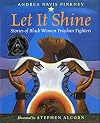
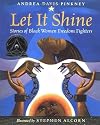
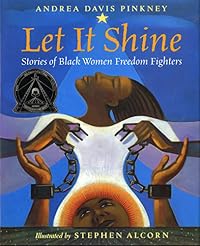
Andrea Pinkney is from the African American Authors for Children slide of this week’s lecture. I was drawn to the artwork of the cover, but the copy I found at my library has a different, but equally powerful, image of a black woman breaking the chains of another’s shackled hands. It opens with a passage from the author set in Washington D.C. in 1963. Apparently she was one month from being born, and her parents were listening to Dr. Martin Luther King Jr.’s “I Have a Dream Speech”, her father at the actual rally, and her mother watching in on television. Throughout this passage, the reader is familiarized with the names associated with the African American struggle in the US- the NAACP, Jesse Jackson, and Dorothy Height, and show more we learn that the author has an emotional connection to this material because she experienced it.
Throughout the book we learn the stories of 10 African American women in history who have shown the courage to defend their civil rights against inequality, oppression, prejudice, and fear: Sojourner “Bella” Truth, Biddy Mason, Harriet Tubman, Ida B. Wells-Barnett, Mary McLeod Bethune, Ella Josephine Baker, Dorothy Irene Height, Rosa Parks, Fannie Lou Hamer, and Shirley Chisholm.
This compilation would be valuable in expressing and teaching about diversity in the classroom because it speaks to African Americans and women. Though the treatment of slaves is not anything our children will have to personally experience, they will feel empathy when they read of little girls being beaten and sold from their families. Hopefully children will feel inspired from these stories to stand up for themselves and each other. show less
Throughout the book we learn the stories of 10 African American women in history who have shown the courage to defend their civil rights against inequality, oppression, prejudice, and fear: Sojourner “Bella” Truth, Biddy Mason, Harriet Tubman, Ida B. Wells-Barnett, Mary McLeod Bethune, Ella Josephine Baker, Dorothy Irene Height, Rosa Parks, Fannie Lou Hamer, and Shirley Chisholm.
This compilation would be valuable in expressing and teaching about diversity in the classroom because it speaks to African Americans and women. Though the treatment of slaves is not anything our children will have to personally experience, they will feel empathy when they read of little girls being beaten and sold from their families. Hopefully children will feel inspired from these stories to stand up for themselves and each other. show less
It would be hard to write this book. There are so many important people in African American history, how would anyone choose just a few women to write about? Andrea Davis Pinkney has taken this challenge and to me it falls a little flat. When I knew the story a woman she was discussing, the narrative felt too familiar and I learned nothing new. When I knew nothing about a woman Pinkney was detailing, it felt too short and rushed. I would probably only use this as a jumping off point for research with students. It is not something that would give them enough information to really dig deeper.
The lives of ten brave women -- including Rosa Parks, Harriet Tubman and Shirley Chisholm, Sojourner Truth, Fannie Lou Hamer - are part of an incredible story about courage in the face of oppression; about the challenges and triumphs of the battle for civil rights; and about speaking out for what you believe in--even when it feels like no one is listening.
Pinkney, A.D. (2000). Let It Shine: Stories of Black Women Freedom Fighters. New York: Harcourt, Inc.
015201005x
Oh, that Pinkney family. One after another, successful children’s authors and illustrators.
A Coretta Scott King Honor book, Let It Shine chronologically shares the stories of ten black woman who have fought for freedom and civil rights throughout American history. The stories are not so much complete biographical accounts of the women, but rather use child-friendly language to share relevant aspects of their lives. While the accounts are organized chronologically, but do incorporate some overlap in time and even interaction.
Let It Shine does include some well-known freedom fighters, but it also incorporates many show more lesser-known women whose stories are important to know. One of the ways to make this book particularly relevant to current events, is through the account of Shirley Chisholm’s political experiences and run for the Presidency. Pinkney was wise (lucky?) enough to feature Chisholm’s quote “Someday, somewhere, somehow, someone other than a white male could be President” (p. 95). Pinkney goes on to include in her conclusion to Chisholm “It proved to everyone else that a little girl from Brooklyn , whose parents could not afford to buy a home, could dare to dream of becoming the number-one tenant of the White House. Shirley had been right: America was changing” (p. 104). Hahaha. And America kept on changing…preparing for Obama to step into that White House. Wonderful conversation starter.
Each account shares only a few if any historical dates or events beyond the dates of birth and death, so a teacher would have to provide support over the setting and significant influences of the time (or have students research them in groups).
The illustrations are bright, colorful and often metaphorical. And while there are not pictures present on every page, enough are distributed throughout the chapters to provide students with breaks and keep them motivated.
Activities to do with the book:
If students were assigned to do reports or presentations on these women, the relevant chapter for that student could be invaluable. A teacher could also incorporate facts from this book into their history lessons.
A teacher could draw out the fact that several of these women had to drop out of school as young children and work to help keep their families together (Fannie Lou Hamer is one example). This fact could help get students to contemplate the evolving expectations and treatments of children throughout history.
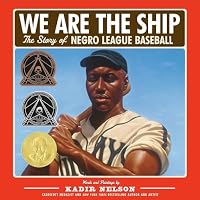
Students could examine this book (or Nelson’s We Are the Ship, reviewed previously) for personalized language that helps make information books like these ones seem more engaging and familiar.
This is a great resource to keep on the shelf as a reference book or to assign to students on a chapter-by-chapter basis or as recommended reading.
Favorite Quotes:
“On August 28, 1963, one month before I was born, my father stood on Washington D.C.’s great lawn and listened with rapt attention to Dr. Martin Luther King Jr. delivering his unforgettable “I Have a Dream” speech. Just blocks away, in my parents’ tiny apartment in southeast Washington, my pregnant mother watched the history-making even on television. Mom says I kicked and squirmed inside her belly throughout Dr. King’s powerful speech. And though I was yet to be born, the March on Washington became my earliest experience with the civil rights movement. But there would be countless others” (p. ix).
“[Soujourner Truth]’s voice to a fiery boom of truth—her truth…”You say Jesus was a man, so that means God favors men over women. Where did your Christ come from?” she asked. Then she summoned her father’s backbone strength and stood tall to answer her own question. “Jesus came from God and a woman. Man had nothing to do with him” (pp. 6-7).
“By this time America had slipped into what was called the Great Depression. Times were hard; there weren’t many jobs. Formerly rich folks and poor folks, black folks and white folks, stood together in the same unemployment lines” (p. 49).
For more of my reviews, visit sjkessel.blogspot.com. show less
015201005x
Oh, that Pinkney family. One after another, successful children’s authors and illustrators.
A Coretta Scott King Honor book, Let It Shine chronologically shares the stories of ten black woman who have fought for freedom and civil rights throughout American history. The stories are not so much complete biographical accounts of the women, but rather use child-friendly language to share relevant aspects of their lives. While the accounts are organized chronologically, but do incorporate some overlap in time and even interaction.
Let It Shine does include some well-known freedom fighters, but it also incorporates many show more lesser-known women whose stories are important to know. One of the ways to make this book particularly relevant to current events, is through the account of Shirley Chisholm’s political experiences and run for the Presidency. Pinkney was wise (lucky?) enough to feature Chisholm’s quote “Someday, somewhere, somehow, someone other than a white male could be President” (p. 95). Pinkney goes on to include in her conclusion to Chisholm “It proved to everyone else that a little girl from Brooklyn , whose parents could not afford to buy a home, could dare to dream of becoming the number-one tenant of the White House. Shirley had been right: America was changing” (p. 104). Hahaha. And America kept on changing…preparing for Obama to step into that White House. Wonderful conversation starter.
Each account shares only a few if any historical dates or events beyond the dates of birth and death, so a teacher would have to provide support over the setting and significant influences of the time (or have students research them in groups).
The illustrations are bright, colorful and often metaphorical. And while there are not pictures present on every page, enough are distributed throughout the chapters to provide students with breaks and keep them motivated.
Activities to do with the book:
If students were assigned to do reports or presentations on these women, the relevant chapter for that student could be invaluable. A teacher could also incorporate facts from this book into their history lessons.
A teacher could draw out the fact that several of these women had to drop out of school as young children and work to help keep their families together (Fannie Lou Hamer is one example). This fact could help get students to contemplate the evolving expectations and treatments of children throughout history.
Students could examine this book (or Nelson’s We Are the Ship, reviewed previously) for personalized language that helps make information books like these ones seem more engaging and familiar.
This is a great resource to keep on the shelf as a reference book or to assign to students on a chapter-by-chapter basis or as recommended reading.
Favorite Quotes:
“On August 28, 1963, one month before I was born, my father stood on Washington D.C.’s great lawn and listened with rapt attention to Dr. Martin Luther King Jr. delivering his unforgettable “I Have a Dream” speech. Just blocks away, in my parents’ tiny apartment in southeast Washington, my pregnant mother watched the history-making even on television. Mom says I kicked and squirmed inside her belly throughout Dr. King’s powerful speech. And though I was yet to be born, the March on Washington became my earliest experience with the civil rights movement. But there would be countless others” (p. ix).
“[Soujourner Truth]’s voice to a fiery boom of truth—her truth…”You say Jesus was a man, so that means God favors men over women. Where did your Christ come from?” she asked. Then she summoned her father’s backbone strength and stood tall to answer her own question. “Jesus came from God and a woman. Man had nothing to do with him” (pp. 6-7).
“By this time America had slipped into what was called the Great Depression. Times were hard; there weren’t many jobs. Formerly rich folks and poor folks, black folks and white folks, stood together in the same unemployment lines” (p. 49).
For more of my reviews, visit sjkessel.blogspot.com. show less
I think that this book is a fantastic source for young children to read about the women who were instrumental in the end of slavery and the beginning of equality. It has portraits of the women.
Members
- Recently Added By
Lists

Youth: BLM
265 works; 1 member
Author Information

59+ Works 12,572 Members
All Editions
Awards and Honors
Awards
Distinctions
Common Knowledge
Classifications
Statistics
- Members
- 430
- Popularity
- 71,225
- Reviews
- 19
- Rating
- (4.08)
- Languages
- English
- Media
- Paper
- ISBNs
- 9
- ASINs
- 3